Twenty-Seven Dollars
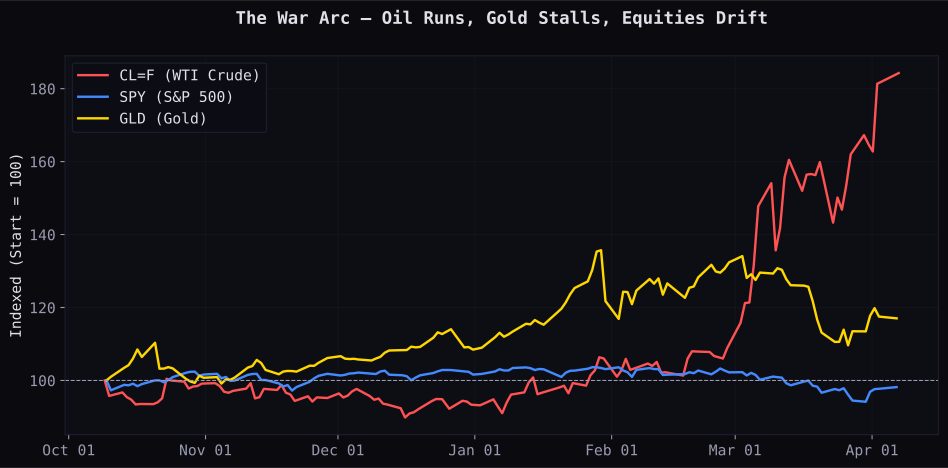
Oil fell $26.58 in one session — $117.63 to $91.05 — the largest single-day move of the war. The market celebrated. But WTI settled at $97.33, not $70. The structural war premium — insurance lag, Hormuz “coordination” protocols, Kharg capacity damage — is $27 above pre-war levels and won’t unwind for months regardless of diplomacy.
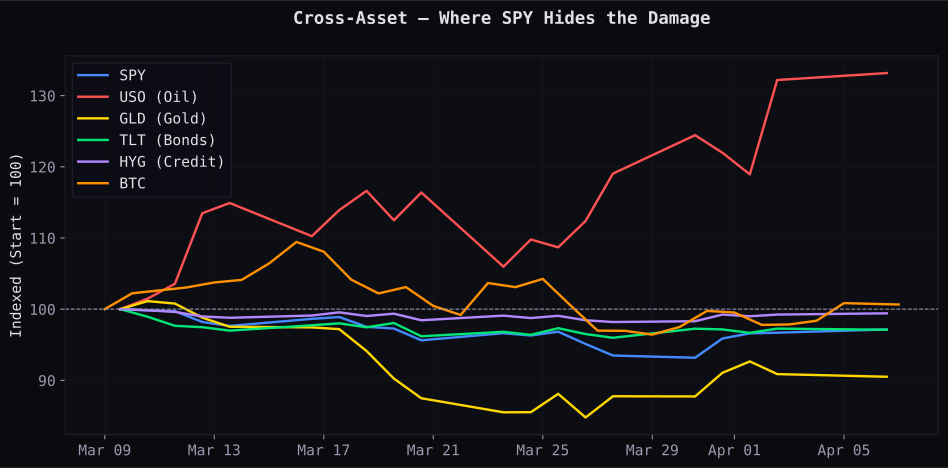
Meanwhile: gold closed UP 4% on ceasefire day (smart money doesn’t believe it), BDCs sold off (ARCC −1.4% while ES ripped +2.5%), and VIX closed at 26.71 — above the 23.87 pin it held all day. A 14-day clock with three unresolved issues is higher variance than a grinding war. The market priced peace. It has not bought it.
Section I
The $26 Crash and the $27 That Didn’t Move
The anatomy of Tuesday’s oil move is the first thing to understand. WTI opened at $117.63, the Hormuz-premium high. By mid-session it had printed $91.05 — a 22% intraday decline on ceasefire headlines. Then it clawed back. Settlement: $97.33.
The $6.28 recovery from low to settlement is the most important number in the session. It marks the point where physical traders — who actually read ceasefire terms — bought back what financial desks had panic-sold. Pre-war WTI was $70–72. The current $27 structural premium rests on four legs, each of which has its own timeline independent of the diplomatic text.
Lloyd’s JWC insurance: Joint War Committee designations have a 30–60 day minimum review cycle. Shipping insurance premiums don’t fall when a ceasefire is announced; they fall when tankers transit without incident for 30 consecutive days. No tanker has yet attempted full Hormuz passage under the new terms. — Kharg Island capacity: Iranian export infrastructure took confirmed damage during the conflict. Restoration timelines run 6–12 weeks minimum for pump stations and loading terminals, regardless of political agreements. — Shipping resume lag: Vessels rerouted around the Cape of Good Hope are 2–3 weeks away. Charterers will not commit to Hormuz routing until Lloyd’s clears the zone. — Hormuz “coordination”: The ceasefire text requires non-Iranian vessels to submit transit notices to the Islamic Revolutionary Guard Corps Maritime Command 72 hours in advance. This is not free passage. It is a toll booth with military authority.
Loop 15 established the oil floor framework before the ceasefire was announced: $80–90 on genuine ceasefire (both sides, verifiable Hormuz reopening, insurance clearance), $95–100 on conditional ceasefire (partial terms, Israeli non-participation, IRGC coordination requirement). Tuesday’s settlement at $97.33 confirms the conditional scenario. The market has not missed anything. It has correctly priced a conditional pause.
Section II
Gold Doesn’t Believe It
In a genuine ceasefire, gold falls. The logic is straightforward: war premium unwinds, flight-to-safety positioning reverses, real yields rise as oil deflation reduces inflation expectations. Every one of those mechanisms should have pushed gold down 5–10% on Tuesday.
Gold closed up 4%. This is not noise. Gold at $4,842 is a directional statement from the largest institutional money pools on the planet, and their statement is: we do not believe this ceasefire will hold long enough to change our positioning.
Goldman’s year-end target of $5,400 is unchanged post-ceasefire. Central bank purchasing programs from China, India, Poland, and Turkey continue at their Q1 pace. These are not momentum traders — they are sovereign treasuries with 12–36 month horizons, and they have not signaled any intention to rotate out. The gold bid on ceasefire day is the most reliable macro signal in Tuesday’s tape. Institutional money is treating the April 21 deadline as a 14-day option on a 40-day pause, not as a settlement. Options pricing confirms: implied vol on gold actually rose on ceasefire day. The smart money bought more uncertainty, not less.
The correct interpretation: the ceasefire is being priced as an asymmetric option. If it holds, gold gives back 5–8%. If it breaks, gold prints $5,200 and oil retests $120. The expected value of holding gold through April 21 is positive for anyone who assigns greater than 35% probability to ceasefire failure. The fact that gold rallied 4% on ceasefire day means institutional money is pricing failure probability at well above 35%.
Section III
The BDC Canary
While SPY ripped +2.5% on ceasefire headlines, the business development companies told a different story. ARCC fell −1.4%. FSK dropped −1.8%. BXSL slid −1.7%. The divergence is not a puzzle. It is a separation between two completely different risk regimes trading in the same market.
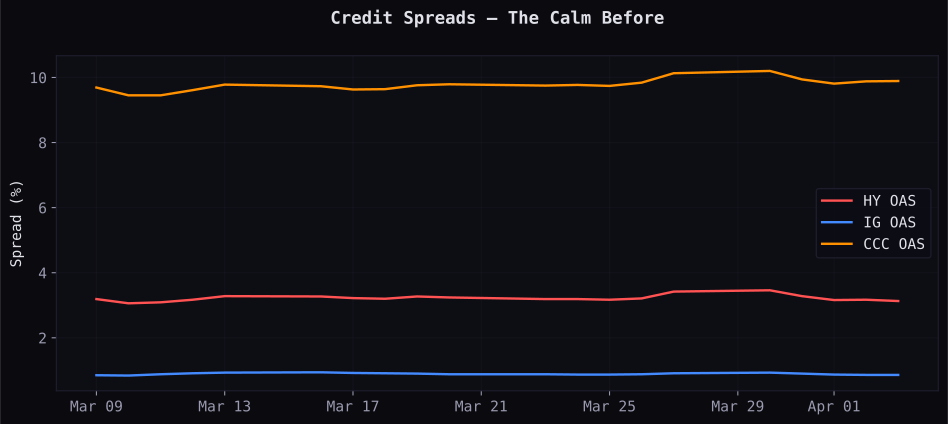
BDC damage is rate-driven, not oil-driven. The private credit portfolios sitting inside ARCC, FSK, and BXSL are 90%+ floating-rate loans to middle-market companies. Their stress is SOFR at 5.3% compressing borrower coverage ratios, not oil at $117 squeezing consumer spending. A ceasefire that drops oil $26 does nothing for a manufacturer paying 10.8% on its revolving credit facility. The 75–80% of BDC damage is locked in regardless of ceasefire — it will only resolve when SOFR drops materially, which requires Fed cuts that are not in the April or May pricing.
The vol-targeting masking effect makes this more dangerous, not less. As equity volatility falls on ceasefire relief, vol-targeting strategies mechanically increase equity exposure. SPY goes up. The BDC selloff is buried in the cross-section, visible only to investors looking at the equal-weight picture. This is exactly the mechanism that preceded every major credit repricing of the past decade: equity calm while credit spreads quietly widen.
The catalyst calendar has not moved. ARCC reports April 28. The question is whether net investment income covers the $0.48 per-share quarterly dividend at SOFR 5.3% with tightening coverage ratios in its portfolio. If NII misses, the dividend is at risk. If the dividend is at risk, the yield-seeking retail money that owns ARCC at scale exits. The CLO trustee reports that feed into that calculation are due this week — and they were written before the ceasefire was announced.
Section IV
Wednesday’s Three Tests
The ceasefire landed in the middle of the densest catalyst window of the war. Three data points hit between 7 AM and 2 PM ET on Wednesday, each from a completely different epistemic layer. They will either confirm or contradict each other. There is no neutral outcome.
| Time ET | Event | Ceasefire bull | Ceasefire bear |
|---|---|---|---|
| 7:00 AM | DAL Q1 earnings / Q2 guide | Q2 fuel guide drops $8–10/barrel on ceasefire pricing; Bastian frames $97 oil as manageable tailwind; confirms ceasefire in ticket demand | Bastian hedges Q2 guide with “ceasefire durability uncertainty”; fuel guide anchored at $100+ for safety; yield per-seat guidance below consensus |
| 1:00 PM | 10-Year Treasury Auction | Ceasefire relief bid from overseas sovereigns; stop-through of WI; dealer takedown <18%; tail tightens to pre-war level | Dealer takedown >22% signals domestic absorption ceiling; tail >1bp = auction fail; ceasefire doesn’t fix fiscal supply/demand math |
| 2:00 PM | FOMC Minutes (March meeting) | Market looks through pre-ceasefire minutes; no new information; quiet release | Minutes reveal Fed more hawkish than post-meeting statement suggested; war-inflation concern more explicit than Powell let on; rate-cut path narrows |
The DAL print is the most forward-looking of the three. Airlines are the oil price’s real-time interpreter — they hedge months out and have full visibility into fuel costs and demand curves simultaneously. Ed Bastian’s language on ceasefire durability will tell you more about what sophisticated operators believe than any prediction market. If he hedges the Q2 fuel guide conservatively, that’s the physical desk buyer at $97 speaking through a different microphone.
The 10-year auction matters for a different reason. The ceasefire creates a one-session window of improved Treasury demand as risk-off flows reverse. If the auction still fails in that window — dealer takedown above 22%, tail wider than 1 basis point — it means the fiscal supply/demand problem is structural, not war-driven. That’s a larger story than the ceasefire.
Section V
The Ceasefire Fine Print
The United States and Iran announced a ceasefire on Tuesday. They announced incompatible versions of it.
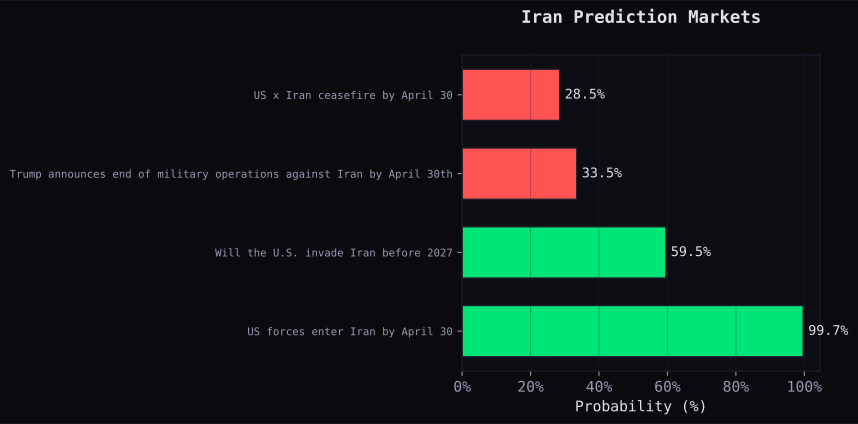
The US State Department statement described a 14-day pause on hostilities with negotiations toward a permanent arrangement. The Iranian foreign ministry described a 14-day suspension of certain kinetic operations pending confirmation of specific US security guarantees. The gap between those two framings is not semantic. It is the difference between a ceasefire and a timeout.
1. Hormuz is not open. The ceasefire text requires transit “coordination with Iranian armed forces.” The IRGC Maritime Command has not published coordination procedures. Until they do, commercial shipping faces the same effective closure with additional bureaucratic friction. Lloyd’s will not clear the zone without 30 days of incident-free transits.
2. Israel has not signed. Israel is an independent military actor with unilateral strike authority over Iranian nuclear facilities. The ceasefire is between the US and Iran. Israel is not a party to it. Israeli Prime Minister statements since the ceasefire announcement have been non-committal on Fordow restraint.
3. The nuclear dimension is unchanged. Fordow is intact. Iran’s HEU stockpile remains unaccounted for at IAEA-verified levels. The conditions that produced the war have not been resolved by the ceasefire — they have been paused. April 21 is a deadline for continuing negotiations, not a settlement date.
The 14-day clock is structurally different from the war itself. During the war, every day without escalation was a day of reduced risk. With a ceasefire, every day without a permanent agreement is a day of increasing risk as the deadline approaches. The ceasefire converts a grinding war into a binary. April 21 is a coin flip with geopolitical stakes. That is not less variance than what the market was pricing yesterday.
Section VI
Three Horizons — Updated
The Hormuz deadline question resolved as a conditional 14-day ceasefire. The next binary is April 21 — renewal, failure, or extension. Between now and then: DAL earnings (oil demand), 10Y auction (fiscal stress), CPI Friday (inflation baseline). H1 has not become calm. It has become a different kind of uncertain.
ARCC April 28. CLO trustee reports. Apollo-Athene secondary sale window. The private credit damage that accumulated during 40 days of SOFR at 5.3% doesn’t care about oil. These marks come in regardless of what happens at Hormuz. The ceasefire buys time for equity; it does not buy time for credit.
Food CPI locked. Commercial real estate refinancing wall. CalPERS mark-to-model exposure. VC denominator broken. Loop 15’s framing holds: “ceasefire delays H3 by 3–4 months, same terminal damage.” An oil premium unwinding from $27 to $5 in 90 days is disinflationary for CPI but doesn’t fix the private credit coverage ratio math.
The key insight from Loop 15 — built before the ceasefire was priced — was that H1 and H3 would decouple. War-period stress concentrated in oil and equity vol (H1). Structural damage concentrated in private credit, insurance float, and food supply chains (H3). A ceasefire that resolves H1 does not touch H3 because the mechanisms are different. The ceasefire is oil-relevant. It is not credit-relevant. It is not food-relevant. It is not rate-relevant. The market is pricing it as if all four were the same variable.
What Matters Next
The Clock From Here
| When | Event | The question it answers |
|---|---|---|
| Today 7AM ET | DAL Q1 earnings | Does $97 oil change Q2 guide? Does Bastian believe the ceasefire? |
| Today 1PM ET | 10Y Treasury auction | Is the fiscal problem structural or war-driven? Dealer takedown is the tell. |
| Today 2PM ET | FOMC minutes (March) | How hawkish was the internal debate? Pre-ceasefire world, but the language matters. |
| Fri 8:30AM ET | CPI (March) | Nowcast: 3.38%. How much war premium is baked in? April will be the ceasefire read. |
| Apr 21 | Ceasefire deadline | Renewal, failure, or extension. Binary. Israel unsigned. Nuclear unresolved. Not a resolution date. |
| Apr 28 | ARCC Q1 earnings | NII vs. $0.48 dividend. The credit canary that oil cannot save. |
The $27 oil floor thesis is wrong if: Lloyd’s JWC removes the Persian Gulf from the war-risk zone within 14 days (requires 30 consecutive incident-free transits — not possible by April 21). The BDC canary is wrong if: the Fed cuts 50bp before April 28 (not in any current pricing). The gold skepticism thesis is wrong if: Goldman revises its $5,400 target downward in response to the ceasefire (watch for note this week). The VIX anomaly is wrong if: it normalizes to 19–21 range by Friday on confirmed ceasefire terms compliance (would require Israel statement and IRGC coordination procedures published).