Three Floors Down
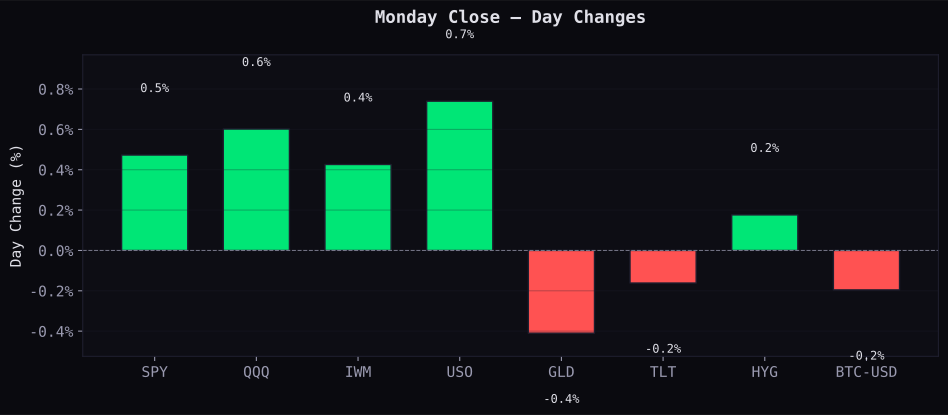
The VIX closed at 24.17 on a green tape. That sentence contains the whole problem. SPY gained 0.5% Monday while RSP (equal-weight) lost 0.4% — seven stocks holding the index above water while 493 repriced a slow-motion credit contraction beneath them.
Subprime auto delinquencies hit 6.6%, a 1994 record. Dollar General lost 14.6% in a month. Freight volumes are down for the 30th consecutive month. None of that is in SPY. All of it is in the vol surface, where an estimated $500B to $1T in vol-targeting strategies mechanically buy equities as long as VIX stays below 30 — and sell into whatever is underneath when it crosses. That mechanical bid expires April 14.
Tuesday brings the first of four catalysts with no relief window between them. The Hormuz deadline at 8 PM ET has a 50–60% probability of extension and a 25–30% probability of escalation. Either way, by Friday morning you will have seen: oil price guidance from a major airline, a 10-year Treasury auction, and a CPI print that consensus is mispricing by 60–90 basis points.
Horizon 1
The Binary
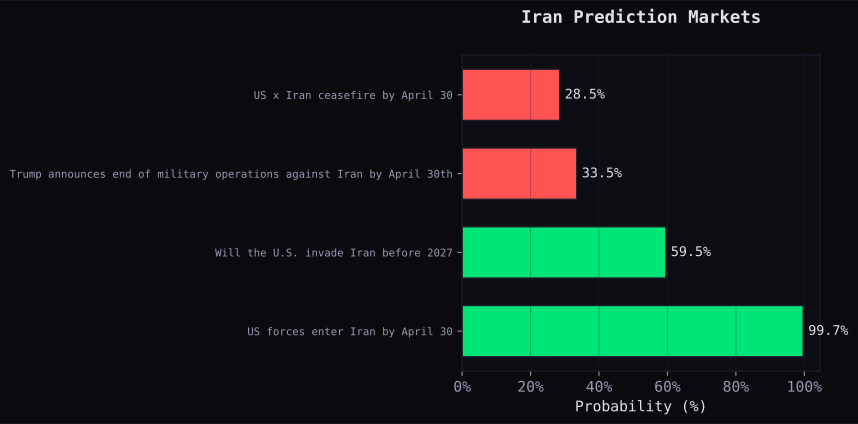
Tuesday's Hormuz deadline is the first of four unsequenced catalysts. There is no relief window between them. The market cannot process one, reprice, and move on before the next one arrives.
The Hormuz situation: Iran has rejected the US ultimatum as "incitement to war crimes." Pakistan is mediating. IRGC Navy has stated publicly the Strait will "never return" to its pre-war operating status. The most likely outcome is a third extension — which the market will initially read as de-escalation, until it prices the extension itself as evidence of entrenched conflict.
Wednesday compresses three independent risks into one trading session. Delta Air Lines reports Q1 at 7 AM ET — the number that matters is not the Q1 beat but the Q2 fuel cost guidance, which is priced from current jet fuel contracts and tells you where the airline sector thinks oil is going. At 1 PM ET, the Treasury auctions $39B in 10-year notes. The Feb 11 baseline for this auction was 50% indirect bidding. March's panic-bid was anomalous. A dealer takedown above 22% signals failed distribution. At 2 PM ET, the FOMC minutes from the March meeting drop. Every hawk-dove count will move rate-path odds.
Thursday brings initial claims, which matter less than they used to now that ICSA is anchored at 202K. Friday delivers CPI. The BLS uses daily gas prices for the entire reference month, not the "week of the 13th" convention Wall Street backward-engineers from the CPI release calendar. Cleveland Fed nowcast: 3.38%. Consensus: 2.5%. The gap is 88bp, and the nowcast uses the same raw BLS gasoline survey data.
Hormuz (Tue 8PM) → DAL guidance + 10Y auction + FOMC minutes (Wed) → stagflation-adjacent claims data (Thu) → CPI bomb (Fri) → OpEx gamma unwind (Mon Apr 14). Each event can individually spike VIX. Together, without a day to breathe, they compress into a five-day window where a single bad print triggers a cascade. Median base case: SPY 625–640 by April 14.
Horizon 2
The Unmasking
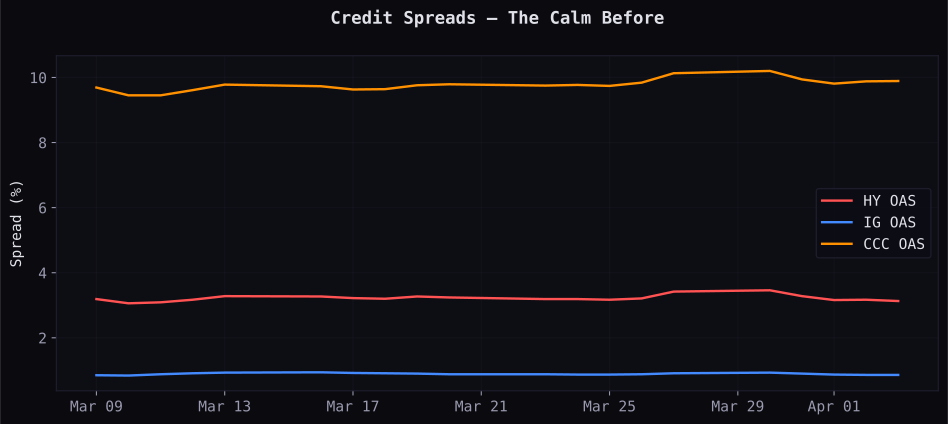
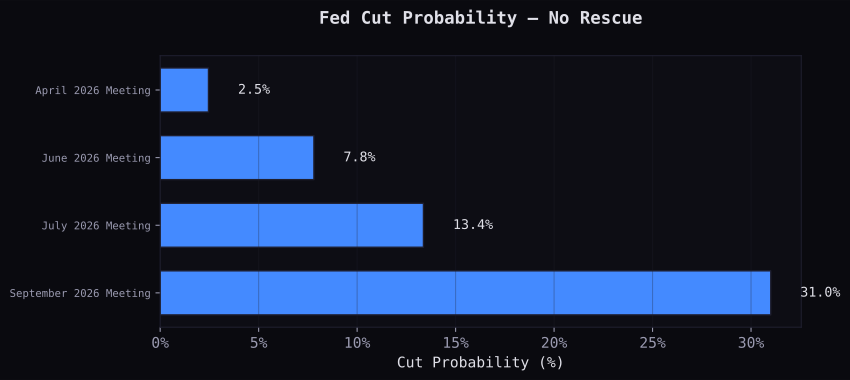
The private credit market is priced for a world that does not exist. CCC OAS sits at 9.89%. Public high-yield is at 3.13%. That 676bp gap between public and private credit is not a liquidity premium — it is a pricing delay. Private credit marks quarterly. The reckoning arrives at earnings season, starting with Ares Capital (ARCC) on April 28.
The BDC cascade chain: OWL is down 68% from peak. FSK was downgraded to junk. Internal research across the BDC sector finds approximately 40% of borrowers are cash-flow negative at current rates. ARCC's NII coverage of its $0.48 quarterly dividend is the sector's Schelling point — a print below $0.46 triggers forced dividend reductions across the peer group, which are then re-rated by rating agencies, which then hits CLO eligibility criteria.
The double-sided insurance fault line is the connection 17 loops of prior research missed. Life insurers hold an estimated $277B in CLOs and $184.7B in munis on the same balance sheet. Both positions are being hit in the same three-week window. CLO OC test failures reduce the par value of the CLO position. Simultaneously, the muni market is under pressure from state fiscal stress and rising rates. An insurer forced to sell either position to maintain its statutory capital ratio becomes a forced seller into an already-thin market.
Apollo-Athene is not a death spiral. It is a slow multiple compression. Fair value on current earnings: $80–95. Current price: $106. The mechanism is not insolvency — it is that private credit defaults feed CLO OC test failures, which compress insurance portfolio book values, which trigger FHLB collateral pressure, which forces muni selling, which is self-reinforcing. The timeline: 6–10 weeks from first BDC dividend cut to insurance statutory disclosure.
Horizon 3
The Irreversibles
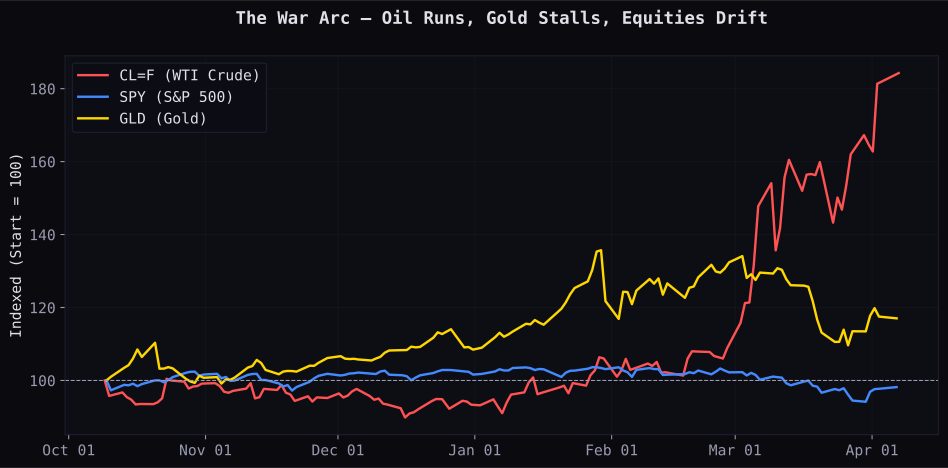
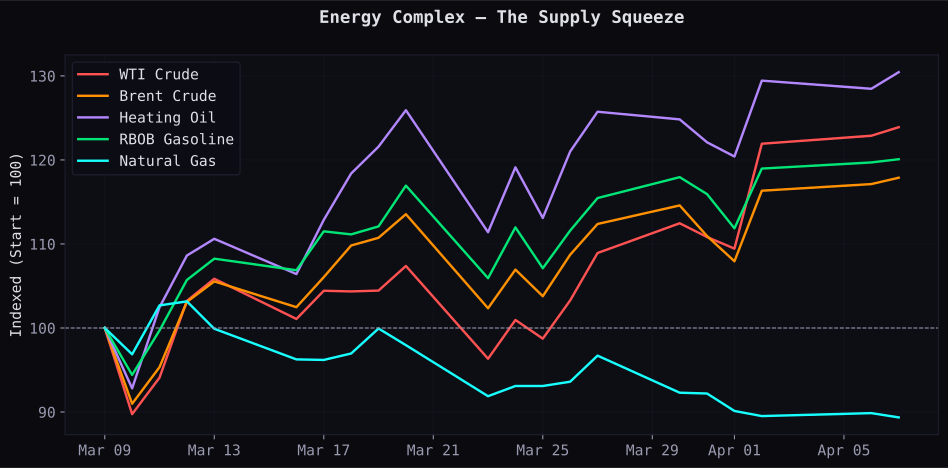
A ceasefire does not restore the pre-war equilibrium. It delays Horizon 3 by three to four months. The terminal damage is the same; only the timeline shifts.
Oil floor: $80–90. The structural bid is insurance repricing, not war premium. Lloyd's Joint War Committee maritime risk uplisting takes 30–60 days minimum to reverse after a ceasefire. Cargo insurance premiums stay elevated months longer. Tanker operators have already repriced annual contracts through Q4. The spot price can fall; the embedded cost structure does not.
Food is already locked in. Urea prices are up 53%. Spring planting decisions were made in March at those input costs. Q4 food CPI is tracking approximately +2pp above pre-war trajectory regardless of what happens in the Strait between now and October. There is no policy lever that reaches this.
The $936B commercial real estate maturity wall is not an oil story. It was already priced to refinance at 4% rates and is now facing 6.5–7%. The war adds nothing to that math — it adds duration by keeping the Fed constrained. Extend and pretend runs into CalPERS' fiscal year-end on June 30, which triggers pension contribution calls at exactly the wrong moment for LP distributions that are already near zero. Seed-stage VC is down 31%. JOLTS quits are down 9.5% YoY. Labor's apparent strength is the lagging indicator. The leading indicator is that the people most likely to quit have stopped moving.
Bias Audit
Why This Thesis Could Be Wrong
The 1990–91 Gulf War. Equities rallied during the war on resolution of uncertainty, not after. The market bottomed before the ground invasion. If the Hormuz deadline resolves in extension and markets read that as "not escalation," the relief rally could be 3–5% in a single session. The bear case requires certainty that the worst outcome materializes — markets rarely give you that.
ICSA at 202K, Sahm Rule at 0.20, ANFCI at -0.43. Financial conditions remain technically loose by the Fed's own measure. The mega-cap AI earnings machine is intact with $519B in hyperscaler CapEx committed. If AI revenue continues compounding independent of oil, the seven stocks holding SPY above water are not a warning sign — they are the correct allocation to the one growing sector in the economy.
The bear case requires three simultaneous hits: labor breaks, oil holds above $110, and the Fed pauses through May. Currently only one of those three is true. If VIX collapses on ceasefire extension, $80–120B in vol-targeting and CTA strategies mechanically re-lever into equities. That mechanical flow does not require a fundamental thesis. It requires VIX below 22. A single de-escalation headline is enough to trigger SPY +5–8% toward $690–710.
Section 6
The Contagion Map
↓
Tanker re-routing (+$3-5M/voyage cost) & Lloyd's JWC uplisting
↓ ↓
Oil $110–130 sustained Cargo insurance +35–55% premium
↓ ↓
Jet fuel guidance blowout (DAL Wed) Urea +53% → food CPI +2pp Q4
↓
CPI Friday: nowcast 3.38% vs consensus 2.5%
↓
Fed stagflation trap: cut = inflation, hold = recession
↓ ↓
HY spreads widen VIX crosses 30 → vol-targeting sells
↓
BDC non-accruals rise → ARCC NII misses Apr 28
↓
CLO OC test failures → insurance portfolio marks down
↓ ↓
FHLB collateral pressure Life insurer forced muni selling
↓
$936B CRE maturity wall: extend & pretend collapses
↓
CalPERS June 30 fiscal year-end → pension contribution calls
↓
LP distributions near zero → VC flywheel stops → labor market reveals
Catalyst Calendar
April 7–14: No Relief Window
| Date / Time | Event | Bull if… | Bear if… |
|---|---|---|---|
| Tue Apr 7 8:00 PM ET |
Hormuz Deadline | Third extension announced; Pakistan framework accepted; Iran signals back-channel progress | Iran declares partial closure; IRGC mines the Strait; no framework response by deadline |
| Wed Apr 8 7:00 AM ET |
DAL Q1 Earnings | Q2 fuel guidance below $3.20/gal; capacity guidance maintained; yield per mile flat | Q2 fuel guidance above $3.50/gal; capacity cuts announced; Q2 guide withdrawn entirely |
| Wed Apr 8 1:00 PM ET |
10Y Treasury Auction $39B | Indirect bidding above 45%; dealer takedown below 18%; tail inside 1bp | Dealer takedown above 22%; tail wider than 2bp; bid-to-cover below 2.3x |
| Wed Apr 8 2:00 PM ET |
FOMC Minutes (March) | Dovish counts dominate; explicit language about data-dependence on cutting; June live | Unanimous stagflation concern language; June cut explicitly deferred; QT acceleration mentioned |
| Thu Apr 9 8:30 AM ET |
Initial Claims | Below 210K; continuing claims flat; no oil-sector layoffs visible yet | Above 225K; energy sector claims spike; Sahm Rule ticks toward 0.25 |
| Fri Apr 10 8:30 AM ET |
CPI (March) | Headline below 2.8%; core below 3.0%; energy component lower than expected; June cut re-priced in | Headline above 3.2%; core above 3.5%; energy component confirms Cleveland nowcast; stagflation confirmed |
| Mon Apr 14 Market Open |
OpEx gamma unwind. Vol-targeting mechanical bid expiration. If VIX has crossed 30 at any point in the prior week, systematic selling accelerates regardless of fundamentals. This is the mechanical event, not the fundamental one. | ||