Brent, the ten-year yield, and the yen, last five days
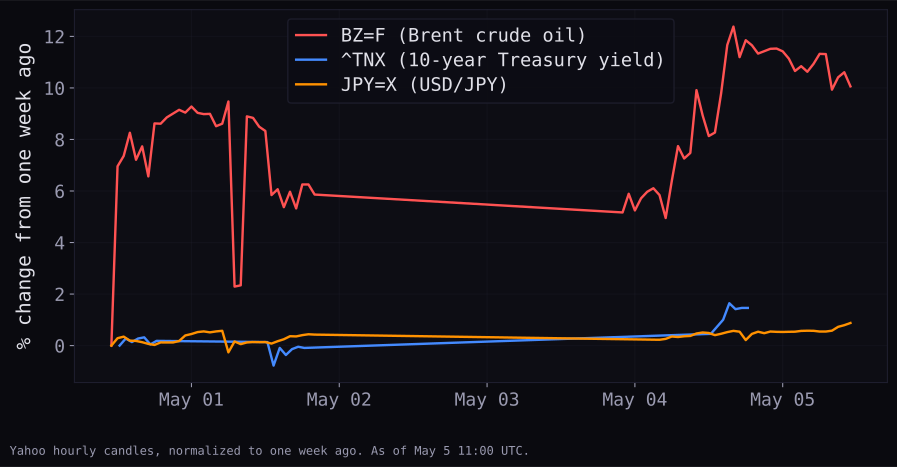
European cash unwound the Monday geopolitical spike. Brent printed an early-Asian low of $111.88 and the prediction market on Iranian airspace closure has fully retraced to its pre-strike level. AMD slipped 5.27% in Monday’s cash session on an HSBC downgrade and is back up modestly Tuesday into its own Q1 print after the bell tonight.
The Monday Fujairah strike pushed Brent to an intraday high of $115.25 and the thirty–year Treasury yield through five percent. The Asian session faded the spike. Brent traded as low as $111.88 in early-London hours, $2.56 below the Monday New York settle.
The Polymarket Iran-airspace-by-May-8 contract has now traded as low as 0.17, the same level it was sitting at on Monday morning before the strike. The full Monday repricing has unwound on the prediction tape.
European indexes confirmed the rotation. DAX printed a fresh session high of $24272, STOXX 50 a fresh high of $5844, and FTSE 100 traded its open between $10242 and $10295.
The carry trade reopened. USD/JPY ran from $157.10 in the early-Asian fade to as high as $157.89, settling around $157.60. The yen had caught a haven bid Monday on the Fujairah print and gave it back as the conflict premium unwound.
The Hormuz normalization curve did not move. The May 15, end-May, and end-June contracts all sit roughly where they did at Monday’s cash close. The market is reading the airspace question (which matures Friday) as resolved, while leaving the strait timing question open.
U.S. futures opened green on the back of all of the above. ES is up 0.4%, NQ is up 0.6%, Dow futures up 0.3%. Pre-market is trading the Iran fade, not waiting for it.
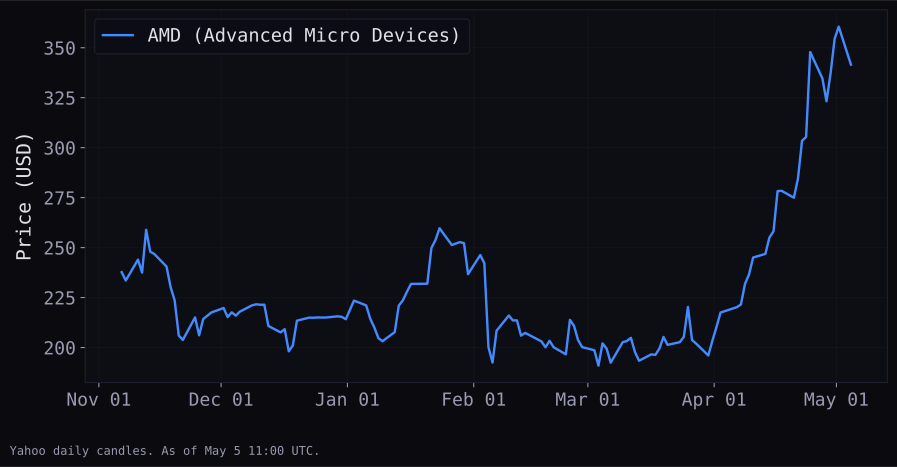
HSBC cut AMD from buy to hold on Monday, citing concerns over tight semiconductor capacity in 2026. AMD’s Monday cash session faded 5.27% on the downgrade, closing $341.54 from a Friday close of $360.54.
The timing is the unusual part. AMD reports Q1 after the bell tonight. HSBC’s call dropped hours before the company gets to set the record itself. A downgrade by a top-line bank in the immediate run-up to a print is rare, particularly on a name with $588 billion of market cap.
Tuesday cash opened with AMD bidding back. The stock is trading $344.28 in the early session, up roughly 0.8% from Monday’s close. The market is treating the HSBC concern as already in the price and waiting for the company itself to set the record tonight.
Consensus going in is around $1.27 EPS on $9.84 billion of revenue, roughly 32% year-over-year growth. The read variables for the print are data-center revenue, the OpenAI 6GW deal cadence, and China MI308 sales. China MI308 dropped from approximately $390 million in Q4 to about $100 million sequentially, a real drag the print has to address.
The set-up is tight. If AMD prints well enough to overwhelm the HSBC concern, the stock has roughly $16 of room before reclaiming the May 1 high near $362. If the print confirms HSBC’s read, Monday’s low around $332 is the support level the cash desks will defend or break.
Palantir is trading $140.32 in the early cash session, down 3.9% from Monday’s close of $146.03. The intraday low so far is $138.70, deeper than the after-hours settle of $142.09. The cash open is extending the rejection of the largest revenue beat in the company’s history, not buying it back.
The pattern is the same as Q4: blowout earnings met with multiple compression. Average analyst target sits around $184; the stock is more than 24% below that. The trade is full at this multiple, and the cash session is now confirming the after-hours read.
AMD prints after the bell with consensus $1.27 EPS / $9.84B. ANET also prints after the bell, on $0.72 EPS expected. SHOP, PFE, ETN, BUD, DUK report pre-market. HSBC reports without a confirmed time.
March trade balance hits at 12:30 UTC. Two more macro releases land at 14:00 UTC. Friday brings non-farm payrolls.