The Tape — 5 Days
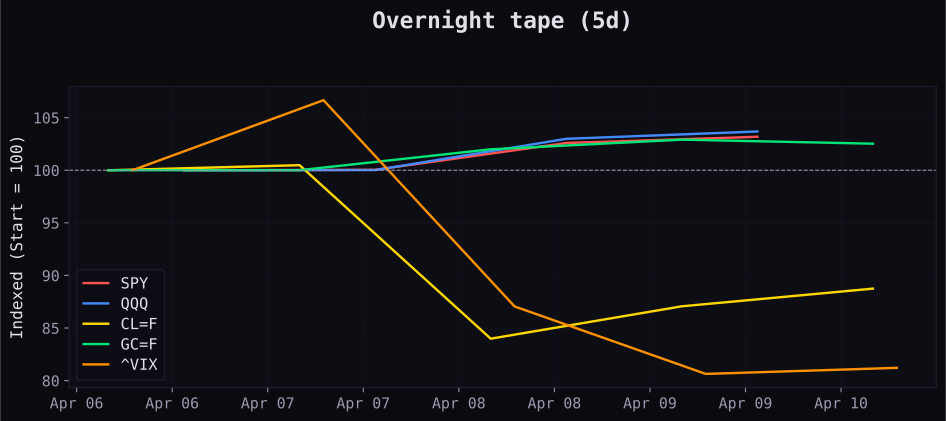
SPY climbs +2.5% off Apr 7 low. Volume runs at 63% of 30-day average. The cleanest squeeze rally of 2026.
CPI 2.8 cool. UMich 47.6 record low. Inflation expectations 4.8 percent. The squeeze rally died at 10:00 sharp. The Fed is locked in.
Wall Street’s consensus print is 3.7 percent headline year-over-year, 0.9 percent month-over-month. Goldman is at 3.3 / 0.87. JPMorgan and FactSet at 3.4 / 0.9. The cluster sits between 3.3 and 3.7. Kalshi’s deepest CPI book ($128,000 of notional on the “at or above 3.4 percent year-over-year” question) trades at 16 percent. That means real money is pricing an 84 percent probability that the print lands BELOW 3.4. The exact-3.3 percent modal market on Kalshi takes 42 percent on $53,000 of volume. The full distribution: 42 percent below 3.3, 42 percent at 3.3 exactly, 16 percent at 3.4 or higher. The deepest betting layer in the world thinks the print lands 40 basis points cool to the sell-side cluster. If Kalshi is right, every 3.7-handle Wall Street economist is wrong about the same number on the same morning, and the rate-cut path is open by lunch.
The arithmetic case for the hot direction is real. Crude is up 67.7 percent over three months. Retail gasoline went from $2.98 to $4.14 in eight weeks. Manheim’s used-car index hit a thirty-month high in March. None of that is in dispute. The question is what those inputs do to the BLS’s March-window measurement when shelter still prints with a six-to-twelve-month lag and Apartment List’s leading indicator is at minus 1.7 percent year-over-year. The deep Kalshi market is betting that shelter drag offsets energy lift inside the print itself, even as the year-end path stays hot. The same Kalshi book has the “CPI hits 4.0 percent or higher this year” market trading at 52 percent. The full read: April benign, full year hot. The cool surprise applies to tomorrow morning. The hot tail applies to the rest of 2026.
SPY trades at 63 percent of its thirty-day average volume this week. SOXX runs at 72 percent. Regional banks at 60. Tech, financials, healthcare, communications, growth, value: every major sector is between 44 and 72 percent of normal flow. In a hundred-and-fifty-stock dispersion sweep, only two tickers carry volume conviction: IWN, the small-cap value ETF, at 1.53 times its prior pace, and IYT, the Dow transports, at 2.53 times prior on a flat price. The first is rotation INTO. The second is institutional distribution. Smart money is rotating out of large-cap distribution and into small-cap value, and the rest of the tape, the part everyone is staring at, is climbing on air.
Pair that with positioning. Large speculators in E-mini S&P futures are net short 230,392 contracts, the hundredth percentile of short positioning of the trailing eleven weeks, and last week they covered only 111,000 of those, less than half. NDX, Russell, VIX futures: all spec short. Goldman’s Prime Brokerage data shows hedge funds posted their worst monthly drawdown since January 2022. CTAs are outright short. Deutsche Bank’s aggregate positioning index sits at the lowest level since June 2025. Sixteen out of twenty-three positioning indicators are defensive. The reluctance rally is a real thing. The pain trade isn’t a sell-off. It’s the squeeze continuing, because that is what hurts the side of the boat that is full.
The number prints at 8:30. The tape reaction is decided by the side of the boat that is full. And the side of the boat that is full is short.
The bond market did not go to sleep. The bond market got positioned. SOFR three-month spec short-covering hit the hundredth percentile last week. Specs covered 216,000 contracts in seven days. Five-year and thirty-year COT short-covering both sit at the hundredth percentile of the trailing year. This week’s Treasury auctions all stopped through, and dealer takedown on the thirty-year landed at 5.8 percent, the second-lowest reading on record. Primary dealers now hold $540 billion in Treasury inventory, well above the $350-450 billion baseline. The MOVE index, at 74, is the lowest pre-CPI print of 2026. That isn’t complacency. That is a dealer book that has gone flat-to-slightly-long after weeks of being short, and now wants the print to validate the trade. This is the same thing the equity book is doing in a different language. Bonds are long because rates expectation is asymmetric: cool gives 15-20 basis points of cut-pricing return, hot gives 8-12 basis points of pain. Equity hedges (long KRE, long banks, long defensives) sit on top as a barbell against directional uncertainty. Both legs of the barbell hedge each other under different CPI scenarios, and dealers don’t need to be right about CPI. They need to be flat into the print. They achieved that by covering shorts. The first ten minutes after 8:30 will resolve which leg matters: a bull-steepener (5-year rallies more than 30-year) means the bond cascade scenario lands and ZN runs to 111.50. A bear-flatten (5-year dumps more than 30-year) means the hot-arithmetic scenario lands and KRE leads down before the squeeze book buys it back. The market spent Friday morning staring at the CPI print. The bigger event is Tuesday. JPMorgan, Wells Fargo, Citigroup, and BlackRock all report pre-market in the same sixty-minute window on April 14th. Three of them are obvious. The fourth is the read-through. And as of this afternoon, the read-through has hard numbers. HPS Investment Partners, the $150 billion private-credit book that BlackRock acquired and that sits at the center of the largest private-credit warehouse in the world, received $1.2 billion in redemption requests against a $26 billion fund. That is 9.3 percent of net asset value walking out the door in a single quarter. HPS paid $620 million. The remaining $580 million was gated by the fund’s 5 percent quarterly redemption cap. Investors who wanted out got told to wait. BlackRock stock is down 21 percent from its February peak, and it is down 12 percent over six months while Citigroup is up 33 percent over the same window. That gap is no longer a hypothesis. It is the price of an actual gating event in the largest private-credit warehouse on the planet. $1.2 billion requested, $620 million paid, the rest gated by a 5 percent cap. The credit-equity disagreement is no longer a thesis. It is an event in motion.
The BDC complex is on fire. BIZD is down 13.7 percent over three months. FSK is down 30.1. OBDC down 13.6. BXSL down 10.9. ARCC down 12.1. Public credit (HYG, the high-yield ETF) is up 0.9 percent over the same window and is NOT confirming. That is the credit market saying the marks haven’t caught up to the underlying yet, and Tuesday morning is the first official quarter where they will. The 2s10s curve flattened 21.5 percent over three months while bank stocks rallied 10. The bank rally is fighting both the curve and rising real rates simultaneously, and it will lose the moment one bank guides credit losses higher than expected. That bank is BLK on Tuesday. For five consecutive days, macro coverage focused only on US data: CPI, Fed pricing, oil curves, banks, rates, sentiment. Iran was the single geopolitical input. The rest of the world disappeared. A dedicated geopolitics sweep surfaced five separate stories that have not been mentioned in this report once. Maduro is in New York. US forces captured Nicolás Maduro and Cilia Flores in Operation Absolute Resolve on January 3 and flew them to Manhattan for federal trial. Delcy Rodríguez is acting president of Venezuela. President Trump said publicly that the United States will run Venezuela. Polymarket has $828,000 of notional spread across 274 separate Maduro markets, deeper than any single CPI bucket on either prediction venue. This report has not flagged it once. This is the most embarrassing miss of the entire research week. Lebanon is breaking right now. Tuesday Israel killed 254 people in Beirut in a ten-minute strike using fifty jets and a hundred and sixty munitions. Wednesday Hezbollah rocketed back. President Trump publicly decoupled Lebanon from the Iran ceasefire, calling it a separate skirmish. Polymarket prices a 95 percent probability of Israeli military action in Lebanon today. The Israel-Hezbollah ceasefire-by-April-30 contract trades at 45 percent on $397,000 of volume; our estimate reads fair at 52-55. It is a bimodal weekend bet with a clean payoff: a Litani ground invasion drops the cease to 15, a Trump-forced truce takes it to 75. Pakistan and Afghanistan are in open war since February. Operation Ghazab lil Haq has displaced 94,000 people per the April 5 OCHA report. North Korea tested cluster-warhead and EMP weapons on April 7-9. Carbon-fiber blackout bombs and a Hwasong-11 cluster munition that traveled over 700 kilometers. Han Kuang 42, Taiwan’s 14-day unscripted exercise, begins tomorrow, April 11. Historically, that triggers a PLA Strait Thunder response within 72 hours. Defense is voting peace. Lockheed is down 3.9 percent on the month. Northrop is down 5.8. Raytheon down 1.8. General Dynamics down 3.3. The ITA defense ETF down 2.9. Goldman downgraded LMT, NOC, RTX. The obvious tail hedge is broken before the war risk goes away.
This is not 1979. The morning report assumed a duration trade migrating from bonds to housing-proxy equities (gold, XHB, XLU as the new hedges). UMich at ten o’clock killed half of it. Housing rolled over with the small caps. Gold gave back its post-CPI pop. The only equity duration proxies that survived the day were NVDA and BTC, which is a strange list until you understand the mechanics. The ten-year real rate is 1.96 percent and rising. The ten-year breakeven is 2.34 percent and falling. Real rates are positive, real rates are climbing, and the bond market is not validating the UMich 4.8 percent inflation expectations spike. That breaks the 1979 stagflation playbook, because the 1979 playbook required negative real rates. Owning currency in 1979 was a guaranteed loss; owning currency in 2026 yields a positive real return. Gold ripped to $850 in 1979 not because of stagflation per se but because of the negative-real-rate mechanic. The mechanic is reversed today. The substitute trade is more specific. Long GDX paired against short GLD captures miner leverage without making a directional bet on a metal that has rising real rates working against it. Long NVDA paired against short MSFT is the dollar-neutral expression of the only fact about big-cap tech that nobody has fully priced: NVDA is the AI-capex receiver, MSFT is the AI-capex spender, and rising real rates compress the NPV of MSFT’s capex but not NVDA’s revenue. The pair has already moved 10.6 points in twenty-one days and the market still treats mega-cap tech as a monolith. The kill tell for the entire stagflation framework arrived at lunchtime: Costco down 3 percent on the day. Quality defensive cracking. Walmart down 1.8. Lilly down 1.5. The consumer is too poor to buy even staples. That is what a credit cycle turn looks like in slow motion before the official data confirms it. DFII10 at 1.96 and rising. The bond market is not validating 4.8 percent inflation expectations. This is positive-real-rates stagflation, and it breaks half the 1970s playbook.
What survived the day across every regime: NVDA up 2.5 percent into a record-low UMich because there was nothing left in the leveraged AI complex that could make it cheaper. BTC up 1.7 percent on the same print because the dollar-hedge role is broken and the inflation-tail role is back. GDX up 1.1 percent. Silver up 0.8 percent. XLU up 0.3 percent. The list of survivors is the list of assets that the Fed cannot help and cannot hurt: the things that grow earnings without needing rate cuts and the things that hedge inflation without needing real rates to fall. Everything else (small caps, banks, housing, discretionary, staples) is collateral damage in the rate-path-lock. SOXX is up 11.8 percent on the month, the strongest single sector tape in the entire week’s research. Nobody opened the hood until this morning. NVDA is down 0.5 percent over the same window. The leader of the AI rally has not participated in the rally that is named after it. The contributors that drove SOXX are INTC (+31.9 percent on a TSMC joint venture and the Musk Terafab announcement), AMD (+16.4 percent on custom-silicon share gain), MRVL (+28 percent), and the semicap names: LRCX +20.2 percent, KLAC +19, AMAT +15. NVDA contributed minus 4.5 basis points. The asymmetry is the trade. NVDA is paradoxically safer as the laggard. A cool CPI rotates capital back into NVDA on a laggard catch-up. A hot CPI hits the over-extended semicap longs first. LRCX, KLAC, AMAT all need rates to stay perfect to hold their multiples. The crowded long is the wrong place to be. The empty long is NVDA. And there is one more thing the tape isn’t pricing: DeepSeek’s V4 release is reportedly slated for the last two weeks of April on Huawei’s Ascend 950PR, the first non-NVIDIA frontier model. Polymarket prices DeepSeek as the best model by June at 1 percent. If V4 ships and works, the entire dispersion math reverses again. The expected-value trade is asymmetric long via a barbell: Long IWN + Long ZN + Short VIX M6 futures + Long NVDA into a hot print as the contrarian pair against semicap shorts. The barbell wins in roughly 70 percent of scenarios. The 30 percent hot bucket is the only case where short-VIX hurts, and even there, the half-life of any vol pop is short because the institutional book is over-hedged for vol. The single ticker that wins across all four scenarios is IWN. It is the only equity exposure that hedges every finding from this week’s research, because it has zero defense exposure (the broken cushion), zero AI mega-cap exposure (the abandoned leader), and full small-cap-value rotation absorption. 8:30 AM — CPI. Consensus 0.9% MoM, 3.7% YoY. Watch the 2-year yield reaction window. Greater than 10 basis points up = bear-flatten cascade. Less than 5 = in-line absorbed. Bond shape resolves the bull-steepener vs bear-flatten question in the first ten minutes. 10:00 AM — UMich preliminary. The “leak” circulating yesterday (sentiment 53.3, year-ahead inflation 3.8%) was actually the March 27 FINAL release re-surfacing in Google, not the April preliminary. The interview window cited (Feb 17-Mar 23) is the March survey by definition. The actual April preliminary is unknown into 10:00. Base case has shifted to BENIGN: oil is down 3.5% since the March field close, SPY is +4% from the March 24 lows, the Iran pause held for 10 days, and the overnight tape disagrees with stagflation (XLY +1.9%, XHB +2.2%, XRT +1.5%). The unique trade for the print: long LULU / short DG bifurcation pair, 770 basis points premarket spread already, high-end consumer green and low-end consumer red. If DG breaks below $120 with DLTR -12% on the month into a print that’s SUPPOSED to help low-end consumers, that’s institutional capitulation on the sub-$50K household income cohort. Structural break, not just a trade. The Iran gas-price wave was the tipping point. Friday afternoon — Lebanon. Polymarket prices a 95 percent probability of Israeli military action today. Headline risk is highest in the cash session. The bimodal Israel-Hezbollah ceasefire trade settles April 30. Saturday-Sunday — Han Kuang 42. Taiwan’s 14-day exercise begins. Historical PLA Strait Thunder window is 72 hours. EWY is the most exposed equity book in the world: +27.9 percent over three months through three days of North Korean cluster-warhead testing, structurally desensitized. Tuesday April 14 — Bank earnings. JPM, WFC, C, BLK pre-market in 60 minutes. BLK is the read-through. JPM options are crowded long: PCR 0.58, 14,330 contracts on the Apr 17 expiry, max pain $360 against $310 spot, dealers short gamma 16 percent up. Asymmetric gap-down setup if NIM disappoints. The institutional book covers fast and the squeeze rally fades by Wednesday. Or BlackRock confirms HPS marks are flat-to-up Tuesday and the credit-equity disagreement collapses in the equity direction. Or Lebanon prints a Trump-brokered cease this weekend and defense rallies on the relief, validating the broken-hedge thesis but resolving the geopolitical tail. Or the print itself lands at 0.9 percent core MoM and the entire framework gets carried out by the bond cascade. The single most wrong-making outcome: headline 4.1 percent or higher AND a 2-year yield gap above 10 basis points within fifteen minutes. That breaks the squeeze book, the bond long, the short-vol trade, and the small-cap-value rotation simultaneously. The probability is 5 percent. The damage is the entire week.
Sectors — 5 Days
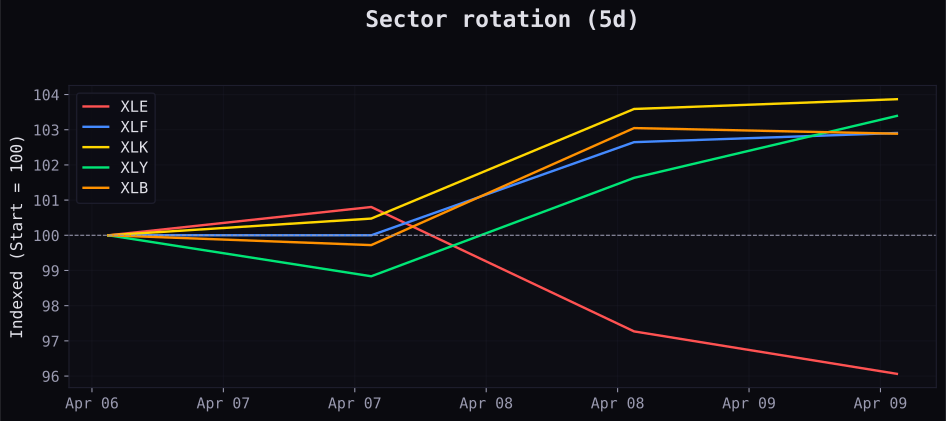 Energy faded the Hormuz war premium. Banks ripped on the squeeze. The two volume-confirmed signals point opposite directions and both are tradable.
Three Books, One Direction
Yield Curve — This Week
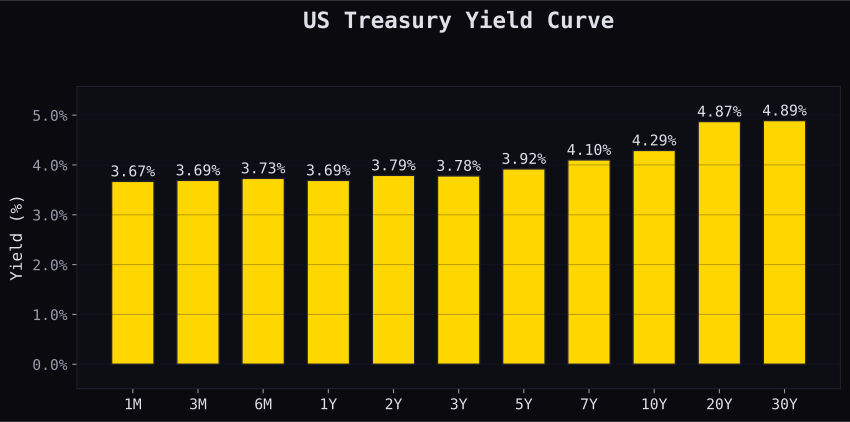 Cash curve flat into the print. 10Y -5bp WoW. The futures-vs-cash gap was dealer de-risking, not information flow.
The HPS Gate
Tuesday April 14 — The Trade Book (Revised 1:45 PM)
HIGHEST CONVICTION: LONG WFC / SHORT BLK pair
WFC: +13.1% trailing earnings, P/E 10.8 (cheapest),
14 Strong Buys, ZERO short interest, first full
post-asset-cap quarter. Possible asset-cap LIFT.
BLK: -31.7% trailing earnings, P/E 28.2, HPS gate
real (1.2B requested / 620M paid / 580M gated),
max pain LITERALLY at $1000 spot, put flow 1.48x calls.
Base case pair return: +14.4% in 4 days.
CONTRARIAN: LONG JPM Apr 24 $312.5C
Vol prices nothing-burger (IV 27% lowest).
Implied move 2.70% smallest in sector.
Dimon ALREADY dropped private-credit bomb in
April 6 shareholder letter. Tuesday call becomes
the forum to walk BACK the harshest language.
DEMOTED: SHORT C
The April 3 8-K turned out to be a routine pre-
earnings segment recast (Retail moved to Wealth,
new U.S. Consumer Cards segment). Stage-managed
optics, not a hidden disclosure. Stock +8.2% / 8d,
Polymarket beat 89% YES, PCR_OI 0.16 (zero hedging),
no institutional downside positioning. Bad R/R to
short into the print. Better trade is to FADE the
post-print pop on Banamex CTA guidance.
THE SLOW-BURN FINDING in the C recast:
$2.28B ACL build in 2025 (+13.4%), 8 consecutive
quarterly builds, accelerating to +$397M in Q4 2025
alone. ACLL ratio 0.32% → 0.47%. The actual
consumer-credit deterioration is in the data, but the
equity tape is pricing the opposite. Slow burn,
not a Tuesday catalyst.
Weekend Hedge — The EWY Put Spread
Han Kuang 42 starts tomorrow Saturday April 11.
14-day tabletop, decentralized, unscripted.
(Live-fire is August, not April.)
PLA Strait Thunder window historically 72 hours.
THE TRADE: Long EWY 135/125 May 15 put spread
Debit: $3.50-$3.65 mid
Max value: $10
Max profit: $6.40-6.50
R/R: 1.83x
Breakeven: $131.50 (-4.5%)
Full payout: $125 or below (-9.2%)
Size: 1-2% portfolio debit
WHY EWY:
+153.7% / 1y, 47.4% AUM in Samsung+SK Hynix
SK Hynix MECHANICALLY TSMC-dependent (HBM4 alliance)
Put/call OI 0.24 (deeply unhedged)
Call IV 54.4% > put IV 51.4% (INVERTED on a 68% vol asset)
Tape rallied THROUGH 3 days of NK cluster-warhead tests
PLA March ADIZ sorties at 121, lowest of Lai era
KILL: EWY closes above $140 on Monday regardless
of PLA action, OR VIX9D opens Monday below 15
The Weekend the Market Forgot
Positive-Real-Rates Stagflation
The NVDA Paradox
The Trade Matrix
42%Cool to 3.3% — matches the deepest Kalshi modal. SPY +1.5%, IWN +2.5%, NVDA +3% on laggard rotation, KRE -2% as the bank squeeze unwinds, ZN +25 ticks, gold +1.5%.42%In-line at street — 3.4 to 3.7%. Squeeze continues, IWN bid, short-VIX trade lands, ZF small long. The bond curve barely moves.12%Hot — 3.8 to 4.0%. SPY -1.5% then BOUGHT inside 48h, semicap (LRCX/KLAC/AMAT) leads down, DO NOT short KRE for swing. Book covers in 48h.4%Tail super-hot — 4.1%+. Full bear-flatten, Lebanon overlay possible afternoon. Cash, defense bid finally arrives.
8:30 AM Actuals — The Split Print
HEADLINE YoY: 2.8% (consensus 3.7%, BIG MISS COOL)
HEADLINE MoM: ~0.1% (energy gave back)
CORE YoY: 3.1% (consensus 2.7%, MODEST MISS HOT)
CORE MoM: 0.4% (consensus 0.3%, sticky)
— Energy shock didn’t pass through to March.
— Services inflation is still sticky-hot.
— 30Y RALLIED 8bp then SOLD 5bp back in 20 min.
— TLT −0.3% / TBT +0.5% — bond vigilante is back.
— Sep cut odds 23 → 30%. Year-end 37% no-cut.
— UMich at 10:00 PRINTED 47.6, RECORD LOW (-11%).
— 1y inflation expectations 4.8% (was 3.8% March).
— 98% of survey BEFORE April 7 ceasefire.
— This is stagflation. Fed locked in.
1:00 PM — The Trade Matrix Scorecard
WINNERS (the empty positioning + the rate fade)
NVDA contrarian +2.5% BEST TRADE OF THE DAY
Short TLT −0.4% bond fade firing all day
Short KRE −1.3% squeeze killed at 10:00
Cocoa squeeze +6.5% independent of CPI
BROKEN AT 10:00 (UMich record low killed them)
Long IWN rolled +0.6 → −0.4%
Long XHB rolled +1.8 → −0.8%
Long ZN/ZF DEAD on core hot
Short VIX M6 crushing → +3.4% to 20.15
Long GLD +0.8 → flat (gave back)
STILL WORKING (the rate-path-lock survivors)
NVDA +2.5% stuck-Fed proof
BTC-USD +1.7% inflation hedge bid
GDX +1.1% miners caught a bid
SLV +0.8% silver outperforming gold
XLU +0.3% regulated yield holds
THE PLAYBOOK’S CALL THAT WORKED PERFECTLY:
SPY 12:30 anchor 679.2-679.8 HIT 679.34 ✓
KRE+HYG joint break before 10:30 HIT BOTH ✓
"Squeeze rally without a re-rating" CONFIRMED
9:30-12:30 ET — The Three-Hour Playbook
9:30-9:50 OPEN
SPY gaps to 680.3-680.7, KRE to ~70.5
First mechanical fade ~9:45
CTAs short $30B SPX (Goldman PB) buy the dip
Forced cover into 10:30, then slows
10:00 UMICH (the second event, LEAK WAS FAKE)
35% RECOVERY (sentiment 56-58, oil −3.5% since field close)
40% mild decline (53-55), wobble-recover
15% leak repeat (52.5-53.5)
10% hot stagflation (<52, 1y inflation >4.0%)
10:30-12:00 KRE + HYG TEST
KRE < 69.2 AND HYG < 80.15 = squeeze dead
Both above = trade-the-melt
11:45-12:00 First discretionary fade
SPY gives back 2/3 of open gap
ANCHOR: SPY 679.2 - 679.8 at 12:30 ET
PM: delever into weekend Lebanon/Han Kuang gap
What to Watch
The Thesis Is Wrong If
Sixteen positioning indicators say bearish. Two volume signals say smart money is hedging the rally and rotating into small-cap value. Wall Street consensus prints 3.7. Real money on Kalshi prints 3.3 with 42 percent confidence and 84 percent below the consensus line. The bond book is positioned long, the equity book is positioned short, the dollar is at a four-year low while Bitcoin doesn’t hedge it anymore, and the defense complex is voting peace into a weekend with five separate live geopolitical fronts. The cover is real. The print at 8:30 will move the tape, but the side of the boat that is full decides where it goes. The side that is full is short. The pain trade is continuation. The trade is small-cap value, long bonds, short volatility, long the abandoned leader. The hot tail is real but it gets bought back in 48 hours. The only outcome the trade matrix doesn’t survive is a 4.1 percent print with a bond cascade, and it’s 4 percent of the distribution.
eli terminal • macro intelligence
April 10, 2026 • Pre-CPI Edition
480+ data points sourced
Yahoo • FRED • Cleveland Fed • Kalshi • Polymarket • ICE BofA • OFR • CFTC • BIS • BEA • IBKR