The Curve
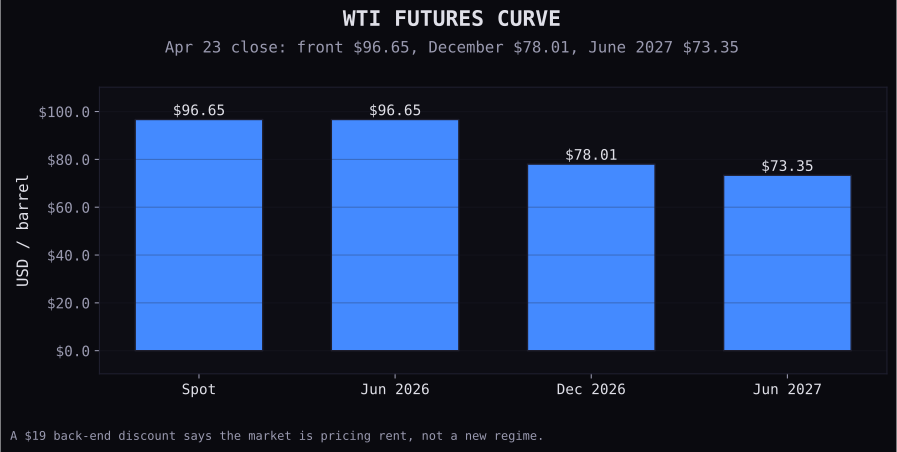
Spot $96.65. Dec 2026 $78.01. Jun 2027 $73.35. A $23 slope from spot to two-year strip.
WTI front prints $96.65. WTI December prints $78.01. That spread is the whole answer.
Spot $96.65. Dec 2026 $78.01. Jun 2027 $73.35. A $23 slope from spot to two-year strip.
WTI for June delivery printed $96.65 at the close. WTI for December delivery printed $78.01. WTI for June 2027 printed $73.35. That is a $19 discount on the six-month contract and a $23 discount on the two-year contract during a live Hormuz crisis. The market is not pricing a new oil regime. It is pricing a toll.
Brent agrees. Brent spot $105.93, Brent December $85.43, Brent June $105.93. Every front-month tick stays at the front. None of it is getting baked into 2027 earnings estimates. Goldman warned Thursday that another month of closure keeps Brent over $100 through 2026. The curve has a different view. Traders are voting with the December contract, not the Goldman note.
XLE closed down 5.9% over the 30-day window that WTI is up 7.0%. XOP, the exploration and production basket, is down 6.6%. The companies whose earnings are discounted off a two-year strip sold off while the front-month contract rallied double digits. Oil-ETF USO is up 18.8%, tracking the front. Integrated energy and the front-month contract are the same commodity priced on two different time horizons, and they went in opposite directions.
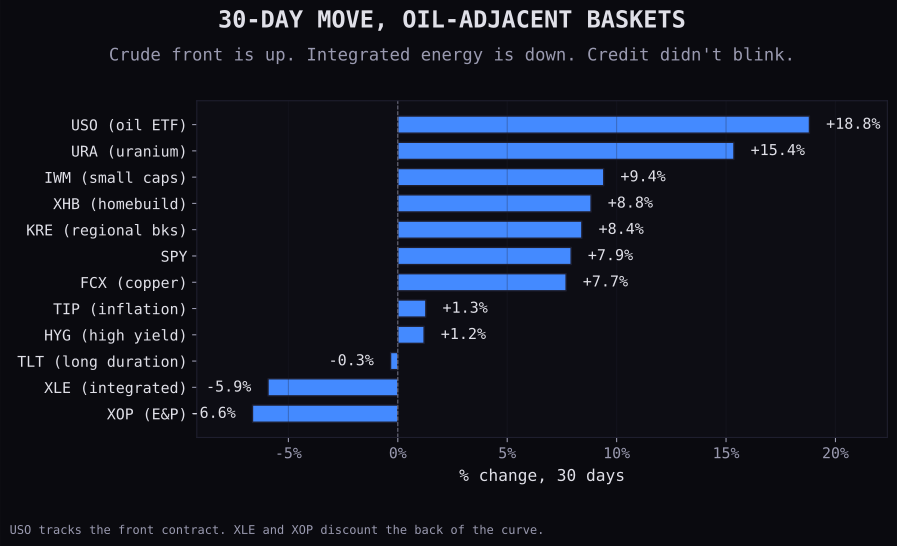
The oil-ETF and oil-equities split is the curve in stock form. Uranium and small caps confirm the reflation tilt.
HYG closed +1.2% over 30 days. LQD +0.7%. JNK +1.3%. JAAA flat. If the market thought the Hormuz standoff was going to become a credit event, high yield would not be green into the shock. It is green. The arbiter of oil-stress-becomes-recession sat the whole thing out.
TIP closed +1.3% while TLT closed −0.3%. Breakevens widened about 1.5 points in 30 days while growth duration did nothing. The bond market's answer to the oil shock is the same as the curve's: tax, not contraction.
Brent printed $107.36 intraday. WTI printed $98.39. VIX9D printed 22.16. The S&P was down 1.3% at the low. By the close: Brent $105.07, WTI $96.49, VIX9D 18.04, the S&P down 0.4%. Event vol lifted for two hours and came back down.
The news did not fade. The US military seized another Iranian tanker Thursday. Iran detained two cargo vessels Wednesday. Zero oil tankers transited Hormuz on Thursday per LSEG tracking. The physical stress is real. The market did not sell off because the curve had already priced the regime a week earlier. Thursday was confirmation, not information.
RBOB gasoline closed +11.1% over 30 days. Heating oil closed −2.6%. A demand-led commodity rally has both moving together. A supply-shock rally with slack industrial demand has exactly this split: drivers pay the rent at the pump, refiners shift slate, distillate drifts. Gasoline is where the toll lands.
Polymarket's Hormuz-normalization-by-end-April contract is at 6.5%. The contract for Trump announcing a US blockade of Hormuz is at 76.5%. US-invades-Iran-before-2027 is at 30.5%, well below the 67.5% print from March 30. The market is paying the ongoing toll while betting the catastrophic branch stays closed. That is exactly the pattern the WTI curve shows.
Recession contracts are bounded. Polymarket US-recession-by-2026 is 26%. Kalshi NBER-2026 is 23.5%. The IMF global-recession contract is 30%. Not peace. Not crisis. A sustained toll on a growing economy.