WTI Crude Oil, 5 Days Hourly
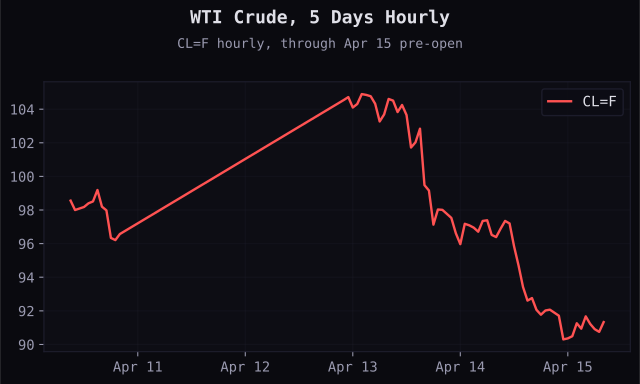
Front-month WTI fell from $105.63 to $86.96, a $19 drop in 3 sessions. The curve re-steepened to -19.8% backwardation. Back months barely moved.
Oil crashed $15 in three days, gold broke out to $4,832, and the plumbing is cracking underneath a 7,000 S&P. The ceasefire clock runs out April 21.
The rate path through 2026 shows zero cuts with near certainty. April hold at 97 percent. June hold at 88 percent. The first meeting with meaningful cut probability is September, at 29 percent. Even December sits at only 24 percent. The market is pricing a Fed frozen in place, and the reason is sitting at $91 a barrel.
Iran deal probability tells the same story in different units. Polymarket prices a permanent peace deal by April 22 at 26 percent, a deal by June 30 at roughly 60 percent, a deal before 2027 at 70 percent. That probability ramp maps almost exactly onto the rate cut ramp with a two-month lag. April deal probability low, April cut probability zero. June deal probability rising, September cut probability rising. The Iran deal timeline is the rate cut timeline. The transmission runs through oil. Without a deal, WTI stays above $90 and Warsh cannot cut no matter how loudly the White House demands it.
The failed Islamabad talks did not kill the odds. They accelerated them. Deal-by-April-30 went from 3 percent on April 5 to 39 percent on Polymarket now, even though Iran rejected the US demands on enrichment at the table. The market reads the failure as serious enough to negotiate, close enough to close. A second round of talks is being discussed. Trump said "next two days" on Monday. The ceasefire expires April 21, the same day as the Warsh confirmation hearing. Both sides have maximum leverage right now.
The Treasury General Account surged $72 billion in three days before Tax Day even arrived. The TGA went from $697 billion on April 9 to $759 billion on April 13, with a single-day net inflow of $56 billion on Monday alone. Today is the actual filing deadline. The real surge has not hit yet.
Every dollar that flows into the TGA drains reserves from the banking system one for one. SOFR printed 3.63 percent on Monday, but the 99th percentile of SOFR transactions hit 3.72 percent, only 3 basis points below the IOER ceiling at 3.75 percent. Some trades are already pricing near the top of the corridor. The ON RRP facility, which used to hold $2 trillion, sits at $306 million, but its counterparty count tripled from 4 to 13 on Monday. Money funds are testing the facility, probing for the relief valve.
The OFR Financial Stress Index masks all of this. The composite crashed from +0.20 to -1.80 in two weeks, signaling dramatic de-stressing. But the funding sub-index barely moved, from -0.01 to -0.05. Credit compression and equity vol collapse drove the composite lower while the plumbing stayed flat. Today's tax payments could push another $100 to $200 billion into the TGA. If tonight's SOFR print comes in above 3.70, the plumbing is cracking. If SOFR prints above EFFR at 3.64, it is breaking. And tomorrow brings a double auction, 20-year bonds plus 5-year TIPS, settling into the drain.
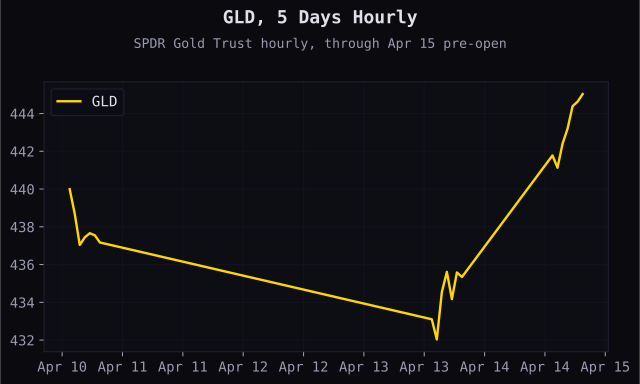
Gold closed at $4,832 on Tuesday, up 2.2 percent, with Newmont following at +2.4 percent. The futures curve prices $5,032 for April 2027 and $5,237 for April 2028, smooth contango at roughly the risk-free carry cost. That looks passive. It is not. Gold already traded $5,586 on January 29 at the peak of the Iran war, and the curve's back month sits below that level. The market has fully discounted the war premium.
If the ceasefire collapses on April 21, gold reprices above the curve instantly, retesting the $5,500 zone on renewed war premium. If the deal succeeds, oil crashes, Warsh gets room to cut, and gold rallies on the rate-cut bid. JP Morgan targets $5,055 by Q4. Deutsche Bank raised to $6,000. Central banks are buying 755 tonnes this year against a pre-2022 average of 400 to 500. The only gold-negative outcome is the narrowest path: a deal that removes the war premium combined with rates staying high because Warsh refuses to cut even with lower oil. That requires both the deal AND the hawkish tail simultaneously.
The S&P rallied 650 points off the March 31 low, a 10.2 percent move in two weeks, and it is not a buying rally. Large speculators in E-mini futures are net short 244,483 contracts and reduced by only 11,071 last week. They are covering, not going long. Micro E-mini retail specs are net long 36,096 contracts at the 100th percentile. Retail is long. Institutions are covering shorts.
The vol term structure confesses the same thing. VIX9D at 16.70 says calm now. VIX1Y at 23.95 says scared later. The ratio is 0.91, steep contango across the curve. SKEW at 149.94 is up from 136.54 on March 18. Sophisticated players are buying crash protection while the headline index prints 7,000. The rally is real, but it is mechanical, driven by forced covering into a weakening dollar and ceasefire euphoria. The DXY at 98.13 is down 1.6 percent on the month, supporting equities through earnings translation.
Dollar General hit a new low at $114.68 on Sunday, down 11.3 percent in a month. XLY, the consumer discretionary ETF, is up 2.2 percent over the same window. That is a 13.5 percentage point spread in one month between the low-income proxy and the high-income proxy. The bottom 40 percent of the consumer is already in recession. Aggregate retail sales will mask it because headline numbers are dominated by the top of the distribution. Recession probability holds at 29 percent on Kalshi and 30 percent on Polymarket. Moody's model sits at 49 percent. The market is pricing the aggregate. The distribution tells a different story.