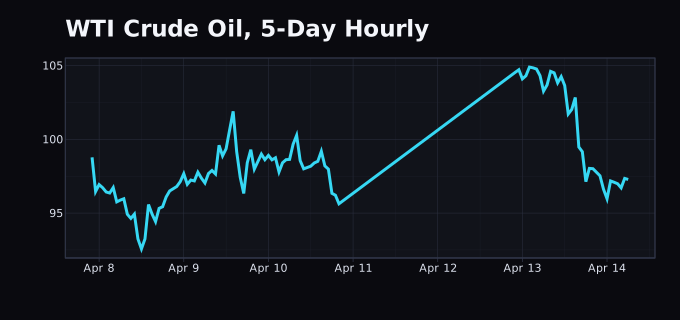
WTI at $97.28, down 1.8% and back below Saturday’s pre-blockade level. The Hormuz premium didn’t last 48 hours. Polymarket prices 48% odds WTI touches $90 this week. PPI at 8:30, four banks report, Tax Day drains reserves.
Oil told the whole story overnight. WTI faded to $96.91, down 2.2% from Monday's close. The blockade premium didn't survive 48 hours. Three more tankers transited the strait overnight without interception, including a US-sanctioned Chinese tanker (Rich Starry) that tested the blockade directly. Polymarket prices 48% odds WTI touches $90 this week, nearly a coin flip on further downside.
Then the shift: Trump told reporters "Iran called and wants to work a deal." Pakistan offered to host the next round in Islamabad. The blockade is producing calls, not confrontations. Oil at $96.91 prices exactly this outcome.
ES ticked up to 6940 (+0.3%) overnight. VIX at 18.56, the lowest since the blockade started. Gold bid +1.4% to $4,807 (Asian session buying). BTC +0.4% to $74,817. The market is positioned for a deal, not a war.
March PPI drops at 8:30 AM. Consensus: +0.3% MoM headline, +2.9% YoY; core +0.3%/+3.3%. This number matters more than usual because it feeds directly into the PCE deflator calculation, and Friday’s CPI was deceptively cool. Headline CPI came in at 2.8%, but core printed 3.1% and stuck there. If PPI runs hot, PCE stays elevated and the Fed stays locked.
The rate market already knows this. Kalshi prices a 98% probability the Fed holds in April, 88% in June. No cuts are priced until at least Q4. The more interesting number: 41% chance of zero cuts in all of 2026, down a tick from 42% but still up from 30% three weeks ago. A hot PPI pushes that above 50%, which would be the first time markets formally priced a full-year hold since the hiking cycle began.
Kalshi prices 94.5% odds that PPI YoY will exceed CPI YoY for 3+ consecutive months in 2026—a near-certainty bet on producer price pressure outrunning consumer inflation. February’s PPI came in scorching at +0.7% MoM, more than double the 0.3% consensus. A repeat today would break the market’s fragile calm.
Recession odds offer the counterpoint: Kalshi has a 2026 recession starting at 33%, Polymarket at 30%. The market is pricing a Fed that can’t cut into a war-driven supply shock even as the economy slows. That’s the stagflation box, and PPI is the lock.
Goldman wrote the template yesterday. EPS of $17.55 crushed the $16.47 consensus (second-highest quarter in company history, record Global Banking & Markets revenue) and the stock fell 1.9%. Record revenues, second-highest earnings ever, 19.8% ROE, and investors sold it. That’s the bar for tomorrow’s reporters.
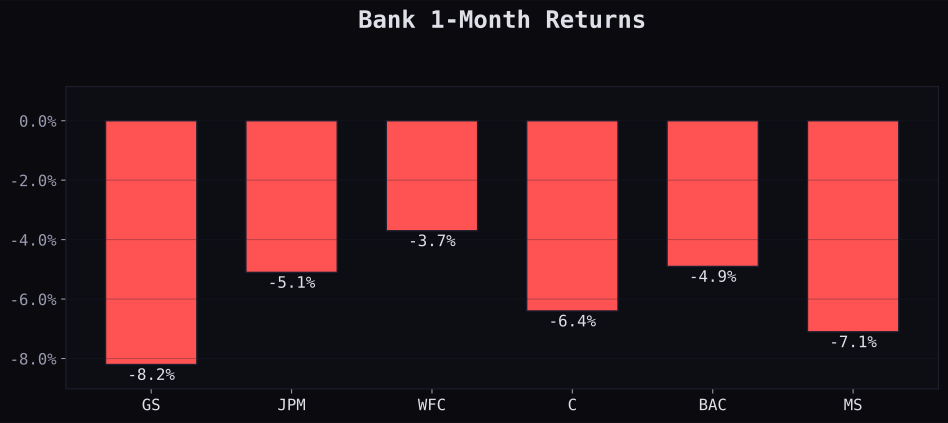
The problem is positioning. WFC has rallied 16.9% in the past month. Citi is up 19.5%. Both ran harder into earnings than GS did (+13.9%). If Goldman’s record quarter couldn’t hold a bid, WFC and C need to clear an even higher bar with arguably weaker franchises. The GS sell-the-news template says: beat expectations and still get sold.
JPM ($313.68, +1.2% Monday) is the safest of the four. Dimon’s NIM guidance and trading revenue are the watch items. The Hormuz volatility spike should have been a windfall for the trading desk. If JPM can’t show a vol-driven beat in fixed income, nobody can. WFC ($86.64) faces the commercial real estate question: writedowns are the known risk, NII trajectory is the swing factor. Citi ($126.28) has transformation costs and LatAm exposure. Neither is a Hormuz play, but both can disappoint independently.
BLK ($1,023.65, +2.4%) is the wild card. The HPS Integration Partners gate ($1.2 billion in redemption requests, $620 million paid, $580 million still gated) is a private credit confidence test. If the gate widens, it’s a read-through to every PE-backed credit vehicle in the market. AUM flows and private credit marks are secondary to the gate number. Polymarket prices BLK at just 66% to beat—the lowest of all four reporters. JPM 92%, WFC 94%, C 91%.
Goldman beat by 6.5% and fell 1.9%. WFC and Citi have run harder. The sell-the-news template is set, and prediction markets flag BLK as the weakest hand at 66% to beat.
Today is April 14, the last day for estimated payments and extensions before tomorrow’s filing deadline. The plumbing is already tight. ON RRP hit $0.227 billion on April 13 with just 4 counterparties, down from $15.3 billion a week earlier. The facility is functionally empty. SOFR printed 3.61% on April 10 against EFFR at 3.64%, only 3bps of spread. But the 99th percentile SOFR hit 3.72%, meaning some borrowers are already paying well above target.
Tax Day historically drains $200–400 billion from reserves into the Treasury General Account over 2–3 weeks. Current reserves at ~$2.89 trillion are only a modest cushion above the Fed’s estimated $2.5–2.7 trillion “ample” threshold. With ON RRP at zero, there is no buffer. Every dollar of tax payment comes directly out of bank reserves.
The OFR Financial Stress Index is still negative at -1.65, and credit stress is deeply negative at -1.04. The system isn’t screaming yet. But watch Thursday: a 20-year bond auction and a 5-year TIPS auction on the same day, settling into drained reserves with the thinnest dealer balance sheets of the year. That’s where the fracture would appear first: not in SOFR on Tuesday, but in auction tails on Thursday.