The War Arc — 3 Months
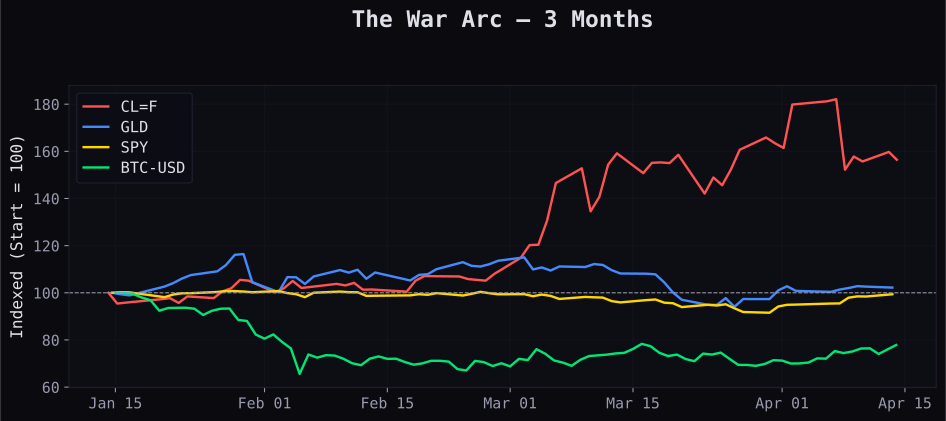
Oil +64%. Gold +6%. SPY −3%. BTC −22%. The war created two markets. The ceasefire crash is a blip on the arc.
The ceasefire stopped one-sixth of the fighting. Oil needed 24 hours to figure that out.
The ceasefire covers bilateral US-Iran combat. That accounts for roughly one-sixth of the war. Arab News tallied the rest: 83% of Iran’s projectiles struck Gulf states: Kuwait, Bahrain, Saudi Arabia, the UAE, Iraq. On ceasefire day alone, Israel launched 100 airstrikes on Lebanon in ten minutes, killing 254 people and wounding over a thousand. Netanyahu stated publicly that Lebanon is not covered. Iran cited the strikes as a violation. IRGC commanders said their hands remain on the trigger.
Saudi Arabia’s East-West Pipeline, the only way to export oil without passing through Hormuz, was struck by Iranian drones on ceasefire day. The damage was limited. But Iran proved it can reach the one piece of infrastructure the entire bypass strategy depends on.
Iran faces a trilemma. Accept Hezbollah’s destruction under Israeli bombardment. Re-close Hormuz entirely. Or escalate to full regional war. Oil at $99 only prices the first option. Friday’s Islamabad talks (Vance versus Ghalibaf, maximalist positions on both sides, 37% odds the meeting even happens) determine which path Iran chooses. Three months ago, the Cleveland Fed’s core PCE nowcast read 2.18%. Today it reads 3.63%. That is a regime change in the inflation trajectory. The FOMC minutes confirm the Fed sees it: seven of nineteen members now project zero rate cuts in 2026. Some participants argued the statement should acknowledge rate hikes as a possibility. The lone remaining dove voted for a 25bp cut and lost 11-to-1. The Fed’s overnight reverse repo facility held $0.18 billion on Tuesday with four counterparties. At its peak: $2.5 trillion. That buffer is gone. Primary dealers hold $557 billion in Treasury inventory, the highest level this cycle. Yesterday’s 10-year auction saw indirect bidders drop to 55% from 74% a month earlier, the largest single-month decline in the data. Today’s 30-year auction at 1 PM is the real stress test. The yield sits at 4.90%, ten basis points from the psychological 5% line. High-yield spreads sit where they were before the war started. History favors credit being late: it was late in 2007, late in 2020, and late in 2022. Net recession probability: 45%. The political economy makes tariff relief unlikely. OBBBA’s $5.2 trillion revenue hole requires tariff income. The ceasefire was designed to fail constructively. The insurance sector is where the war thesis meets private credit meets the bond market.The Inflation Cement
The Stagflation Print — 8:30 AM
GDP Q4 final: 0.5% (revised DOWN from 0.7%, from 1.4% advance)
— Weakest since pandemic. Investment revised down.
Core PCE YoY: 3.0% (in-line). Headline PCE: 2.8%.
Cleveland Fed nowcast: 3.63%, forward path accelerating.
The combo: weakest GDP + sticky inflation = stagflation.
Tomorrow's March CPI is the confirmation print.
The Plumbing Test
Oil & Credit — 1 Month
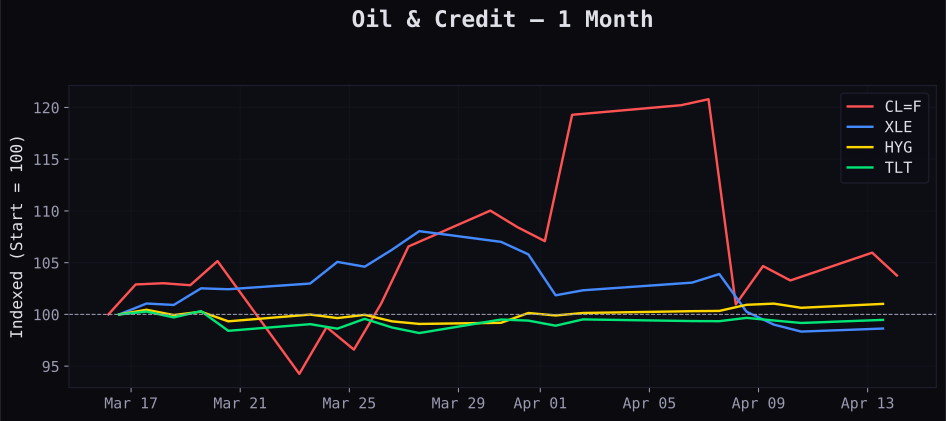 Credit flat while oil whipsaws $30. The plumbing is calm. Either it's right or it's late.
Probabilities
12%Soft landing — tariffs ease, Hormuz opens, Fed cuts43%Growcession — GDP 1.0-1.5%, feels like recession, technically is not30%Mild recession — Q3 convergence, inventory trap triggers15%Deep recession — all three stages fire, Hormuz re-escalates
The ceasefire covers 17% of the war. Inflation is cementing above 3% with two consecutive data releases due in 24 hours. The Treasury market’s marginal buyer is disappearing. The market is pricing a world where the ceasefire works, inflation cools, and Friday is uneventful. The data says the ceasefire is fiction, inflation is accelerating, and Friday is loaded. One of these views is about to be expensively wrong.
eli terminal • morning brief
Thursday, April 9, 2026 • Pre-Market Edition
Retrospective edition