The Tape — 5 Days Into Good Friday
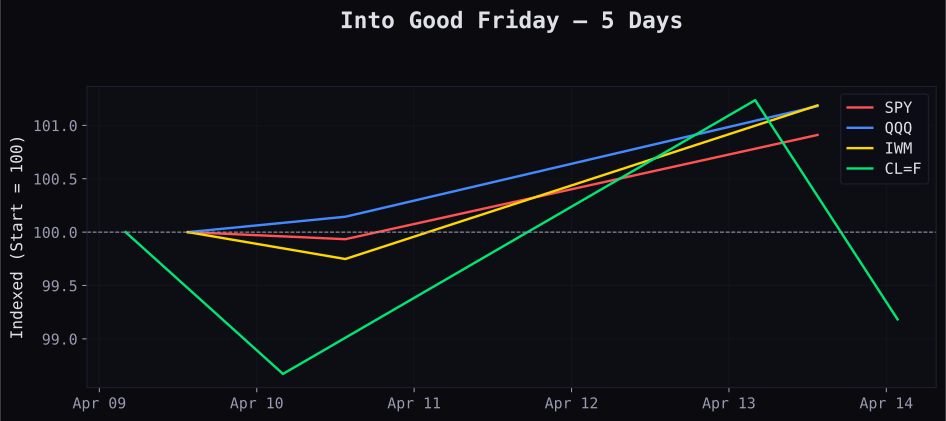
Thursday's 600-point swing and oil breakout above $112 dominate the week. Volume conviction is in energy, not equities.
Jobs dropped into a closed market. OPEC meets Saturday. The Iran deadline expires Sunday night. Monday absorbs all three at once.
Oil broke through the $101 ceiling that had held for two weeks. WTI went from $84 on March 23 to $114 intraday on April 2, a $30 range in eight trading days. But energy equities are not buying it: XLE is up 5.5% over 30 days while crude is up 38%, a 32-point divergence. Either XLE catches up violently, or the oil rally is a geopolitical premium that gets repriced the moment a ceasefire headline sticks.
The war’s most durable damage is already in the fertilizer market. Urea at $700 per ton, up 50% from pre-war levels, is baked into spring planting decisions. USDA confirmed corn acres fell 3% to 95.3 million. Expensive fertilizer in March means lower yields in September means higher grocery bills by winter. Food CPI runs +2.4% today. Helios AI projects 12–18% by Q4 if urea stays above $600.
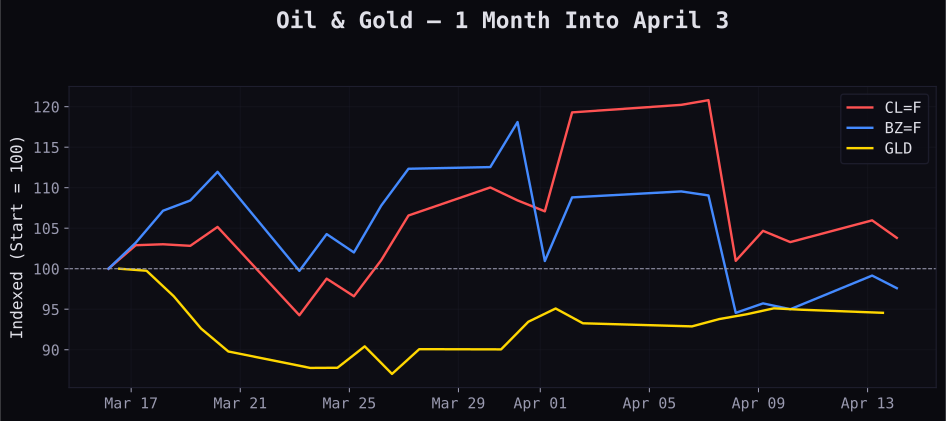
Three catalysts resolve over one weekend with no liquid equity market to absorb any of them. NFP already landed: +178K against a +57K consensus. February revised down to −133K. The two-month average is +23K, one month of collapse, one month of recovery, both bottled up. OPEC meets Saturday to decide May output. The Iran deadline expires Sunday night at 8 PM Eastern.
The scenarios: Extension (40%): Trump extends the deadline again, third time in a row, oil pulls back to $105–108, SPY opens flat. Escalation (30%): strikes on power plants resume, oil runs to $120+, SPY gaps down 2–3%. Ceasefire (10%): the surprise, oil crashes to $85, SPY gaps up 3–5%. Twenty percent for something in between.
Lloyd’s war risk insurance has gone from $150,000 to $5 million per voyage, a 33x increase that has not budged one tick since the Iran-Oman protocol headlines. When Lloyd’s starts cutting rates, that’s your all-clear on oil. Until then, every headline about diplomatic progress is noise.
Monday absorbs NFP, OPEC, and the Iran deadline in a single opening print. The last time a Good Friday jobs report collided with a geopolitical deadline over the same weekend, the following Monday gapped 3.2%. The market cannot hedge what it cannot trade. Everything is bottled up, and Monday is the release valve.
eli terminal • morning brief
Good Friday, April 3, 2026 • Markets Closed
Retrospective edition