WTI + Brent forward curves, before and after
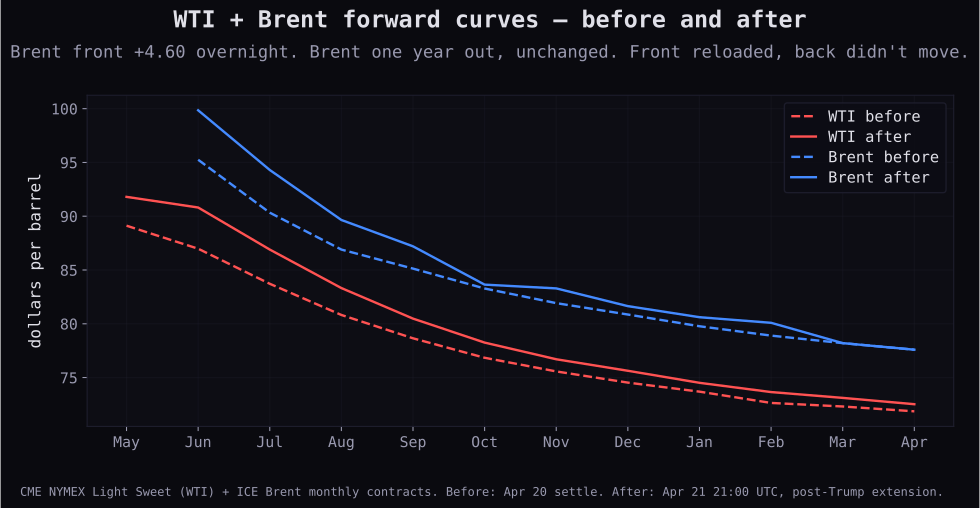
Solid = today post-20:28 UTC Trump extension. Dashed = Apr 20 settle. Front reloaded; back pinned.
Brent front month: $95.25 → $99.85. Brent Apr 2027: unchanged at $77.59. The front reloaded; the back didn’t move a cent.
Solid = today post-20:28 UTC Trump extension. Dashed = Apr 20 settle. Front reloaded; back pinned.
Trump extended the US-Iran ceasefire on Truth Social at 4:28 PM ET without any concession from Tehran on enrichment. Iran never sent a delegation to Islamabad. The blockade of Iranian ports remains in force. Oil rallied. The headline version of the story is "peace extended, blockade continues." The Al Jazeera live blog carried it as de-escalation. The forward curve carried it differently.
Brent June 2026 closed at $99.85, up $4.60 from yesterday’s $95.25. Brent front was at $90.06 intraday this morning before the extension and finished near $100 by the settle. WTI May 2026 closed $91.80, up $2.68 from $89.12. WTI intraday high was $92.23; the low was $85.50. The whole front-tenor supply-constraint premium reloaded in a single session.
Every contract inside the first six months priced up. WTI Jun $90.81, Jul $86.90, Aug $83.32, Sep $80.48 — each roughly two to three dollars above yesterday. Brent Jul $94.30, Aug $89.65, Sep $87.20. The curve didn’t just shift at the front; the whole first half of it lifted.
Brent April 2027 closed at $77.59. Yesterday’s Brent April 2027 was $77.59. Zero change. WTI April 2027 closed $72.52 against yesterday’s $71.86 — a 66-cent drift that’s smaller than the daily volatility on the back-month contract.
That’s the signal the headline reads don’t contain. The curve is pricing the blockade as a now-event, not a regime. The market believes the front-tenor supply stress is real — the $4.60 Brent reload wouldn’t happen otherwise — and believes it dissipates on a known timeline. The 12-month-out contract is the market’s best guess at what oil is worth when Hormuz runs normally. It didn’t move a cent.
Backwardation deepened. WTI front-to-back went from −19.4% to −21.0%. Brent from −18.5% to −22.3%. Both commodities wrote the same story in the same direction.
WTI’s curve is smooth and monotonic. Brent’s is not. The Brent front is a spike, not a slope — Jun $99.85 → Jul $94.30 → Aug $89.65 drops $10 in two months. Then the curve flattens: Oct $83.64, Nov $83.29 — essentially a shelf. Then it resumes declining. The Brent front reloaded nearly $5 without dragging the long end. WTI’s front reloaded $2.68 with the back drifting $0.66 — more even, more structural.
Brent is absorbing the blockade premium where it hurts most (physical Hormuz-adjacent cargoes) without propagating it into the 2027 tenor. That’s a market saying "it’s a big shock, and it’s contained."
The adjacent observations line up with the curve. The Trump-invades-Iran-before-2027 market prints 30% — down 4 points from yesterday, not up. The Hormuz-traffic-returns-to-normal-by-end-April market prints 14%. The 9-day VIX pulled back from the intraday high of 20.89 to 18.68 and closed below the 30-day VIX (19.50) — event-vol unwound after the extension landed. Gold sold −2.3% on the day, near the 3mo low of range. TLT closed at the day low. None of that is a risk-off tape. None of it is an escalation bid.
The story the tape tells through the curve and the adjacent markets is narrower than the headlines suggest and narrower than a clean "peace" read would support. Front-tenor supply constraint is binding today. The back tenor believes the constraint dissipates. Neither end of the curve is pricing a regime shift in either direction.