The War — 3 Months Normalized
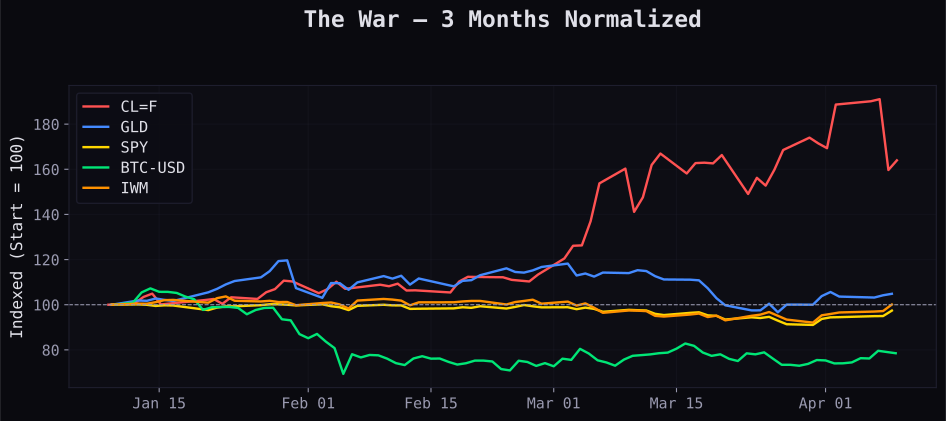
Oil +64%. Gold +6%. SPY −3%. BTC −22%. Small caps flat.
The Dow gained 1,325 points on a deal that was already unraveling
before the closing bell.
Oil crashed the most since April 2020. Equities had their best day since April 2025. The two-week ceasefire, brokered by Pakistan's PM hours before Trump's annihilation deadline, promised "complete, immediate, safe opening" of the Strait of Hormuz.
Three ships transited. Normal is 135 per day.
426 tankers are still waiting. Mines are still in the water. The IRGC claimed shipping stopped again within hours, citing Israel's continued bombing of Lebanon. Trump and Netanyahu said Lebanon is not covered by the ceasefire. Iran said it is. The deal was contradicting itself before markets closed.
Insurance premiums haven't moved. War risk cover: 10–25x pre-crisis. Multiple insurers cancelled policies entirely. The underwriters — the people who price catastrophe for a living — do not believe this ceasefire.
Prediction markets agree with the underwriters, not with the Dow. Hormuz traffic back to normal by end of April: 26%. By end of May: 46%. Trump announces end of military operations by April 30: 40%. US invades Iran before 2027: 32%.
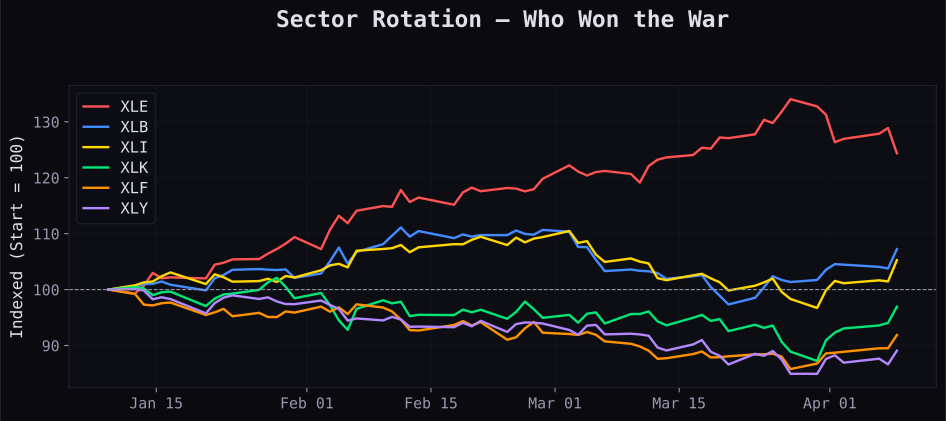
WTI settled at $94.41, already bounced to $97 in after-hours. Energy equities — XLE, XOP, OIH — are up 24-35% over three months and did not sell off with crude. Smart money sees through the headline.
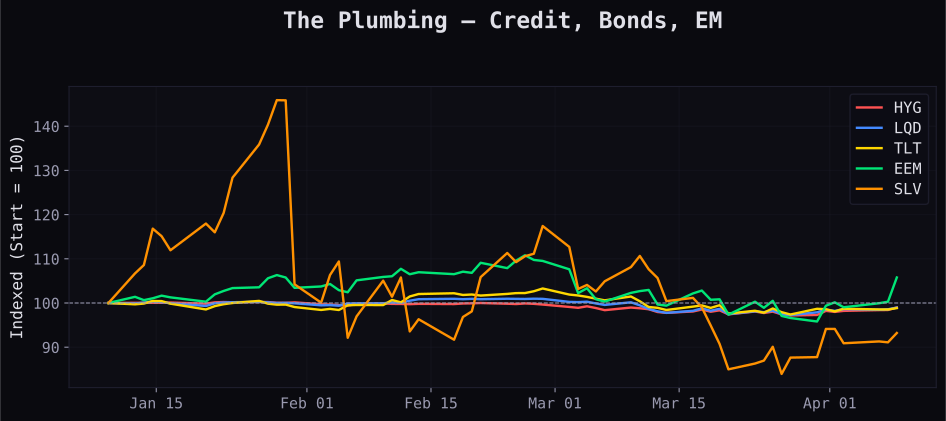
Stocks and bonds are telling completely different stories. This is the most important thing happening in markets right now, and almost nobody is talking about it.
The 2-year yield jumped 48 basis points in one month (3.455% to 3.936%). The 10-year rose 65bp from the February auction. In a normal pre-recession environment, yields fall as markets price rate cuts. They are rising.
The bond market is pricing stagflation. Stocks are pricing ceasefire relief. One of them is wrong.
The Fed is boxed. 97% hold in April. 90% hold in June. 31% chance of zero cuts all year. 14% chance of a hike. Every scenario that matters — private credit refinancing, labor market recovery, consumer spending — depends on the Fed cutting. Core PCE at 3.63% says: not yet.
Eleven research agents. Four hundred tool calls. Sub-agents spawning sub-agents three levels deep. The recession question isn't a single detonator. It's a sequence where each stage makes the next one worse.
The effective tariff rate is at 11% — highest since 1943. Section 122, the replacement after SCOTUS struck down IEEPA tariffs 6-3, expires July 23 with no replacement authority. That's 106 days. Binary outcome. The market is not pricing it.
Companies front-ran tariffs, building 18-24 months of inventory when they expected 6. The retail inventory-to-sales ratio sits at 1.29, just below the 1.30 recession threshold. When this buffer depletes in Q2-Q3, new orders hit at full tariff prices. Margin compression. Then layoffs. Then consumer pullback. Then more defaults.
Defaults at 5.8%, exceeding public high yield for the first time. The entire sales pitch — "lower defaults than public markets" — has reversed. FSK trades at a 50% discount to NAV. Moody's downgraded it from investment grade to junk. The DOJ publicly warned about "sketchy marks."
Multiple flagship funds are gating redemptions simultaneously. This is not idiosyncratic. BCRED saw $3.7 billion in gross redemptions. Morgan Stanley's North Haven fulfilled 45.8% of requests. Blue Owl's OTIC saw 40%+ redemption requests — bank-run territory.
The contagion path is loaded but unfired: defaults cascade to NAV crunch, to warehouse tightening, to CLO stress, to insurance companies forced-selling public investment-grade bonds, to wider spreads, to a feedback loop. The critical vulnerability: ON RRP at $0.18 billion means the plumbing buffer that cushioned March 2020 is gone.
Not cracking. Calcifying.
The hires rate is at 3.1%. That matches the April 2020 COVID low — without a pandemic forcing it. Job postings are at 2017 levels despite a decade of population growth. Payrolls are flat for eight months under positive headlines. The BLS revised away 911,000 jobs. Half the reported gains never existed.
80% of job openings are now filled by poaching employed workers. The unemployed are locked out of the hiring market. Long-term unemployed grew by 322,000 year-over-year. Once you lose your job, you are stuck. The labor market's immune system is weakened. Any external shock transmits faster than it would have in 2023 or 2024.
The private credit borrowers — middle-market companies levered five to seven times — are exactly the companies that freeze hiring first and lay off last. The "low-hire, low-fire" labor market IS private credit in slow-motion distress. Same companies, different datasets.
BIS credit-to-GDP gap: −12.10. The private sector is the most under-levered relative to trend in decades. In 2007, this was +12. There is no credit bubble to pop.
If recession comes, it is a demand recession — driven by tariffs and confidence, not by balance sheet unwinding. Demand recessions are shorter and shallower than 2008. Credit spreads are compressing. OFR financial stress is at -0.925, compared to +15 in 2020 and +25+ in 2008. The plumbing is calm.
S&P 500 specs are massively short at -233,000 contracts, covering at 100th percentile intensity. The bear case is already crowded. AI capex at $690 billion represents roughly 3% of GDP as pure new investment demand, self-funded by $484 billion in hyperscaler cash. Prediction markets: 74% no recession.
Weighted recession probability: 35-40%. Higher than any single research agent estimated alone, because the compound interaction between tariff stagflation, private credit distress, and labor calcification is multiplicative, not additive. Multiple independent agents — who never communicated — all converged on Q3 2026 as the decisive window.
CPI — tomorrow 8:30 AM. Polymarket prices 94% probability of monthly inflation at 0.8%+. If the print runs hot, the Fed trap closes completely.
Islamabad talks — April 10. If the Hormuz deal collapses, oil goes back above $100 and the inflation leg gets worse.
Bank earnings — April 13-15. JPM, Goldman, BofA, Morgan Stanley, Wells, Citi, BlackRock. Credit loss provisions are the private credit contagion test.
EU Russian LNG ban — April 25. A second energy shock converging with Hormuz fragility. Seventeen days away. Nobody is discussing it.
Section 122 expiration — July 23. Binary cliff for the entire tariff regime. 106 days.
The entire thesis is wrong if Section 122 expires and tariffs drop, producing instant disinflation that lets the Fed cut, which lets private credit refinance, which unfreezes the labor market. It is wrong if Hormuz fully opens and the EU waives the LNG ban, removing the inflation leg. It is wrong if tax cuts pass or AI productivity materializes. Any three of these together make recession probability drop below 15%.