The supply chain ran as one trade, last two years
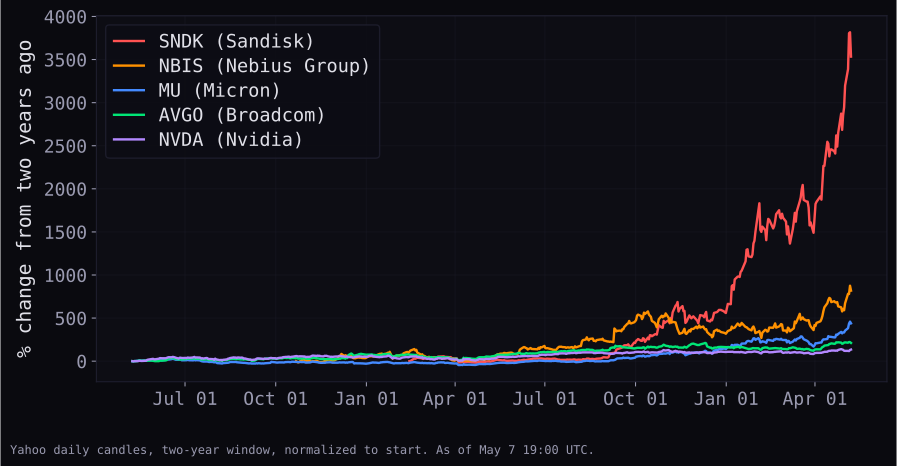
Hyperscaler capex hit $140 billion last quarter. The cohort ran +200% to +3,747%. Today the chain split.
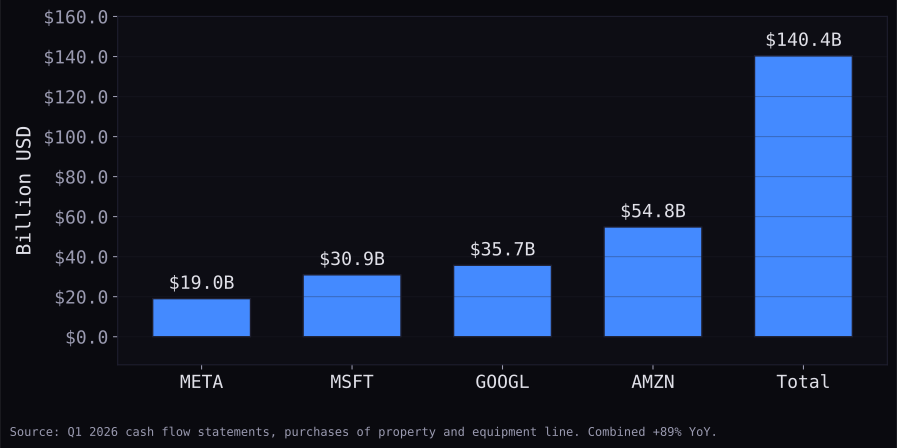
Microsoft, Amazon, Google, and Meta spent $140.3 billion on property and equipment in Q1 2026, +89% year over year.
AWS alone printed $41.5 billion in one quarter. That is more than the entire global NAND industry's planned 2026 capex of $22.2 billion.
Combined hyperscaler annualized capex pace runs near $560 billion.
The Q1 print by name. Alphabet +108% YoY into Google Cloud build for Gemini and external customers. Amazon +99% loaded AWS with $41.5B in three months. Microsoft +84% shipping Azure capacity to OpenAI and the rest. Meta +47%, the only one below consensus capex.
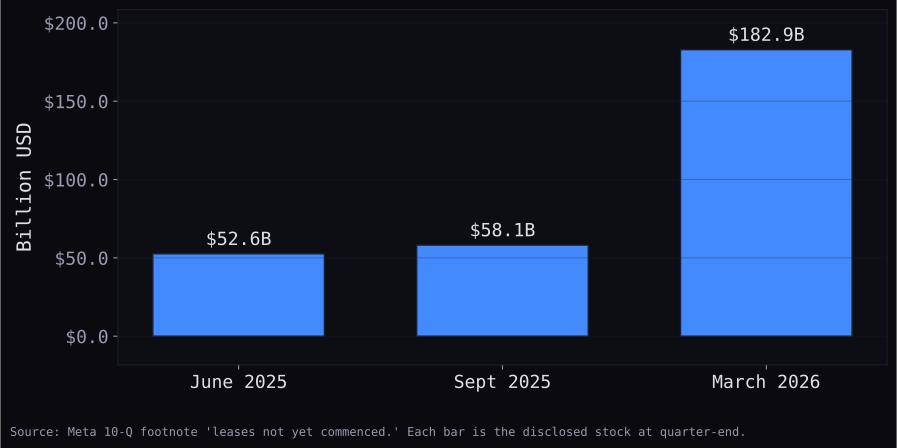
ASC 842 capitalizes leases at commencement, not at signing. A 25-year lease for a 2028 data center sits in a footnote until 2028.
Meta's Q1 10-Q discloses $182.88 billion of leases not yet commenced. Last June the same footnote read $52.56 billion. Tripled in nine months.
The rest of Meta's contractual stack: $237.67B of non-cancelable contractual commitments (mostly third-party cloud capacity), $14.72B of contingent cloud capacity, $45.99B maximum exposure to loss on the Hyperion VIE (Blue Owl + PIMCO data-center finance vehicle).
Recognized long-term debt on the same balance sheet: $58.7B.
The lease commitment is the credit support that lets a developer borrow.
Oracle. Database company pivoting hard into cloud infrastructure for a small set of large customers.
The Q3 fiscal 10-Q discloses $261B of additional lease commitments, $11B of power purchase obligations, and $552.6B of RPO, up from $130.2B a year ago.
The filing's exact language for the RPO increase: "primarily attributable to certain significant cloud contracts that were entered into during the period." No customer named, no concentration broken out.
Notes payable went from $85.3B to $124.7B in nine months. Oracle issued $43B of senior notes in that window plus $4.95B of 6.50% mandatory convertible preferred.
The OpenAI compute relationship is real, large, and publicly disclosed (the September 2025 $300B 5-year deal, earnings-call commentary about customer-supplied GPUs and prepayments). It is not in the 10-Q.
CoreWeave. GPU cloud broker between hyperscaler demand and physical capacity. Disclosed customers per the 10-K and S-1: Microsoft 62% of revenue, Meta $21B contract, Jane Street $6B.
The 10-K showed $21.6B of debt against $60.7B of RPO at year-end. Three 8-K filings since added $6.75B in new debt: senior notes at 9.75% due 2031, convertibles at 1.75% due 2031 with a $119 conversion price, revolver upsized to $2.5B.
Guidance: revenue $12-13B, capex $6-7B per quarter, interest $510-590M per quarter. Capex at twice revenue, interest at 17% of revenue.
Oracle and CoreWeave buy chips. The chips contain HBM from SK Hynix, Samsung, and Micron, plus NAND from Sandisk and Western Digital.
Samsung announced HBM capacity +50% for 2026. SK Hynix is doubling DRAM in 2H 2026. Kioxia pulled BiCS10 NAND production forward by a year. Micron capex +23% YoY to $13.5B.
Total NAND industry capex for 2026, across the entire industry: $22.2B.
Micron Q2 fiscal: DRAM revenue grew 74% (ASPs +mid 60s, bit shipments +mid single digits). NAND revenue grew 82% (ASPs +high 70s, bit volume +low single digits). Roughly 90% of revenue growth is price.
Micron doubled its customer-pricing-adjustment reserve from $1.19B in August to $2.55B in February.
Sandisk +3,747% / 2y. Nebius +897%. Western Digital +787%. SK Hynix +743%. Seagate +725%. Micron +432%. Vertiv +271%. Intel +255%. Broadcom +205%. AMD +156%. Nvidia +125%.
Every name except Nvidia hit a fresh peak on May 3 or May 4, inside a 48-hour window.
Sandisk's run is partly fundamentals (datacenter SSD revenue tripled, NAND ASPs running) and partly mechanical.
The S&P 500 added Sandisk November 28 2025. The NASDAQ-100 added it April 20 2026, replacing Atlassian. Trillions of passive flows had to buy.
Tradr launched a 2X Short SNDK ETF (SNDQ) on April 24, listing institutional shorting for the first time. Self-fulfilling prophecy works in both directions.
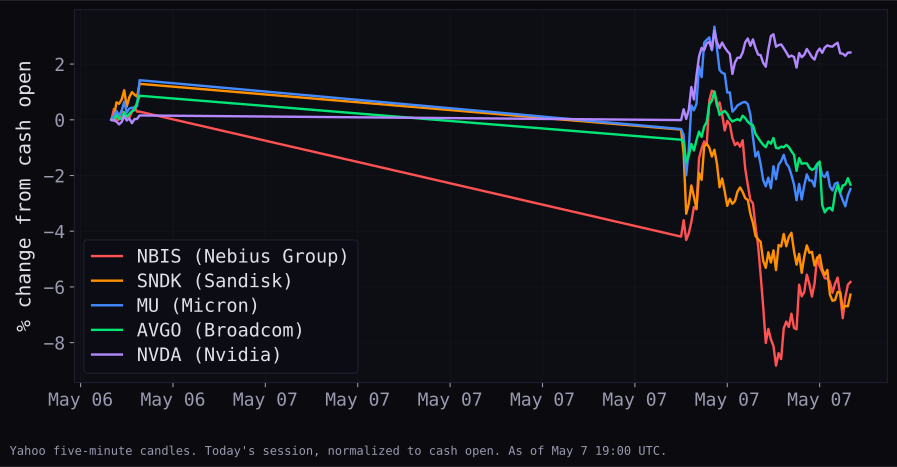
Sixteen of eighteen tracked names closed within 0.5% of their Wednesday intraday highs at today's cash open. Synchronized to the basis point.
The chain held that synchronization for forty-five minutes, then began breaking layer by layer.
The mid-day catalyst was specific. The Wall Street Journal reported OpenAI missed its internal targets for new users and revenue. The Information reported the Broadcom-OpenAI custom-chip deal financing hit a setback.
Arm warned at the open of the global memory shortage hitting smartphone volume and capacity constraints in its data-center business; the stock −10%.
Three pieces of news, all aimed at the same node in the chain, all hitting before 2pm ET.
Construction-economics names broke first at 14:25 UTC. Quanta (electrical contracting at 47x EV/EBITDA on 8.7% operating margin) −1.98%. Vertiv (data center cooling) −0.78%. GE Vernova (gas turbines, grid equipment, $163B RPO) −0.91%.
The bitcoin-miner subset rolled at 15:25 UTC. Nebius gave up half its day in thirty minutes (+3.43% to +1.07%). Iren went negative. Cipher Mining at −6.24% off the intraday high.
Storage cracked deep at 16:25 UTC. Sandisk −5.05% at −6% off intraday high. Western Digital −2.96%. Micron at −5.96% off high.
Capex equipment joined at 17:55 UTC. Applied Materials, Lam Research, KLAC each −2-3%. Broadcom broke 30 minutes later on the Information piece, −1.65% at −3.89% off intraday high.
Nvidia held +2.27%. The largest cap and only chip designer with both data-center GPU dominance and custom-silicon optionality through Blackwell and Rubin.
The hyperscalers are not the canary. Microsoft, Amazon, Google, and Meta each carry $50B+ of operating cash flow. Meta's $182.88B lease commitment is 1-2% of annual cash flow.
Hyperscaler capex disappointment compresses a multiple. It does not trigger a default.
The canary is at the financing layer that built capacity against the hyperscaler lease. Oracle and CoreWeave are the two public expressions.
Oracle holds $124.7B of notes payable and $261B of additional lease commitments, with $552.6B of RPO from cloud contracts the 10-Q does not break out by customer. Customer concentration that earnings-call commentary and press reporting implies is large; the filing does not disclose it.
CoreWeave: $28B+ of debt across senior notes (9.75%), convertibles (1.75% at $119), and a $2.5B revolver. Disclosed customers per the S-1 and 10-K: Microsoft 62%, Meta $21B, Jane Street $6B.
Both names carry renegotiation risk, not default risk. The question is at what price the next contract clears.
The dated catalyst at CoreWeave is in the credit agreement. Unlimited equity cures for covenant failures are permitted until October 28, 2026. The debt service coverage ratio doesn't get tested until October 31, 2027.
Between those dates, CoreWeave can dilute its way out. October 2027 is the moment when "issue more equity" stops working.
The dated catalyst at Oracle is the next senior-note issuance. Each prices wider than the last. The structural trigger fires when a deal fails to clear.
Super Micro peaked at $91 in July 2024. Trades $33.83 today, −62% twenty months later.
The business survives. Servers ship. Customers pay.
The Q2 fiscal 10-Q discloses gross margin compression from 11.8% to 6.3% year over year, attributed by management to "competitive pricing to gain market share." That language is scaling-kills-margin on an income statement, dated.
Three prior memory cycles ended the same way.
Micron drew −45% / 7mo (2018), −46% / 12mo (2021-22), −42% / 10mo (2024-25).
Western Digital −60% (2018), −58% (2021-22). Seagate −56% (2021-22). SK Hynix −47% (2021-22).
Median name drawdown across three cycles: 45%.
The supply response that ended every prior cycle is dated for this one. Samsung HBM +50% in 2026. SK Hynix DRAM doubling 2H. Kioxia BiCS10 a year forward.