Sunday September 27, 2026 • Hormuz, the Xi Visit, the Long Bond
Trump Said No to Iran's Seven Days. Only the Bettors Were Open.
The Wall Street Journal reported Friday night that Trump had rejected Tehran's Hormuz plan, and with crude and Treasuries shut, the bet on the US ending its Iran blockade by October fell from 34.5% to 24.5% in half an hour. When he said it himself on Saturday, it moved about 1.5 points.
Friday Sep 25 close
S&P 500 7,743.41 +0.51%
·
WTI 92.41 −2.3%
·
30Y 5.504% +4.3bp
·
FXI 33.96 −0.8%
·
VIX 14.87 −0.80 pts
Week, Sep 18 to Sep 25 close
SPY +1.3%
·
WTI −7.9%
·
5Y 5.007% +15.1bp
·
10Y 5.184% +18.6bp
·
30Y 5.504% +17.3bp
·
FXI −1.0%
·
KALSHI OCT HIKE 55.5% → 64%
24/7 venues, Fri 21:00 to Sun 05:00 UTC
BLOCKADE ENDS BY OCT 31 35.5% → 27%
·
HORMUZ NORMAL BY DEC 31 27.5% → 20.5%
·
US-IRAN TRUCE TO OCT 31 57.5% → 49.5%
·
OCT HIKE 64% → 63%
·
BITCOIN 84,322 +0.6%
Ten points on an anonymously sourced report, about two on the President's own words
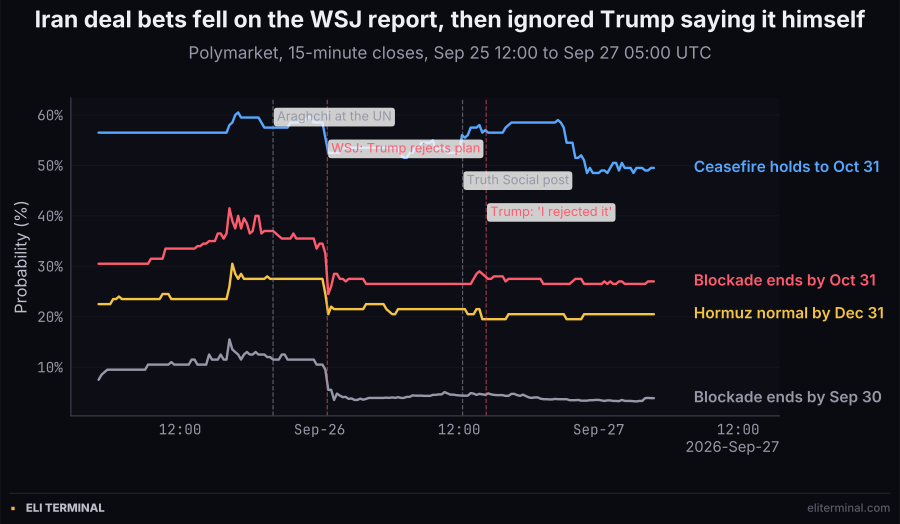
The red dashed line at 00:40 UTC Saturday is the Journal's report; the one at 14:20 UTC is Trump confirming it outside the White House. The steep drops all come at the first line.
The Wall Street Journal had Trump's no on the wires by 00:46 UTC Saturday, and the Iran blockade bet lost ten points in half an hour
"Trump has told aides he expects U.S. bombing to resume after the elections." That line, from The Wall Street Journal's Friday night report citing US officials, carried a second piece of news: the President had turned down Iran's seven-day plan to reopen the Strait of Hormuz. The Times of Israel posted it to its live blog at 3:46 a.m. Israel time, 00:46 UTC (Times of Israel), and Newsmax had a write-up by 00:52 UTC (Newsmax via Yahoo).
Polymarket's contract on the US announcing an end to its Iran blockade by October 31, with about 68,000 dollars traded, printed 34.5% at 00:15 UTC and 24.5% at 00:45. The September 30 version, on 144,000 dollars, went from 10.5% to 3.5% by 01:15.
The contract on Hormuz traffic returning to normal by December 31, the deepest strait book at 169,000 dollars, fell from 27.5% to 20.5% in the same half hour, and the market on a US invasion of Iran before 2027, on 221,000 dollars, went from 14.5% to 16.5%.
No barrel of crude and no Treasury changed hands on the news. NYMEX had settled Friday afternoon and does not reopen until Sunday evening in New York.
Bitcoin, the one large risk asset trading, went from 84,059 at midnight UTC to 83,861 at 00:30, a move of 0.2%. It spent the whole weekend inside a range of about 1.1%.
Thirteen hours later Trump said "I rejected it" on camera, and the contracts had almost nothing left to price
He posted first. "IRAN CAN NOT HAVE A NUCLEAR WEAPON!!!" went up on Truth Social at 8:18 a.m. New York time, 12:18 UTC (Trump's Truth archive).
Then, leaving the White House for Tennessee, he confirmed the Journal's story: "They made a proposal but I rejected it." The Times of Israel logged the remarks at 5:20 p.m. Israel time, 14:20 UTC, and Bloomberg's Courtney Subramanian had them out at 10:25 a.m. New York time (Bloomberg).
"They want to make a deal where they open the strait immediately because they are losing so badly," Trump said, per CBS News. "That deal would not be acceptable." And: "We have total control of the Hormuz Strait, massive amounts of oil are coming out" (CBS News).
The Hormuz-by-December contract slipped from 21.5% to 19.5% in the quarter-hour after 14:00 UTC. The October blockade bet went from 29% at 13:45 to 27.5% by 14:30. An anonymous account of the President's thinking moved the October contract ten points, and the President's own words moved it about one and a half.
Araghchi said "the choice now rests with the United States," and the answer arrived four and a half hours after he spoke
"The seven-day timeline will start as soon as the United States accepts this plan," Iranian Foreign Minister Abbas Araghchi told reporters outside the Security Council on Friday, at a stakeout UN Web TV scheduled for 20:00 UTC (Al Jazeera, UN Web TV). The price he named: an end to the US naval blockade, oil-sanction waivers, about 12 billion dollars in frozen assets and a ceasefire that covers Lebanon.
The Iran bets had already done their hoping by then. The October blockade contract ran from 30.5% at 12:00 UTC Friday to a high of 41.5% at 16:15, as crude broke during the White House tea for Xi Jinping. It printed 37% in the 20:00 UTC hour Araghchi spoke and 35.5% an hour later.
"We have seen the first reaction from the US president, but nothing has been conveyed to us from the mediators yet," Araghchi wrote on Telegram on Saturday. "Only a negotiated solution can get them out of this deadlock. That is our position" (Al Jazeera). None of the Iran contracts moved on the post.
The US-Iran truce bet rose after Trump said no, because the contract asks a narrower question than the headline
Polymarket's contract on the US-Iran ceasefire continuing through September 30 is the deepest Iran book, at 545,000 dollars. It dipped from 90.5% to 86% in the Journal's half hour, recovered by morning, and printed 94.5% at 19:45 UTC Saturday, five hours after Trump said "I rejected it."
The contract asks whether the shooting stays paused for three more days, not whether a deal happens. The Journal's own report, that the President expects bombing to resume after the November 3 midterms, is a forecast of no strikes before then, and the September book priced it that way.
Then, between 21:00 and 22:00 UTC Saturday, the same contract fell from 94.5% to 86%, and the October 31 version from 58.5% to 51.5%. This desk found no headline, statement or strike report stamped inside that hour, and the move is unexplained.
The October truce bet ended the weekend at 49.5%, a coin flip on the pause surviving into the week before the vote.
Pezeshkian told CBS that UN inspectors could come in, and the 1.8 million dollar enrichment market did not move a point
"If they wish to come in and have inspections, we can reach accords," Iranian President Masoud Pezeshkian told CBS's Margaret Brennan, in an interview excerpt CBS posted at 9:26 p.m. New York time Friday, 01:26 UTC Saturday.
Asked twice whether Iran would admit UN nuclear inspectors under a long-term ceasefire, he said, "That is absolutely correct." And: "Developing nuclear weapons is haram" (CBS News).
Polymarket's contract on Iran agreeing to end uranium enrichment by December 31 carries 1.77 million dollars, the most money on any Iran question this desk tracks. It printed 11.5% at Friday's 21:00 UTC close and 11.5% in every hour through Sunday morning. Inspectors are not an end to enrichment, and the market kept the two apart.
Pezeshkian gave Al Jazeera a colder line the same weekend: "We have no trust in the American side and do not know on what basis an understanding can be reached with it" (Al Jazeera).
The Houthis called their attacks "a small-scale rehearsal," and Saudi air defenses were busy again by Saturday morning
"Merely a small-scale rehearsal for a full-scale escalation," Hezam Al-Assad of the Houthi political bureau said of the group's recent operations, in remarks CBS logged at 1:50 p.m. New York time Friday, 17:50 UTC (CBS News). Early Saturday, the Saudi-led coalition said it had intercepted two ballistic missiles aimed at Khamis Mushait and two drones headed for Riyadh (The National).
Tehran added a threat about the sky. "Flights in the region are either free for everyone, or for no one," Mohammad Mokhber, an adviser to Supreme Leader Mojtaba Khamenei, said after airports in Iraq suspended Iranian carriers under US sanctions on 27 Iranian airlines (Ynet).
The contract on the Bab el-Mandeb strait being effectively closed by September 30, on 232,000 dollars, sat below 1% all weekend. Nobody put money on the rehearsal becoming the performance before Wednesday.
IMF PortWatch counted one Hormuz transit on September 20, and the deep bet on a normal strait by September 30 now trades at a third of a cent
"Massive amounts of oil are coming out," Trump said on Saturday. The Straits Daily Brief, citing IMF PortWatch, recorded one transit through Hormuz on September 20 against a pre-crisis baseline of 85 a day, with 281 vessels holding position in the region (Straits Daily Brief). PortWatch counts ships broadcasting their positions, so tankers running dark would not appear in it.
Polymarket's contract on Hormuz traffic returning to normal by September 30 has drawn 427,000 dollars. It traded near 60% in early July and at 0.35% on Sunday morning, three days from expiry.
The contract on the US announcing an end to the blockade by September 30 peaked at 85.5% on August 8. Anyone who bought it there is holding a claim now priced under four cents.
Buyers at the August peak have three days left, and the market gives them under four cents
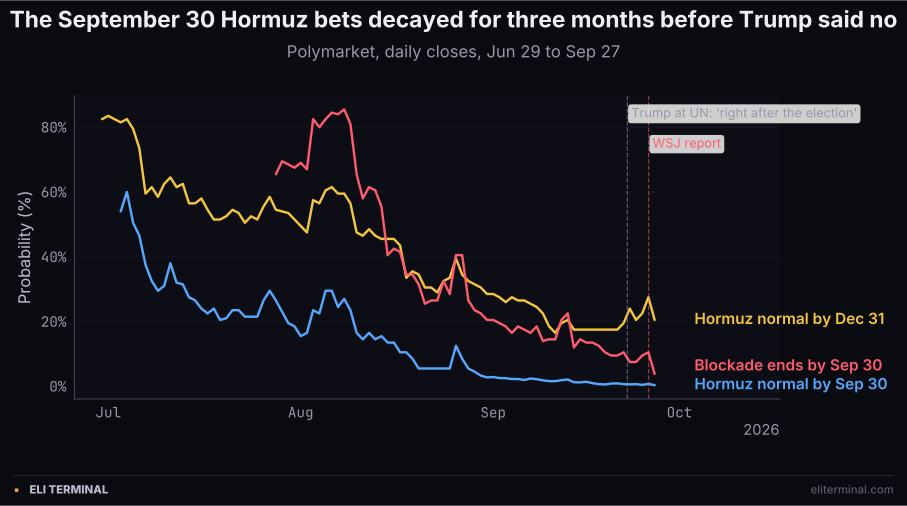
The September contracts were dying well before Trump's no. The weekend's drop in the December line gave back the rise that the Reuters and Kyodo reports had built since September 22.
WTI's last price, 92.41, was set before anyone outside the White House knew Trump's answer
Crude spent the week pricing a deal. WTI settled at 100.30 on September 18 and 92.41 on Friday, down 7.9%, through a Kyodo report of a seven-day offer on Tuesday, Reuters' account of a "phased" deal on Thursday and Friday's break during the Xi tea (Reuters via U.S. News). Friday's 2.3% slide ran against a warning from Standard Chartered's Emily Ashford: "A similar deal has been announced so many times before, and we have seen little traction on it" (Bloomberg via Rigzone).
The Hormuz and blockade contracts have now given back all of Friday's gains and more. The barrel has not had a chance to. No liquid prediction market prices crude over the weekend, so the only verdict on 92.41 until the Sunday evening open belongs to the Iran bets, and they said no.
Xi Jinping left Washington with pandas, a coal pledge Beijing's readout left out, and nothing signed
"We had a great meeting," Trump said after Thursday's Oval Office session, which CBS placed at noon New York time, 16:00 UTC, and he took no substantive questions (CBS News). Xinhua's account had Xi telling him the United States must "adhere to the correct position of opposing Taiwan independence and handle the Taiwan issue with prudence," wording Bloomberg called one of his most explicit calls for a change in US policy (Bloomberg).
At the state dinner Trump toasted: "President Xi and I both understand we represent different systems, but the ties between our people endure, and we've never gotten along better." Xi answered that the two countries' goals "are both ambitious and can surely be mutually reinforcing" (Fortune). US Ambassador David Perdue said Trump told Xi that any Chinese help for Iran's war was "unacceptable to us" (CBS News).
The written outcomes reached readers on Saturday, with Politico's account posted at 16:38 UTC, when no market that trades China was open. The White House said Beijing "has agreed to buy at least 10 million metric tons of coal from the U.S. annually in 2027 and 2028," plus better tariff treatment for about 30 billion dollars of non-sensitive goods each way.
China's statement did not mention the coal, and neither side's document addressed chips or rare-earth export controls (Politico via Yahoo). The trade truce itself had been extended to January 10 by Scott Bessent on Wednesday night, minutes after Xi landed at Joint Base Andrews (NBC News).
Every written deliverable landed after the last of these closed
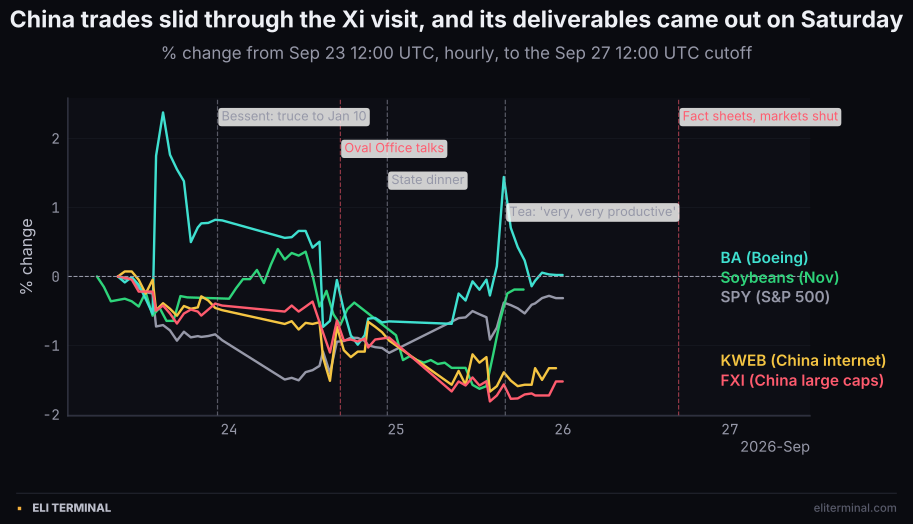
Markers: Bessent's truce extension, the Oval Office talks, the state dinner, Friday's tea, and the Saturday fact sheets on a blank stretch of chart.
FXI fell 1.5% across the Xi visit, and no market with real money behind it prices a US-China trade deal
The large-cap China fund FXI traded 34.48 at 13:00 UTC Wednesday and closed Friday at 33.96, down 1.5%, while SPY finished within 0.2% of where it started. KWEB, the China internet fund, fell 1.6% over the same stretch. In the Oval Office hour FXI went from 34.34 to 34.24, and the offshore yuan weakened from 6.710 per dollar on Wednesday night to 6.722 at Friday's close.
November soybeans fell from 1,316.50 cents at 18:00 UTC Thursday to 1,305.50 by 01:00 Friday, the hours spanning the state dinner, and reached 1,300 at 12:00 UTC. Brownfield's close on Thursday said the summit had delivered "no significant developments for ag" (Brownfield). The contract was back at 1,319 by Friday's 17:00 UTC hour, a recovery this desk cannot tie to any agricultural announcement.
Boeing, whose Chinese order Jamieson Greer had described as roughly 140 aircraft in "a good state" (CNBC), closed the week at 198.10 against 198.20 a week earlier. No order was announced. On the prediction venues, every contract on a US-China tariff agreement has too little money behind it to count as a price.
Jensen Huang sat at the head table, and the new "Super Intelligence" channel does not touch chip export controls
Nvidia's Jensen Huang, Apple's Tim Cook, AMD's Lisa Su and Elon Musk were seated with the two presidential couples, with Sam Altman in the room (Fortune). The White House said the two sides would open a bilateral communication channel for AI incidents, with Xi calling for "a healthy competition" between "leading nations in artificial intelligence" (Al Jazeera).
Greer had said a week earlier that chip export controls were kept out of the proposed AI dialogue (RTHK). Nvidia closed Friday at 225.10, up 0.2% on the day after its chief executive dined with Xi. No contract anywhere prices US chip export terms to China.
Barr said the Fed was "out of position," and October went from a coin flip to 64% in a week
Kevin Warsh has not spoken publicly on policy, in any record this desk could find, since September 16, when he told the New York Times' Colby Smith, "I'm not in the forward guidance business" (Federal Reserve transcript). His colleagues filled the week, and Kalshi's contract on a quarter-point hike on October 28, with about a million dollars traded, moved on one of them.
Monday went the other way. Austan Goolsbee told a London audience that persistent supply shocks are ones a central bank "should not simply look through" (Chicago Fed), and the October contract slid from 54% to 48% as WTI fell 4%.
Wednesday, Governor Michael Barr said "we were out of position" and that "further policy adjustments are likely to be needed" (Federal Reserve). Reuters stamped his remarks at 14:07 UTC, and the contract went from 51% at 13:00 to 61% by 15:00 and 70% in the 16:00 hour (Reuters via Investing.com).
Thursday's speakers barely moved it. New York Fed President John Williams called another hike by year-end "a reasonable way of thinking about it" in London (CNBC), and October went from 65.5% to 68% in the two hours after the remarks were out, around 08:41 UTC. Philadelphia's Anna Paulson said "some modest further tightening may be warranted" (Bloomberg via Spokesman-Review), and Cleveland's Beth Hammack warned that inflation risks remain tilted to the upside (Reuters via U.S. News).
The week closed with October at 64% and December at 70.5%, up from 55.5% and 66.5%.
Barr's Wednesday lifted both panels; by Friday the long bond was rising without the hike bet
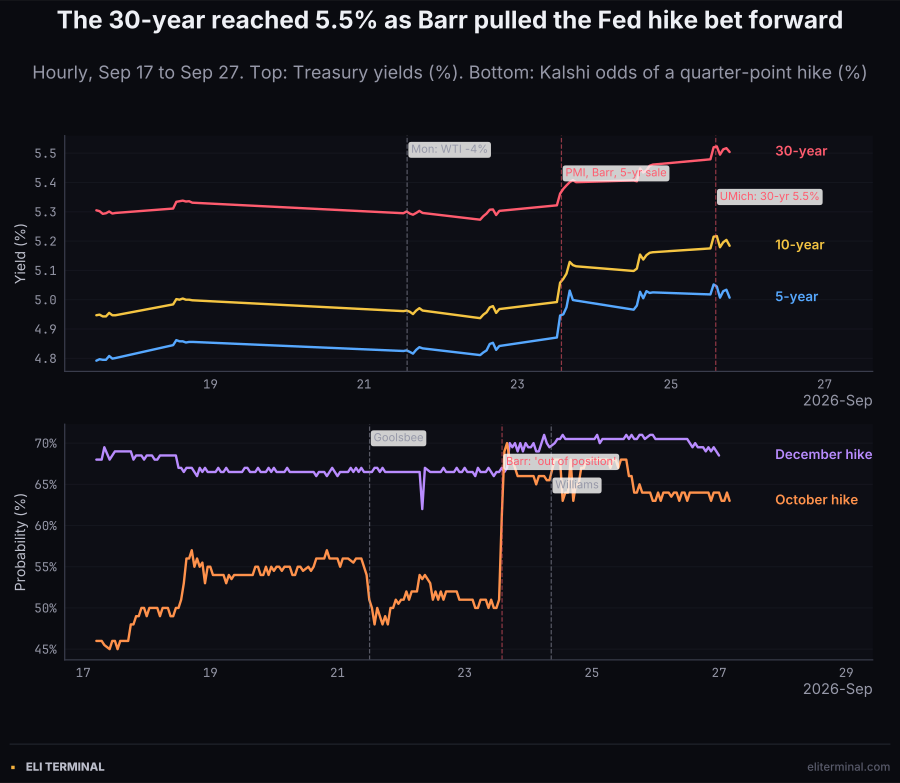
On Friday the October bet fell four points while the 30-year rose 4.3 basis points.
The 30-year Treasury yield rose 17 basis points to 5.5% in a week when crude fell 8%
The long bond ended the week at 5.504%, its highest close since 2004, up from 5.331% on September 18. The 10-year rose 18.6 basis points to 5.184% and the 5-year 15.1 to 5.007%, while the 13-week bill yield rose 9.2 basis points.
Almost all of it came from Wednesday on: S&P Global's flash PMI at 58.4 at 13:45 UTC, Barr's remarks twenty minutes later, and a 5-year auction at 5.033% that tailed 3.1 basis points.
Thursday's 7-year note sold at 5.085%, the highest since 1993 (MarketScreener). On Friday the University of Michigan repeated its inflation expectations unchanged at 14:00 UTC, and the 30-year crossed 5.5% in what Bloomberg's headline called a "vacuum" (Bloomberg). Kalshi's October contract fell from 68% to 64% the same day.
Warsh offered his own explanation for rising long yields on September 16: economic strength, geopolitics, and "competition for capital," with "the so-called hyperscalers" raising money (Federal Reserve transcript). Crude, the most direct price on the geopolitics, fell 7.9% this week, and the long end rose anyway.
Stocks did not share the worry. SPY gained 1.3% on the week and the VIX finished at 14.87.
Crude reopens on a rejected plan, and Wednesday settles the September bets
Oil's first print since Trump's answer comes when NYMEX reopens Sunday evening, after this edition's cutoff, and job openings follow Tuesday.
On Wednesday, September 30, the August personal consumption expenditures report lands at 12:30 UTC alongside GDP, Micron reports after the close as a 1.2 trillion dollar company, and the September contracts on Hormuz, the blockade and the truce all resolve. The jobs report follows Friday at 12:30 UTC, four weeks before the October 28 decision.
The bettors have already written down a Hormuz deal before the midterms. What they have not priced is the other half of the Journal's story, the bombing Trump reportedly expects to resume after November 3: the invasion market sits at 15.5%, one point above where it started Friday.
The Wall Street Journal's Friday night report that Trump had rejected Iran's seven-day Hormuz plan took the October blockade bet from 34.5% to 24.5% in half an hour while crude and Treasuries were shut. His own "I rejected it" thirteen hours later moved it about 1.5 points, and the 1.77 million dollar enrichment market did not move on Pezeshkian's inspector offer. Xi Jinping left with a coal pledge Beijing did not mention and FXI down 1.5%. The 30-year closed the week at 5.504% as crude fell 7.9%, so WTI's 92.41 is the one price that has not yet heard the answer.
END
eli terminal • Weekend Edition • Sunday September 27, 2026