Crude broke on September 15. The long bond did not follow it down.
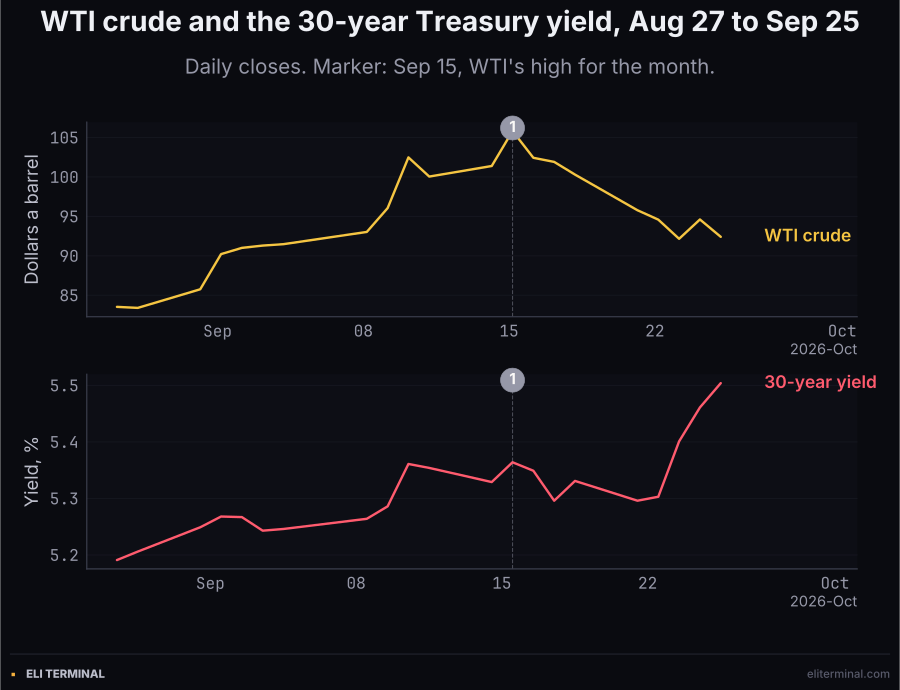
Through mid-September the 30-year and crude climbed together. Since WTI's September 15 high, crude is down 12.7% and the 30-year yield is up 14 basis points.
Iran's seven-day Hormuz plan and a summit that ended over tea took WTI down 2.3% and Kalshi's October hike bet from 67% to 64%. The 30-year Treasury yield rose 4.3 basis points anyway and closed at 5.504%, its highest since 2004.
Through mid-September the 30-year and crude climbed together. Since WTI's September 15 high, crude is down 12.7% and the 30-year yield is up 14 basis points.
The survey had nothing new on inflation. The University of Michigan's final September reading, out at 10:00 a.m. New York time, kept year-ahead inflation expectations at 4.6% and five-year expectations at 3.4%, the same figures as the preliminary release two weeks earlier; only the headline sentiment index moved, to 48.1 against a 47.6 forecast (InvestingLive).
The 10-year yield went from 5.198% to 5.209% in the five minutes after the release, and the 30-year from 5.502% to 5.512%. SPY slipped from 769.73 to 767.61. By 14:40 UTC the 30-year had printed 5.529% and the 10-year 5.225%, both session highs, in a move Bloomberg's headline placed in a "vacuum" (Bloomberg).
The Fed bet moved the other way in the same hour. Kalshi's contract on a quarter-point October hike, about a million dollars deep, went from 68% to 66%. Long-dated Treasuries were setting a 22-year high while the market for the next Fed move was taking risk off.
Crude's break began before any Iran headline this desk could time. Araghchi's public outline of the plan came at 20:00 UTC, after this window and after the oil settlement.
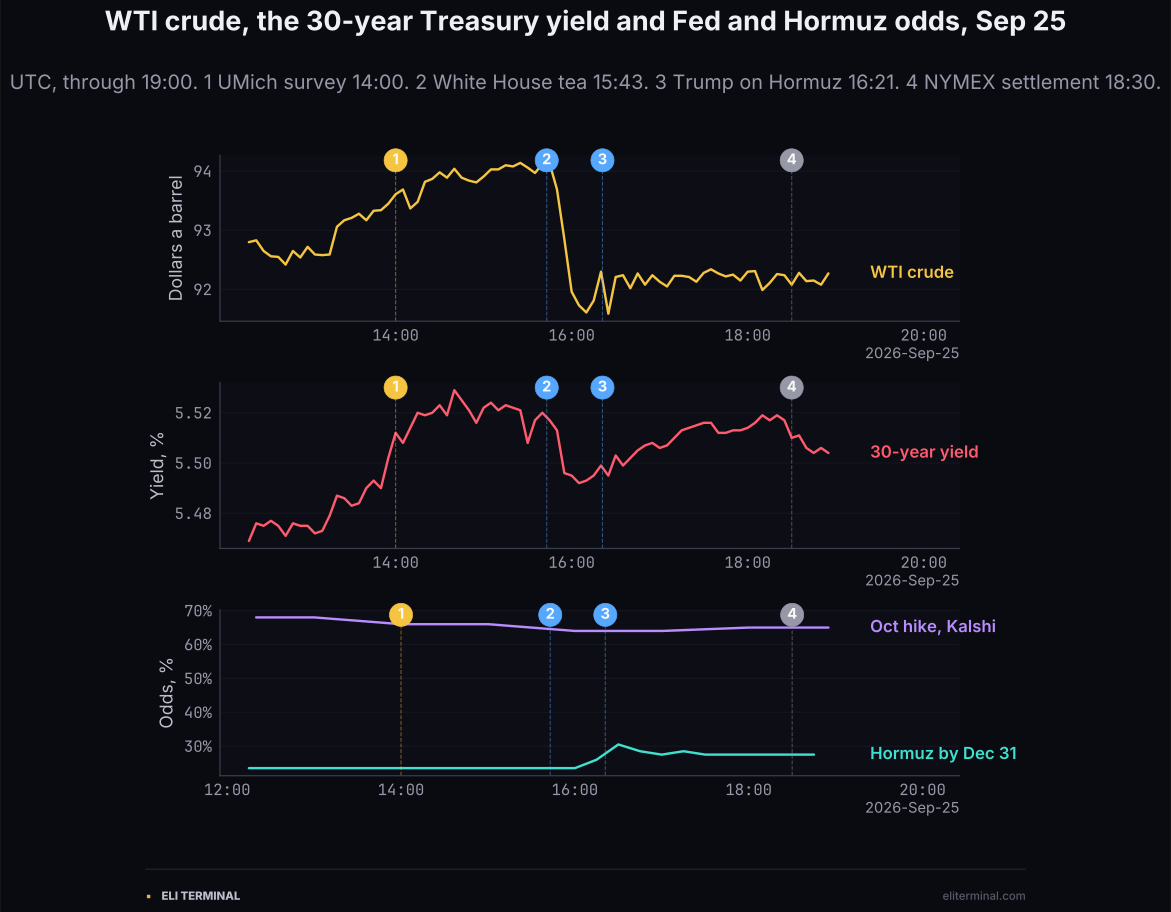
WTI traded 94.13 at 15:50 UTC and 91.61 by 16:15. At 11:43 a.m. New York time, 15:43 UTC, the White House tea for Xi Jinping had produced Trump's "very, very productive" and Xi's line about "charting the course for the great ship of China-U.S. relations" (CBS News). Neither mentioned Iran.
Trump's Hormuz remark came afterward, at the National Archives, which CBS logged at 12:21 p.m., 16:21 UTC. Asked whether the strait would reopen, he said, "I think we're going to do great" (ABC). By then crude had already made its low.
The Hormuz bets moved after the oil. Polymarket's contract on traffic through the strait returning to normal by December 31, on about 170,000 dollars, sat at 23.5% until 16:00 UTC, touched 30.5% at 16:30 and settled at 27.5%. The deeper ceasefire contract, 545,000 dollars on the truce holding through September 30, rose from 86.5% to 90.5% by 17:00. Oil moved first and no wire story this desk found is stamped inside the 15:45 to 16:00 UTC window.
Crude kept most of its drop and the long bond did not. The 30-year yield fell from 5.517% to 5.492% as WTI broke, then was back at 5.517% by 18:05 UTC with WTI still near 92. The 10-year went from 5.207% to 5.169% and back to 5.204% on the same schedule.
Polymarket's contract on the US announcing an end to its Iran blockade by October 31, with about 69,000 dollars traded, did the same round trip. It went from 35.5% at 15:45 UTC to 41.5% at 16:15 and was back to 35.5% at 20:45.
Thursday rehearsed it. Reuters reported around midday New York time that US and Iranian negotiators were discussing a phased deal to reopen Hormuz and lift the blockade (Reuters via U.S. News). WTI dropped from 96.48 to 93.74 inside the hour and the 30-year dipped about a basis point and a half, then reached 5.473% by 17:50 UTC, above where it started. Bloomberg had the 30-year touching 5.501% earlier that day, its highest since June 2004 (Bloomberg).
"The seven-day timeline will start as soon as the United States accepts this plan," Iranian Foreign Minister Abbas Araghchi told reporters outside the Security Council. "The choice now rests with the United States" (Al Jazeera). The price, per Al Jazeera: an end to the US naval blockade, oil-sanction waivers, the release of about 12 billion dollars in frozen assets and a ceasefire that covers Lebanon.
UN Web TV scheduled the stakeout for 4:00 p.m. New York time, 20:00 UTC (UN Web TV). NYMEX crude had settled at 2:30 p.m., 18:30 UTC. WTI traded 92.23 at 20:00 UTC and 92.41 at 21:00. Accounts that tied Friday's oil drop to his plan were describing a settlement that came ninety minutes before he spoke.
Washington did not sound hurried. "The United States is in a very strong position with control of the Strait of Hormuz, so we are not in a rush," a US official said in comments carried by Townhall (Townhall). Standard Chartered's Emily Ashford put it plainly: "A similar deal has been announced so many times before, and we have seen little traction on it" (Bloomberg via Rigzone).
On Monday, the October contract slid from a weekend high near 56% to 48%, and the 30-year fell 3.5 basis points. On Friday the same contract went from 68% to 64% and the 30-year rose 4.3. The December contract sat at 70.5% all day, a day after New York Fed President John Williams called another hike by year-end "a reasonable way of thinking about it" (CNBC).
The split shows up in the curve. The 5-year, the maturity most tied to the Fed's next few meetings, finished 1.8 basis points lower. The gap between the 5-year and 30-year widened by 6.1 basis points to 49.7, after narrowing on Wednesday when Michael Barr's remarks pushed the whole front end up.
Over the week the 30-year rose 17.3 basis points while WTI fell 7.9%. Crude and the Fed bet both eased on Friday. The long bond kept selling, and neither one was holding it up.
The S&P 500 rose 0.51% and the Dow gained 0.93%, ending a three-week losing streak (Yahoo Finance). SPY went from 768.30 to 771.52 during crude's break and held there while the 30-year climbed back, closing at 771.35.
The VIX fell 5.1% to 14.87 on the day the 30-year yield closed at a 22-year high. Equity volatility followed crude, not the bond market.