Thursday September 24, 2026 • Xi Summit Day
Reuters Said 'Phased' on Hormuz, and Oil Lost Two Dollars in Five Minutes
With Houthi missiles fired at Yanbu and a threat from Tehran on the wires, crude was up 5% by noon in New York. A Reuters report that Washington and Tehran were exploring a phased deal took 2.30 dollars off WTI in five minutes, and the Xi summit and a hawkish Fed president moved almost nothing.
Thursday Sep 24 close
S&P 500 7,704.13 −0.02%
·
NASDAQ 26,939.37 +0.01%
·
S&P INTRADAY LOW 7,662.57 −0.56%
·
VIX 15.67 +0.49 pts
Oil, day change
WTI SETTLE 94.61 +2.7%
·
WTI HIGH 96.78 +5.0%
·
BRENT SETTLE 106.60 +3.4%
·
WTI 16:15 TO 16:20 UTC 96.35 → 94.06
Treasuries, day change
10Y 5.162% +4.8bp
·
10Y HIGH 5.181% +6.7bp
·
30Y 5.461% +6.0bp
·
7Y AUCTION 5.085% 0.7bp tail, +57bp vs Aug
China exposure, day change
FXI 34.24 −0.3%
·
KWEB 24.69 −0.6%
·
BOEING 196.80 −1.6%
·
META 777.59 +4.5%
Prediction markets, Wed 21:00 to Thu 20:45 UTC
IRAN CEASEFIRE HOLDS TO SEP 30 86.5% → 86.5% (low 81.5%)
·
BLOCKADE ENDS BY OCT 31 31.5% → 33.5% (high 37.5%)
·
HORMUZ NORMAL BY DEC 31 20.5% → 22.5%
·
OCTOBER HIKE 66% → 67%
The steepest five minutes in crude came two minutes after the Reuters story
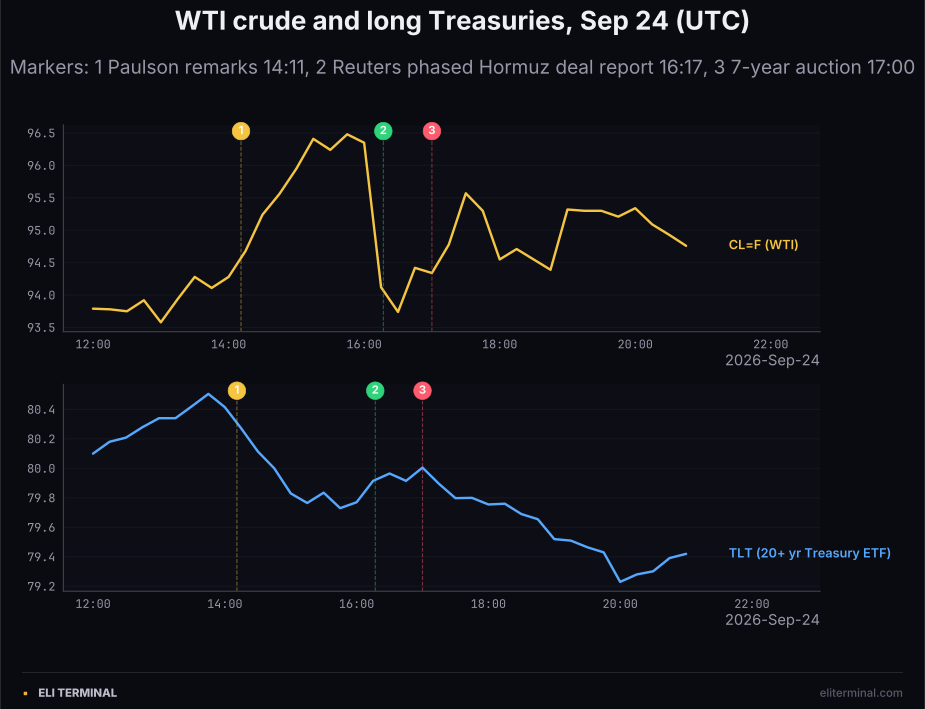
Crude and long bonds moved in opposite directions all session. For about forty-five minutes after 16:17 UTC they both reversed at once, and then the auction and the selling came back.
Reuters reported a phased Hormuz deal at 16:17 UTC, and WTI lost 2.30 dollars in five minutes
"One way forward would be to solve the crisis in stages. The first would be to end the blockade and reopen Hormuz," a senior Iranian official told Reuters on the sidelines of the UN General Assembly. Samia Nakhoul, Parisa Hafezi and John Irish's story, stamped 12:17 p.m. New York time, said negotiators in New York were exploring a path in which Tehran reopens the strait and Washington lifts its blockade, and that Iran was willing to move its demand for transit fees into a side agreement (Reuters via Investing.com). Bloomberg reported the same talks, with Qatar mediating (Bloomberg).
WTI printed its session high of 96.78 in the five minutes from 16:00 UTC and still sat at 96.35 at 16:15. By 16:20 it was 94.06, and by 16:40 it touched 93.31. In the same five minutes SPY went from 764.62 to 766.85, the VIX fell from 16.14 to 15.64, and the 10-year yield dropped from 5.166% to 5.137%.
The report carried its own caveat: neither side, the sources said, wants to be the first to give up its leverage. By 17:30 UTC WTI was back at 95.57.
Before the scoop, the morning belonged to Safavi and the Houthis
"Since the conflict has spread from the Persian Gulf and Strait of Hormuz to the Red Sea, it is possible that, in response to more war, the front will expand even further, reaching the Indian Ocean and perhaps beyond," Yahya Rahim Safavi, an adviser to Supreme Leader Mojtaba Khamenei, said in a video released by Fars (A News). Then Saudi Arabia said it had intercepted six Houthi ballistic missiles aimed at Taif and at Yanbu (Al Jazeera). Yanbu is the Red Sea terminal the kingdom has been using to route around Hormuz, fed by an East-West pipeline that restarted on Tuesday (Reuters via AJOT).
WTI went from 91.30 in Asian hours to 94.36 by 08:15 UTC, most of it in two steps at 05:30 and 07:45. Polymarket's contract on the US-Iran ceasefire holding through September 30, the deepest Iran book at 545,000 dollars, fell from 88.5% to 81.5% in the 08:30 UTC quarter-hour and was back at 87.5% by 13:15. The Fars video and the Saudi statement both reached the wires in that European morning, and neither carries a minute this desk could pin to a candle.
The second leg has no single headline. WTI climbed from 94.28 at 14:00 UTC to its high just after 16:00, with Brent touching 108.23. "The Iranians are threatening to take the battle to the Indian Ocean, and the Houthis are shooting ballistic missiles at Saudi cities," said Robert Yawger of Mizuho (Dow Jones via MarketScreener). Both of those facts were hours old by then.
The Iran contracts moved in the same quarter-hour as the barrel
Polymarket's contract on the US announcing an end to its Iran blockade by October 31, with 68,000 dollars behind it, had drifted between 29.5% and 34.5% all day. It went from 31.5% at 16:15 UTC to 36.5% at 16:30 and 37.5% by 17:00, then gave most of it back to close at 33.5%. The contract on Hormuz traffic returning to normal by year-end, on 170,000 dollars, went from 20.5% to 22.5%.
Two days earlier, Trump's UN speech pushed any deal past the midterms and the October blockade bet lost eight points in fifteen minutes. Thursday's report won back five of them in fifteen minutes, and the market kept about two by the close.
Everything tied to Iran jumped at 16:17. The Fed contract did not
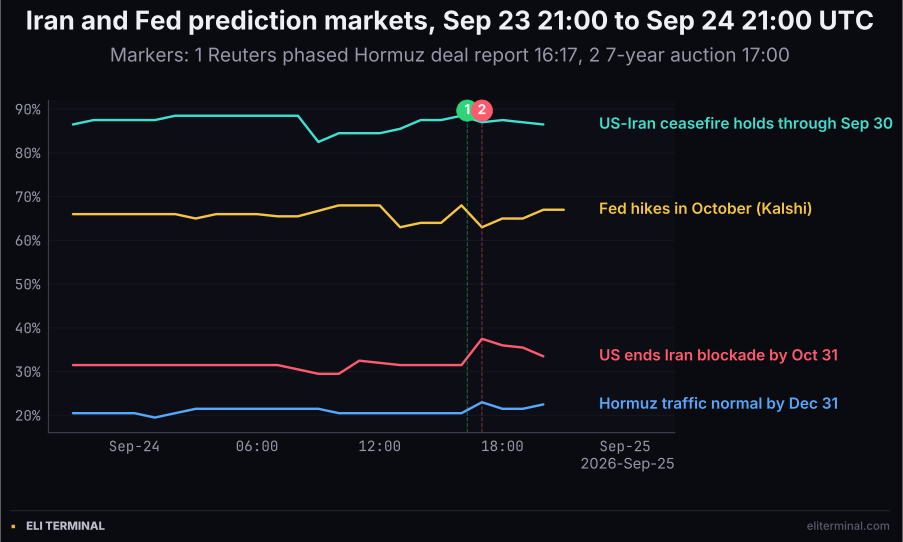
The ceasefire book dipped in the European morning and recovered before New York opened. The October hike contract finished one point from where it started.
The 10-year set another 2007 high, and the October hike bet stayed put
The 10-year yield rose from 5.091% at 13:50 UTC to 5.166% at 15:20, over the same stretch WTI climbed from 94.1 to 96.4. It gave back three basis points with the Reuters story. At 17:00 UTC the Treasury sold 44 billion dollars of 7-year notes at 5.085%, the highest since April 1993 and 57 basis points above August's sale, tailing the when-issued yield by 0.7 basis points against a 0.2 average (Newsquawk, MarketScreener).
By 17:50 UTC the 10-year had reached 5.179%, and it settled near 5.16%, up about 5 basis points and a new highest close since 2007. Wednesday's 5-year sale tailed 3.1 basis points. This one drew a smaller tail at a higher yield.
"Looking ahead, if conditions evolve as I expect, some modest further tightening may be warranted," Philadelphia Fed President Anna Paulson said in Philadelphia, citing the Middle East conflict and data-center construction among the price pressures (Bloomberg via Spokesman-Review). Jobless claims had come in at 197,000 near 57-year lows (Reuters via U.S. News). Kalshi's October hike contract, on a million dollars, read 64% in both hours after Paulson's remarks were out and finished at 67%, a point above Wednesday's close. On Wednesday Michael Barr moved the same contract 15 points. On Thursday Philadelphia's Fed president said much the same, long yields rose again, and the contract barely moved.
Bessent extended the Busan truce to January 10, and China stocks fell anyway
"We will extend what we call the 'Busan Agreement'... until Jan. 10," Scott Bessent told Fox News at 6:20 p.m. New York time Wednesday, 22:20 UTC, minutes after Xi Jinping landed. "There are some deliverables that have not been perfect on the Chinese side" (NBC News). On Wednesday he had floated a "bigger deal." What came was two more months of the old one.
SPY traded 768.18 at 22:15 UTC and 767.98 half an hour after Bessent spoke, and slid to 762.91 by 08:15 UTC as crude rose. At Thursday's close FXI was down 0.3% at 34.24, KWEB down 0.6%, and the yuan little changed. Boeing, whose Chinese order has been described as roughly 140 aircraft in "a good state" (CNBC), went from 199.39 before the bell to 195.01 in the first quarter-hour of trading and closed down 1.6% at 196.80. Nothing this desk found announced an aircraft order during the session.
The truce extension landed after hours Wednesday and left no mark
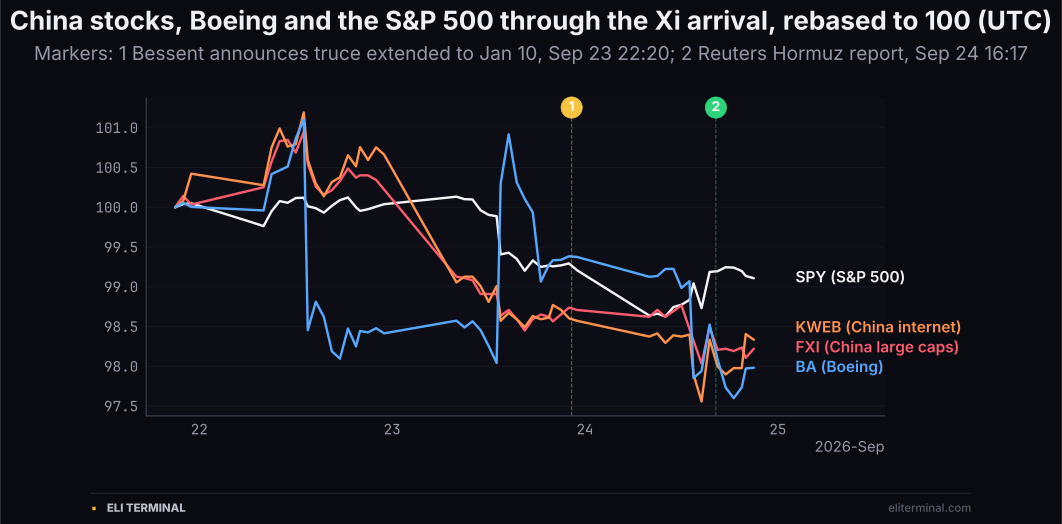
China's large caps and internet stocks finished summit day lower than on the evening Xi landed. SPY's recovery came after the Reuters report, not after the truce.
Friday opens with the barrel still deciding the price of money
The day's range in the S&P 500 ran from 7,662.57 to a close of 7,704.13, flat. The index recovered most of the way after 16:17 UTC, as crude came off. Thursday's price of oil, long bonds and stocks was set by a report of what negotiators in New York might do. The two heads of state meeting in Washington had less effect on it.
Brent still settled 3.4% higher at 106.60, and the market on a normal Hormuz by year-end rose by only two points. Later on Thursday the Houthis claimed strikes on a "sensitive target" in Riyadh and on Aramco facilities at Yanbu, with no Saudi confirmation of the Riyadh strike (Jerusalem Post). The 16:17 UTC drop was a bet on sequencing, and the missiles were still flying at the close.
On the day Xi Jinping sat in the Oval Office, WTI ran up 5% as Houthi missiles flew at Yanbu and Tehran threatened the Indian Ocean, a 12:17 p.m. Reuters report of a phased US-Iran Hormuz deal took 2.30 dollars off it in five minutes and lifted stocks and bonds in the same window, and the 10-year still set a new 2007 high after the highest 7-year auction yield since 1993, while Scott Bessent's truce extension and Anna Paulson's call for more hikes left China stocks and the October Fed bet where they were.
END
eli terminal • Close Report • Thursday September 24, 2026