Iran blockade odds and WTI crude, Sep 22
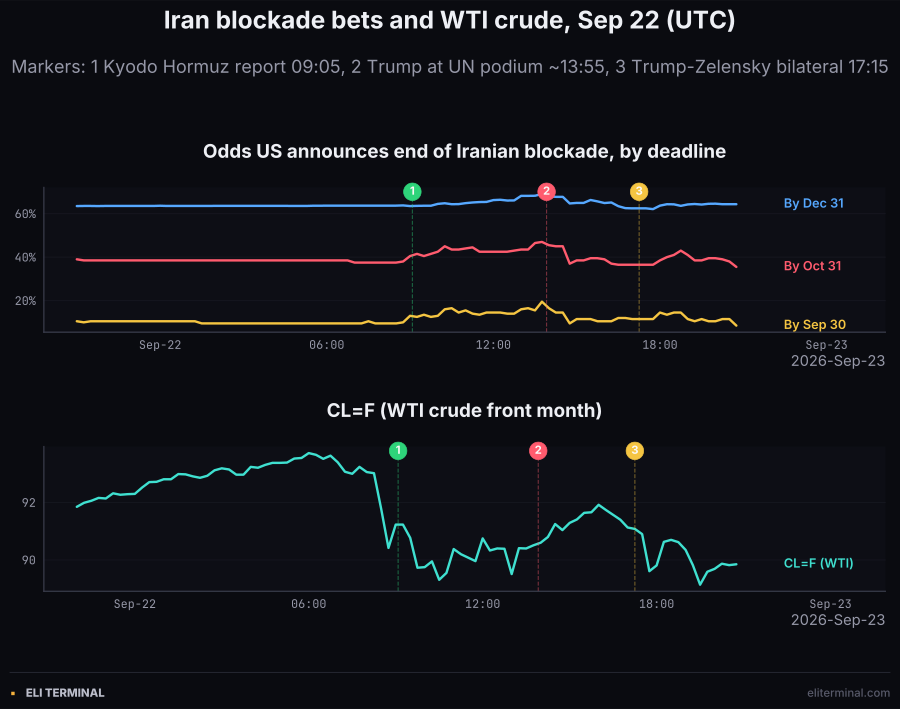
Markers: Kyodo headline 09:05 UTC, Trump at the UN podium about 13:55 UTC, Trump-Zelensky bilateral scheduled 17:15 UTC.
A Kyodo report of a seven-day Hormuz offer built the October blockade bet all morning. Trump's UN speech moved any deal past November 3, and the bet gave back its gains in fifteen minutes, while the Xi summit two days out has almost nothing riding on it.
Markers: Kyodo headline 09:05 UTC, Trump at the UN podium about 13:55 UTC, Trump-Zelensky bilateral scheduled 17:15 UTC.
"Within seven days." A senior Iranian official told Kyodo News that Tehran could reopen the Strait of Hormuz inside a week if Washington began easing military pressure and lifted its blockade of Iranian ports, an offer the official said Supreme Leader Mojtaba Khamenei had approved. Newsquawk carried the Kyodo headline at 09:05 UTC (Newsquawk), and Iran International had it two minutes later (Iran International).
WTI did not wait for either timestamp. The front month fell from 93.02 at 08:25 UTC to 90.42 at 08:55, down 2.8% in half an hour, and Brent dropped from 101.71 to 98.98 in the same window. Reuters separately reported that Saudi Arabia had restarted its East-West pipeline at a low rate after the September 13 drone strike (Reuters via Investing.com), but this desk could not fix that story to the minute either.
The prediction markets moved later and slower. Polymarket's contract on the US announcing an end to the Iranian blockade by October 31 sat at 37.5% until 08:30 UTC, then climbed through the European morning to 47% at 13:45, on about 214,000 dollars of lifetime volume. The same question with a December 31 deadline went from 63.7% to 69%.
Trump was scheduled to reach the General Assembly podium at about 9:55 a.m. New York time, 13:55 UTC, for a speech CBS timed at roughly 35 minutes (CBS News). He gave the room two choices: "Will a deal be made with Iran that lets them rebuild and create a far greater country than it ever was before? ... Or do I annihilate the Islamic Republic and do it quickly?" Most of Iran's delegation walked out (Euronews).
The line that carried a date came next. "I believe we'll make a deal right after the election, because it doesn't make sense for them not to," Trump said, per NBC News, which reported he accused Tehran of "waiting to see how I do in the midterm election" (NBC News). The midterms fall on November 3, three days after the October contract expires.
That contract fell from 45% to 37% in the fifteen-minute window ending 14:45 UTC, erasing the entire Kyodo gain. The September 30 version dropped from 14.5% to 9.5%, and the December 31 version, the one deadline that clears the election, gave up only three points. WTI went the other way: 90.51 at 13:55 UTC, 91.25 by 14:40, 91.92 at 16:00. Brent crossed back above 100 at 14:40 UTC for the first time since the morning slide.
The S&P 500 barely noticed a president threatening to annihilate a country from the UN rostrum. SPY traded 773.83 at 13:55 UTC and 773.69 at 14:45, and the VIX finished the day down 3.8% at 14.28.
The afternoon reversed the speech. Envoys Steve Witkoff and Jared Kushner spent about three hours with Iranian Foreign Minister Abbas Araghchi on the UN sidelines, and Trump, in a bilateral with Volodymyr Zelensky scheduled for 1:15 p.m. New York time, called it "a very good meeting, a very productive meeting" with another session "in the very near future" (Al Jazeera). It was the first confirmed direct contact since the war began in February.
The sharpest crude drop of the afternoon printed in that window: WTI went from 90.89 at 17:45 UTC to 89.61 at 17:55, down 1.4% in ten minutes, and settled at 89.41. The October blockade contract recovered from 36.5% to 43% by 18:45 UTC. This desk could not fix the minute Trump spoke, so the sequence is adjacency, not a timestamp join.
Witkoff's own account differed from the president's. "We engaged in lengthy talks with the Iranian delegation through the mediators, who shuttled between the two sides throughout the day," he said, per Fox News (Fox News). Iranian state television said Araghchi met Witkoff at the envoy's "insistence" to convey Tehran's conditions.
By 20:45 UTC the October contract stood at 35.5%, two points below where it started the day before Kyodo. December-dated bets finished higher: blockade lifted by year-end at 64.4%, and Hormuz traffic back to normal by December 31 up six points to 25.5% on 326,000 dollars of volume. The day did not lower the market's belief in a deal. It moved the expected date past November.
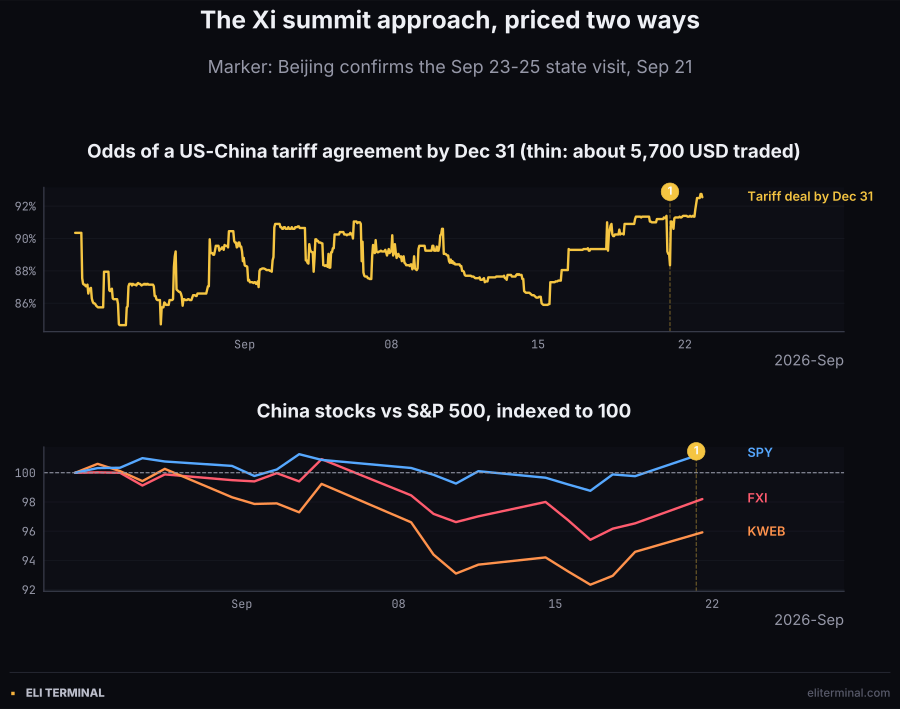
Four weeks of summit preparation moved the tariff contract a couple of points. China ETFs ended the stretch below where they started.
China's Foreign Ministry confirmed on Monday that Xi Jinping will make a state visit to the United States from September 23 to 25, and spokesperson Guo Jiakun called two reciprocal presidential visits in six months "of historic, milestone significance" (U.S. News). Asked about a US official's complaint that China had not fully resumed rare-earth deliveries, Guo referred reporters to "competent authorities" and said China "is committed to keeping the global industrial and supply chains of critical minerals safe and stable" (Chinese Foreign Ministry).
Trump's last on-record verdict on Xi came on September 13, when he waved off a Wall Street Journal report that Chinese entities had fed Iran satellite imagery: "I think he's behaved reasonably well" (Fortune). On Tuesday he met Japan's Sanae Takaichi at the UN and agreed to coordinate on China (Bloomberg). None of the speech transcripts and wire accounts this desk reviewed quote him on Xi from the podium.
The only summit deliverable with a price history is Polymarket's contract on a US-China tariff agreement by December 31. It traded 90.35% on August 24 and 92.55% at Tuesday's close, having wandered between roughly 85% and 91% in between, on about 5,700 dollars of lifetime volume. That is one or two traders' opinion, and it should be read as nothing more.
Its neighbors are no deeper. A contract on Trump endorsing China's claim to Taiwan by the end of the summit fell from 6.5% on September 17 to 2.85% on Tuesday, on about 4,500 dollars. The same venue lists a ladder of contracts on how long the Trump-Xi handshake will last, drawing sums of the same size as the tariff question.
FXI, the large-cap China ETF, closed at 35.55 on August 24 and 34.99 on Tuesday, down 1.6%. KWEB, the China internet fund, fell 3.4% over the same stretch, while SPY rose 1.3%. The thin contract drifted two points toward a deal as the stocks with the most direct exposure to one lagged the US market by three to five points.
Tuesday itself was a non-event in Chinese assets. FXI finished up 0.16%, KWEB up 0.48%, and offshore yuan traded between 6.691 and 6.700 per dollar across the full 24 hours to 21:00 UTC. Nothing moved during Trump's speech, the Takaichi meeting or the Iran talks.
The deep China markets are about other things. Polymarket's contract on Xi visiting the US by September 23 closed Tuesday at 98.6% on about 116,000 dollars, a bet on logistics. A US-China military clash before 2027 sits at 2.7% on 213,000 dollars. On chips, rare earths, soybeans or the tariff truce, no liquid contract exists; the Washington Post's Tuesday headline described a summit "focused on spectacle over solutions" (Washington Post).
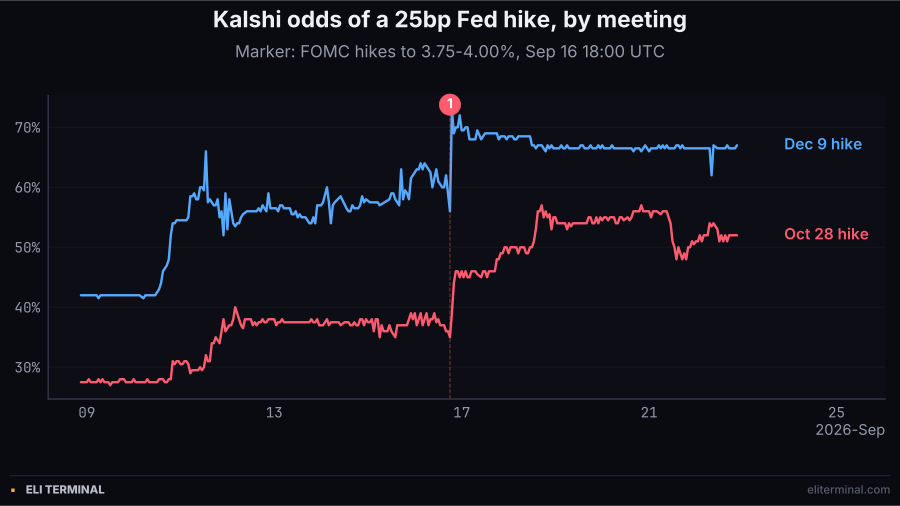
The October contract lost eight points on Monday with no Fed speaker on the calendar and was flat through Tuesday's session.
Vice Chair Philip Jefferson, speaking at the New York Fed's Treasury market conference, confined himself to discount window modernization and the role of Treasuries as collateral (Federal Reserve). The speech contains no sentence on inflation, the rate path or the October meeting.
Kalshi's contract on a quarter-point hike on October 28, with 731,000 dollars traded, held between 51% and 52% for every hour of the New York session. It had peaked near 56% over the weekend, then slid to 48% on Monday afternoon with no Fed speaker and no data on the calendar, a move this desk cannot explain. The December hike contract sat at 66.5% to 67% through the session. Forbes described the pattern as markets signaling consecutive hikes (Forbes).
Oil's 3.2% drop offered the only rates-relevant push of the day, and the ten-year yield ignored it, finishing at 4.968%, up half a basis point.