October and December Fed hike odds, Sep 13 to Sep 21
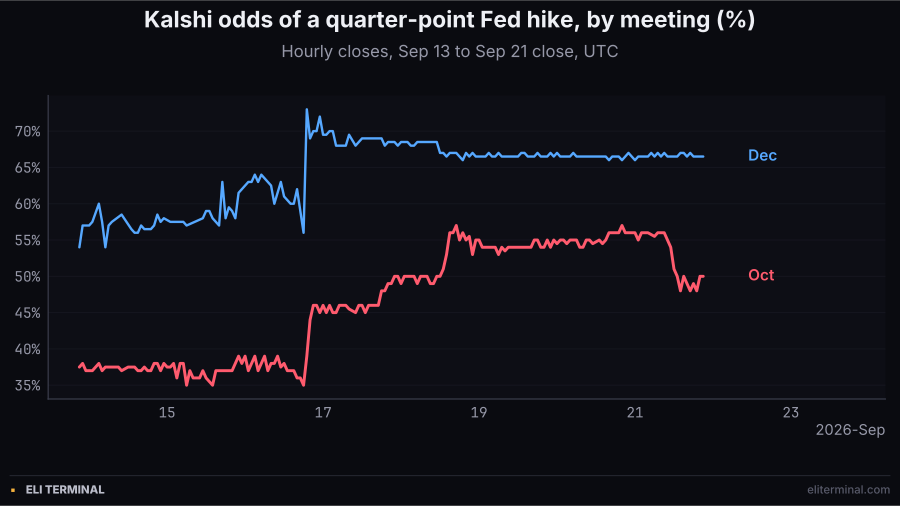
Hourly closes. The 27% to 66% swing inside the 19:00 UTC hour of Warsh's press conference sits inside a single candle.
Austan Goolsbee, Alberto Musalem and Susan Collins made the case for tighter policy five days after Kevin Warsh's hike, and Kalshi's October hike odds slid from 56% to 50% while the Nasdaq closed at a record.
Hourly closes. The 27% to 66% swing inside the 19:00 UTC hour of Warsh's press conference sits inside a single candle.
"Supply shocks have come more frequently, hit harder, and lasted longer," Chicago Fed President Austan Goolsbee told the Official Monetary and Financial Institutions Forum in London on Monday (Chicago Fed). The persistent ones, he said, are shocks a central bank "should not simply look through."
ActionForex had his remarks up by 12:07 UTC (ActionForex). Kalshi's contract on a quarter-point hike at the October meeting closed the 11:00 UTC hour at 54%, the 12:00 hour at 51% and the 14:00 hour at 48%. Polymarket's October no-change contract stepped from 44.5% to 48.5% across the same window.
The slide started in the hour before that 12:07 stamp, so the join to the speech is loose. The contract fell while a Fed president argued for tightening into a supply shock, and it never climbed back above 50%.
Speaking to reporters afterward, Goolsbee gave traders a softer line, according to the Associated Press: if inflation comes mostly from supply shocks, one more hike could be enough. "And if we get evidence that convinces us that it's coming from demand, then it likely would not be enough," he said, and of the cost: "It's going to be painful. It would necessarily be painful" (AP).
"I did not see the inflation progress I was hoping to see," Boston Fed President Susan Collins told the AP's Christopher Rugaber in an interview published at 15:09 UTC (Press Democrat). October closed the 15:00 hour at 50% and the 16:00 hour at 49%.
Alberto Musalem made the most explicit case for moving soon. The St. Louis Fed president told Reuters that "earlier and incremental policy firming is better and less disruptive than later and larger and potentially more abrupt policy action," called the 3.75% to 4% range "on the accommodative side," and said of inflation: "It's not a risk. It's there" (Reuters via KELO).
Syndicated copies of that exclusive carry a 1:26 p.m. stamp on Central-time station sites, which is 18:26 UTC, and FXStreet's write-up followed (FXStreet). October printed 49% in the 18:00 hour, 48% in the 19:00 hour and 50% at the close. On the day a Fed president argued for a sooner hike, the contract on a sooner hike finished six points lower.
Goolsbee, Musalem and Collins all voted in 2025 and rotated off; Reuters noted Musalem is not a current voter, and ActionForex said the same of Goolsbee. The four presidents who vote this year, Beth Hammack of Cleveland, Lorie Logan of Dallas, Neel Kashkari of Minneapolis and Anna Paulson of Philadelphia, did not feature in Monday's coverage.
Warsh closed his September 16 press conference with a different view of the cost. "I don't believe that we need to do harm to the labor markets to achieve our objective," he told Yahoo Finance's Jennifer Schonberger, after telling the New York Times that "I'm not in the forward guidance business" (Federal Reserve transcript). Five days later, a Fed president called the same fight "necessarily painful" on the record.
Before the decision, the October contract sat at 35% to 38% for three days. It printed a 27% to 66% range inside the 19:00 UTC hour of Warsh's press conference, closed that night at 46%, reached 55.5% by Friday's close and spent Saturday and Sunday between 54% and 57%.
The weekend's answer to Warsh was a mild yes: a slightly better than even chance of back-to-back hikes. Monday took the October contract back to 50%, a coin flip, which erased most of Friday's climb.
December did not move. Kalshi's quarter-point December contract printed 66.5% at Friday's close and 66.5% at Monday's, and no Monday hourly close left the 66% to 67% band. Traders kept one more hike this year and grew less sure it comes in October, the timing Goolsbee described to reporters rather than the one Musalem argued for.
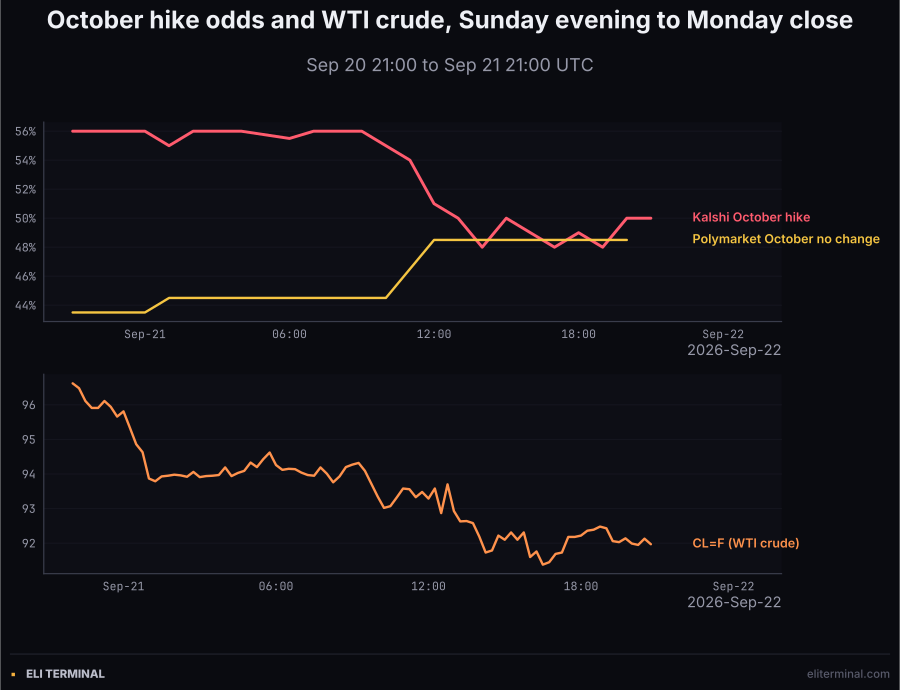
The October contract lost most of its ground between 11:00 and 14:00 UTC, the hours WTI slid from 93.6 to 92.2.
WTI futures opened Sunday evening at 96.62, above Friday's 96.08, and were at 93.87 by 01:00 UTC. They printed 93.58 at 11:00, 92.19 at 14:00 and 91.97 at the close. Brent settled at 100.34, down 3.4%, according to the AP (AP via CP24).
The October contract's worst stretch, 11:00 to 14:00 UTC, matched crude's steadiest leg lower of the session. Reuters summarized Musalem as saying the commodity shock had moved beyond oil, but the rate bettors moved with oil.
Ten-year Treasury yields eased to 4.95% from 5.01% late Friday. The 13-week bill yield closed at 3.98% on both days, so the shortest end of the curve did not price any change in the path.
ING's commodities strategists pointed to "profit-taking by investors after the recent jump in oil prices, together with hopes for discussions at this week's U.N. General Assembly and at a meeting between China's and the United States' leaders," the AP reported.
"My question is, if and when do I blow the entire nation up? They better behave," Trump told Fox News correspondent Trey Yingst, who relayed it on Fox & Friends Weekend on Sunday morning; Mediaite posted it at 10:29 a.m. Eastern, 14:29 UTC (Mediaite). In the same exchange he said he would "probably be open" to meeting Iranian President Masoud Pezeshkian at the UN General Assembly (Gulf News).
Crude's first print after the threat, at 22:00 UTC Sunday, stood 0.6% above Friday's close. Within three hours it was 2.9% lower, and it never got back.
Polymarket's thin contract on the US-Iran ceasefire holding through October 31 rose from 50% on Sunday evening to 60.5% at Monday's close. Six of those points came in the final hour, and no headline could be found in that window. The move is unexplained.
Treasury Secretary Scott Bessent's verdict on Sunday's talks with Chinese Vice Premier He Lifeng, held at JPMorgan's Manhattan headquarters, was on the wires by 00:01 UTC Monday, before Asia opened (investinglive). "We've agreed to meet again," he said, and US Trade Representative Jamieson Greer said chip export controls were kept out of a proposed AI dialogue (RTHK).
Crude's 2.9% slide in the first three hours of Sunday trading overlaps that release and the Asian open, so the timing points to Bessent without settling it. Hong Kong's Hang Seng rose 1.2% and South Korea's Kospi 1.6% on the day.
Polymarket's contract on a US-China tariff agreement by December 31, a thin market, printed 91.3% before Bessent spoke and 91.3% at Monday's close. What Thursday's summit actually decides, including the November 10 expiry of China's suspension of rare-earth export controls, has no deep contract on either venue (The National).
Goolsbee named services inflation and spillover from AI data-center construction as the demand-side pressure that would leave "no ambiguity" about tightening, according to ActionForex's account of the speech. Hours later, the companies selling into that boom rallied hard.
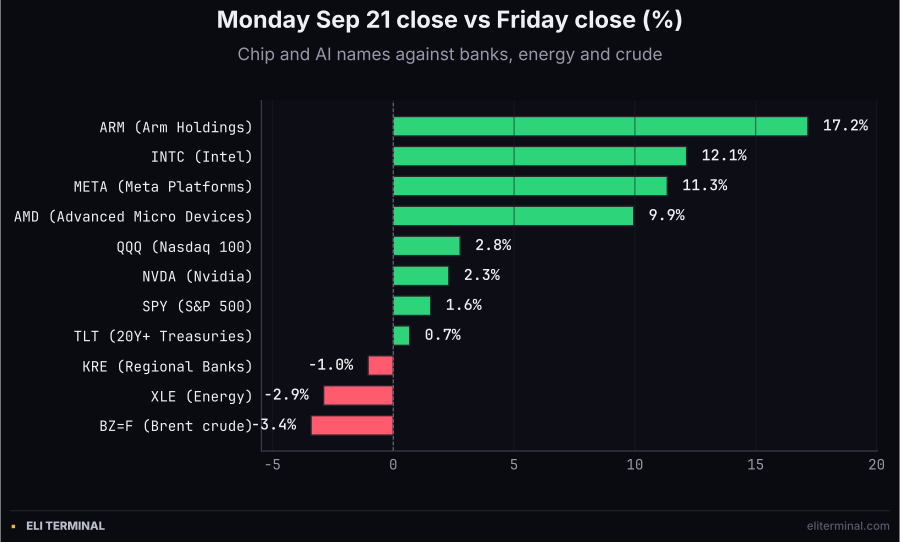
AI hardware and Meta led. Regional banks fell on a day the S&P 500 rose 1.5%.
Meta rose 11.3% to 741.25 after Wells Fargo analyst Ken Gawrelski lifted his price target to 796 dollars from 640, writing that the company "now has a story to tell" in AI as its Muse agent app topped Apple's App Store; JPMorgan upgraded the stock to overweight (Motley Fool). Shares traded 681 before the 13:30 UTC open and 745 at 19:00.
For AMD, the day meant a 1 trillion dollar market value, the AP reported, on a 9.95% gain to 615.52. The first fifteen minutes of cash trading did most of it, from 583.89 just before the open to 604.02. Intel rose 12.1% to 121.78 as CPU makers rallied (CNBC).
Arm jumped 17.2% to 322.90 without a new statement from the company. Rene Haas's line that "demand for our technology has never been stronger" aired on CNBC five days earlier, on September 16 (CNBC), and a Piper Sandler overweight initiation with a 320 dollar target was reported Monday. Most of the move came after the open, and the lag from Haas's remarks is a mystery.
Regional banks went the other way, with KRE down 1.0%, and the energy ETF fell 2.9% alongside crude.
Monday closed with October at 50%, December at 66.5% and the S&P 500 within 0.4% of its record. The three Fed presidents who talked hikes do not vote this year. Hammack opens the Cleveland Fed's inflation conference on Thursday, the same day Trump hosts Xi at the White House.