The hike happened Wednesday. The pricing happened after.
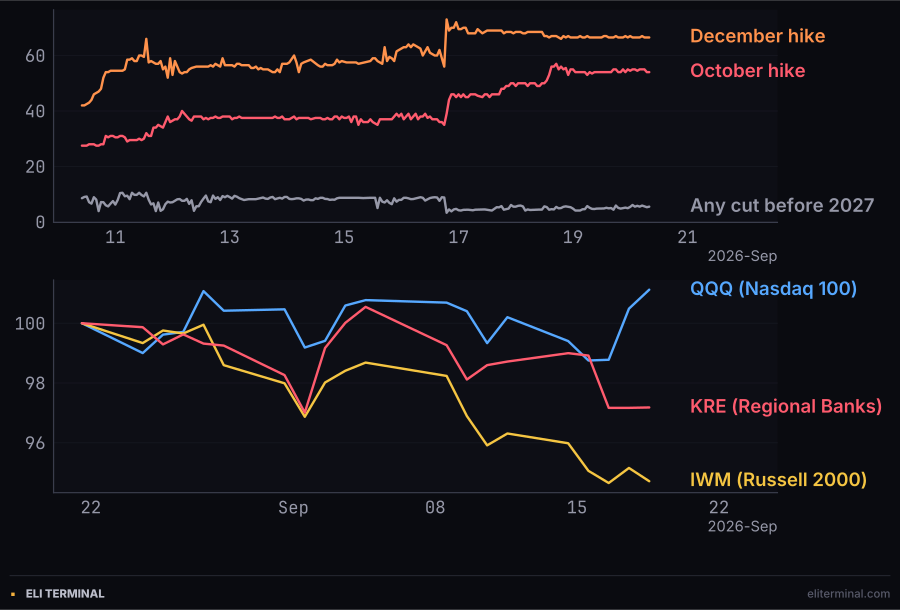
The decision candle moved these contracts down. The press conference moved them up. Bottom panel rebased to the August 22 close.
The Fed chair raised rates and refused to say what comes next. The men who did make dated promises watched the markets written on those dates fall 30 and 47 points against them, while Brent broke 4.8% in an hour nobody in New York was awake for.
The decision candle moved these contracts down. The press conference moved them up. Bottom panel rebased to the August 22 close.
The statement crossed at 18:00 UTC on Wednesday. In that fifteen-minute candle the gold fund opened 399.96 and closed 395.24, a low of 394.90, down 1.18% before anyone had asked a question.
Everything else sat there. The S&P 500 fund opened the same candle at 760.18 and closed it at 759.97. Long Treasuries went up, not down, from 81.24 to 81.42. The volatility index printed its session low of 16.40 inside the hike.
Fox Business's Edward Lawrence gave the reason from inside the room a half hour later, telling the chair the market had priced a 90% chance of the hike. A 12-0 vote and a quarter point were not the news. The man who had to explain them was.
Colby Smith of the New York Times asked whether a sequence of hikes now follows. Warsh said he was not in the forward guidance business and would not pre-judge future decisions, and the 18:45 UTC candle opened 758.99 and closed 753.89, a 0.67% drop in a quarter of an hour.
It kept going to 19:15. From the 18:30 high of 760.21 the S&P fund lost 1.40%, the Nasdaq fund touched 700.00 from 711.88, regional banks fell 3.19% high to low, and the volatility index added 15.5% off its 16.40 decision-hour floor. A separate piece this weekend walks that press conference minute by minute.
Inside the same 19:00 hour, the Kalshi contract on an October hike printed a high of 66% and a low of 27% and closed at 39%. A 39-point range in sixty minutes is not a market absorbing information. It is a market that has been told it will not be told anything.
The deepest rate contract listed anywhere went with it. The market on any Fed cut before 2027 carries 1.33 million dollars of volume, and opened the 19:00 UTC hour at 8.8%. Its low inside that hour was 0.3%. It closed the hour at 3.3%, finished the week at 5.4%, and has not been above 6% since. Whatever else the press conference did, it took the cutting cycle off the board as a traded idea in under sixty minutes.
The October contract closed Wednesday at 46%, Thursday at 49%, and then walked up through Friday: 50% at 12:00 UTC, 51% at 13:00, 53% at 14:00, 56% at 15:00, 57% at 17:00. It sits at 54.5% on Sunday against 36% before the decision.
No Federal Reserve speaker and no macro release appears on Friday's calendar. The schedule tool returns an empty set for September 18. Seven points of hike probability arrived across a US session with no wire attached to them, and the honest description is that we cannot name what moved it.
The Polymarket contract on another 2026 hike tells the same story from further out. It first printed 75.5% in the 19:00 UTC hour Wednesday, ran to 79.5% by 20:00, and reads 86.5% now. The December contract holds 66.5%, which leaves the market surer that a hike is coming than which meeting delivers it.
Over the five sessions the Nasdaq fund gained 0.92% and the Russell 2000 fund lost 1.66%. Regional banks fell 1.56%. The S&P fund finished down 0.34%, which is the average of two markets doing opposite things.
Wednesday's daily close hid the whole day. The Nasdaq fund closed 704.72 against Tuesday's 704.54, up 0.03% on the day the Fed raised rates for the first time in three years, having traded 711.88 to 700.00 in between. Anyone reading end-of-day data has no idea the day happened.
Friday was the second-largest quadruple witching on record at roughly seven trillion dollars of notional expiry, per TheStreet. The semiconductor fund closed 573.00, up 2.21%, after touching 580.81 and giving back a third of it into the bell.
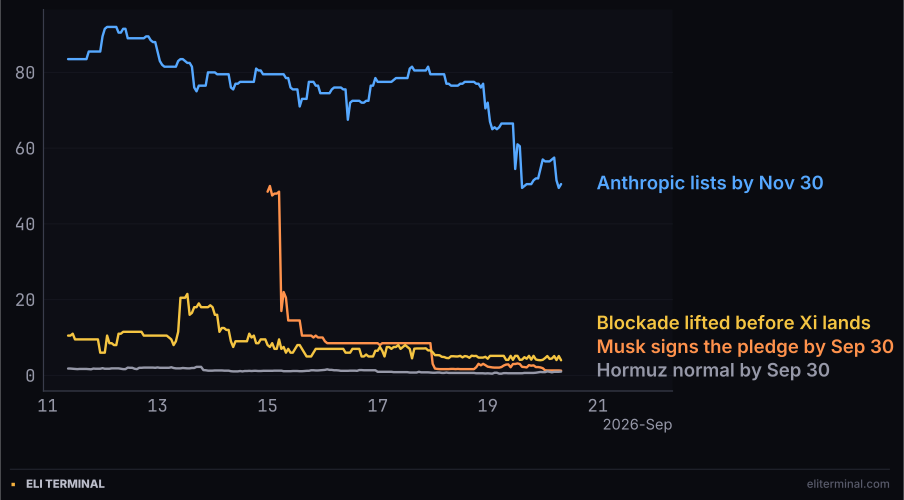
Every line is a public commitment with a date attached. None of them gained ground as the date approached.
Dario Amodei published a roughly 3,800-word essay called "We Must Pace the Frontier" on September 12, arguing the industry should deliberately slow capability gains so safety work can catch up. Musk replied on X with "Dario is right" and nothing else. Sam Altman wrote within hours that OpenAI agreed and would match Anthropic's first pledge.
Polymarket listed a contract on whether Musk actually signs the statement by September 30. It opened at 48.5% at 00:00 UTC on September 15, was 17% by 06:00 the same morning, 10.5% by 15:00, and trades 1.25% now. The Altman version of the same contract sits at 5.5%.
Both are thin, a few hundred dollars of volume between them, and one trader can move either. Read them as one desk's opinion rather than a consensus, and the opinion is still striking: three public endorsements inside a single news cycle, and a market that will not pay two cents for a signature.
The company announced on September 18 that Accenture would take the embedded-evaluator role, the first concrete implementation of Amodei's plan, reported by CNBC and TechCrunch. The Wall Street Journal reported the same day that the IPO had moved to November from the October window investors expected.
A slip from October to November stays comfortably inside a contract that resolves on November 30. That contract fell from 79.5% at 18:00 UTC Friday to 70.5% by 23:00, 65% by early Saturday, 54.5% by Saturday noon and 49.5% at its low. Thirty points, on news that did not breach the deadline.
The market did not price the stated date. It priced the fact that the date had moved once. CNBC had called the position a tightrope four days earlier: publish a slowdown manifesto, market a two-trillion-dollar listing.
Sam Altman told Fortune an IPO this year would be ill-advised. Polymarket's contract on an OpenAI listing by December 31 was 8.5% on September 11 and reads 3.35% now, cut by more than half in nine days.
The valuation markets did not follow it down. OpenAI's valuation reaching 1.25 trillion by December 31 still trades 58% on 95,000 dollars, and the contract on a listing-day market cap above 1.6 trillion trades 67.5% with no year attached to it at all. A number like that prices a company, not an event.
Musk wrote on September 1 that "Grok 4.7 comes out in 10 days", the fourth dated commitment since July by the count kept at CellCog. On September 11 he wrote it needed a few more days to cook. On September 14 he graded it as roughly on par with Opus 5.0, not 5.1, having said in August it would exceed all current models. A companion piece this weekend runs that chain of four dates in full.
Polymarket does list dated release contracts, a strip of one-day strikes. The September 21 strike trades 20.45%, September 26 trades 1.2%, September 27 trades 1.3%, September 30 trades 0.75%. Every one of them carries under a thousand dollars of volume, so the strip is a quote, not a market.
Where there is real money the direction is clear. Kalshi's contract on xAI holding a top-ranked model before 2027, on 94,000 dollars, printed 16.5% at noon UTC on September 14, the morning after Musk announced a Grok 4.8 trained on a new stack, and 10% by Friday evening. Announcing the next model while the last one is late bought roughly a day.
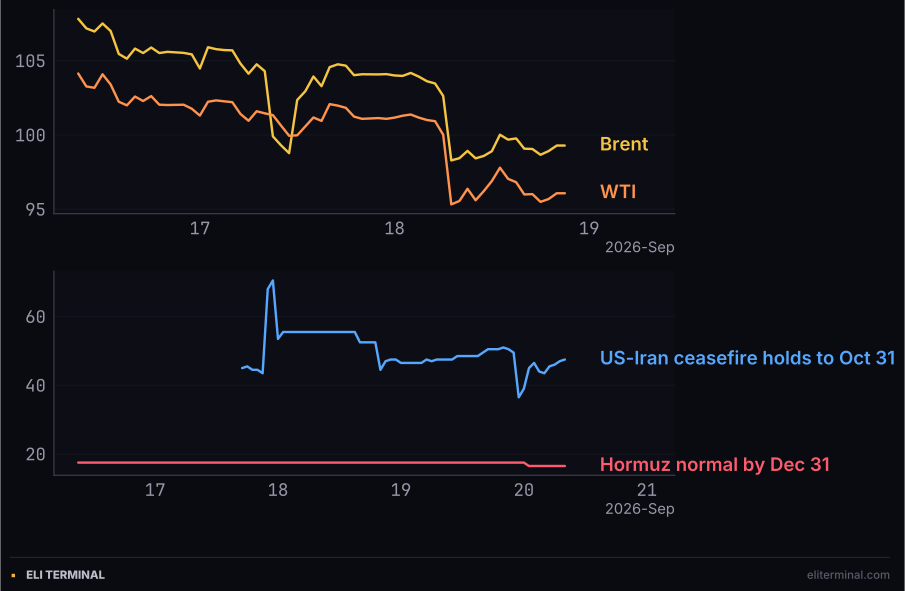
The break lands at 03:00 in New York. The Hormuz contract underneath it does not register that anything happened.
Brent's 07:00 UTC candle on Friday opened 102.73 and printed a low of 97.81, a fall of 4.8% inside sixty minutes. WTI did the same thing in the same hour, 100.03 down to 94.83. Both then held those levels for the entire US session.
The wire that explains it ran the day before. CNBC reported on September 17 that Saudi Arabia was offering more crude through Hormuz after the drone strike on its East-West pipeline, and satellite imagery put Saudi throughput at 2.8 million barrels a day over six days against roughly 700,000 in August. Thursday's session took Brent down 1.01 dollars. Friday's 07:00 hour took it down five.
That whole week the headlines pointed the other way: Houthi strikes on Yanbu and Khamis Mushait, civil defence alerts across Jeddah and Taif, the only major overland bypass of the strait still shut. Brent finished 8.7% below Tuesday's 108.75 close. CNBC's Friday piece settled on the explanation that the pipeline outage was less disruptive than feared.
The market on Strait of Hormuz traffic returning to normal by December 31 printed 17% before the break and 16.5% after it, a flat line through a 4.8% hour in the underlying. The September 30 version of the same question moved from 0.65% to 0.85%.
The September 15 version is the one to look at. It carries 2.54 million dollars of volume, the deepest Hormuz contract listed, and it was already quoted at 0.05% two days before its deadline expired. It has printed 0.05% in every hourly candle since. That is the cost of a dated promise on the world's most disrupted waterway, expressed as a price.
Iran's foreign minister told reporters in Beijing on September 16 that Tehran had agreed a plan with Oman to reopen the strait, with no Omani confirmation since. Crude fell 2.92% that day inside an FOMC session, and not one Hormuz contract registered the claim. A separate piece this weekend takes apart how those contracts are written.
Every hourly candle from September 10 through 12:00 UTC on September 18 printed the Greenland-deal-by-December-31 contract between 14.5% and 15.0%. The 22:00 candle on Friday printed 91.0%. Nobody traded ahead of that post, which is rare enough to be worth recording.
What Trump wrote on Truth Social was that the United States had entered an agreement giving it permanent control over security in Greenland. What Denmark and Greenland said on Saturday, per Al Jazeera, is that nothing compromises Greenlandic sovereignty and the signing happens next week at the United Nations General Assembly.
The markets split exactly along that seam. Signed by December 31 trades 95.8%; signed by September 23 trades 75%; the agreement text released by September 23 trades 51%. And the contracts on the United States acquiring Greenland never left 3.15% and 5.95% all week. Within hours the market had read "permanent control over security" as a basing agreement and priced the sovereignty question at nothing. A companion piece covers that repricing on its own.
Trump will greet Xi Jinping at the airport, the Washington Times reported Saturday, ahead of two days in Washington with a state dinner, a private tea and a tour of the founding documents per the South China Morning Post. On the table, per NPR: artificial intelligence, rare earths, fentanyl, and a trade truce that expires in November.
The visit contract went 85.5% on September 14 to 93.2% now, a grind with no single jump in it, which is what logistics confirming looks like as opposed to news breaking. Jensen Huang is slated to attend the dinner.
Not one contract exists on the thing the meeting decides. No market on chip export terms, none on the November truce, none on rare-earth quotas. The tradeable China surface is a Taiwan invasion at 4.55% and a military clash before 2027 at 6.2%. A contract on the two countries agreeing to pace the AI frontier this year did exist, spiked from 6.5% to 32.5% in the two hours around 23:00 UTC on September 14, and was back at 8% by dawn. It reads 7% now.
A five-year conditional exemption letting qualifying platforms trade blockchain versions of stocks without registering as exchanges landed September 17, covered by CoinDesk and CNBC, two days after the Senate blocked the Clarity Act from advancing.
Bitcoin closed Thursday at 76,404, up 0.33%. Then the 13:00 UTC candle on Friday opened 77,978 and printed a high of 80,416, up 2.6% in an hour, and the day finished at 80,901, the largest single-day move of its week by a factor of three. It trades near 80,400 on Sunday.
Peter Schiff called the rally illogical, which is one reading. The other is that the announcement and the reaction are separated by nineteen hours and a weekend boundary, and the same shape shows up in crude the same morning: the wire runs Thursday, the price moves Friday.
A UN fact-finding mission reported on September 17 that it found grounds to believe the United States committed war crimes in Iran and that Tehran committed crimes against humanity. Crude did not move on it, the dollar index closed 100.22 flat against the prior session, and no Iran contract registered it.
Trump said the same day that the United States was nearing the end of the war and claimed direct talks with Tehran. The contract on a qualifying US-Iran diplomatic meeting by September 30 did move, to 11% in the 19:00 UTC hour, and was back at 5.5% three hours later. It has since drifted to 14% on General Assembly logistics rather than on anything he said.
The fire pause held a ninth day through Thursday's cutoff with no Iranian salvo at any Gulf state, Jordan or Israel, per the GlobalSecurity day 203 situation report. The ceasefire contracts price it as a pause and not as peace: holding through September 30 trades 77.5%, through October 31 trades 47.5%.
Three chief executives endorsed a slowdown and none signed anything. Musk named a date four times. Trump announced an agreement that has no signatures on it and a ban on three news organisations with no administrative step behind it. Iran announced a plan to reopen a strait that has been shut for 203 days.
Warsh declined to say what happens in October, and by Sunday the market had done the work itself, arriving at 54.5% with no speaker, no data and no guidance. Trump told reporters at a Charlotte airport Wednesday evening that he had spoken to the chair about the vote, three hours after that chair twice told the press room he had nothing to say about conversations with the president. There is no listed contract on which of them is right.