SPY, QQQ and KRE, 15-minute candles, September 16
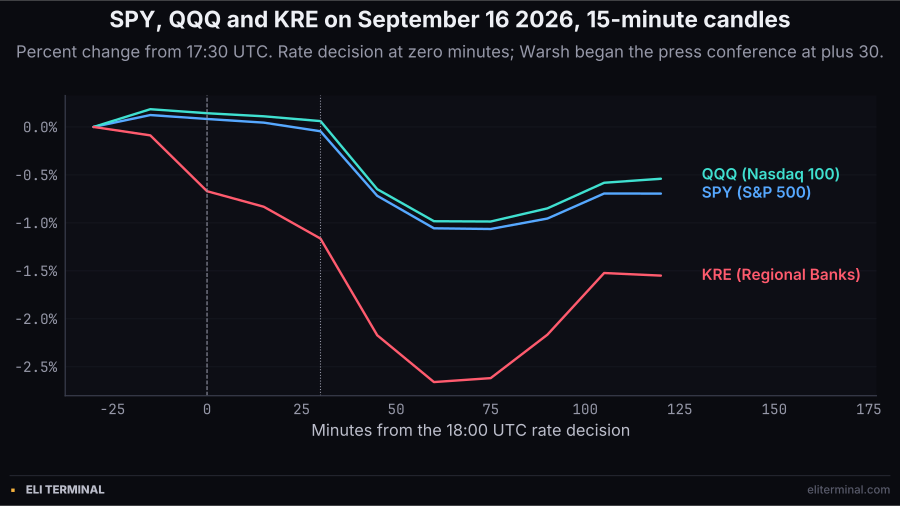
The decision is the dashed line at zero. The press conference is the dotted line at plus 30. Nothing happens between them.
The first Federal Reserve rate rise since 2023 landed at 18:00 UTC on September 16 and the S&P 500 fund did not move a tick; three quarters of an hour later it had shed 1.4%, and the contract on an October hike had traded both 27% and 66% inside a single clock hour.
The decision is the dashed line at zero. The press conference is the dotted line at plus 30. Nothing happens between them.
Kevin Warsh raised interest rates on the afternoon of September 16 and the stock market barely blinked. The S&P 500 fund opened the 18:00 UTC candle at 760.18 and closed it at 759.97. Gold absorbed the entire decision instead, falling 1.18% in the same quarter hour.
Nobody was surprised, and the surprise was never the point. Kalshi's contract on a quarter-point September move had sat at 87% through the whole New York morning, and Fox Business's Edward Lawrence told the chairman to his face that markets had put the odds closer to nine in ten.
Warsh took the podium at 18:30 UTC. Forty-five minutes later the same fund printed 749.60, the regional banking ETF was down 3.19% from where it traded half an hour before the decision, and the volatility index had added 15.5%.
One clause went missing between the two statements. In July the Committee wrote that inflation was elevated "in part reflecting supply shocks that have driven price increases in certain sectors, including energy." On September 16 that explanation was gone, replaced by three words: "Inflation remains elevated."
The vote changed too, in the other direction from what anyone expected. July's hold went through 9 to 3 with Beth M. Hammack, Neel Kashkari and Lorie K. Logan named in the statement as wanting a hike. September's hike went through 12 to 0 with nobody named at all, because there was nobody to name.
Colby Smith of the New York Times got the second question and asked the one the deleted clause invited. "When the Fed starts raising rates, it generally follows with a sequence of hikes. Is there anything different in today's assessment of the economic conditions that would suggest that the typical pattern does not apply," Smith asked, and then, "what impact do you expect higher rates to have at this juncture if the bulk of what is keeping inflation elevated is stemming from supply shocks?"
Warsh answered by declining to answer. "So we're trying to get to more people, so now I get to cherry pick my preferred question from you, Colby. This won't surprise you, I'm not in the forward guidance business," he said, per the Fed's own transcript. "I'm not going to pre-judge any future decisions we make."
The Fed does not stamp clock times on its transcripts and no outlet timestamped the individual exchange, so the minute Smith spoke is not on the public record. What is: the press conference began at 18:30 UTC, Yahoo Finance filed its "Warsh opens his comments" entry at 18:38, Smith asked the second question of the session, and SPY's break is the candle that opened at 18:45 and closed 0.67% lower.
Nobody in the room could follow up. Warsh had banned follow-up questions and had the microphones collected after each reporter's first turn, part of a format overhaul Axios catalogued the next morning; Bloomberg clocked the whole thing at around thirty minutes, the shortest since Fed chairs started holding these in 2011.
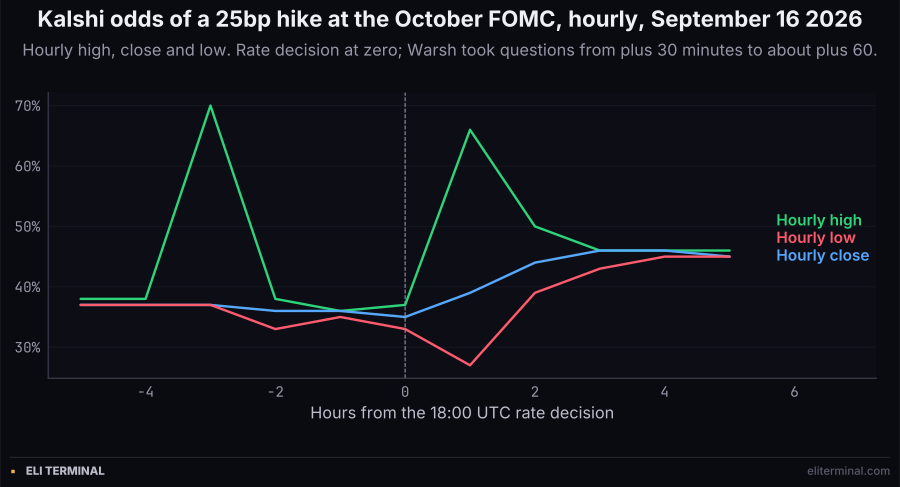
The gap between the green and red lines at plus one hour is the whipsaw. A lone print touched 70% three hours before the decision, on a book that was otherwise quoting 37%.
The rates market did something strange with that non-answer. The October contract closed the decision hour at 35%, down two points on the hike itself. In the following hour it traded a high of 66% and a low of 27% and closed at 39%.
A 39-point range inside sixty minutes is not a market absorbing information. It is a market that has no idea, and the October complex is deep enough that the disorder cannot be blamed on a thin book: the hike, hold and cut contracts for that meeting carry roughly 1.5 million dollars of volume between them.
The December contract, trading on the same venue in the same hour, did none of that. It went from 56% to a high of 74% and closed at 73%, a clean seventeen-point directional move with none of the thrashing. Traders agreed, decisively and within minutes, that Warsh was going to hike again. They could not agree on when.
That split is the whole cost of the policy, expressed in basis points of probability. The projections released with the decision put the median 2026 funds rate at 4.1%, one more quarter point from here, with twelve of the eighteen participants at that level, four above it and two content to stop. The longer-run dot ticked up to 3.2% from 3.1%.
Asked by Bloomberg's Michael McKee to square a "timelier return" to target against projections that push 2% out to 2029, Warsh disowned the document. "Those aren't my forecasts," he said. "Those are the forecasts of my 18 colleagues, and I've tried to represent them dutifully to you. My business is to not give forward guidance." The Fed's own footnote confirms eighteen participants submitted; the chairman is not among them. The market is trading a dot plot that does not contain the person who casts the deciding vote.
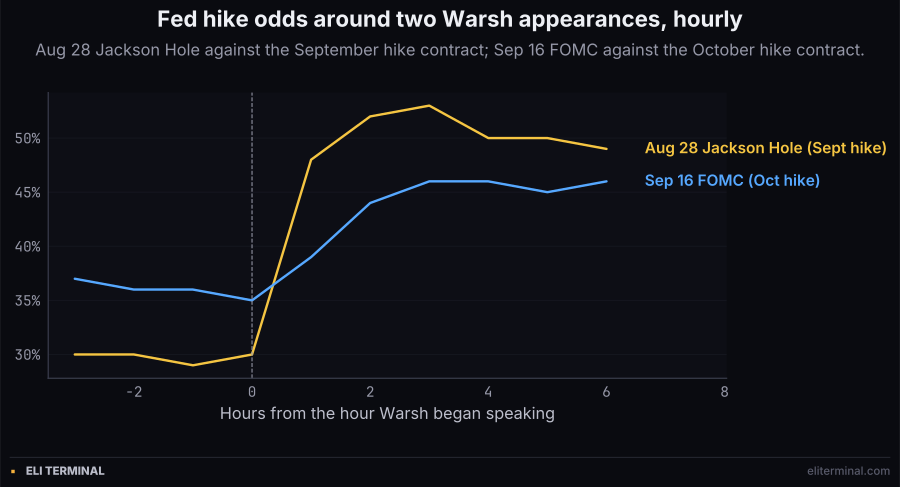
Two contracts, two venues for the same voice. Neither moved while he was on his feet. Both moved in the hour afterwards.
Four weeks before the hike, Warsh gave his first Jackson Hole keynote at 14:00 UTC on August 28 and told the room he was "committed to a discipline, not to a decision." Kalshi's September contract had traded between 29% and 31% for two straight days. It closed the hour of the speech at 30% and the next hour at 48%, reaching 53% by mid-afternoon. NPR described the same move in words, from about one in three before he spoke to better than even after.
So: two appearances, two venues, two different contracts, and the same shape both times. Flat for hours or days, then more than half the entire repricing delivered in one sixty-minute bucket that begins after he starts talking. This is a pattern, not a one-off.
The odd part is where inside the hour it lands. On both dates the contract barely twitched during the scheduled, scripted, embargo-released portion of the event, and did the work afterwards. A chair who publishes nothing forward-looking has moved the information out of the document and into the room, which means it arrives on the transcript's clock rather than on the wire's.
Warsh chose this. He cut the June statement to roughly 130 words, has declined to submit his own dot since taking the job, and at that first meeting said individual rate projections were not suited to what the Fed now faces. The whipsaw is not a malfunction of his approach. It is the approach, priced.
Elizabeth Schulze of ABC News asked Warsh what his message was to a president who keeps demanding cuts. "I've got nothing for you on the – on the discussion with the president," he answered. Zachary Halaschak of the Washington Examiner came back to it later, asking directly when he had last spoken to Trump, and got: "I don't have anything for you on discussions with the president. And I'm not a Wall Street newsletter." Then: "Independence is a two-way street."
That evening, at Charlotte Douglas International Airport in North Carolina, Trump told reporters something else. "I talked to Kevin and I said, 'you might as well vote with the board because it's not going to matter,'" he said, in remarks filed by Yahoo Finance at 23:41 UTC and also reported by CNBC. He said he still had confidence in the chairman, and of the Fed board, "he's got a very tough board."
Warsh said that at roughly 18:50 UTC. Trump said the opposite at some point before 23:41 UTC, which is when the Yahoo Finance story went up; no outlet published a clock time for the gaggle, so the gap is somewhere inside five hours.
Two named people, one conversation, and only one of them says it happened.
Which of them is right is not something the record settles, and no market anywhere is being paid to find out. The closest listed contract asks whether Trump will publicly insult Warsh by September 30. It ran to 48.5% on the day of the hike, collapsed to 8% the next morning and sits at 5.5% now, on 830 dollars of lifetime volume, which is one person's opinion rather than a price.
The deeper contract, on whether Warsh is out of the job by June 2027, went from 10.5% to 9.5% across the whole week and never flickered. A president and a Fed chairman contradicted each other in public about whether they had spoken, and the only tradeable expression of it moved a single point.
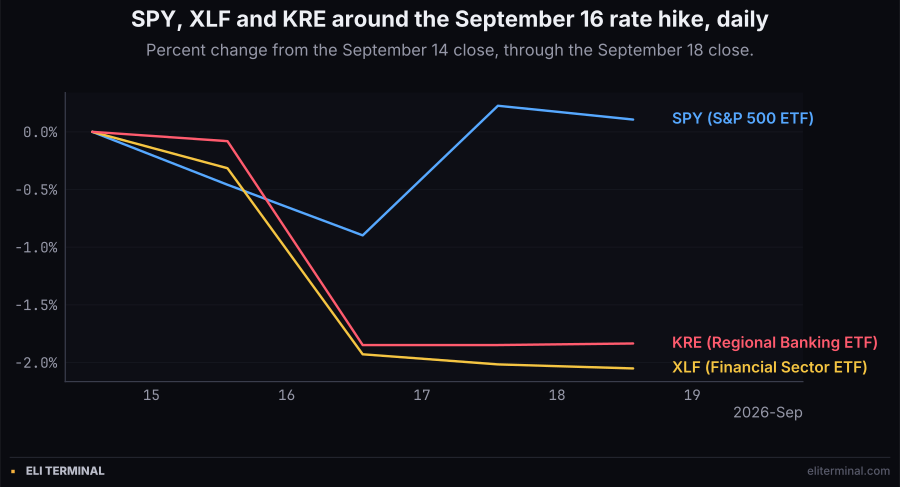
The blue line round-trips the hike. The other two never leave the floor they fell to.
By Thursday's close the selloff had been erased. SPY added 1.13% on September 17 and the Nasdaq fund 1.73%, its best session in six weeks, while the volatility index gave back 12.8% and kept falling to 14.81 by Friday.
None of it survives into the daily closes. The Nasdaq fund settled at 704.72 against 704.54 the session before, a gain of 0.03%, having traded a range of 711.88 to 700.00 in between. A 1.7% intraday round trip on the first rate hike in three years shows up in end-of-day data as nothing at all.
Financials did not participate in the recovery. KRE closed Friday at 72.75, within a cent of where it closed on hike day and 1.8% below its Monday level; XLF finished 2.1% down on the week. The 10-year note, which touched 5.006% in its last prints of Wednesday afternoon, ended Friday at 4.998%.
So the index treated Warsh's press conference as a scare and the banks treated it as news. That is the durable disagreement left on the tape four days later, and the October contract at 54.5% is the thing that resolves it, on October 28.
eli terminal • Market close data anchored to 2026-09-18T21:00:00Z • Prediction markets anchored to 2026-09-20T12:00:00Z
Sources: Federal Reserve press release, transcript and Summary of Economic Projections; Kalshi and Polymarket via eli terminal; Yahoo Finance candles