Seventeen Flat Days, Then One Hour
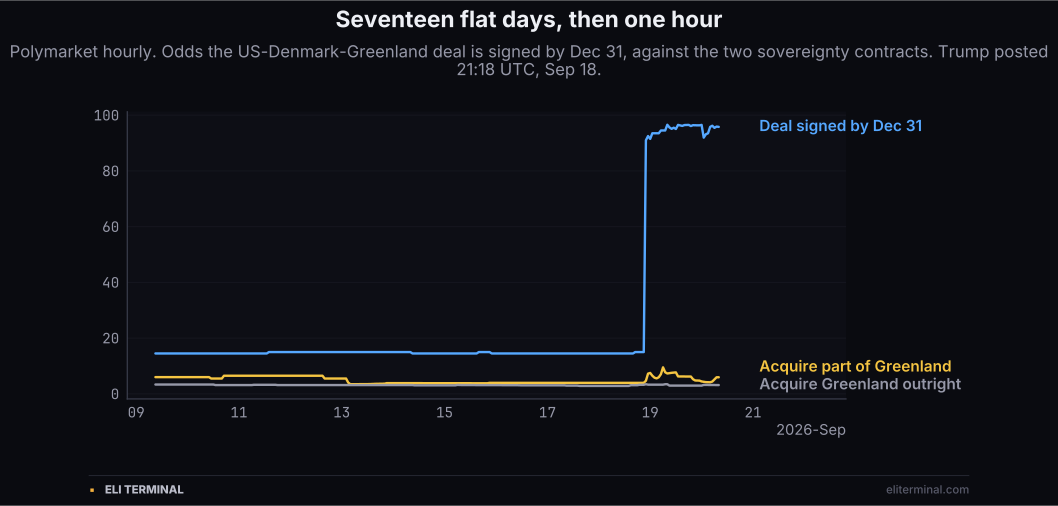
The deal contract held between 14.5% and 15.0% every day from September 2. The vertical is the 22:00 UTC hour on September 18.
A contract on a Denmark and Greenland deal had not moved half a point in seventeen days. Forty-two minutes after Trump pressed post it printed 91%, and the one stock that always jumps on his Greenland posts had already closed down 2% that afternoon.
The deal contract held between 14.5% and 15.0% every day from September 2. The vertical is the 22:00 UTC hour on September 18.
"I am pleased to announce that the United States of America has entered into an Agreement with The Kingdom of Denmark, and Greenland, that gives the United States permanent control over security, and all other needs, in Greenland, completely addressing ALL of our many U.S. concerns." Trump published that on Truth Social at 5:18 p.m. Eastern on Friday, 21:18 UTC, and added that the administration would "immediately begin the process of developing a large Military presence in the appropriate part of Greenland, of which there are many."
He also called it an "Infinite Life" Agreement, at "NO COST" to the United States. NBC News, CNBC and Axios all had the post inside the hour.
The last trade Polymarket recorded before that post valued the deal at 15.0%. The first hourly candle after it closed at 91.0%.
Seventy-six points is a large move in any market. What makes it worth a piece is not the size. It is what the line looks like on the left-hand side.
Every daily close on that contract from September 2 through September 18 printed either 14.5% or 15.0%. Seventeen consecutive days inside a band half a point wide. Across the final 205 hours before the announcement, the high was 15.0% and the low was 14.5%.
Most big political repricings show something moving in the hours beforehand, because somebody always knows. Lawyers know, advance teams know, the people booking the room at the UN know. A deal that three governments were preparing to sign in New York had a lot of people around it.
None of them, on the evidence of this contract, traded it.
Here is the honest limit on that inference. The December contract has done 112,737 dollars of lifetime volume, and most of that arrived after the news. By this desk's own standard, anything under 500,000 dollars is one or two people's opinion rather than a crowd.
A flat line in a market that thin is consistent with nobody knowing. It is equally consistent with somebody knowing perfectly well and deciding that a market where a 5,000 dollar order moves the price four points is not where you monetise it. Liquidity does not support the strong reading on its own.
Which is why the interesting corroboration is somewhere else entirely, on a venue that traded 7.86 million shares that day.
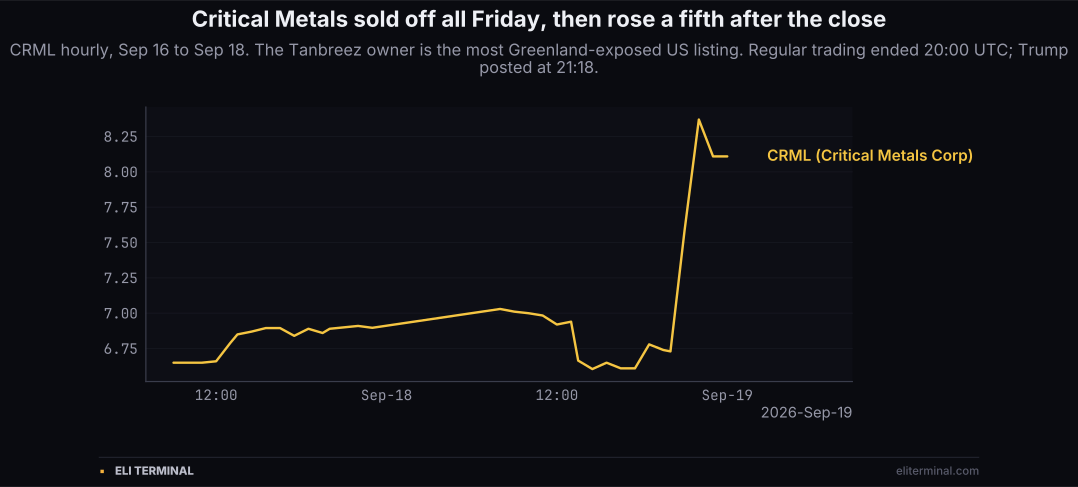
CRML, which owns the Tanbreez rare earth project in southern Greenland, opened Friday at its high of 7.00 and closed at 6.73. The vertical is after the bell.
Critical Metals Corp is the most Greenland-exposed listing on a US exchange, through the Tanbreez heavy rare earth deposit in the island's south. Its shareholders have a well-documented reflex: Investing.com logged a 25.7% single-day jump on acquisition speculation earlier this year, and 24/7 Wall St had it up 5% on a refinery study as recently as Tuesday. These are people who read Trump's Greenland posts for a living.
On Friday the stock opened at 7.00, which was its high for the day, traded down to 6.57, and closed at 6.73, off 2.0% from Thursday. Then, after the close, it printed 7.59 and 8.37, finishing the evening session at 8.11.
That peak is 24.4% above the closing bell, on a stock that had spent the entire session leaking lower. Two unconnected venues, one thin and one liquid, produced the same shape: nothing, then everything.
Gram Slattery, Erin Banco, Jacob Gronholt-Pedersen and Stine Jacobsen moved a Reuters exclusive the same day reporting that Washington and Copenhagen were "closing in on a potential deal" over Greenland's status, sourced to two people who requested anonymity. Their story said the parties had discussed using Greenlandic territory for Golden Dome, the missile defence shield, and arrangements to limit Chinese influence on the island.
The wire then overwrote that story in place once Trump posted, which is standard practice and also why its original filing time is now hard to recover. This desk could not establish to the minute whether the exclusive moved before or after 21:18 UTC, and will not guess. ThePrint carries the pre-announcement text.
Either way the finding survives. Every print stamped before the 22:00 UTC hour, in both markets, is a pre-news print.
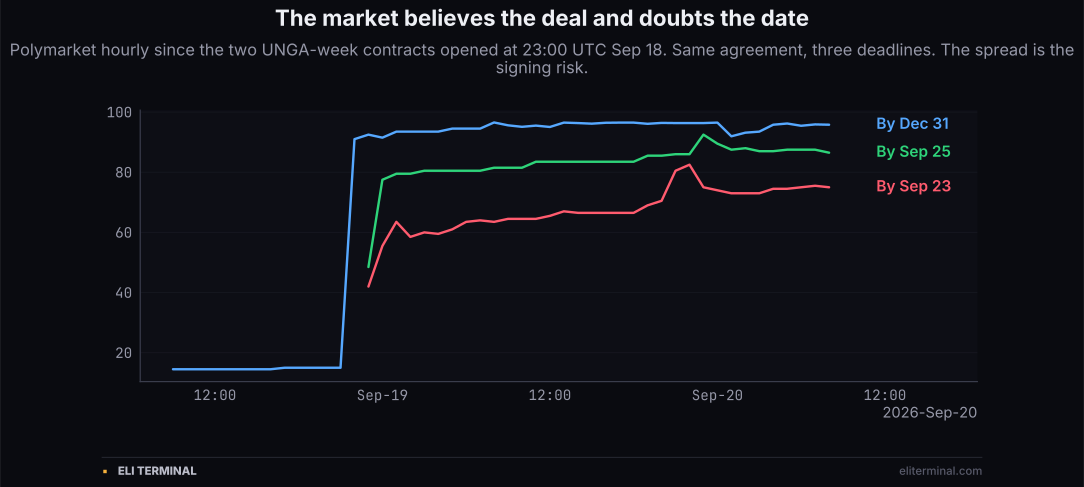
Three deadlines, one agreement. The two UNGA-week contracts did not exist before 23:00 UTC on September 18.
Polymarket listed two new contracts about ninety minutes after the post, asking whether the agreement would be signed by September 23 and by September 25. As of 08:00 UTC Sunday they trade at 75.0% and 86.5%, against 95.8% for the December 31 version.
That 20.8-point spread is the entire distance between "we have entered into an Agreement" and a document with signatures on it. In plain English: the market is almost certain this gets done, and puts one-in-four odds on it not being done by Wednesday.
The spread is not mysterious once you read the parties rather than the President. PolitiFact established on Saturday that the deal was still unsigned, that the three governments were pointing at the UN General Assembly and a date by September 28, and that Greenland's premier described the talks as "close to concluding an agreement" rather than concluded.
Trump announced a finished thing. Jens-Frederik Nielsen described an unfinished one. The ladder between the September 23 contract and the December contract is the market pricing that difference at about twenty points, and it got there within a day.
Watch what did not happen to the sovereignty markets. The contract on the US acquiring any part of Greenland in 2026 sat at 3.95% when Trump posted, ran to 7.25% by 23:00 UTC, peaked at 7.50% and has since settled back to 5.95%. The contract on Trump acquiring Greenland before 2027 moved from 3.25% to 3.45% and now trades 3.15%, which is below where it started the month.
A man had just told the world he had secured "permanent control over security, and all other needs" in Greenland. The market that would pay out if he acquired the island barely twitched, and the tail that did lift gave most of it back overnight.
That reading took the specialists rather longer to publish. James Townsend of the Atlantic Council told PolitiFact that "the 1951 agreement gave us a lot of what it sounds like he agreed to today," and Wayne State's Greg Fox pointed out that the NATO treaty already obliges the US to defend Denmark, Greenland included. Common Dreams collected Danish commentators calling the thing a rebranding of the status quo.
Mette Frederiksen said the agreement recognises Danish "sovereignty and territorial integrity" and Greenlanders' "right to self-determination," per Al Jazeera. In Nuuk, reporting from the Inquirer found vigils with placards reading "We are not a purchase."
Now the part that looks like a non-reaction and is really a calendar. Nasdaq Copenhagen closed at 15:00 UTC, six hours and eighteen minutes before the post; Danske Bank finished at 375.40, Novo Nordisk B at 281.55, Vestas at 207.00. US regular trading ended at 20:00 UTC, an hour and eighteen minutes before. The foreign exchange week ended at 21:00.
The krone's final print of the week came at 6.50750 to the dollar, one ten-thousandth above its 20:00 mark, and the dollar index's last candle is stamped 20:59:59 UTC. Neither is a verdict on Greenland. Both are the sound of a market being switched off.
So the honest version is not that nothing moved. It is that everything still open moved, and almost nothing was open. The two things that repriced, a prediction market and the US after-hours session, are the only two things on the planet that were taking orders at 21:18 UTC on a Friday.
Among the things that were open and did very little: MP Materials added 0.9% after the bell and Energy Fuels 1.0%, both a fortieth of what Critical Metals did, and the aerospace and defence ETF moved 0.1%. The Greenland trade, on Friday night, was a rare earth trade and nothing else.
Reuters reported that Golden Dome was on the table in those negotiations. There is no contract anywhere on Golden Dome, on Arctic basing, or on Pituffik. A search across both venues returns exactly one liquid Greenland market family, all of it on Polymarket, none of it on Kalshi, and the deepest contract in it is smaller than a mid-size house.
The most consequential question in the file, whether the United States ends up with a missile defence installation on the Greenland ice sheet, is unpriceable because nobody has written the ticket.