The promise chain, priced
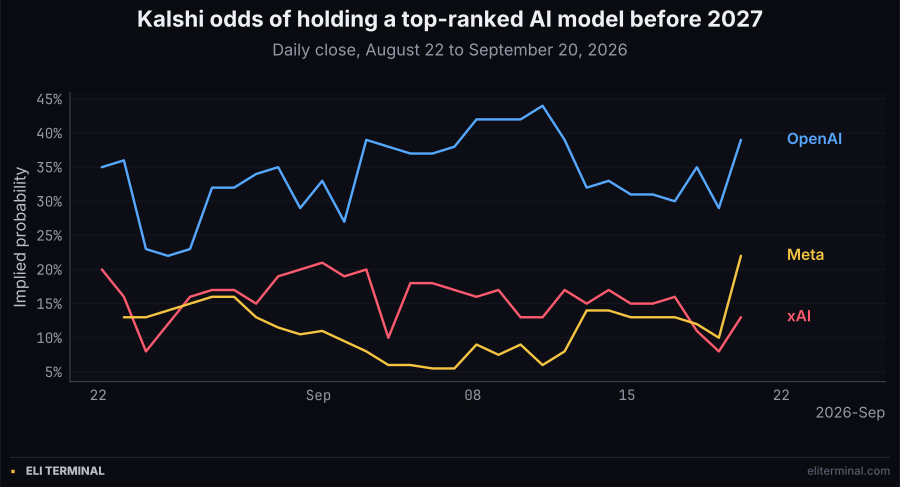
xAI in red. It more than halved across the period in which Musk made the case for Grok 4.7 four separate times. OpenAI and Meta both finished the window higher than they started it.
Grok 4.7 is missing from xAI's model directory, its news page and its release notes. The deepest market on where xAI stands fell from 21% to 8% while the promises piled up.
"Grok 4.7 comes out in 10 days." Elon Musk posted that at 02:59 UTC on September 2, which was just before eleven at night in New York. Eighteen days later the model is not in xAI's API directory, not on the company's news page, and not in its release notes.
Checking those is the whole verification, and it is quick. The published model list runs grok-4.6, grok-4.5, grok-4.3 and older; there is no grok-4.7 identifier, no price and no context window. The machine-readable index at docs.x.ai/llms.txt has no string for it either.
xAI has been shipping plenty, just not this. Fifteen release entries landed between September 4 and September 18, all of them Grok Build point upgrades plus a voice transcription model. The newest Grok the company has announced anywhere remains 4.6, from August 12.
The contract that reads closest to this asks whether xAI holds a top-ranked AI model before 2027. It closed at 21% on September 1, the day Musk made the promise, and at 8% on Friday. Ninety-four thousand dollars of volume sits behind it, which makes it the deepest read available on the question.
xAI in red. It more than halved across the period in which Musk made the case for Grok 4.7 four separate times. OpenAI and Meta both finished the window higher than they started it.
Nothing about that decline was a single drop. It was a grind: 20% on September 3, 17% on the 7th, 13% on the 10th, 15% through midweek, then 11% and 8% on the 18th and 19th.
One honest caveat on the tail. Saturday morning the contract bounced to 13%, and it did not bounce alone: OpenAI went 29% to 39% and Meta 10% to 22% over the same hours, on a thin weekend book. That rebound is the whole board, not a verdict on Grok.
The chain starts on July 24, when Musk wrote that Grok 4.6 was two weeks out and 4.7 four weeks out, pointing at late August. Four days later he described 4.7 as the 2.1 trillion parameter model and said it would be "better than 4.6 in every way." Those posts are transcribed in CellCog's tracker, which has been logging them since August.
August 12 brought a third date, "3 to 4 weeks," and six minutes after it the line that has aged hardest: "Grok 4.7 will exceed all current models." Three days later he softened it to "a good chance of exceeding all current models in intelligence."
Then the ten days. That post landed the night of September 1 in New York and pointed at September 11, and on September 11 at 17:22:03 UTC Musk conceded it: Grok 4.7 "needs a few more days to cook." He blamed his own reinforcement learning, saying the team "might have penalized response length too much," leaving a model that "gives up on hard tasks (that it can do!) too early."
The concession moved nothing. The top-model contract printed 12% that morning, 11% in the 19:00 UTC hour less than two hours after the post, and 13.5% by evening.
A market that believed the September 11 date would have repriced hard on a public miss. This one did not twitch, because by then it had already stopped pricing the date at all.
Frontier model dates slip everywhere, and the fair comparison is not to a world where labs ship on time. Google announced Gemini 3.5 Pro at I/O on May 19 and shipped only the Flash variant; Bloomberg reported on July 16 that the Pro model was months behind schedule. Meta's next generation is still training.
Musk's own record is mixed rather than bad. Grok 4.6 was promised for "around August 7" and arrived on August 12, a five day slip on a model that did land, and that lifted the Artificial Analysis intelligence index from 56 to 61.
He also said the quiet part out loud. On September 14 he graded the unreleased model at "roughly on par with Opus 5.0, not 5.1," which is a public downgrade from "will exceed all current models" and an unusual thing for a chief executive to volunteer. Anthropic had shipped Claude Fable 5.1 on September 1, hours before that post landed, and it went straight to the top of the leaderboards Musk was grading against.
On September 14 at 01:24:12 UTC, with 4.7 still unshipped, Musk named its successor: "Grok 4.8, which is a 2.5T model trained with our new C++ software stack, will finish training this week and start RL." Announcing a bigger model while the previous one is late is the kind of post that used to buy something.
It bought nothing. Kalshi's market on whether xAI has the best coding model on December 31, a deeper book at a hundred and seventy-two thousand dollars, printed 6.5% in the hour before that post and 6% in the hour after.
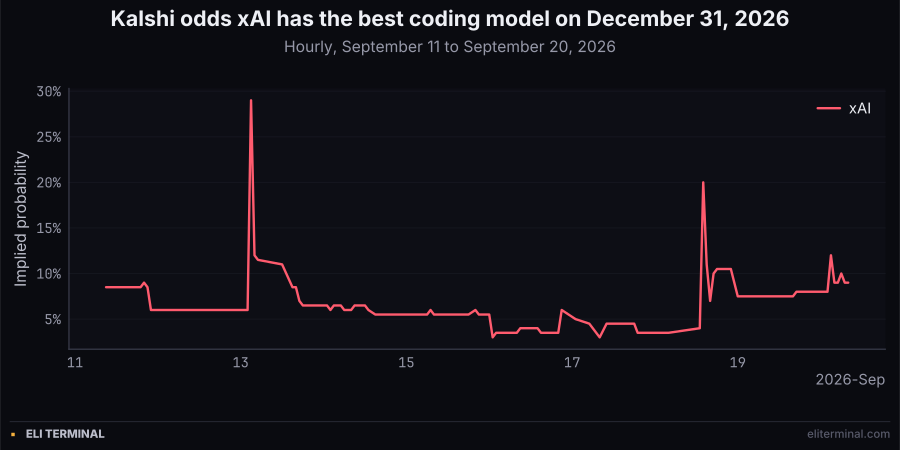
The 29% print lands in the 03:00 UTC hour of September 13, roughly twenty-two hours before Musk's Grok 4.8 post. By the time he posted, the contract was back at 6.5%.
Twenty-two points arrived and left inside one September 13 session with no announcement anywhere near it. The contract opened that hour at 7%, touched 29%, and was back to 12% by the next hourly print and 6.5% by evening. Whatever that was, it was not news, and nobody has published an explanation for it.
A second spike, to 20% on the morning of September 18, has a likelier story behind it and still no clean join. A developer noticed a grok-4.7 entry in Google Cloud quotas and posted it at 07:10 UTC on September 17; the trend picked it up at 12:05 UTC. The contract moved roughly twenty-six hours later, which is adjacency, not causation.
Two venues do list a contract on whether Grok 4.7 ships by a given date, which is worth stating because the absence of one would be the easier story. Kalshi runs a dated series, and OrcaRouter's tracker counts legs for August 14, 21, 28 and 31 and September 4, 8, 11 and 18, every one of which closed with no qualifying release. Polymarket runs a daily strip on the same question.
The problem is that the strip cannot be read. Its eleven remaining September buckets are mutually exclusive by construction, and on Saturday morning they added to 182%.
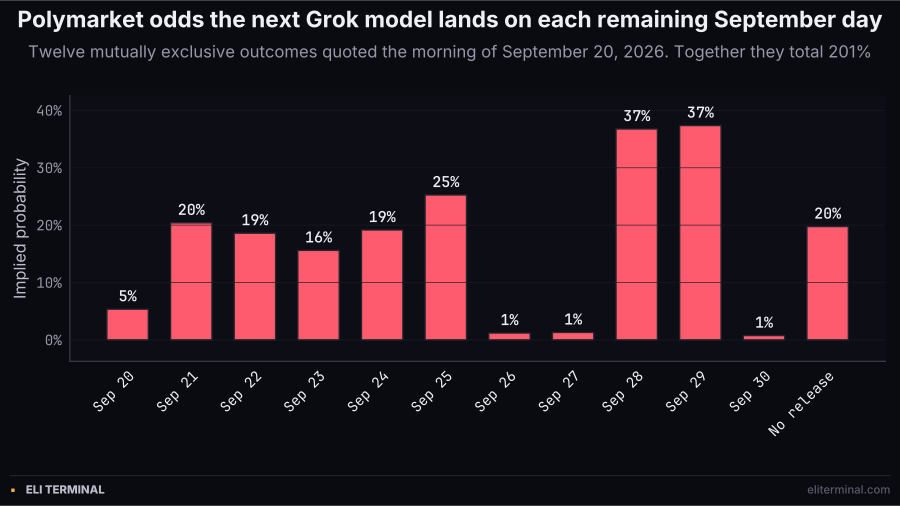
Add the no-release contract at 20% and the twelve outcomes total 201% on a set that can only sum to 100%. The September 26, 27 and 30 buckets carry the most volume in the strip and are priced near zero.
Volume explains it. The September 23 and 29 buckets have traded eight and three dollars respectively, while the busiest bucket in the whole strip has seen seven hundred and eighty five. Those are not prices; they are one or two people, and nobody is arbitraging a book that small.
So the tradeable read on Grok 4.7 has migrated to markets that never mention it. The two contracts doing the real work ask about rankings, carry ninety-four thousand and a hundred and seventy-two thousand dollars, and both go through xAI's standing rather than its calendar.
The equity test comes up empty, and partly for a structural reason. SpaceX absorbed xAI in February in a deal valuing the combination near $1.25 trillion, and the unit was rebranded SpaceXAI in July. There is no listed xAI security and has not been one for seven months.
Tesla is the nearest thing, having committed roughly $2 billion to the January Series E, and Tesla did not react to any of it. The stock closed at 365.44 on September 11, the day Musk conceded the miss, and 364.27 on September 18, down 0.32% across five sessions in which the Nasdaq proxy rose.
Its one violent half hour that week ran the wrong way for this story. Tesla fell from 370.90 to 360.96 between 13:45 and 14:15 UTC on September 18, a 2.7% break while the S&P proxy moved 0.27%, and the Tesla news flow that morning was about a hunt for Chinese Optimus suppliers. Same clock, different subject.
Musk said in August that Grok 4.7 would exceed all current models. Across the weeks that followed, the deepest market on xAI holding a top-ranked model went from 21% to 8%, and the deepest market on its coding standing went from 12% at the start of September to 3% on September 16.
The posts themselves stopped registering somewhere in there. A missed deadline moved the top-model contract 1.5 points; a brand new 2.5 trillion parameter model moved the coding contract half a point in the wrong direction; the only two spikes of the period landed on a leak and on nothing at all.
That is a specific and slightly unusual thing for a market to do. It has not decided Musk is wrong about the model, which is why the contracts sit at 12% rather than zero. It has decided his dates carry no information, and it now waits for the API entry instead.