The same event, two contracts, Sep 10 to Sep 20
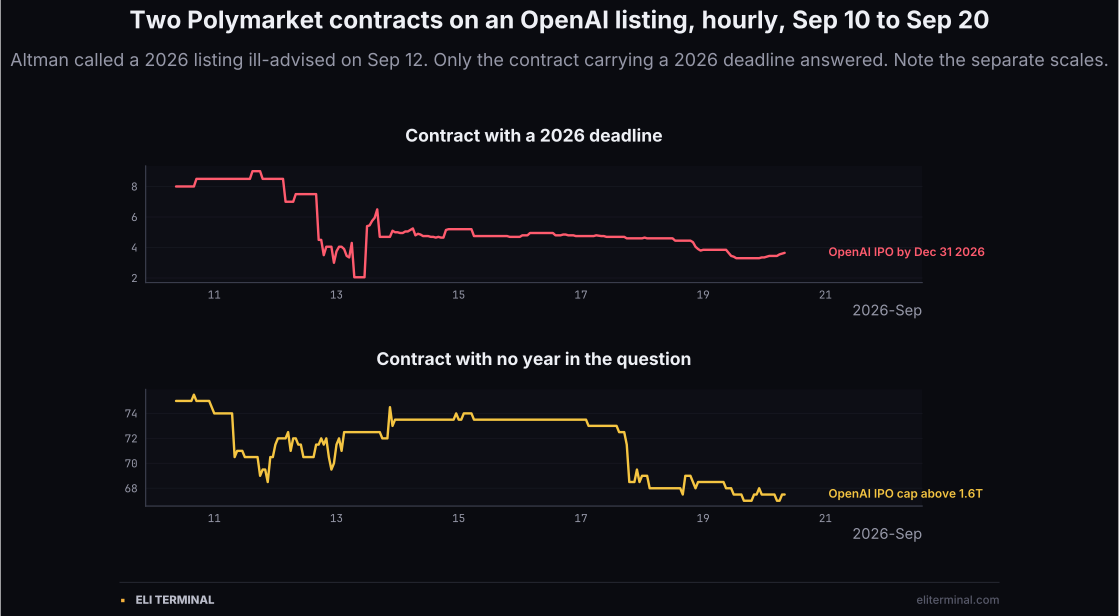
Separate vertical scales. The top line lost roughly two thirds of its price in seven hours on September 12; the bottom line's largest step came five days later, on a different story.
Two Polymarket markets track the same listing. On the day Sam Altman called a 2026 IPO ill-advised, the one carrying a deadline fell from 7.5% to 3.0%, and the one with no year in its question closed the day half a point lower.
Separate vertical scales. The top line lost roughly two thirds of its price in seven hours on September 12; the bottom line's largest step came five days later, on a different story.
We're not rushing into an IPO. I actually think that given everything happening with safety, right now would be an ill-advised moment to go public. Sam Altman, to Fortune editor-in-chief Alyson Shontell at OpenAI's San Francisco headquarters
Pressed on whether that meant the year was gone, he was blunter: "I would say not 2026, yeah. We've got a lot of stuff to do." Fortune put the interview out on September 12 with a 2:04 PM ET stamp, 18:04 UTC. TechCrunch followed at 1:19 PM Pacific.
Polymarket's market on an OpenAI listing completed by December 31, 2026 printed 7.5% in every hourly candle from 08:00 UTC to 16:00 UTC that day. The 17:00 candle came in at 4.5%, the 19:00 candle at 3.5%, and the day closed at 3.0%.
That is a contract shedding 60% of its price between lunch and bedtime, and it is the deep one: $1.01 million of lifetime volume and about $26,700 of resting liquidity. Its mirror, on OpenAI not listing by the same date, moved in lockstep from 92.5% to 96.95% and carries $747,000 of lifetime volume.
One honest wrinkle. The first leg printed in the 17:00 UTC hour, roughly an hour before the timestamp on Fortune's IPO story and three hours before TechCrunch's. Fortune's separate piece on the safety pact had gone up at 11:00 AM ET and the contract did not budge for two hours afterward, so that was not the trigger; what moved it at 17:00 UTC is not something the public record accounts for.
Sitting a few clicks away is a market titled, in full, "OpenAI IPO closing market cap above $1.6T?" It traded 71.5% at 16:00 UTC on September 12, 71.5% at 17:00, 72.0% at 18:00, 71.5% at 19:00, and closed the day at 70.0%. The next day it closed at 73.5%, higher than before the interview.
Read the resolution language and the flatness stops being strange:
This market will resolve to "Yes" if the official closing price for OpenAI's market capitalization on its first trading day is above the listed value. Otherwise, it will resolve to "No". If no IPO occurs by December 31, 2027, 11:59 PM ET, this market will resolve to "No". Polymarket resolution criteria, retrieved 2026-09-20
So the number is not a probability that OpenAI goes public. It is the joint probability that OpenAI lists at any point in the next fifteen months and prints above $1.6 trillion on day one. Altman moving the listing out of 2026 barely touches that, because 2027 is inside the window and a later, larger OpenAI is a higher first-day cap, not a lower one.
The contract is not broken. The question it appears to ask and the question it actually asks have come apart, and the sibling market at the $1.4 trillion strike quotes 68.5% on $1,242 of resting liquidity, which is one trader's opinion dressed as a consensus.
Money went to the right place and attention did not. The dated contract carries nearly twenty times the lifetime volume of the one whose title reads like an answer to "will OpenAI go public."
Amodei posted a roughly 3,800-word essay titled "We Must Pace the Frontier" on September 12, arguing the industry should deliberately slow how fast models gain capability. His own definition is narrower than the headlines: pacing "does not mean halting model training or technical progress, but ensuring companies take adequate time to align and safeguard their models, and for third party evaluators to confirm this" (TechCrunch). Anthropic's own commitment was to give outside evaluators permanent, employee-level access.
Altman endorsed it within hours, writing that he agreed on the need to pace the frontier and that OpenAI would match the evaluator commitment (NBC News). On the pact itself he declined to go further: "I'm not going to pre-announce private discussions that I think should be at some point shared as a group. But yeah, I think that will happen."
Anthropic's contract on listing by October 31 closed September 11 at 58%, traded as high as 69.5% on the 12th, and closed that day at 63.5%. The company's chief executive spent the day calling for the industry to slow down and the odds it would be a public company inside seven weeks went up, not down.
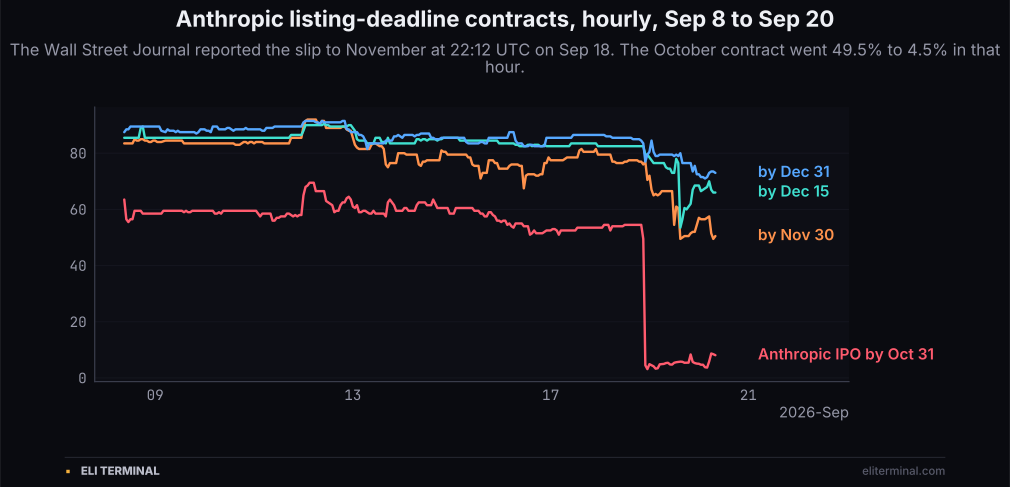
Four deadlines, one company. The October line goes to the floor inside a single hour on September 18; the later deadlines absorb what it gave up.
Everything anyone knew about the listing plan came from reporting; the company has confirmed none of it. CNBC, relaying Reuters, had the marketing window opening in mid-October, Nasdaq as the venue, and a raise of up to $100 billion at around $2 trillion, all sourced to people familiar rather than to a filing.
Then on Friday evening the Journal reported the slip. The story carried a stamp of 6:12 PM Eastern, 22:12 UTC, and said Anthropic was targeting November so it could show third-quarter results to investors after OpenAI's September release of Astra (via Yahoo Finance).
The October contract held 54.5% through the 20:00 UTC candle, printed 49.5% at 21:00, and printed 4.5% at 22:00. It closed the day at 3.15%. Forty-five points, one hour, on a market with $1.00 million of lifetime volume.
The rest of the ladder did what a working ladder does. November 30 went from 70.5% to a 49.5% low the next day, December 15 from 79.5% to 53.5%, December 31 from 86.5% to 72.5%, all of it draining down the calendar rather than out of the trade.
Worth saying plainly, because the two stories sit next to each other and invite a link that the reporting does not support: the Journal wrote that the timing change was settled before the public argument about AI safety began. The slip is a quarter-end accounting decision in the account of the people who broke it, not a slowdown decision.
September 14 was the first US session after the weekend, and it split cleanly. Nvidia closed down 3.36%, AMD down 4.40%, Intel down 5.59%, Oracle down 3.65%, CoreWeave down 6.75%. SoftBank fell 10.72% in Tokyo to 5,839 yen, and its American receipt fell 15.15%, a gap that is partly currency and partly the thinner line.
Microsoft closed up 1.97% at 505.41, having touched 509.95. The S&P 500 fund lost 0.45% and the Nasdaq 100 fund 0.80%, so the index barely registered any of it.
That is a strange sort. The company with the largest commercial claim on OpenAI, and therefore the most to lose from an OpenAI listing sliding a year, was the one thing in the complex that went up on the day. The names that sold were the ones selling picks and shovels into model training, which is the activity a pacing agreement would slow. Traders repriced the capital-expenditure chain and left the equity stake alone.
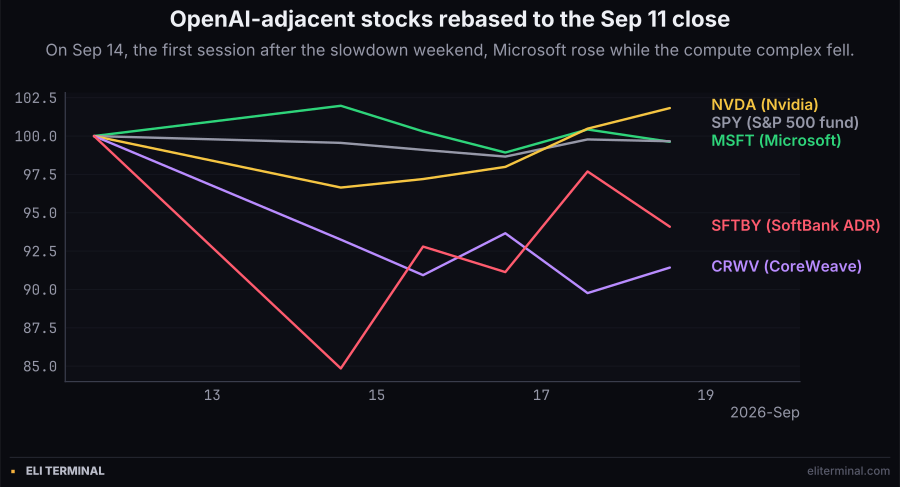
Same weekend, same news, opposite signs. The flat grey line is the index that recorded almost none of it.
September 18 produced nothing at all on the equity side. Microsoft closed down 0.80%, Nvidia up 1.34%, CoreWeave up 1.85%, the index down 0.12%, with the Journal's story landing after the bell and no listed equity sensitive enough to carry it overnight. A $2 trillion listing moved by a month is a prediction-market event and, for now, not a stock-market one.
The generous reading is the one the men themselves gave. Altman put it as a duty: "We all have a tremendous amount of responsibility, and cannot let egos or incentives for profit or anything else get in the way." Nothing in the tape contradicts that, and nothing in it confirms it either.
The unfriendly reading has named owners. Michael Burry called the campaign self-serving, arguing that slowing the pace protects incumbents from faster-moving competitors, and that "competition is coming up fast, slowing benefits incumbents." CNBC laid out Altman's own framing of why the industry wants to slow, and other outlets have made the moat argument on their own account. These are readings, offered by people with no access to the private discussions Altman declined to pre-announce.
On Friday the argument acquired a docket. A suit filed in the US District Court for the Northern District of California names Anthropic, OpenAI, SpaceXAI and Google and claims the September 12 exchange amounted to an illegal agreement to restrain development, reducing what subscribers get for their money (CBS News). The plaintiffs concede each company may slow itself; what they say antitrust forbids is the shortcut of agreeing to "substitute collective restraint for individual accountability."
The White House took the other side entirely. Trump wrote on Truth Social that "we will not in any way hinder or stifle the Growth of this incredible Industry. Rather, we will cherish it, help it, and watch over it, as it grows," and announced he was forming an "AI Force" modelled on Space Force (Fortune).
No contract anywhere prices the lawsuit, the pact, or the AI Force. The tradeable surface of the biggest argument in the industry is four deadline contracts on when Anthropic rings a bell.