The pipeline news and the price, Sept 16 to Sept 18
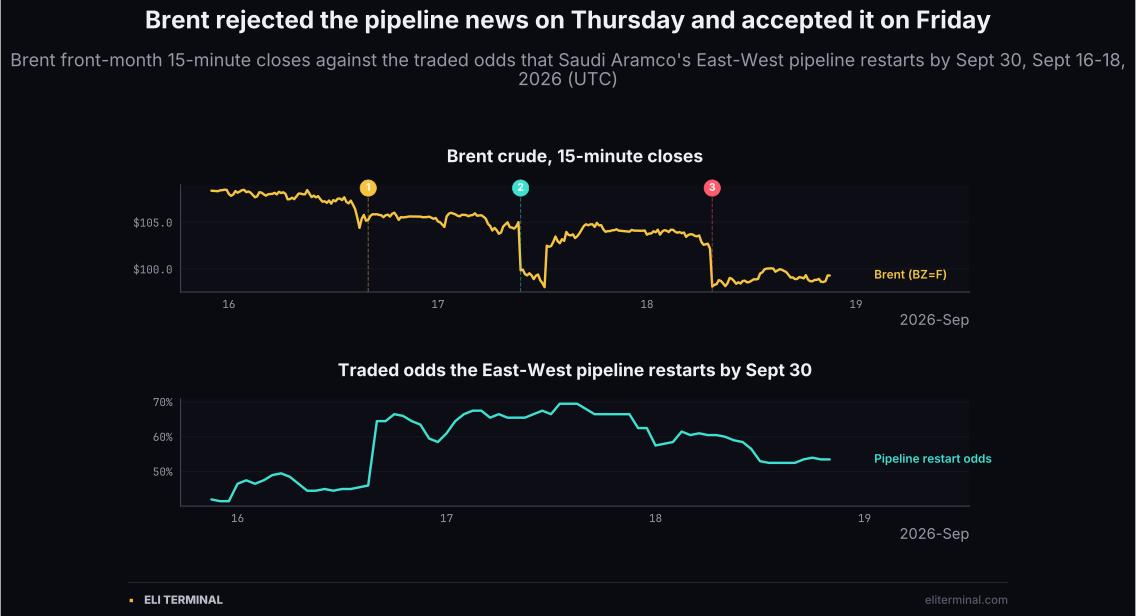
Marker 1 is Bloomberg's Wednesday report. The odds step up inside that hour. Brent does not break until marker 3, thirty-nine hours later.
The Bank of Japan took its policy rate to a 31-year high in the Tokyo lunch break and the yen was 1.2% weaker seven hours later, Brent lost $4.32 in a single fifteen-minute candle before New York woke up, and then the second-largest options expiry on record moved the S&P 500 by 0.17%.
Marker 1 is Bloomberg's Wednesday report. The odds step up inside that hour. Brent does not break until marker 3, thirty-nine hours later.
Half past three in the morning on the American east coast is when the oil market decided. Brent's fifteen-minute candle at 07:30 UTC opened at 102.13 and printed a low of 97.81, on the heaviest volume of the overnight session. That is a 4.2% move inside a quarter of an hour, with no exchange in the United States open.
The wires caught it in the Asian session. WTI fell nearly 5% below $100, extending a three-session decline to 8.4%, and Brent worked back toward $103 by the New York afternoon.
It had rehearsed the same move the day before and rejected it. Thursday's 09:30 UTC candle took Brent from 104.99 to a 99.75 low, and by 12:30 UTC it was back above 102. Friday's break is the one that held, and the difference between a scare and a repricing is exactly that.
Bloomberg reported on Wednesday that Saudi Aramco was working to bypass the damaged section of its 1,200-kilometre East-West pipeline and restore roughly half its capacity within days, with full restoration targeted in about six weeks. The pipeline moved 4 to 5 million barrels a day before the drone strikes shut it, roughly 4% to 5% of global supply.
The contract on a restart by September 30 went from 46% to 64.5% in the 16:00 UTC hour. That is an 18.5-point step, in the hour the story crossed, two hours before the Federal Reserve's rate decision.
Brent took another thirty-nine hours. By the time crude finally broke on Friday morning the pipeline contract was already unwinding, from 66.5% at Thursday's close to 53.5% on Friday, which is the odd part: the market that led the price down was selling the thesis as the price arrived at it.
Aramco was also doing something the pipeline market does not price. It sold roughly 60 million barrels from Ras Tanura for ship-to-ship transfer at Oman's port of Sohar, letting buyers take Saudi crude without sending their own vessels into the Gulf, and satellite imagery put Saudi throughput at 2.8 million barrels a day over six days against about 700,000 in August (CNBC).
Both of those things are true, which is the whole difficulty with Day 203. The Strait of Hormuz tracker logged eight transits on September 13 against a pre-crisis baseline of 85 a day, and counted 477 vessels holding position away from berth in the Gulf watch box.
Three tankers were hit this week. The IRGC struck the Togo-flagged Trend on September 17 after what Tehran called an illegal passage attempt, and two more vessels took unknown projectiles.
The deepest contract anyone wrote on this expired on Tuesday, worthless. A Polymarket market on Hormuz traffic returning to normal by September 15 carried $2.54 million of volume and spent its final week printing 0.05%. Whatever that money was doing, it was not expressing an opinion about September.
The interesting number is the one that went the wrong way. As crude fell 8%, the contract on the United States announcing an end to the Iranian blockade by December 31 slipped from 65.9% on Sunday to 60% on Friday. Crude priced supply relief; the market written on a Washington announcement priced slightly less of it, because barrels moving around a closure and a closure ending are not the same event.
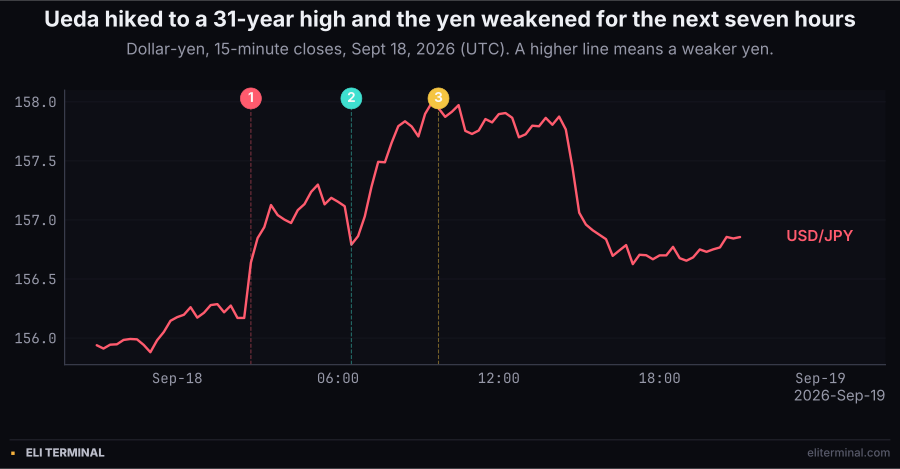
The only yen strength of the session lasted fifteen minutes, at the top of Ueda's press conference.
The Bank of Japan raised its policy rate a quarter point to 1.25% on Friday, the highest since 1995, on a 7-2 vote with two board members preferring to hold (CNBC, BOJ). The decision landed in the Tokyo lunch break, and dollar-yen jumped 0.70 yen in the 02:45 UTC candle. A currency does not usually weaken on its own central bank's tightening.
Ueda opened his press conference at 06:30 UTC and the yen firmed for exactly one candle, to 156.49, before giving it all back and running to 158.054 by 09:45. Strategists told Bloomberg the split vote and the absence of hawkish guidance did it.
A destination, not a schedule. FXStreet rendered his framing this way: the old assignment was to drag inflation up toward 2%, and the new one is to stop it wandering away from 2% in either direction. The currency market charges for the difference.
Kevin Warsh had produced the identical shape forty-eight hours earlier. The Fed's 18:00 UTC decision on Wednesday left the S&P proxy flat and took 1.18% out of gold inside the candle; the damage to equities arrived at 18:45, in the Q&A, when Warsh said he was not in the forward guidance business. Two hikes, two chairs, and in both cases the decision was the quiet part.
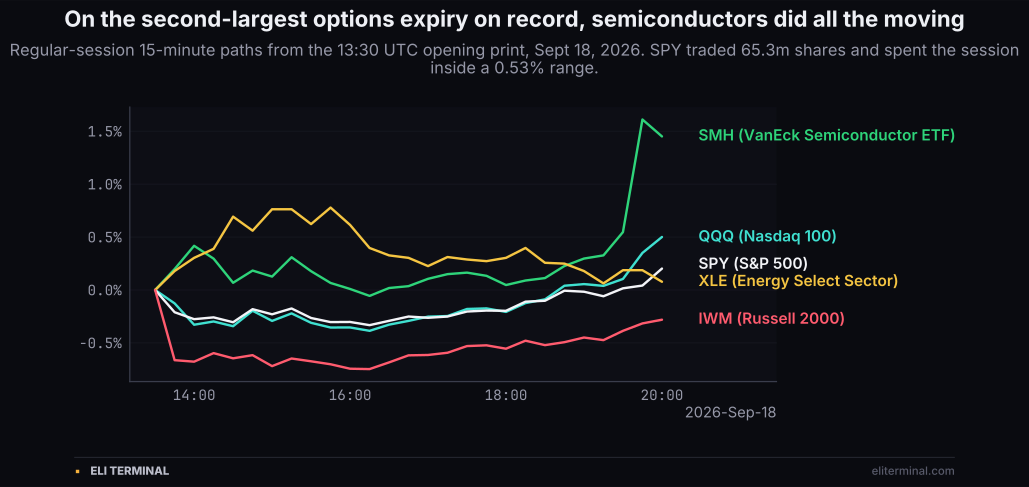
Five funds, six and a half hours, and one move: semiconductors in the last forty-five minutes.
About $7 trillion of US options notional rolled off on Friday, roughly a quarter of the entire market and the second-largest quarterly expiry on record, according to Citadel Securities data reported by Bloomberg. Citadel's Scott Rubner put roughly 60% of it at the open. The firm's market intelligence desk warned the roll could leave the tape more sensitive to underlying flows once the positioning that had been dampening realised moves came off.
Then nothing happened. SPY traded 65.3 million shares, its heaviest session of the month and 31% above Thursday, and spent the entire day inside a 0.53% range between 757.97 and 762.00. Nvidia turned over 189.7 million shares, more than double Thursday's 94.2 million, to finish up 1.34%.
The volatility curve is where the expiry actually shows up. Nine-day implied volatility closed at 12.27, down 8.4% on the day and the lowest reading of September, while three-month volatility barely moved at 18.24. A six-point gap between the two is the market saying it has no idea what happens in a quarter and complete confidence about next week.
The one real move came in the final forty-five minutes, and it was narrow. The VanEck semiconductor fund closed +2.21% while the Russell 2000 proxy fell 0.47%, an almost three-point spread inside a session the index level recorded as 0.17%.
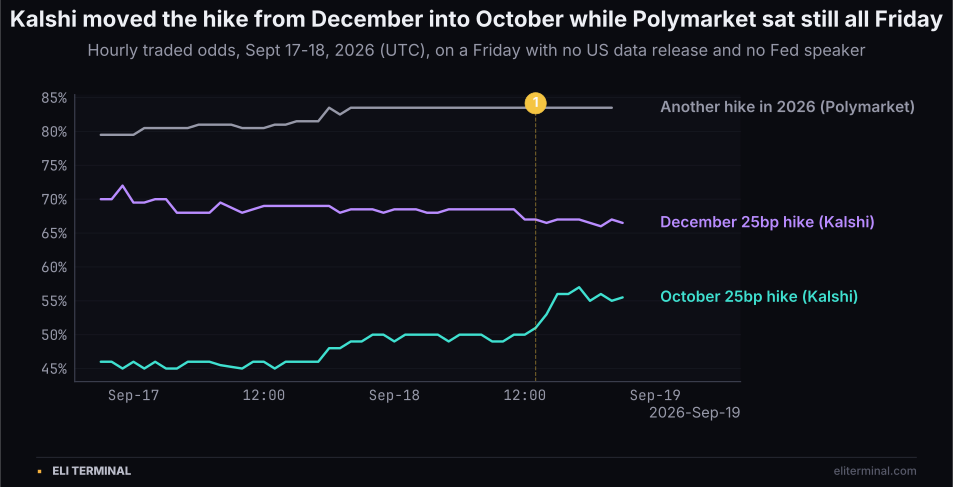
Marker 1 is Friday's US morning, when Goldman Sachs and Bank of America added an October hike to their forecasts.
James Egelhof did the translation. The BNP Paribas chief US economist told CNBC on Friday that the word accommodation means stimulus at the Fed, so Warsh calling his hike the removal of "a dose of accommodation" implies the current stance is still meaningfully stimulative. Three words, and a lot of room above 4%.
Goldman Sachs put an October hike into its baseline and Bank of America went further, penciling October and December. CME FedWatch had the October probability at about 58% on Friday, against 42% a week earlier.
Hour by hour, Kalshi's October contract traced it: 50% at 12:00 UTC, 51% at 13:00, 53% at 14:00, 56% at 15:00, a 57% peak at 17:00, and a 55.5% close. The December contract fell from 68.5% to 66.5% over the same window. Nothing was on the calendar all day, no data and no Fed speaker, and the front of the curve moved anyway, the five-year yield up 5.5 basis points and the ten-year up 5.1.
Polymarket's contract on another hike in 2026 printed 83.5% in every single hourly candle on Friday. Two venues, the same central bank, and only one of them had a question left to answer: the hike was never in doubt by Friday, only its month.
On Truth Social on Friday the president said the United States had entered into an agreement with Denmark and Greenland giving it "permanent control over security, and all other needs" on the island, at "NO COST to the United States," and called it an "Infinite Life" agreement (NBC News). Mette Frederiksen said the three governments would sign the following week, and that the text recognises Danish sovereignty and Greenlanders' right to self-determination.
The deepest market on it did not care. The contract on a signed Greenland deal by December 31 printed 14.5% in every hourly candle for fourteen consecutive days, ticked to 15.0% at 17:00 UTC on Friday, and closed the American session there. A president announced permanent control of the Arctic's largest island and the traded probability of a signature moved half a point.
Around three in the afternoon eastern time he also wrote that he was "banning" CNN, MS NOW and Politico from the White House over "FAKE NEWS," naming no specific story and no administrative step (CNN, Axios). The S&P proxy's 19:00 UTC candle traded a fourteen-cent range. The volatility index closed at its lowest level of the week. There is no listed contract on American press access, which is its own answer.
The American headline that did move money was a filing nobody has read. CoinDesk reported on Friday that the CFTC had sent an undisclosed two-part crypto rules package to the White House after the Senate failed to move the Clarity Act, with chair Mike Selig saying the agency was "locked in and ready to ship its rules for the new frontier of finance." Bitcoin went from 77,978 to 80,416 in the 13:00 UTC hour and closed at 80,901, up 5.89%, its largest day of the week by a factor of three. The SEC's tokenised-stock exemption had landed the day before and bitcoin closed that session up 0.33%.
The White House detailed the itinerary for the state visit on Friday (Bloomberg), and the contract on Xi visiting the United States by September 24 rose from 90% to 94.5% on the day. That is logistics confirming, not news breaking.
The agenda is chips, critical minerals, Taiwan and fentanyl, and the deliverable most analysts expect is a one-year extension of the Busan truce, which expires on November 10. Seven weeks after the handshake.
Not one of those things has a market. The only liquid China contract is an invasion of Taiwan by year-end, which sat at 4.7% on Friday on $139,000 of volume, up three quarters of a point on the day. A summit that will set the terms of semiconductor export controls and decide whether tariffs restart in November is priceable in exactly one dimension, and it is the wrong one.
eli terminal • Market close September 18, 2026 • All times UTC
Prices from Yahoo Finance and exchange data. Probabilities from Polymarket and Kalshi, as of 21:00 UTC.
▪