The October and December hike contracts through the decision and the day after
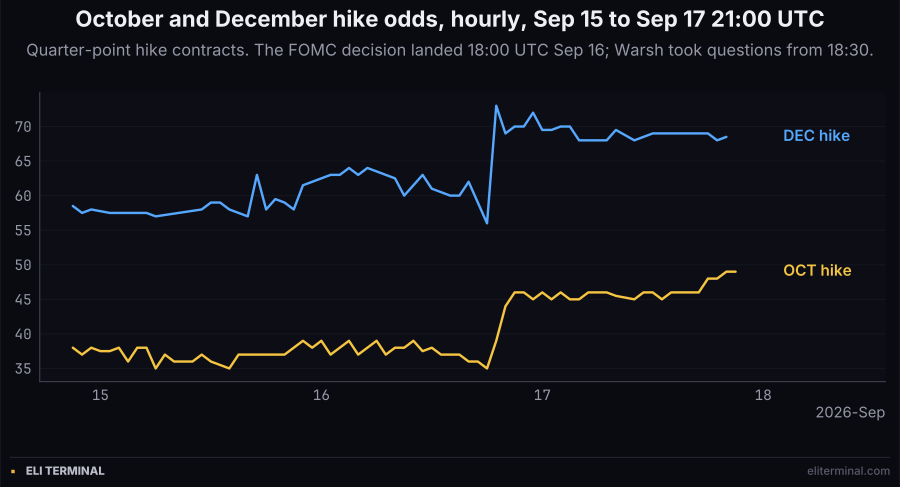
Both contracts did all their repricing inside the press conference hour on Wednesday. The flat stretch on the right is Thursday.
The S&P 500 took back the entire Fed day before New York opened, gold recovered everything the decision had cost it, and the October rate contract printed 46% in every hourly candle for twenty hours.
Both contracts did all their repricing inside the press conference hour on Wednesday. The flat stretch on the right is Thursday.
Kevin Warsh told the press room on Wednesday that he would not tell anyone what comes next. "I'm not in the forward guidance business," he said to Colby Smith of the New York Times, and to the Associated Press's Chris Rugaber: "I'm not a data point dependent guy. So I won't react one way or another to data that shows up on our doorstep" (Federal Reserve transcript).
Thursday tested that immediately. At 12:30 UTC the Labor Department reported 196,000 initial claims for the week ended September 12, down 10,000 and the lowest in two months (Bloomberg), and the Census Bureau put August housing starts at a 1.275 million annual rate, down 2.6% and under the 1.320 million consensus, with single-family starts up 7.6% and multifamily down 21.7% (Census).
Everything with a price reacted. In the forty-five minutes from 11:45 to 12:30 UTC the dollar index slipped to a session low of 100.02, SPY went from 760.13 to 763.54, gold added 1.3% to touch 401.65, and long Treasuries extended. The chair's reaction function may be switched off; the tape's is not.
The one thing that did not move was the market on the Fed itself. The October quarter-point hike contract closed the 11:00, 12:00, 13:00 and 14:00 UTC hours at 46%, 46%, 45% and 46%.
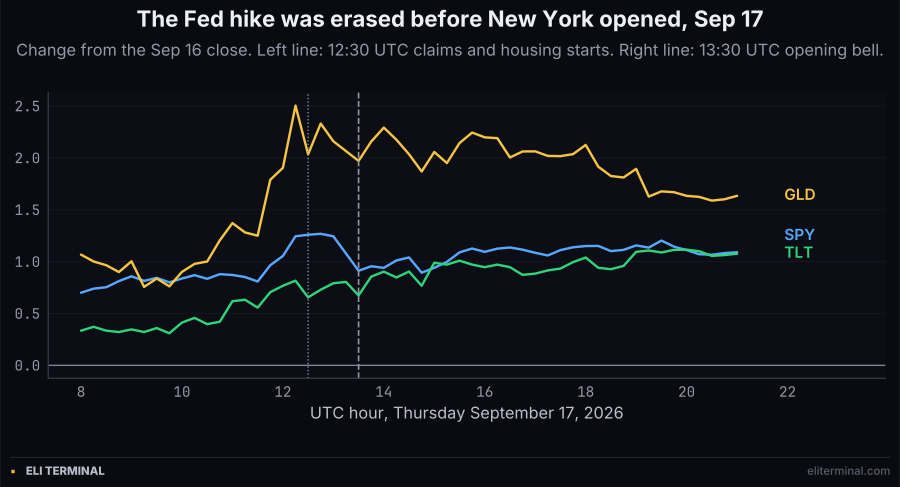
Dotted line is the 12:30 UTC claims and housing starts releases. Dashed line is the opening bell. The move is all to the left of it.
754.05 was where SPY closed on hike day, after Warsh's answers cost it 1.4% peak to trough. By 19:45 New York time that same Wednesday evening it was back to 757.47, and by 04:00 Thursday morning, 759.36.
The opening bell on Thursday came at 13:30 UTC with SPY at 763.15, up 1.21% on the day before the session had started. It closed at 762.60. Six and a half hours of American trading subtracted 0.07% from a rally that had already happened in Asia and Europe.
Bloomberg had the setup right the night before, running "US Stocks Primed to Rebound From Fed Day Slump as Futures Rally" while the cash market was shut. The rebound was not a Thursday decision. It was a Wednesday-night decision that Thursday ratified and then sat on.
Gold did the same thing in a bigger way. GLD had lost 3.05% from its 18:00 UTC high while Warsh spoke; it opened Thursday at 400.28, above where it traded before he took the podium, and closed at 398.36, up 1.69% on the day.
Six to three. The Bank of England's Monetary Policy Committee voted at 11:00 UTC to leave Bank Rate unchanged, with Megan Greene, Catherine Mann and Huw Pill all voting to go to 4%, against UK inflation at a five-month high of 3.1% (Euronews).
Bailey's warning was that the energy shock had not fed through yet. The longer the volatility persists, he said, the bigger the effect on inflation and the more likely the Bank has to raise. CNBC filed it as the Bank defying the Fed's lead.
Cable was 1.3405 in the 10:45 UTC candle and 1.3365 in the 11:00 one. Sterling lost 0.3% on the announcement itself and 0.67% across the day, the cleanest event join available anywhere on Thursday, and it ran the opposite way to every US asset.
Two of the largest central banks in the world took opposite decisions seventeen hours apart on the same inflation problem. Only one of them has a liquid contract quoting its next meeting.
Here is the number the day was supposed to produce, and did not. From the 21:00 UTC candle on September 16 through the 17:00 UTC candle on September 17, the Kalshi contract on a quarter-point October hike closed between 45% and 46% every single hour, and across those twenty hours no hourly high exceeded 46 and no hourly low fell below 45. A one-point range, on a market carrying $445,000 of volume.
That is not a market agreeing with itself. That is a market that spent Wednesday's press conference hour printing a 27 to 66 range, a 39-point span in sixty minutes, and then refused to touch the position again.
FinanceFeeds read the same picture from the other venue and published it Thursday, citing Polymarket at 45% as of 07:42 UTC, Kalshi at 47%, and fed funds futures at 50% (FinanceFeeds). Three venues, one number, no movement.
The contract finally lifted between 17:00 and 21:00 UTC, going 46, 48, 48, 49, 49, while Polymarket's thin no-change-in-October contract fell from 52.5% to 48.5%. No wire landed in that window that explains it. The December contract, meanwhile, spent the whole of Thursday between 68% and 70% and finished where it started.
"It's not clear to me we've slayed inflation," Jamie Dimon told Yahoo Finance on Thursday, pointing at global deficits and the capital demands of AI, remilitarization and infrastructure (Yahoo Finance). He also asked for light-touch federal AI oversight rather than a patchwork of state rules.
Something agreed with him. The Kalshi contract on September CPI printing above 3.6% year over year closed Wednesday's 23:00 UTC hour at 38%, ran to 44% overnight, and spent Thursday afternoon at 50%, touching 55% in the 20:00 UTC hour. Against 27% on Wednesday lunchtime, that is the probability of hotter inflation roughly doubling across the two days the Fed raised rates to fight it.
Treat the level with care: that contract carries about $35,000 of volume, which is a handful of participants, not a consensus. The direction is still the only large revision of the day, and it runs against the entire point of Wednesday's decision.
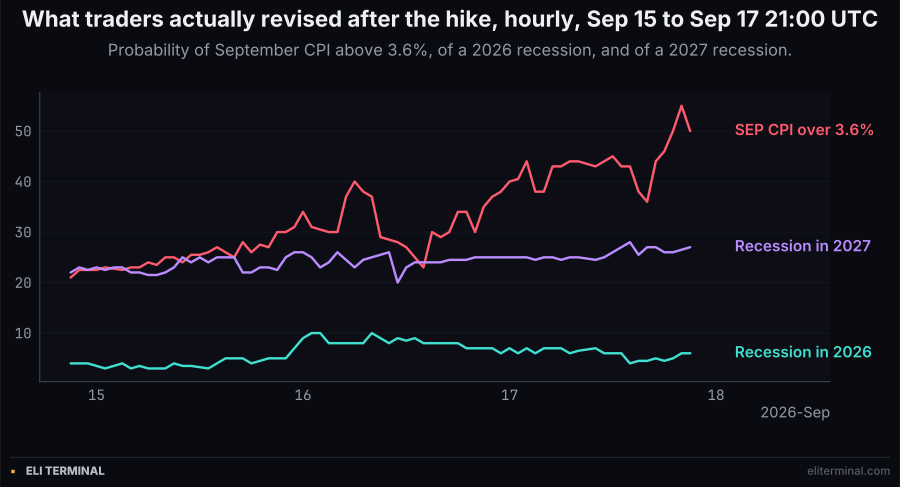
The 2026 recession contract carries $3.5 million of volume and is the deepest market shown here. The CPI contract carries $35,000 and is the thinnest.
The 2026 recession contract traded at 9% at 13:00 UTC on Wednesday, before the hike. It printed 4% in the 14:00 UTC hour on Thursday and closed at 6%, on $3.5 million of volume, the deepest book in this piece.
Over exactly the same stretch, the 2027 recession contract went from 23% to a 28% print at 14:00 UTC and settled at 27%. One hour, two contracts, opposite directions, same book of traders.
Nothing here says the market changed its mind about whether a downturn arrives. It moved the date. The same shape shows up in the rate market, where a hike neither vanished nor doubled and simply sat between an October meeting the market cannot call and a December meeting it half believes.
At King Charles III's AI summit in Scotland, with around thirty executives, policymakers and researchers in the room, Jensen Huang told reporters he expects Nvidia to sell twice as many chips in the coming year as this one, citing countries building their own AI infrastructure (CNBC, Bloomberg).
NVDA closed Wednesday at 213.90 and opened Thursday at 218.38, a 2.10% gap. It closed at 219.34. The American session, all six and a half hours of it, was worth 0.44%.
That is the same shape as the index: the reassessment happened in Europe and New York inherited it. It is also worth remembering what the doubling covers. Nvidia's own August guidance was 70% revenue growth, with Colette Kress saying a double was what supply constraints were preventing, so the chief executive's number is the supply-unconstrained case, not a raise.
Micron did better on a smaller stage. MU closed up 5.50% at 977.50 after Intel's Lip-Bu Tan warned that memory prices have risen five to seven times and that capacity gets worse next year (Yahoo Finance). Generac rose 18.3% to 207.23 on the Amazon backup-generator agreement worth up to $8 billion, of which $2.4 billion is actually scheduled, for 2027 and 2028.
KRE settled at 72.74 on Wednesday and 72.74 on Thursday. To the cent, on the two sessions bracketing the first Fed rate rise since 2023, having traded as high as 73.79 and as low as 72.57 in between.
The fund had fallen 3.19% high to low while Warsh answered questions. It opened Thursday at 73.53, gave it all back through the afternoon, and landed on its own prior close. Every other risk asset on the board revised; the most rate-sensitive basket in the market declined to.
Energy did something similar with the day's actual news. WTI settled at $101.91, down 52 cents, and Brent at $104.82, down $1.01, after reports that Saudi Arabia was routing more crude through the Strait of Hormuz by ship-to-ship transfer near Sohar to cover the shut East-West pipeline (CNBC). Energy Secretary Chris Wright put 18 million barrels of crude and products through the strait that week. XLE rose 0.70% anyway.
The Independent International Fact-Finding Mission on Iran found reasonable grounds to believe the United States committed a war crime through indiscriminate attacks, including Tomahawk strikes on the Tree of Tayyiba Elementary School in Minab that killed more than 150 people, about 120 of them children, and separately found crimes against humanity by the Iranian government (NBC News, Al Jazeera).
The contract on a US invasion of Iran before 2027, which carries $333,000 of volume, closed the 21:00 UTC hour on Wednesday at 16.5% and closed every single hour of Thursday at 16.5%. The dollar index finished at 100.23, flat. Crude fell on shipping logistics.
One market did move, a day late. Polymarket's thin contract on a US-Iran diplomatic meeting by September 30 sat at 5.5% through the whole session and then doubled to 11% in the 19:00 UTC hour, twenty-four hours after Trump claimed in North Carolina that he had spoken to Tehran directly and that the war was near its end (Al Jazeera).
Paul Atkins's SEC granted a five-year conditional exemption at 14:54 UTC letting tokenized-stock venues operate without registering as exchanges (SEC). Bitcoin closed the Thursday session at 76,403.77, up 0.33%. Crypto equities took the news and the underlying did not.