Two releases, two different markets
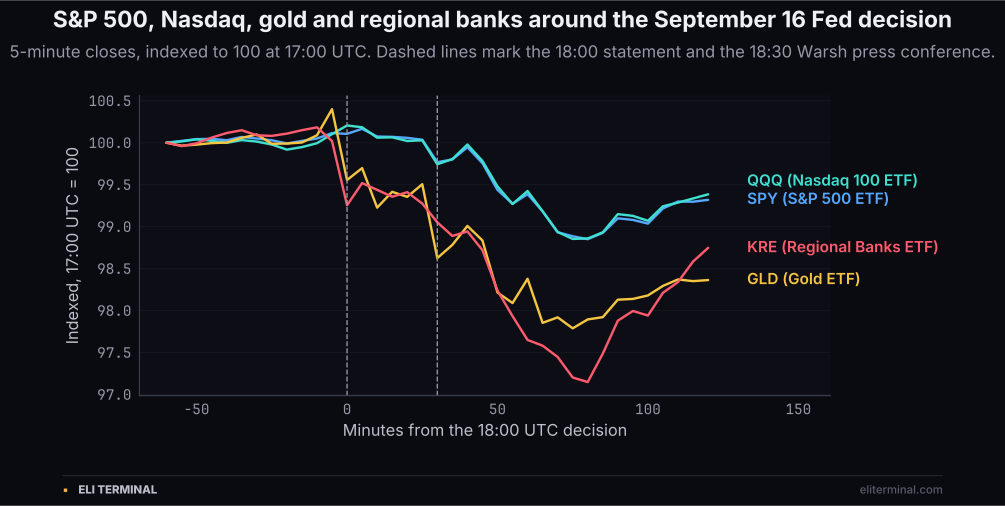
Gold and regional banks traded the 18:00 release. The S&P 500 and the Nasdaq 100 did not move until Warsh started talking thirty minutes later.
Gold and regional banks traded the 18:00 release. The S&P 500 and the Nasdaq 100 did not move until Warsh started talking thirty minutes later.
At 2pm in Washington the Federal Open Market Committee raised the target range for the federal funds rate by a quarter point to 3.75%-4%, the first increase since July 2023, by a vote of 12-0. Kalshi's contract on a September hike had traded between 86% and 89% for the previous two days and printed its last candle at 88%. Nobody was surprised and the tape showed it: the S&P 500 tracker opened the 18:00 UTC bar at 760.18 and closed it at 759.97.
What actually changed sat in two short sentences near the end of a statement that ran 114 words. The action, it said, "will support a timelier return" to the committee's 2% goal, and then the last line dropped the conditional language entirely: "The Committee will deliver price stability." That is a promise, not a projection.
CNBC's redline caught what came out: the language about supply shocks and sector-specific price increases, the wording that had let the committee treat inflation as somebody else's problem. In came resilient domestic spending, strong productivity, robust capital investment and uncertainty "owing, in part, to geopolitical developments."
The Summary of Economic Projections released alongside it was the harder document. In June the median participant had the funds rate at 3.8% at the end of this year and 3.6% at the end of next. In September those medians are 4.1% and 4.1%.
A whole year of easing came out of the forecast in one afternoon. The committee now has the rate above 3.875% until 2028 and does not get PCE inflation back to 2% until 2029.
Gold read that page immediately. The gold tracker made its high of the day at 400.60 in the minute before the release and was at 394.90 fifteen minutes later, and front-month gold futures went from 4413.10 to 4349.10 in the same window. Regional banks fell with it. The S&P 500 and the Nasdaq 100 sat still.
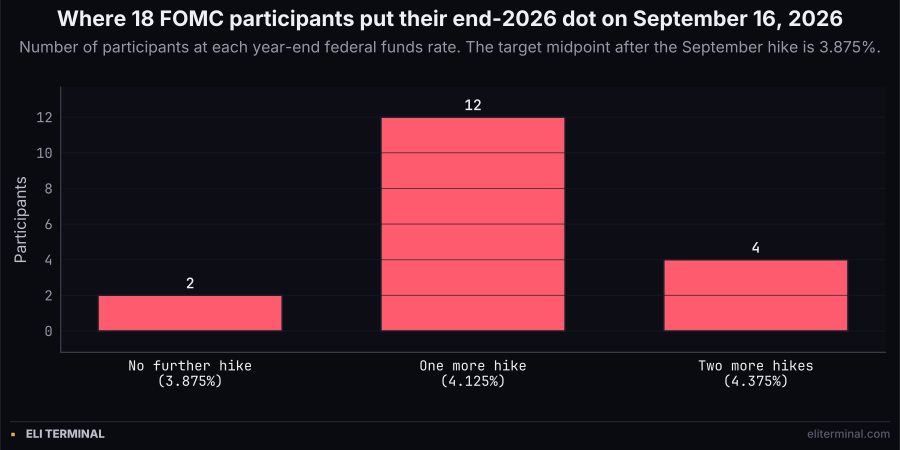
Sixteen of the eighteen participants penciled in at least one more increase this year. Two put the committee's work at done.
Warsh walked out half an hour after the release, and by the rules he had set there would be no follow-up questions and the microphone would be taken back after each reporter's first one. Bloomberg clocked the whole thing at right around thirty minutes, the shortest since Fed chairs started doing these in 2011.
He was still reading prepared remarks when the market broke. Between 18:30 and 18:35, with no reporter having spoken, the S&P 500 tracker fell from 759.64 to a low of 757.54 and the gold tracker dropped 3.83 points.
The lines he was reading are the reason. Warsh called inflation "too high and has been for too long," said this summer's readings "do not tell me that underlying trends have meaningfully improved," and then delivered the sentence the desk had been waiting on since Jackson Hole.
I would be hard-pressed to describe broad financial conditions as restrictive. This view was widely shared by the Committee. So we removed a dose of accommodation. Kevin Warsh, opening remarks, September 16
Removing a dose implies there are more doses. Nothing in the transcript after that point made the implication go away.
The second question of the afternoon went to Colby Smith of the New York Times, who asked the only question that mattered to anyone holding risk: when the Fed starts raising rates it usually keeps going, so is there anything different this time?
This won't surprise you, I'm not in the forward guidance business. The decision we made today was a sober decision, serious decision, responsible decision, one that we have been preparing for and thinking about in my 110 or 20 days here. You heard from other people in the dots effectively, what their forecasts are. I'm not going to pre-judge any future decisions we make. Kevin Warsh, answering Colby Smith, New York Times
Next up was Edward Lawrence of Fox Business, who quoted the market's own number back at the chairman, put the priced-in odds of the hike at 90% and asked whether this had been a market-led decision. Warsh said the Fed has "an enormous amount of power," that the balance between markets and the central bank "could be better struck," and finished: "Sometimes the market tries to pre-judge our outcomes. I'll observe market prices and see what they have to say. But today was our decision."
Asked by Elizabeth Schulze of ABC News what his message was to a president who has demanded cuts, he said: "I've got nothing for you on the discussion with the president." Chris Rugaber of the Associated Press raised the morning's retail sales report, a 1.2% jump in August, and got "I'm not a data point dependent guy."
Kalshi's October hike contract, a market carrying roughly $445,000 of volume, spent the whole day between 35% and 38%. It then fell on the statement, to a low of 33% inside the 18:00 hour and a 35% close.
Traders read the 114 words and concluded the Fed had gone one and done. Then Warsh spoke, and inside the single hour beginning 19:00 UTC that same contract printed a high of 66% and a low of 27% before closing the hour at 39%. It finished the session at 46%.
December went the other way and stayed there. The December hike contract slid from 61% in the morning to 56% by 18:00, then ripped to 73% while Warsh was still at the podium and settled around 70%. The market's answer to Colby Smith's question, which Warsh would not give, was: yes, a sequence, and the next one is more likely in December than in October.
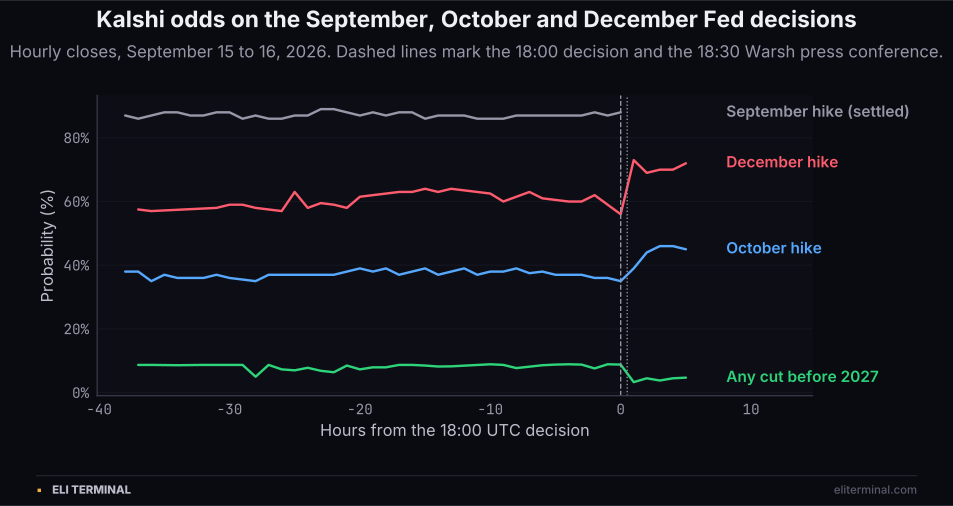
October fell on the statement and rose on the press conference. The cut contract, the deepest of the four, went from 8.7% to a 0.3% print in a single hour.
Kalshi's contract on any rate cut before 2027 carries $1.33m of volume, three times the October market and thirteen times December. It sat at 8.8% when the statement crossed at 18:00.
Inside the 19:00 hour it printed 0.3%. It closed the session at 3.8% and was near 4.7% by 23:00. Whoever was holding the yes side of the deepest Fed contract on the board took the worst of the afternoon, and they were on the side that had been right about September.
Neil Irwin of Axios asked about the long end, and Warsh gave three reasons for the year's rise in yields: a strengthening economy, geopolitics, and one answer a Fed chair does not usually give.
The surge in capital expenditures, which I referenced in my remarks, is real, and the so-called hyperscalers are out in the market raising funding, and so the competition for capital is real and I think it partly explains the increase in yields. Kevin Warsh, answering Neil Irwin, Axios
He had called the ten-year Treasury "the most important asset anywhere in the world" two sentences earlier. It closed the 18:50 five-minute bar at exactly 5.000% and the 18:55 bar at 5.006%, its high of the day.
The curve did not move in parallel, and that is the tell. The five-year yield rose 3.3bp on the day and closed at its high of 4.859%; the thirty-year fell 1.5bp to 5.349%. Bond traders bought the near-term tightening and took risk premium out of the far end.
The Dow closed down 631.21 points, off 1.21%, having been down 906 points at 19:25 UTC. Financials led it: Bank of America lost 2.72% and traded as low as -3.93%, regional banks fell 1.77%, JPMorgan 1.01%.
Nvidia, meanwhile, gained 0.82%, and the Nasdaq 100 tracker finished the session green by three basis points. On the day the Fed made money more expensive, the market sold the institutions that lend it and bought the company everyone is borrowing to buy from.
Credit did not flinch at all. High-yield was up 0.05% and investment grade up 0.16%, which is the market saying a quarter point and a hawkish dot plot are a valuation problem for equities and not yet a solvency problem for borrowers.
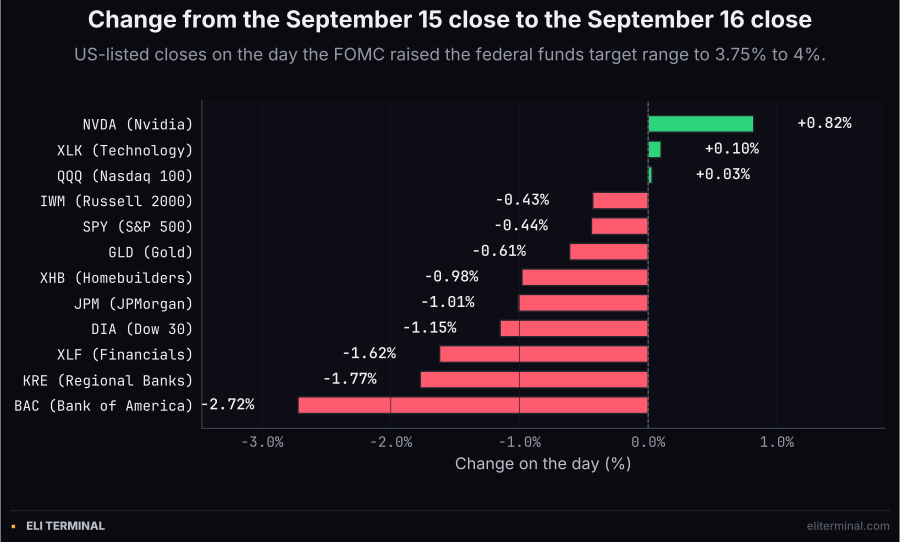
Bank of America down 2.72%, Nvidia up 0.82%, on the same session and the same news.
The president's response came later that afternoon. Trump wrote on Truth Social that rates "should be 1%, or less, because we are the Best Credit in the World," then told reporters something more interesting: "I talked to Kevin and I said you might as well vote with the board because it's not going to matter." He added that he still has confidence in Warsh.
Warsh had spent his half hour at the podium declining to confirm that the conversation existed. The president confirmed it himself before the day was out.
And the market did nothing with any of it. Polymarket's contract on Warsh leaving the Fed before June 30, 2027, which carries about $20,000 of volume, sat at 10.5% through the decision and the press conference and closed at 10.0%. A thinner market on whether Trump insults Warsh by name before September 30 fell rather than rose, though at under $900 of volume that is one trader's read, not the market's.
The hike was the easy part. It had been a coin flip at 53% a week earlier; after the August CPI print on September 11 the September contract never traded below 75%, and the 12-0 vote arrived exactly as advertised.
The sequel was the hard part, and the market blew it in both directions inside ninety minutes: too dovish at 18:15, when October was bid down to 33%, and arguably too hawkish at 19:00, when the same contract touched 66%. Diane Swonk of KPMG read the same documents and moved her house to three total hikes.
Michael McKee of Bloomberg put the contradiction to Warsh directly: the statement promises a timelier return to 2%, the projections push 2% out to 2029. Warsh's answer was that the projections are not his. "Those are the forecasts of my 18 colleagues, and I've tried to represent them dutifully to you."