Two days of a bill dying, in two layers
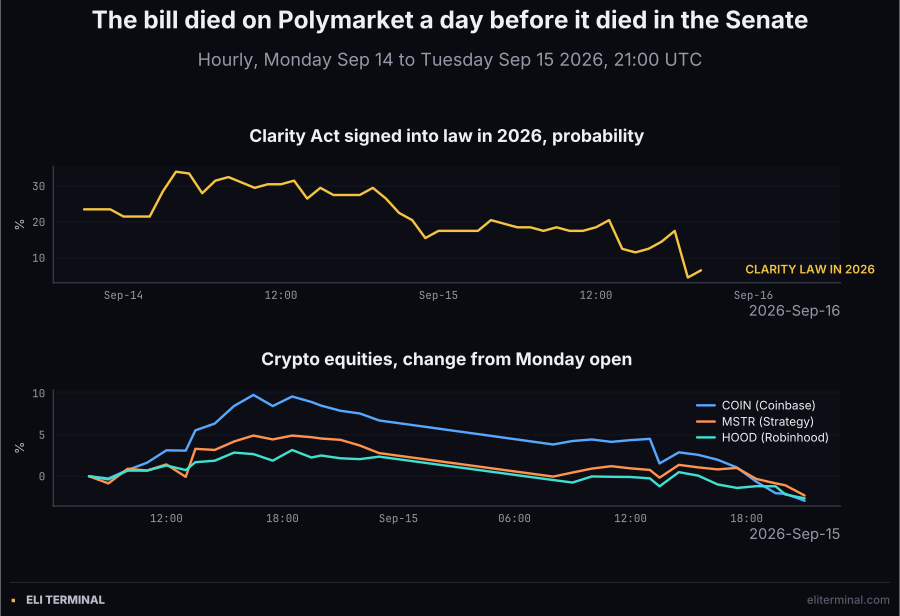
The gold line loses two thirds of its value on Monday night. The equities take until Tuesday afternoon.
The Senate blocked the crypto market-structure bill minutes after 18:15 UTC and Coinbase fell 10.1%, but a 546,000 dollar prediction contract had already cut the bill from 34% to 12.5% before New York opened.
The gold line loses two thirds of its value on Monday night. The equities take until Tuesday afternoon.
At 2:15 in the afternoon in Washington the clerk began calling the roll on the motion to proceed to H.R. 3633, the Digital Asset Market Clarity Act. It failed, 49 to 50, with no Democrat voting yes (Yahoo Finance). Cloture needs sixty.
Cynthia Lummis had already said what that would mean. The Wyoming Republican, the industry's most reliable Senate advocate, told reporters earlier the same day that if the procedural vote failed, "it's over" (CNBC).
The bill did not die over the SEC and CFTC split the industry had spent a year negotiating. It died over ethics language covering officials' crypto holdings. Senate Democrats sent a counteroffer overnight seeking broader coverage of federal officials' relatives, Republican negotiators rejected it before the roll call opened, and Ruben Gallego explained his no vote this way: "All President Trump wants is for the Senate to give him time to crime, and I won't support any piece of legislation that enables him" (Gallego's office).
John Thune had filed cloture on the bill back on August 8, which is what fixed the vote to September 15 in the first place (The Block). Everyone had five weeks to price it.
The deepest contract on the question, a Polymarket market on whether the Clarity Act gets signed into law this year with 546,000 dollars behind it, printed 34% at 04:00 UTC Monday. That was hours after Republican leaders released a revised 630-page draft carrying new ethics restrictions. Coinbase rose 9.2% that session to 191.45 and Strategy rose 4.6%.
Then Democrats tabled their counterproposal. By 23:00 UTC Monday the contract was 15.5%, and by 14:00 UTC Tuesday it was 12.5%. Coinbase opened Tuesday at 183.62, down 4.1% from Monday's close, before a single vote had been cast.
Somebody bid it back up anyway. Between 15:00 and 17:50 UTC the contract climbed from 11.5% to 19.5%, and it was still at 16% ten minutes after the roll call opened. Whoever bought that last leg paid roughly three times what the position was worth half an hour later.
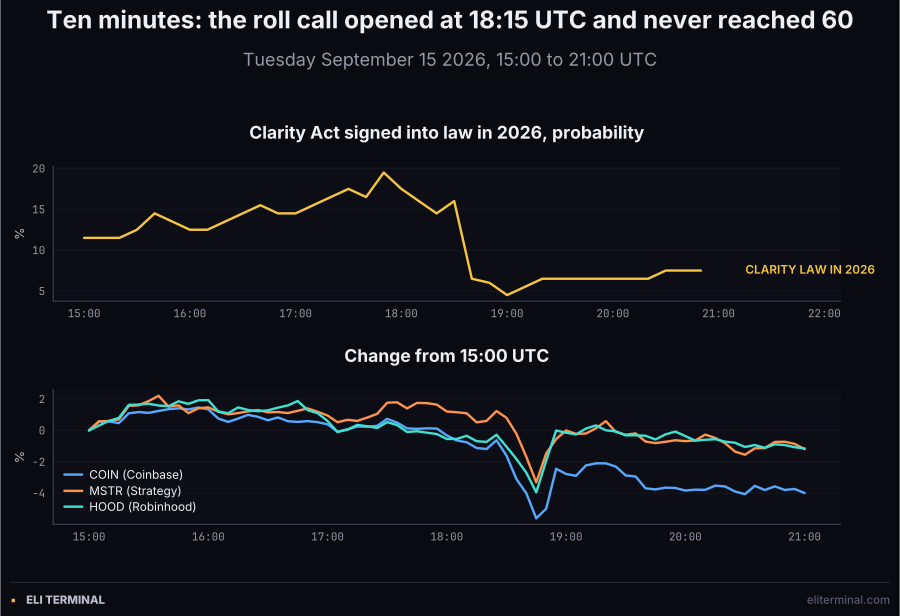
Both layers break in the same ten minutes. Only one of them had been telling the truth since Monday.
18:40 UTC. The contract printed 6.5%, down from 16% ten minutes earlier, a two-thirds loss on a market that had traded more than half a million dollars.
The tape broke in the same ten minutes. Coinbase went from 177.50 at 18:30 UTC to a 168.07 low inside the 18:45 bar, down 5.3%. Strategy printed 125.44 against 132.01, Robinhood touched 105.86 against 110.21, Bitcoin bottomed at 74,931 and Ethereum at 2,357.
The recovery was faster than the break. Fifteen minutes after the low Robinhood was back at 110.52, within a dime of where it stood before the vote, and Strategy had retraced to 129.74. Coinbase closed the session at 172.11 and never got back to its pre-vote price.
Read together, that is an air pocket rather than a repricing. The repricing had happened twenty hours earlier on a venue that stays open all night, and the 4pm ET closing prices simply arrived at the number the contract had been quoting since Monday.
87% at midnight UTC, 89% at the New York close. Kalshi's contract on a quarter-point hike at Wednesday's meeting spent all of Tuesday inside a three-point band, on the eve of what would be the Federal Reserve's first increase in three years.
The New York Fed's Empire State survey landed at 12:30 UTC at 7.6, against a 14.1 forecast and 20.6 in August, the slowest expansion in the series since June (New York Fed). Ten-year yields slipped less than three basis points in the forty minutes after. The hike contract did not move at all.
August retail sales, the other number that could have argued with the Fed this week, was not due until Wednesday morning. Tuesday had no data with the standing to change anything, and the market priced it that way.
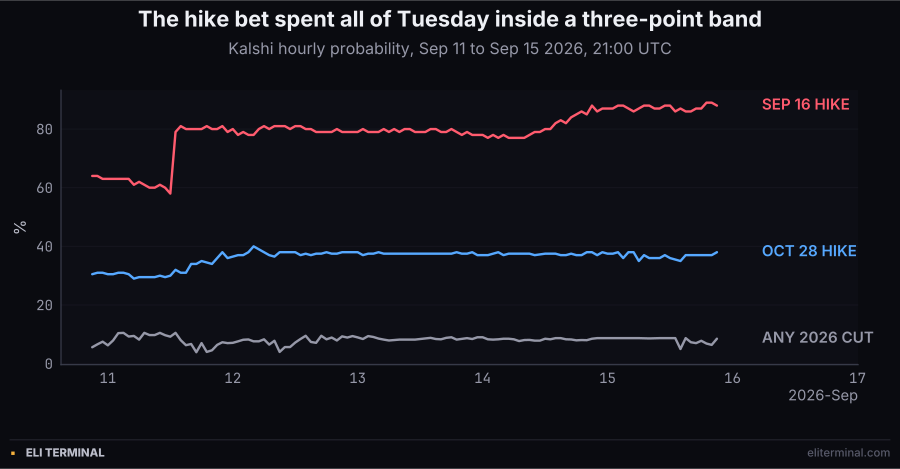
The last real move in the red line was Friday's CPI print. Tuesday added nothing.
The October contract is the one still carrying an argument. Kalshi's market on a hike at the October 28 meeting sat at 37% through Tuesday and closed there, which reads as Kevin Warsh raising on Wednesday and then stopping to look around. The contract on any 2026 cut traded down from 8.7% to 6.4%.
Shipping sources told Reuters that crude loadings had been suspended at Yanbu, Saudi Arabia's Red Sea export hub and the outlet the kingdom has leaned on since the Strait of Hormuz closed. WTI settled at 105.83, up 4.38%, after trading as low as 101.21 in the morning. It was the largest move of the day in anything liquid.
The East-West pipeline feeding Yanbu has been shut since September 11 after drone attacks launched from Iraq, and three pumping stations are now confirmed damaged with repairs running as long as five or six weeks (CNN, CNBC). Polymarket's market on a restart by September 30 fell from 44% at 13:00 UTC to 38% at 15:00 while WTI ran from 101.80 to 105.00, then bounced back to 48.5% an hour later on 28,000 dollars of lifetime volume, which is thin enough that one trader changing their mind moves it.
Energy was the only sector that worked. XLE rose 2.17% against a 0.45% decline in the S&P 500 and a 0.96% decline in the Russell 2000.
The 10-year traded above 5% for the first time since 2007 on Tuesday morning, with Bloomberg and CNBC putting the high at 5.04%. Treasury's own constant-maturity series closed it at 5.00%, three basis points above Monday, with the 30-year at 5.36% and the 20-year at 5.40%.
At 17:00 UTC Treasury sold 20-year bonds at a 5.420% high yield, on a 2.57 bid-to-cover with indirect bidders taking 52.5%, the weakest indirect share of the month's long-end sales. The 30-year yield did not rise on it. Thirty-year futures-hour prints ran 5.378% around the auction and 5.364% by late afternoon, and the constant-maturity close at 5.36% was two basis points above Monday. A soft sale at the highest yield the tenor has printed since it was reintroduced in 2020, and the long bond ended the day roughly where it started.
Scott Bessent spent that same afternoon at House Financial Services. Asked how the administration would fund Donald Trump's promised 5,000 dollar checks, the Treasury Secretary said "there are ways to do it that would not affect the deficit" and declined to name one, adding that Treasury was still researching whether Congress would need to authorize them at all (Yahoo News). His remarks and the auction result landed roughly ninety minutes apart. Nothing in the tape connects them.
Volatility never showed up for any of it. The VIX closed at 17.20, ten one-hundredths of a point above Monday, on the day before a rate decision the whole market believed was coming.