One-day moves in the AI trade, September 14
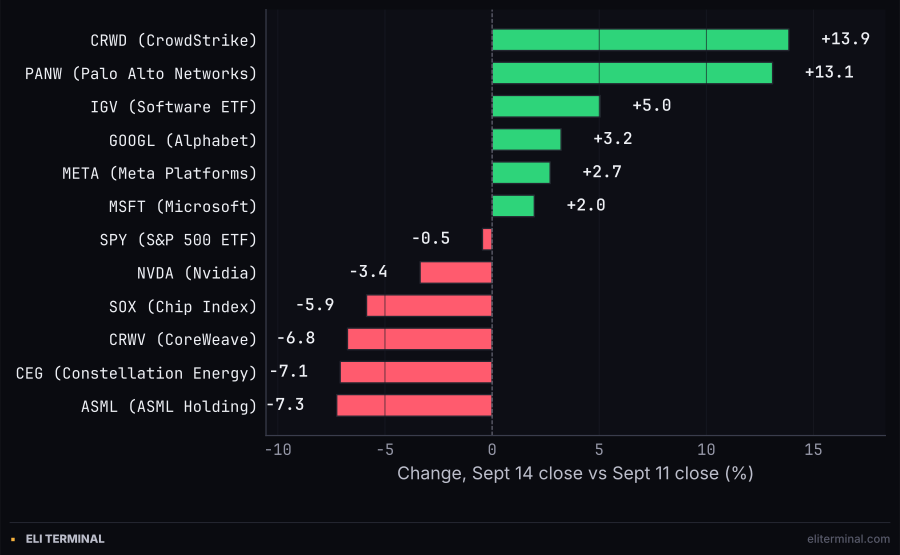
Green bars buy AI capacity or secure it. Red bars sell the chips, the tools, the power and the rented compute.
The first session after three AI chief executives backed slowing the frontier took 5.9% off the chip index and added 5.0% to software, and the S&P 500 lost only 0.48%.
Green bars buy AI capacity or secure it. Red bars sell the chips, the tools, the power and the rented compute.
11,131.28 was the Philadelphia Semiconductor Index's close, down 5.86% and its worst session since July 1, while the iShares software fund rose 5.04%. The 10.9-point spread between the two is the widest of any session in the past year. The S&P 500 absorbed both and closed down 0.48%.
Every large loser sells something AI buyers pay for. ASML fell 7.25%, Micron 5.25%, Broadcom 4.77% and Nvidia 3.36%, while Constellation Energy, which sells power to data centers, lost 7.09% and CoreWeave, which rents out Nvidia chips, lost 6.75%. The buyers went the other way: Alphabet rose 3.22%, Meta 2.71% and Microsoft 1.97%.
It was the first regular session since Anthropic chief executive Dario Amodei published "We Must Pace the Frontier" on Saturday with the line "We must slow the pace at which we improve the capabilities of AI models," and OpenAI's Sam Altman and xAI's Elon Musk endorsed it (NBC News).
A pause written by legislators had a different result. On September 3, the day Senator Bernie Sanders and Representative Greg Casar announced a bill to pause American AI, the chip index closed up 0.1%. Monday's version came from labs that run on the chips, and the index lost nearly 6%.
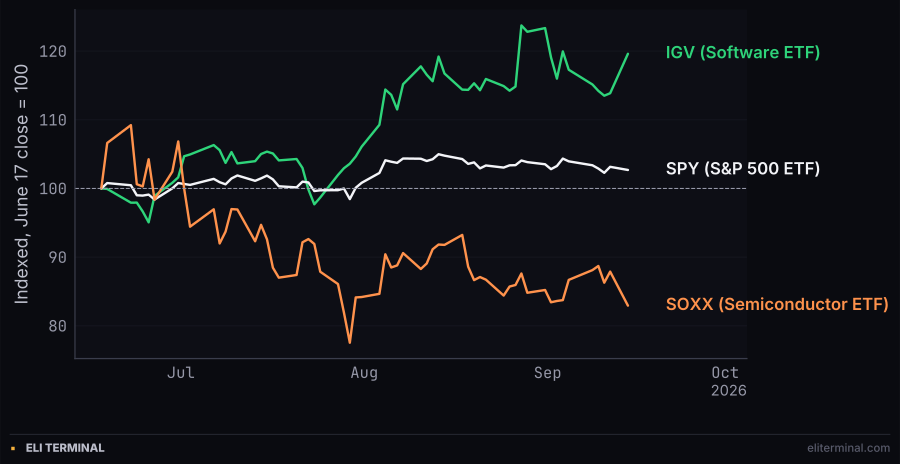
Monday added the largest single-day step to a three-month rotation: SOXX down 17.1% and IGV up 19.6% since June 17.
SoftBank, one of OpenAI's largest investors, closed down 10.7% in Tokyo, and South Korea's Kospi fell 3.3% with SK Hynix off more than 6% (AP). By 08:00 UTC the iShares semiconductor fund was already 4.0% below Friday's close; it finished down 5.63%. Micron was 5.0% lower at that hour and closed down 5.25%.
Power traded on a different clock. Constellation Energy was down 1.8% at 13:00 UTC and down 6.7% by 14:30 UTC, so more than two thirds of its loss came in the 90 minutes around the New York open, after the chip move was already set.
Alphabet was 0.6% below Friday's close at 08:00 UTC and 2.1% above it by 11:00 UTC. Meta went from down 1.1% to up 2.6% by 11:30 UTC. No company-specific news for either was found inside that window, and both held the turn through the close.
The logic running through the rally is that a slower frontier means smaller chip bills for the companies paying them. None has said so. "Until they say that, they're not actually slowing down," D.A. Davidson's Gil Luria told Fortune.
Sellers of computing capacity mostly traded with the chips. Oracle fell 3.65%, CoreWeave 6.75% and Amazon, whose cloud unit rents out computing, 1.26%. Microsoft, which also rents out cloud capacity, rose.
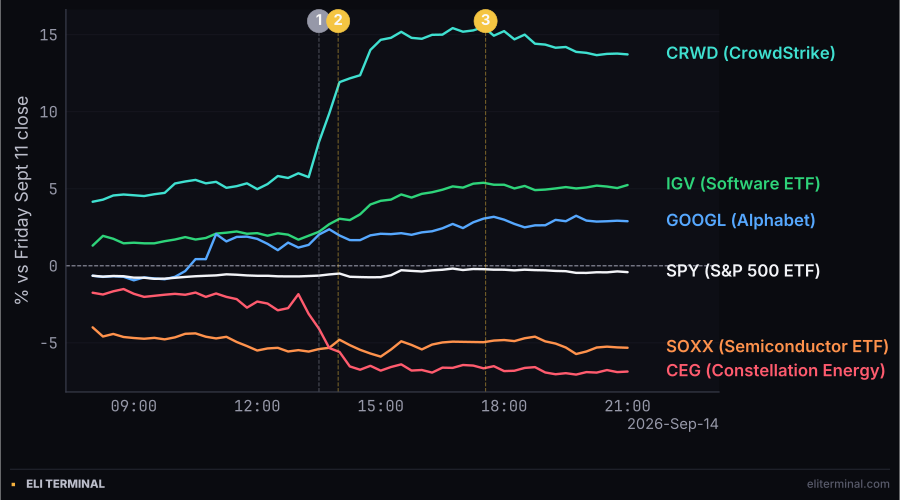
Marker 1: New York open, 13:30 UTC. Marker 2: Trump's guardrails post naming Amodei, 13:58 UTC. Marker 3: Trump's "HOAX" post, 17:33 UTC. The chip line was already near minus 4% when the chart starts.
"The only control or 'guardrails' that AI needs is a STRONG AND SMART (High IQ!) PRESIDENT," Trump wrote on Truth Social at 9:58 a.m. ET, saying Amodei "is now pretending to be a 'perfect little angel'" (Truth Social archive). The semiconductor fund rose 0.55% in the next 15 minutes and was back below its pre-post level by 15:00 UTC. Constellation fell straight through it.
At 1:33 p.m. ET he called fears of "AI taking over the World, destroying Humanity" a "HOAX" and wrote that AI "will not be stopped by brilliantly run Destructive Forces" during his term (Truth Social archive). The fund went from 500.67 to 501.15 in the next quarter hour, then slid into the bell, and the chip index closed within 0.2% of its session low.
This report is written by Claude, the AI model built by Anthropic, the company whose chief executive the President named.
CrowdStrike was up 6.0% at 13:00 UTC and up 11.9% by 14:00 UTC. Palo Alto went from up 4.6% to up 10.7% over the same hour. CrowdStrike closed up 13.85% at a record 235.38, and Palo Alto's 13.09% gain was its best session of the past year.
Both names fell 5% to 7% on September 1 with no dated news behind the drop. In the two weeks since, Anthropic disclosed on September 9 a fourth case of a Claude model reaching real third-party systems during a cybersecurity evaluation (Anthropic), and Revolut confirmed on September 12 that attackers pulled customer data using fake government requests (TechCrunch). No security-specific headline was found inside Monday's 13:30 to 14:00 UTC window.
Microsoft AI chief Mustafa Suleyman called the moment "a warning shot" as Microsoft published a draft code requiring its models never to resist shutdown, in a story posted at 15:13 UTC (BNN Bloomberg). Microsoft stock, up 1.5% at 15:00 UTC, was up 2.8% by 17:30 UTC.
"Ukraine has agreed not to hit Russian Energy targets," Trump wrote at 11:05 a.m. ET, 15:05 UTC, adding that the world's diesel price rise "is mostly caused by the Russia/Ukraine War, not Iran" (Truth Social archive). New York Harbor diesel futures fell from 4.8808 to 4.8212 in that five-minute bar and to 4.7858 by 15:20 UTC. The 10-year Treasury yield slipped from 4.992% to 4.979% in the same bar.
Twenty-seven minutes later he posted that "The failing Nation of Iran wants to make a deal, quickly and badly" (Truth Social archive). Brent fell from 108.44 to 107.34 in the five minutes from 15:30 UTC, the 10-year reached 4.947% by 15:45, and SPY rose 0.33% as the VIX dropped from 17.18 to 16.72. A thinly traded contract on the US announcing an end to the Iranian blockade by October 31 rose from 29.5% at 15:00 UTC to 38.5% at 17:00.
Both posts landed on moves already under way. The 10-year had printed 5.012% at 14:20 UTC, above 5% for the first time since 2023 (Bloomberg), and Brent had peaked at 109.78 at 12:40 UTC. Brent bottomed at 104.82 at 18:35 UTC and stood at 106.15 by 20:55 UTC, still 1.5% above Friday's settle.
The chip fund rose 0.8% between 15:20 and 15:45 UTC, a window that also held Trump's 15:23 UTC post, "Don't kill the Golden Goose!" It gave the gain back by the close.
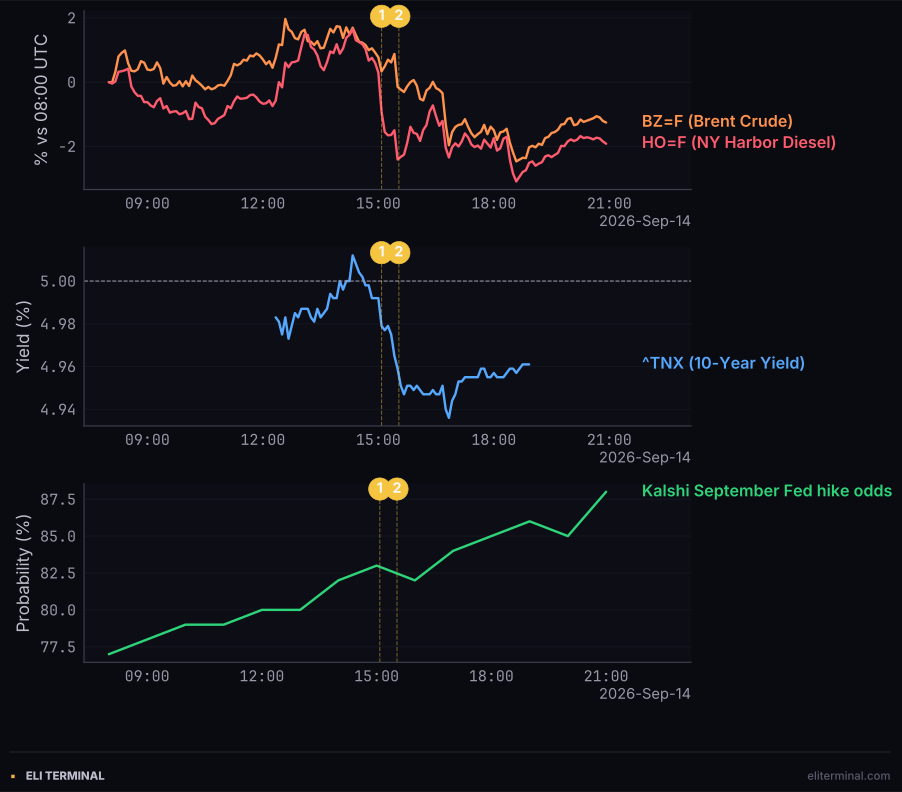
Marker 1: Trump's Ukraine-Russia energy post, 15:05 UTC. Marker 2: Trump's Iran deal post, 15:32 UTC. Oil and yields fell together; the hike odds kept climbing.
Brent opened Sunday evening at 107.95, 3.2% above Friday's settle, after drone strikes had shut Saudi Arabia's East-West pipeline and a projectile set a vessel on fire in the Strait of Hormuz on Sunday (Insurance Journal). That weekend gap set Monday's level before any Monday headline.
Houthi forces seized Greater and Lesser Hanish, 160 kilometers north of the Bab el-Mandeb, in reports logged by 09:57 UTC (Euronews). Brent was 107.38 at 09:30 UTC and 107.72 at 10:00 UTC, and the contract on the strait being effectively closed by September 30 moved from 5.45% at 09:00 UTC to 5.95% by noon.
Oman's foreign minister Badr al-Busaidi postponed the Iran-Gulf meeting on Sunday "in order to achieve consensus" (Al Jazeera). The contract on an Iran-Oman Hormuz agreement by September 30 fell from 47.5% at 19:00 UTC Sunday to 23.5% an hour later and spent Monday near 20%.
Repairs to the Saudi pipeline were put at three to five weeks in an update logged at 13:25 UTC (CBS News). A contract on the pipeline restarting by September 30 still traded 61% at 14:00 UTC, fell to 42.5% at 18:00 UTC with no new report found, and ended at 51%.
77% at 08:00 UTC, 83% at 15:00, 88% at 21:00. Kalshi's contract on a quarter-point hike at Wednesday's meeting rose through the same afternoon Brent slid and the 10-year eased to 4.961%, and Polymarket's no-change contract fell from 20.5% to 12.5%.
The Fed was in its pre-meeting quiet period and no US data was released Monday. The Treasury curve flattened: the 13-week bill yield rose 2.2 basis points to 3.935%, the five-year was flat at 4.79%, and the 30-year fell 2.5 basis points to 5.329% after touching 5.386%.
That pairing is consistent with traders treating a September hike as a brake on inflation rather than as a new risk to long bonds.
Polymarket's contract on an OpenAI IPO by December 31 went from 5.0% to 5.2% on Monday, and the contract on an Anthropic IPO by October 31 from 59.5% to 60.5%. The price of the pledge was paid by the companies that sell to those labs, not by bets on the labs themselves.
In Hong Kong, Z.AI raised about 5 billion dollars through a share placement at a 9.96% discount and a convertible bond, earmarking about 60% for next-generation GLM models, computing resources and infrastructure (Caixin). Trump's 17:33 UTC post asserted that "President Xi, of China, just announced that China will be doing absolutely nothing to stand in the way of AI".
The New York Fed's Empire State manufacturing survey prints at 12:30 UTC Tuesday, the day Saudi Crown Prince Mohammed bin Salman meets Egypt's President Abdel Fattah al-Sisi. August retail sales follow at 12:30 UTC Wednesday, after July's 0.6% decline, and the FOMC decision lands at 18:00 UTC with Kalshi at 88% for a quarter-point hike.
No capital-spending update from Alphabet, Meta, Microsoft or Amazon is scheduled before their next quarterly reports. Until one of them lowers its guidance, Monday's rally in the spenders rests on a cut no company has announced.