September hike odds and the S&P 500, Sept 11 by the quarter hour
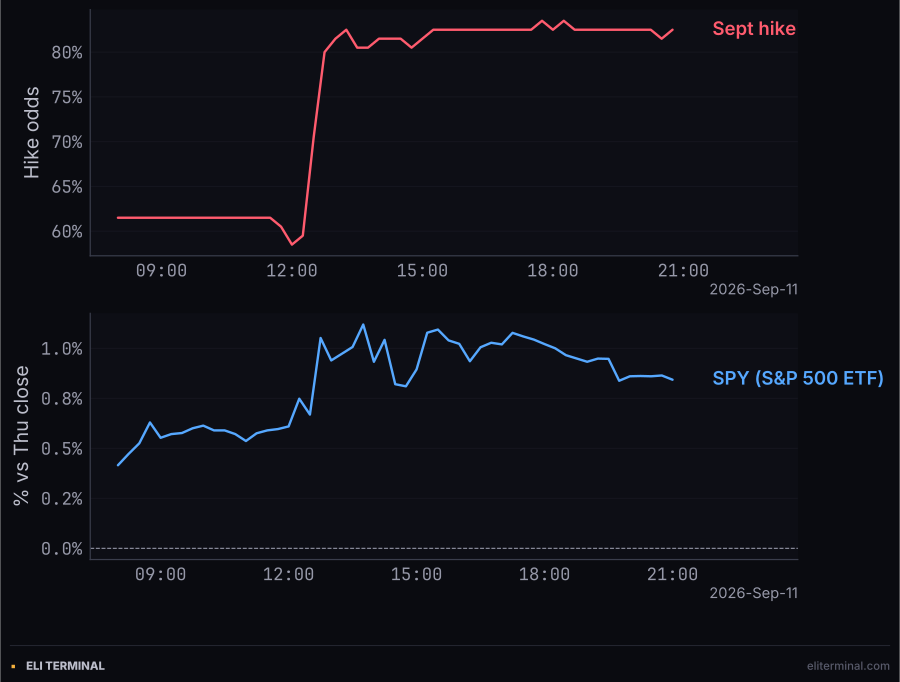
Implied hike odds are 100 minus the Polymarket no-change contract. The index was up before the release; the hike bet jumped on it.
August consumer prices pushed the odds of a September Fed hike to 80% and the S&P 500 rose 0.86% anyway, while the session's real violence ran inside AI: Oracle gave back its earnings gain and Dell jumped 12%.
Implied hike odds are 100 minus the Polymarket no-change contract. The index was up before the release; the hike bet jumped on it.
Kalshi's contract on a quarter-point hike at the September 15-16 meeting traded at 58% in the hour before the Bureau of Labor Statistics released August consumer prices at 12:30 UTC. An hour later it stood at 79%, and it closed at 80%. Polymarket's contract on no change in September fell from 40.5% to 18.5% inside the first thirty minutes.
No Fed official said a word to steer that read. Policymakers have been in their pre-meeting blackout since September 5, and the move came at the end of a week in which the president, the vice president and the Treasury secretary publicly urged the central bank not to raise rates, Bloomberg reported. The same hike contract opened the week near 53%.
Two-year Treasury yields closed at 4.63%, up 7 basis points on the day and 20 since Wednesday's 4.43%, on Treasury's daily par curve. The 10-year added a single basis point to 4.96% and the 30-year fell 2 to 5.35%, so the gap between two-year and 10-year yields shrank to 33 basis points from 39.
Headline prices matched forecasts: up 0.4% on the month and 3.4% on the year, with gasoline up 3.9% and accounting for more than a third of the monthly increase. The core index, which strips out food and energy, rose 0.3%. Unrounded, that was 0.29% against a consensus near 0.21%, and it was the core number the hike contracts moved on.
The miss was narrow. Cell phone services jumped 5.37% in a single month while owners' equivalent rent rose 0.19% and median CPI rose about 0.18%, according to the unrounded breakdown on the Inflation Guy blog the same morning.
Bond pricing of future inflation went the other way. The 10-year breakeven rate slipped to 2.36% from 2.40% while the nominal 10-year yield rose, which put the entire day's increase in the inflation-adjusted, or real, yield.
4.955% at 12:20 UTC, 4.908% at 12:50 UTC. The 10-year's first response to a headline that matched forecasts was a rally of almost 5 basis points, and it never traded lower again. By 18:50 UTC the yield had climbed to 4.975%, and the 5-year traced the same path, from 4.715% at the low to 4.791%.
Three-month bills never took the detour. The 13-week yield rose from 3.873% to 3.913% across the session and fell in only one fifteen-minute interval, at the maturity that sits closest to next Wednesday's decision.
The University of Michigan's preliminary September survey crossed at 14:00 UTC with sentiment at 47.8 against 51.0 expected and year-ahead inflation expectations up to 4.6% from 4.0%. The 10-year yield read 4.930% before it and 4.928% after it. The weakest sentiment reading since May's record low and a jump in expected inflation left no mark on the curve that had just repriced a hike.
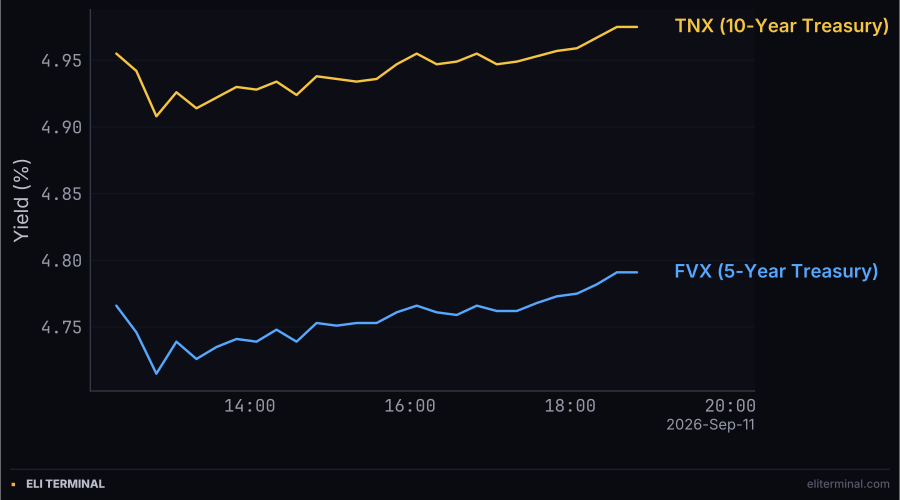
The post-CPI rally in bonds lasted about half an hour. Both yields closed the afternoon at their session highs.
SPY, the S&P 500 fund, sat 0.42% above Thursday's close when premarket trade opened at 08:00 UTC and 0.61% above it at noon, half an hour before the release. The CPI quarter hour lifted it to 765.80, up 1.05%. The regular session then subtracted rather than added: SPY ended its first fifteen minutes at 765.46 and closed at 764.29, up 0.85%.
Stocks and the hike market reacted inside the same fifteen minutes and reached opposite verdicts. From 12:30 to 12:45 UTC the VIX fell from 16.59 to 15.95 while Polymarket's no-change contract lost more than 9 points, and the volatility index finished at 15.84, down 11.21%, ending a climb from 14.53 a week earlier.
Friday ended a four-day losing streak for the S&P 500, the Dow and the Nasdaq, but SPY still closed the week down 0.8%. The part of Friday's gain that came before 12:30 UTC lined up in time with crude's overnight slide, not with any inflation data.
Oracle's stock traded at 163.74 by 20:30 UTC Thursday, more than 7% above its 152.94 close, minutes after its fiscal first-quarter results crossed. It held that gain through Friday's premarket and through the CPI release, printing 164.04 at 12:45 UTC. The first fifteen minutes of regular trading took it to 157.01 on 19.4 million shares, 153.86 by 14:30 UTC, and it closed at 150.28, down 1.74%.
The earnings release gave both sides material. Revenue rose 30% to $19.3 billion, cloud infrastructure revenue rose 121% to $7.4 billion and remaining performance obligations reached $664 billion. Operating cash flow of $23.1 billion ran against capital expenditures of $28.5 billion, up from $8.5 billion a year earlier, and the company sold $20 billion of common stock through an at-the-market program during the quarter.
Chief financial officer Hilary Maxson kept full-year capital spending guidance at 90 to 95 billion dollars on Thursday's call, about 70 billion net of customer prepayments. Friday's close left Oracle 22% below its June 15 level, and its quarterly 10-Q, filed at 20:10 UTC Friday, arrived after the selling was over.
Dell went from 516.00 to 544.49 in the same opening fifteen minutes that took Oracle from 163.60 to 157.01, and Hewlett Packard Enterprise went from 56.24 to 59.72. Dell closed at 567.29, up 11.98%, and HPE at 62.09, up 12.44%, each at its highest close in three months.
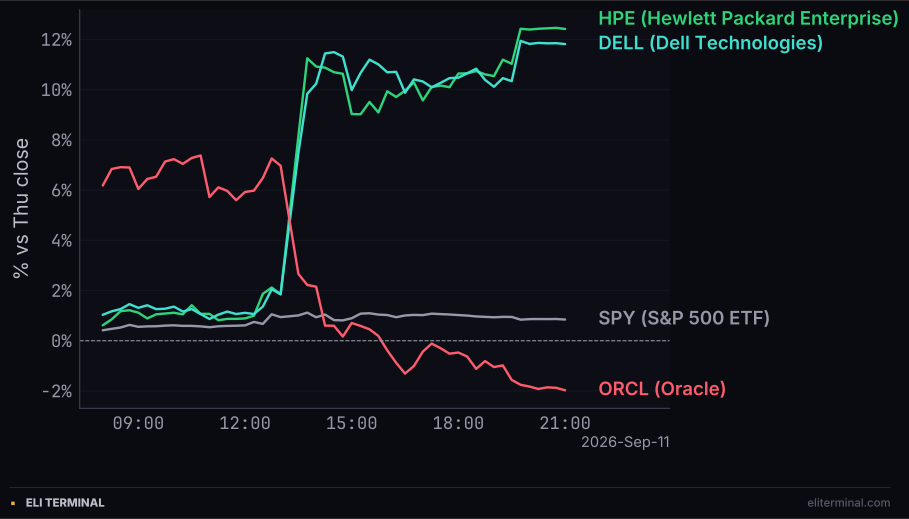
Oracle's line and the server makers' lines cross in the first half hour of regular trading and never meet again.
Dell had no filing or presentation on Friday. It spoke at the Goldman Sachs technology conference on Wednesday and fell 5.35% on Thursday. 24/7 Wall St. tied Friday's buying to Oracle's spending guidance, and the timing fits: the server makers' biggest candle and Oracle's biggest candle are the same candle.
Gains elsewhere went to the equipment a data center buyer pays for. NetApp rose 8.54%, HP Inc. 8.40%, Super Micro 7.28%, Arista 5.61% and Cisco 4.37%, while Nvidia closed down 0.03% and the GPU cloud operators CoreWeave and Nebius fell 0.15% and 1.56%. Racks, storage and switches were bid; the chip designer and the other capital-hungry buyers of AI capacity were not.
The buying held to the bell. HPE traded 4.07 million shares in the final regular-session quarter hour and added 1.3%, while SPY slipped 0.1% on its heaviest volume of the afternoon. At the same Goldman Sachs conference, SpaceX finance chief Bret Johnsen disclosed a new AI compute contract worth about 1.11 billion dollars a month, Benzinga reported; SpaceX shares rose 2.04%, about a sixth of Dell's move.
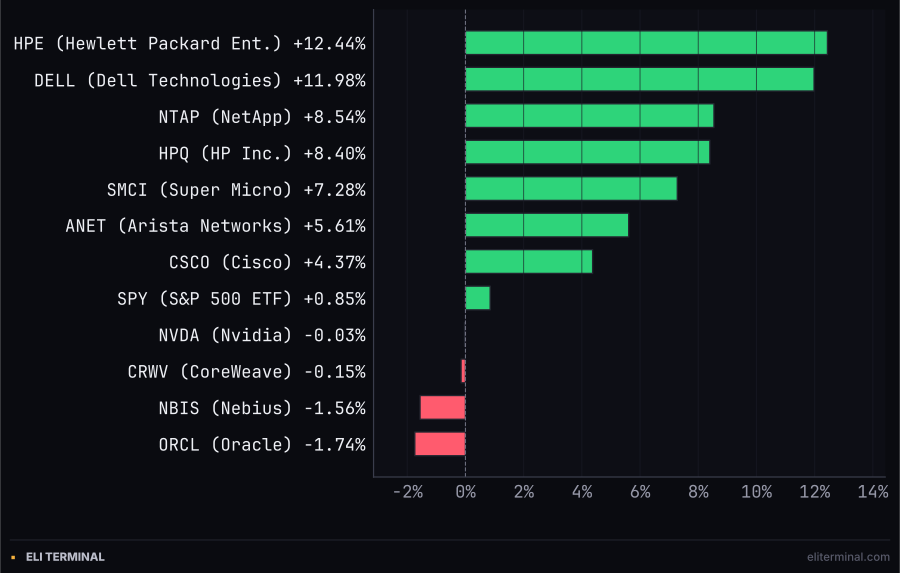
Every hardware seller beat the index by at least 3.5 points. Every large buyer of AI capacity on the list closed lower.
Brent crude traded at 108.51 at 03:45 UTC and at 103.60 by 10:45 UTC, a 4.5% slide through Asian and European hours. During that window Bloomberg reported that Oman was working to bring Gulf Cooperation Council foreign ministers and Iran together in Salalah on Monday, and at 07:20 UTC AFP carried Iran's foreign ministry confirming plans for the meeting.
The barrel stopped falling as the war news got worse. Time published at 10:25 UTC that the Houthis had taken Perim Island in the Bab el-Mandeb, citing four Yemeni government sources who spoke to Reuters, inside the half hour of Brent's low. The contract climbed back to 105.37 by 16:15 UTC and settled at 104.61, down 2.81%, still up 8.7% on the week.
Saudi Arabia's East-West pipeline, shut after Thursday's drone attack, stayed shut, and Axios reported that Crown Prince Mohammed bin Salman had called President Trump twice on Thursday asking for U.S. strikes on the Houthis, and that Trump declined. Frontline, the crude tanker owner, rose 1.67% to its highest close in a month and the energy fund XLE rose 0.32%, both against a falling barrel.
At 19:00 UTC, the Polymarket contract on an Iran-Oman Hormuz agreement by September 14 stood at 12.5%. By 19:45 UTC it was 24%. WTI sat between 100.49 and 100.67 across those 45 minutes, and no wire report found in that window accounts for the jump.
President Trump spent the morning at the Pentagon marking the 25th anniversary of the September 11 attacks, and at 19:08 UTC he returned on Truth Social to the $5,000 payment to every adult he had promised at the Republican convention in Dallas: "When I say something, I mean it! The $5,000 Dividend will happen because the People of our Country deserve it." CNBC had put the plan's cost above 1 trillion dollars.
TLT, the long Treasury bond fund, moved from 80.85 to 80.89 in the quarter hour after the post and closed up 0.11%, and the 30-year yield ended the day 2 basis points lower. The dollar index read 99.11 before the post and 99.12 after it. A pledge that would need Congress to fund it drew no reaction from the maturities that would finance it.
Monday brings the Gulf-Iran meeting in Salalah, which Bloomberg described as not yet confirmed and which the Houthi advance on the Red Sea coast could still complicate. The Hormuz agreement contract that doubled late Friday resolves the same day.
Wednesday stacks August retail sales at 12:30 UTC and the Federal Reserve's decision at 18:00 UTC. Kalshi closed Friday pricing a September hike at 80%, a further hike in October at 36% and one in December at 56%.
Dell and HPE go into Fed week at three-month highs, Oracle 22% below its June level. A hike on Wednesday puts a price on exactly the thing Friday separated: the companies paid to build AI capacity and the companies borrowing and issuing stock to buy it.