Where stocks, bonds and small caps turned, September 9
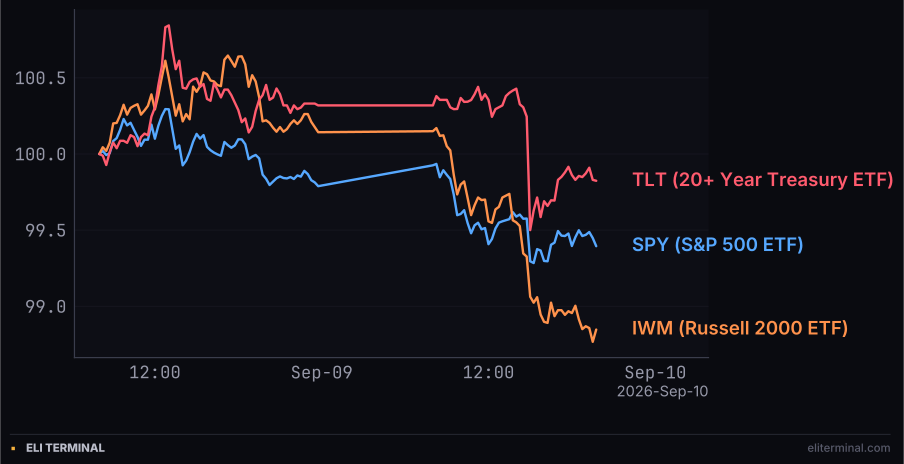
All three break at the same quarter hour. Only two of them come back.
Meta gained 6.55% on a rally that was finished before the opening bell, the 10-year Treasury yield hit 4.837% after the government's own bond buyback backfired, and oil rose 3.25% as Iran and the United States traded new strikes near the Strait of Hormuz.
All three break at the same quarter hour. Only two of them come back.
Treasury Secretary Scott Bessent revealed the size of the government's long-bond buyback at 15:00 UTC Wednesday, tripling the normal operation to 6 billion dollars in an attempt to keep a lid on rising yields.
It did the opposite. The 10-year yield sat at 4.808% at 14:50 UTC; by 15:20 UTC, three 15-minute bars later, it had printed 4.857%, its highest intraday level since November 2023, before easing into the close at 4.837%, up 3.1 basis points on the day.
TLT, the long Treasury ETF, fell from 82.075 to 81.47 in the single bar spanning 15:00 to 15:15 UTC, and the S&P 500 posted its own session low of 760.94 nine minutes later.
Stanley Druckenmiller, Bessent's former mentor, wrote that once markets believe Treasury is defending a price, every rise in yields becomes a test of official resolve, and the operations must grow to survive the tests.
290.64 is where the Russell 2000 ETF closed, down 1.37%, the worst of the day's four major benchmarks.
The regional bank ETF KRE fell in a similar shape, sliding from 73.86 at 14:45 UTC to 73.25 by 16:15 UTC and never bouncing the way the S&P did in the same window.
Goldman Sachs has flagged that roughly 32% of Russell 2000 companies carry floating-rate debt against just 6% in the S&P 500, which means Wednesday's yield spike fell hardest on the index least able to absorb it.
Canada's retaliatory tariffs on 20 billion dollars of American goods, covering steel, dairy, appliances and electronics, took effect a day earlier after Washington imposed new import bans and procurement restrictions on Canadian goods; the dispute adds a second drag on the small, domestically exposed companies the Russell tracks.
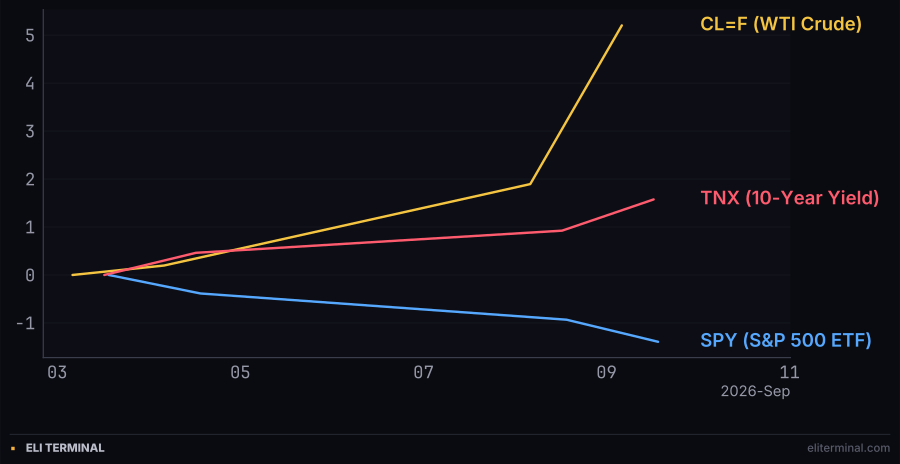
A week of crude and yields rising together, and stocks giving ground to both.
West Texas crude settled at 96.05 dollars a barrel, up 3.25% and a fourth straight higher close, while Brent rose 3.36% to 101.21.
The move built gradually rather than spiking on a single headline: crude traded near 94.45 at 00:00 UTC, ground higher through the Asian and London sessions, and kept climbing into the New York afternoon to trade above 96.80 by 20:00 UTC.
Goldman Sachs said the intensifying pattern of tanker strikes raises the probability that Brent clears 120 dollars a barrel.
The prediction market on the Strait of Hormuz returning to normal traffic by September 30 has fallen from 14.5% on August 11 to 1.85% Wednesday, a slower and steadier repricing than the tape's own week, but pointed the same direction.
US Central Command said it destroyed five Iranian oil tankers in the Gulf of Oman and near Kharg Island overnight, retaliation for Revolutionary Guard ballistic missiles fired twice in two days at a US Navy warship.
Iran said it struck 10 vessels near the Strait of Hormuz in response, what Al Jazeera called the largest wave of shipping attacks since the war began, and separately fired a ballistic missile at the Muwaffaq Salti base near Azraq, Jordan, which hosts US forces; Tehran has now targeted that base more than ten times since March.
Gold touched an intraday high of 4,435 dollars an ounce in early trading on the tanker news before settling at 4,416.0, up 0.50% on the day.
None of this printed as a single dramatic candle in New York trading hours. It had already happened before the US day began, and the tape absorbed it as a level, not an event.
Meta shares traded near 619 dollars at 08:00 UTC Wednesday. By the 13:30 UTC opening bell they were near 648, and they closed the session at 653.69, up 6.55%.
The move came in two pre-market legs, from 619 to 624 around 08:45 UTC and then from 623 to 647 between roughly 10:00 and 11:00 UTC, hours before Meta's Muse personal AI agent rolled out broadly to US users on iOS, Android and the web.
Mizuho kept an Outperform rating and a 750 dollar target, writing that Muse marks the beginning of a substantial product cycle not yet priced into the shares; KeyBanc set an Overweight rating with a 780 dollar target on similar grounds.
Muse runs on a dedicated virtual machine with its own visible browser, developed under chief AI officer Alexandr Wang, and a separate system called Sentinel controls what it is allowed to do online; it launched in three tiers, free, 20 dollars a month, and 100 dollars a month.
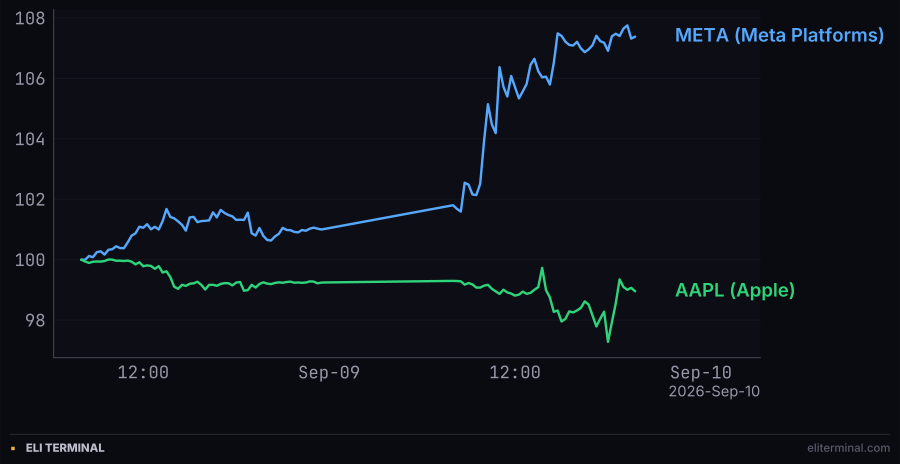
One stock's story ended before 9:30am. The other's started at 1pm.
John Ternus ran his first major keynote as Apple's chief executive at 17:00 UTC Wednesday, eight days after Tim Cook moved to executive chairman, and unveiled the company's first foldable phone.
Apple stock had already round-tripped once before he spoke: a jump from 315.85 to 318 at 13:45 UTC reversed within fifteen minutes, and the stock slid to a morning low of 312.17 by 15:00 UTC.
The real move came during the keynote itself, when AAPL fell to a session low of 309.90 by 18:15 UTC, about seventy-five minutes after Ternus opened the event, then reversed to a session high of 319.15 by 18:45 UTC, a swing of more than 3% in under 45 minutes, before settling to close at 315.34, down 0.28% on the day.
The iPhone Duo, a 1,999 dollar foldable with a 7.6-inch inner display and 5.4-inch outer screen, arrived alongside a smaller than expected price increase on the iPhone 18 Pro, up 100 dollars to 1,199, matching what analysts had predicted rather than the steeper 10 to 20% some had floated over the summer.
Ternus called rival foldables two phones awkwardly stuck together. The stock spent the next ninety minutes deciding whether to agree with him, and by the close it mostly had, just not by much.
Alphabet shares closed at 330.65, down 2.28%, the worst move of the day among the mega-caps that didn't have a scheduled event of their own.
The decline was a grind, not a cliff: GOOGL was already near 330 by 13:00 UTC, hours before the New York open, and it spent the regular session drifting to a low of 327.99 at 15:00 UTC, the same bar in which the bond market broke, before recovering slightly into the close.
The one dated news item was Google's own announcement of a 15.1 billion dollar AI infrastructure investment in Finland, including a 22-year power purchase deal with Fortum covering as much as half the output of one nuclear plant, more capital committed to the AI buildout, not less.
That is not, on its face, a reason for a stock to fall more than 2%, and Meta rallied 6.55% the same day on its own AI spending story. No fresher legal or regulatory filing turned up in Wednesday's wires; the size of Alphabet's move outran anything published about it.
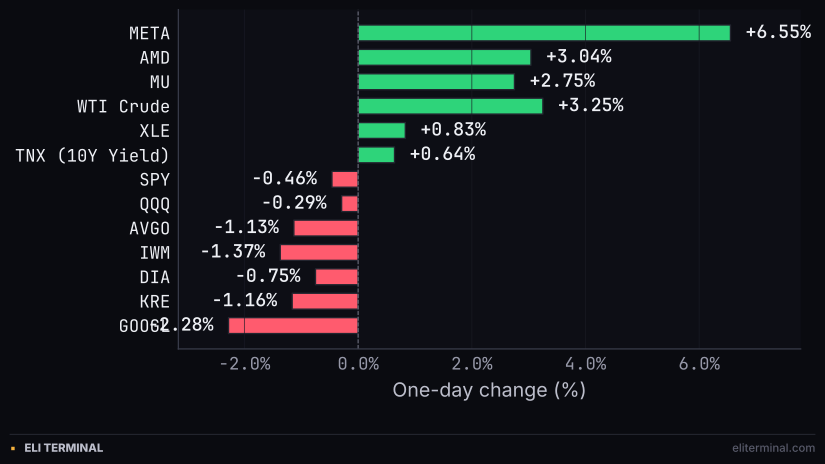
One stock and one commodity carried the gainers. Everything defensive sat on the other side.
XLK, the technology sector ETF, closed at 187.87, unchanged on the day, its Meta and chipmaker gains canceling out Alphabet's and Apple's losses almost to the penny.
MU and AMD gained 2.75% and 3.04%, both riding the same AI-demand story that lifted Meta, while NVDA slipped 0.91% and TSM fell 0.83%, a split inside the chip trade rather than a unified move.
The Kalshi market on the Federal Reserve holding rates steady in September closed Wednesday at 46%, down from 47% Tuesday; the Polymarket contract on a rate hike at the same meeting closed at 54.5%, up from 52.5%, both moving in the direction of a change rather than a hold.
Fed Governor Christopher Waller had said on September 3 that he was leaning toward holding steady barring surprises in the inflation data. Wednesday's failed buyback and the yield spike it produced are exactly the kind of surprise that reading was built to withstand.
August producer prices and weekly jobless claims are due Thursday at 12:30 UTC, the next scheduled test of whether Wednesday's yield move was a one-day buyback story or the start of something the Fed has to answer.