SPY, WTI crude, AMD and Nvidia over the past month
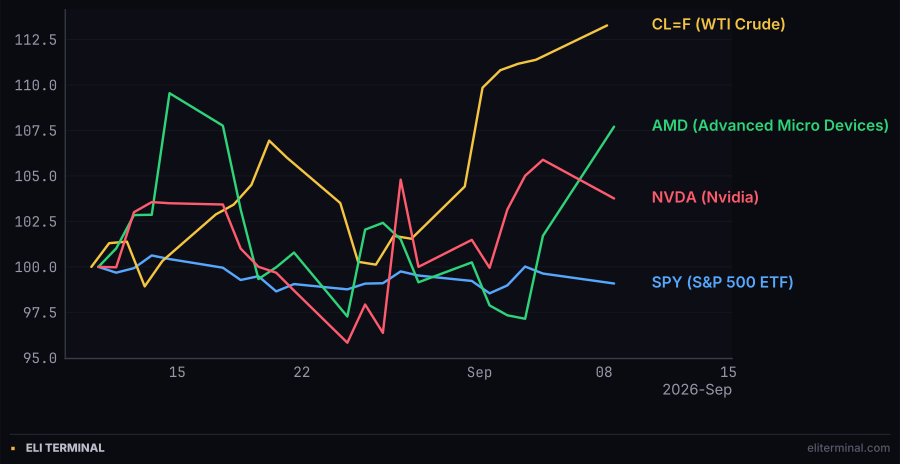
Crude and AMD both broke higher into Tuesday's close. Nvidia and the broad index did not follow.
AMD gained 5.9% on its own Tuesday AI guidance, Nvidia fell 2% in the same half hour, and WTI crude pushed toward 100 after the U.S. destroyed a fleet of Iranian oil tankers.
Crude and AMD both broke higher into Tuesday's close. Nvidia and the broad index did not follow.
7,673.52 is where the S&P 500 closed Tuesday, down 0.58% on the first trading day back from Labor Day. The Nasdaq Composite slipped 0.32% to 26,421.41, and the Dow Jones Industrial Average did the damage for the day, down 628 points, or 1.18%, to 52,786.07.
None of the three benchmarks captured what was happening underneath them. AMD closed up 5.9% to 505.74 while Nvidia fell 2.01% to 225.73 in the same session, the two most closely watched AI-chip names moving in opposite directions on a day the Nasdaq barely moved at all. Tesla rose 3.97% to 368.16, clawing back part of the prior session's Cybercab-driven slide.
The VIX told a different story than the close did. It rose 8.19% to 15.72 even as the S&P's own move stayed under a point, a volatility gauge climbing eight times faster than the index it tracks, pricing in more nerves than Tuesday's flat-looking print showed on its face.
AMD opened Tuesday's regular session at 488.88, a gap higher from Friday's close of 477.57, which was itself already a 4.7% gain. The stock added most of Tuesday's move in the first hour, touching 500.56 by 10:30 a.m. ET, and closed the day at 505.74, up 5.9% for the session on top of Friday's advance.
Tuesday was day one of Citi's 2026 Global TMT Conference in New York, running through Thursday, and AMD's executives used the stage to guide data center revenue toward roughly 70 billion dollars in 2027, about double this year's pace, and to put AMD's total AI addressable market at 2 trillion dollars by 2030. They reaffirmed Taiwan Semiconductor Manufacturing Company as the primary wafer supplier behind that build-out.
Raymond James raised its price target to 641 from 565 and upgraded the stock to Strong Buy from Outperform the same day. The two-session run followed AMD's August 4 earnings report, when data center revenue had already grown 107% year over year to 6.7 billion dollars, and built on the 6-gigawatt GPU supply agreement AMD signed with OpenAI last October.
Nvidia closed its first half hour of Tuesday trading at 227.94, down from a premarket level near 233. The reversal landed in the same 9:30 a.m. ET window that sent AMD higher, and Nvidia never recovered the ground, closing the day at 225.73, down 2.01%.
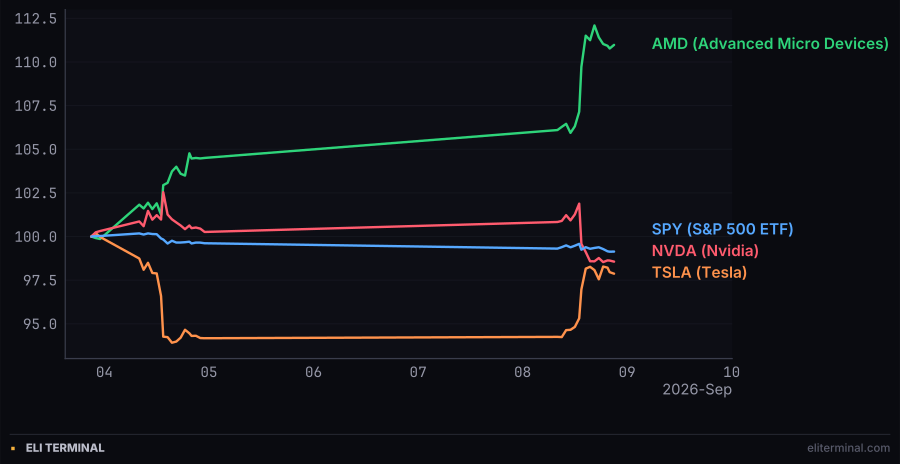
AMD's break happened at the open. Nvidia's smaller reversal happened in the same hour, the other way.
The split ran through the rest of the chip basket. Broadcom rose 2.97% to 368.56 and Taiwan Semiconductor gained 2.36% to 439.00 the same day ASML and AMD advanced, while Micron fell 1.61% to 1,000.26 alongside Nvidia. Six widely held AI-hardware names split three up and three down on a session with no single sector-wide headline attached to either side.
U.S. Central Command said Tuesday its forces destroyed five Iranian crude carriers, the Kaviz, Charminar, Horizon 1 and Riesco in the Gulf of Oman and the Derya near Kharg Island, after the Islamic Revolutionary Guard Corps twice tried and failed to hit a U.S. Navy warship with ballistic missiles over the prior two days. CENTCOM said crews were ordered off the vessels before they were struck and that no American personnel were hurt.
Iran's Revolutionary Guard claimed it had struck two U.S. vessels in the strait; CENTCOM's response was blunt, stating no U.S. Navy warship had been struck and that every attempted IRGC attack failed. West Texas Intermediate ran from Monday's close near 93 to an intraday high of 94.73 by 8 a.m. ET Tuesday, well before the CENTCOM statement had circulated widely, then drifted back through the day to close at 93.03, up 1.69%. Brent traded the same shape, up 1.70% to 97.92.
The Energy Select Sector SPDR fund, which owns the producers that benefit most directly from a higher barrel, rose just 1.11% to 64.77, about two-thirds less than crude's own move. A war premium the barrel priced in several times over was not something the equities behind it fully believed.
Gold is supposed to catch a bid when a warship gets shot at. Tuesday it did the opposite, falling 0.81% to 4,393.90 even as the dollar index also slipped 0.32% to 98.84, a pairing that has no single clean cause in anything published that day. The 10-year Treasury yield ticked up only 2.2 basis points, to 4.806%, too small a move to explain gold's drop on its own.
A Kalshi contract on a 25-basis-point hike at the Federal Reserve's September 16 meeting closed Tuesday near 53%, up from about 50% Sunday night, most of the move arriving by Monday's holiday close and holding through Tuesday's session. Fed Chair Kevin Warsh used his late-August Jackson Hole remarks to call for a quieter central bank while saying summer's inflation readings hadn't shown meaningful improvement, and traders have priced the September meeting as close to a coin flip ever since.
A separate market on an Iran-Oman agreement over the strait by September 14 held near 16% to 17% through most of Tuesday before slipping to 15% by the close, consistent with a session that added an escalation rather than an opening. Neither market moved sharply enough on Tuesday alone to call the shift more than a drift; the next real test on the rate-hike side arrives with Thursday's producer price index and Friday's consumer price index.
Mistral said Tuesday it raised 3 billion euros, about 3.5 billion dollars, in a Series D round valuing the company above 21 billion euros, roughly 24 billion dollars, calling it the largest equity fundraising round ever completed by a European technology company. Samsung Electronics led it; EQT's Scaleup Europe Fund and existing investor PSG Equity co-led; Advent, funds managed by BlackRock, and the government of the Grand Duchy of Luxembourg were new to the cap table, joining returning backers a16z, ASML, Nvidia and Bpifrance.
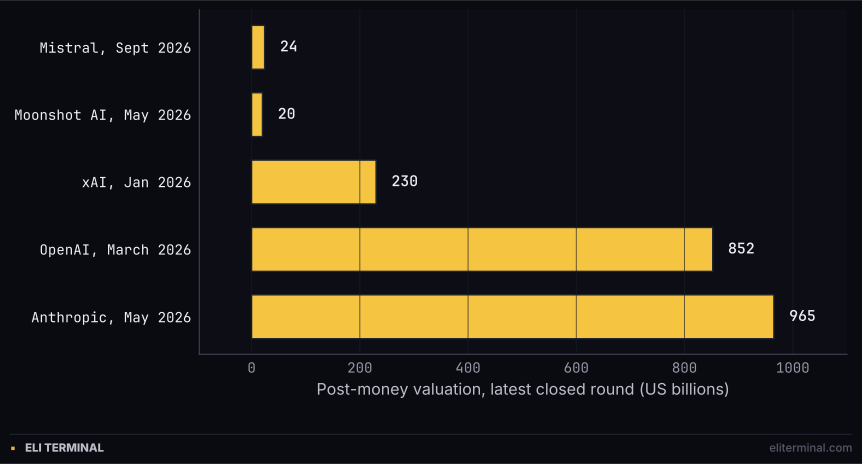
Mistral's record European round sits closer to a Chinese lab's valuation than to either American frontier lab's.
Set beside the rounds the American frontier labs closed this year, Mistral's raise is a fraction of both the money and the valuation. OpenAI closed 122 billion dollars in March at an 852 billion dollar valuation. Anthropic closed 65 billion dollars in May at 965 billion dollars. xAI closed 20 billion dollars in January at 230 billion dollars. China's Moonshot AI raised 2 billion dollars in May at a 20 billion dollar valuation, in the same range as Mistral's own number.
The European Union's AI Act entered into force in August 2024, with obligations on general-purpose AI models taking effect a year after that, making the bloc the jurisdiction that actually slowed frontier AI development well before anyone in Washington proposed doing the same. Senator Bernie Sanders and Representative Greg Casar introduced a bill to ban artificial superintelligence and pause advanced AI development in the United States on September 3, 2026, five days before Mistral's round closed. Measured against what the two largest American labs raised this year, Tuesday's round is close to what came out the other side of a constraint Europe imposed on itself two years earlier.
The round's lead, Samsung Electronics, is South Korean. Advent and PSG Equity are American private equity. BlackRock is an American asset manager. ASML is Dutch and Nvidia is American. Luxembourg's government was the one sovereign check in the group. A round marketed as building Europe's sovereign AI alternative was priced and led almost entirely by capital domiciled outside the countries it is meant to make independent.
Nvidia and ASML are both publicly traded and both put money into Tuesday's round. Nvidia fell 2.01% to 225.73 and ASML rose 2.91% to 1,764.85 the same day. Both moves sit inside the wider AI-hardware split already running through the session, the one that lifted AMD and Taiwan Semiconductor and dropped Nvidia and Micron; neither stock's Tuesday path carries a signature that separates from that broader pattern. Whatever the market made of a Korean conglomerate, an American chipmaker and a Dutch toolmaker jointly financing Europe's answer to OpenAI, it did not show up as a distinguishable move in either investor's own stock.
Tesla closed at 368.16 Tuesday, up 3.97%, clawing back roughly two-thirds of the 5.9% drop it took the prior Friday, when the National Highway Traffic Safety Administration opened a formal audit into whether Tesla's Cybercab, already running paid driverless rides in Austin, meets federal motor vehicle safety standards without a steering wheel or pedals. Nothing filed Tuesday resolved that audit; the rebound reads as part of the day's wider AI-and-chip advance more than any new word from the regulator.