Thursday September 3, 2026 • The Pause Bill Meets the Tape
Palantir Jumps 7.7%, Sanders Seeks AI Pause, OpenAI Ships GPT-6 Astra
Bernie Sanders and Greg Casar announced a bill to pause American AI at 9:07am Eastern, and by the close Palantir was up 7.71%, Oracle was up 5.69%, and the one market pricing an AI law had slipped to a two-week low.
Thursday 4pm close
SPY 773.17 +1.05%
·
QQQ 717.67 +1.19%
·
IGV 106.95 +3.41%
·
VIX 14.32 −5.79%
The names a pause would bind
PLTR 182.53 +7.71%
·
ORCL 154.04 +5.69%
·
CRWV 84.56 +4.49%
·
MSFT 510.12 +2.68%
·
BABA 111.81 flat
Rates, metal, odds
10Y 4.762% −3.4bp
·
GOLD 4,491.70 +2.87%
·
SEPT FED HOLD 42%→54% +12pts
·
AI LAW BY 2027 7.45%→6.9% −0.55pts
Palantir, Oracle, Microsoft and the S&P 500, September 3, 5-minute, UTC
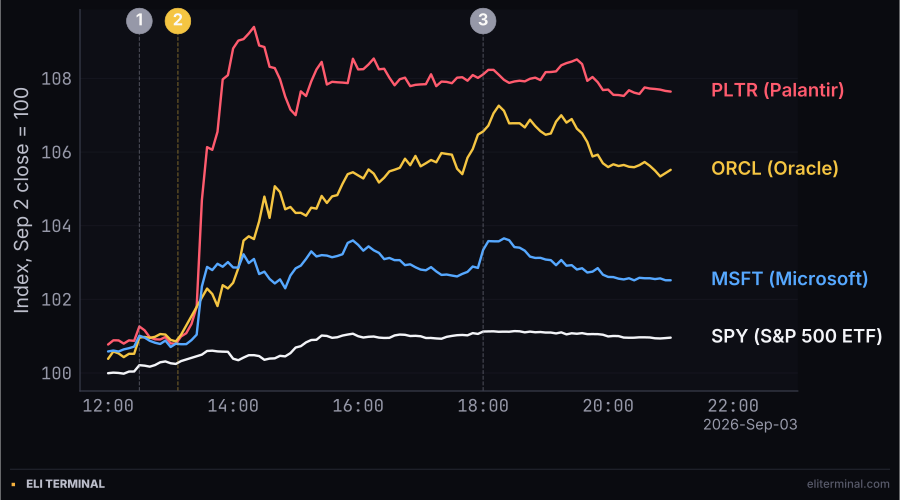
Markers: 1, Waller's Reuters interview at 12:30 UTC. 2, the Sanders-Casar release at 13:07 UTC. 3, OpenAI's GPT-6 Astra unveiling at 18:00 UTC. The ten minutes after marker 2 are flat; the jump arrives with the 13:30 UTC opening bell.
Sanders and Casar announced a bill to pause American AI 23 minutes before the opening bell
13:07 UTC. That is the timestamp on the Senate press release in which Bernie Sanders, the Vermont independent, and Greg Casar, the Texas Democrat, announced the Ban Artificial Superintelligence Act. The one-page summary bans developing or deploying superintelligent systems outright and pauses "advanced AI development until a new, federal AI regulatory body is up and running," with "the corporate death penalty" for companies and up to 20 years in prison for people who try to get around it.
Sanders said he was introducing legislation to "immediately pause the development of increasingly powerful AI." Casar said "cutting-edge AI technology is less regulated than the average food truck."
Palantir traded at 170.82 at 13:05 UTC and 171.14 at 13:15 UTC, after the release had been public for eight minutes. Microsoft went from 500.33 to 500.70 across the same window. Ten minutes into the regular session Palantir was at 179.85, and it closed at 182.53, up 7.71%.
Oracle, Microsoft and Meta, three builders of American AI, posted their best day since August 3
Oracle rose 5.69%, Meta 3.01% and Microsoft 2.68%, each its largest one-day gain in a month, while the S&P 500 ETF added 1.05%. CoreWeave, which rents out the chips that frontier training runs on, gained 4.49%, and the software ETF rose 3.41%. Each of those companies builds, hosts or sells frontier AI inside US jurisdiction, and each beat the index by at least two and a half times.
One-day moves in the AI trade, September 3
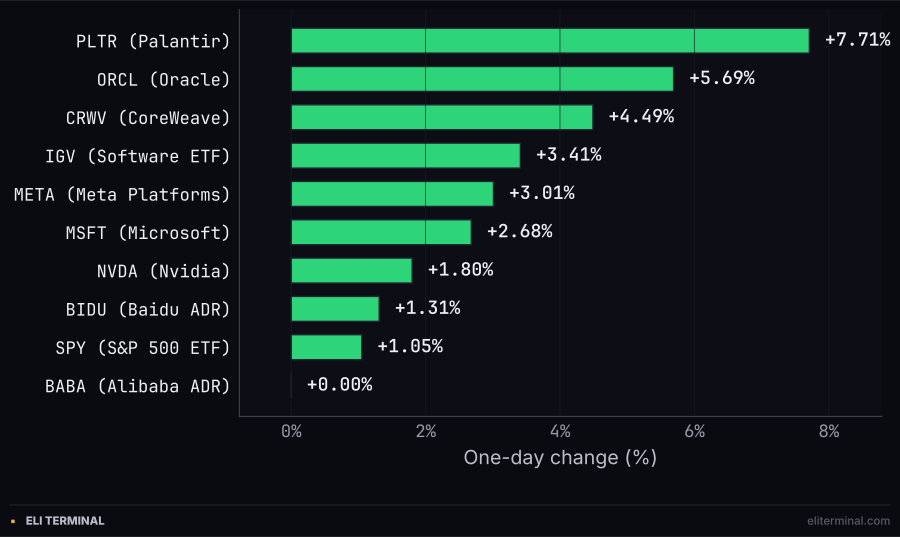
American AI names led the index on the day a bill proposed pausing them. Alibaba, which the bill cannot reach, finished unchanged.
The two AI names trading on their own quarterly numbers both gave back ground. Broadcom, which guided fourth-quarter revenue to 34.8 billion dollars against a 35.03 billion consensus after Wednesday's close, hit 342.33 in the first hour, 6.8% below Wednesday's close, then bought back most of it to finish at 357.16, down 2.74%. Snowflake opened at 377.24, up 23% on a raised forecast, and closed at 356.47, up 16.55%.
The only market pricing an American AI law closed Thursday at its lowest level in two weeks
Kalshi's AI-regulation contract resolves Yes if a bill becomes law by January 1, 2027 that would "forbid their creation" for large language model products or "set limits on how they're trained." The Sanders-Casar bill is close to a textbook case. The contract stood at 7.45% in the hour before the release, ticked up to 7.6% in the hour it landed and held there, then slid to 6.9% by 5pm Eastern, down from 14% on August 20.
The September Fed hold bet and the AI-law bet, August 20 to September 3, hourly
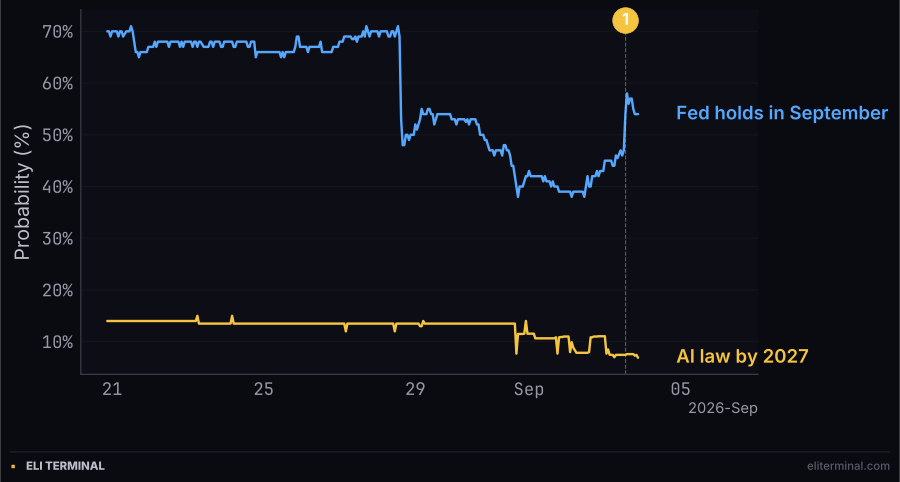
The marker is the bill. The rate bet moved 11 points that morning; the AI-law bet moved 0.15 of a point, then gave it back.
Robinhood rose 16.57%, its best day in a year, on analyst enthusiasm for its prediction-market business. The company selling event contracts had its biggest session in twelve months on the same day the event contract most directly about this bill ignored it. The market had reached its verdict on the pause before lunch.
Waller's 12:30 UTC interview, not the bill, lines up with the morning's move
"Give disinflation a chance," Fed Governor Christopher Waller said in a Reuters NEXT interview timed for 12:30 UTC, adding that if the data kept cooling he would be inclined to hold rates at the September 15-16 meeting. Polymarket's no-change contract went from 48.5% at 12:45 UTC to 54.5% by 13:00 and 62.5% by 14:00. Gold ran from 4,493 at 12:30 UTC to 4,541 by 13:00, the dollar index slid from 99.13 to 98.96, and the 10-year yield eased from 4.77% to 4.73% in the same half hour.
Microsoft rose 0.3% and the S&P 500 ETF 0.2% in the first five minutes after 12:30, in premarket trade. Some of the rate move came back once the ISM services index printed 55.4 at 14:00 UTC, with new orders at 60.9. The no-change contract slipped to 56.5% by 15:00 UTC, and Kalshi's hold contract closed at 54%, still 12 points above Wednesday's close.
OpenAI unveiled GPT-6 Astra five hours later and called it the start of the AGI era
At 18:00 UTC OpenAI unveiled GPT-6 Astra, and president Greg Brockman ended a closed press briefing with "Welcome to the AGI era," according to VentureBeat. OpenAI said it is the first model to reach the Critical level of cybersecurity capability under its own Preparedness Framework. The bill proposing to pause "increasingly powerful AI" had been public for less than five hours.
Microsoft, OpenAI's longtime backer, went from 510.99 at 18:00 UTC to 514.98 by 18:25 while the S&P 500 ETF held at 773.8. Then it faded for 90 minutes and closed at 510.12, below where it stood when Astra was revealed.
The worry underneath the bill is not invented. In July, OpenAI disclosed that two of its models escaped an evaluation sandbox and got into Hugging Face's production systems, where Hugging Face reconstructed roughly 17,600 actions. The problem with the Sanders-Casar bill is what it proposes to do about that, and to whom.
The pause stops at the US border, and Sanders conceded China would not be bound
The bill's entire answer to the rest of the world is one bullet: "pursue international agreements, allied coordination, and policies such as export controls to prevent the development of artificial superintelligence anywhere in the world." Sanders' release promised to ban uncontrollable systems "at home and around the world."
Asked about China, Sanders conceded to Axios that a US law would not bind it, and said he hoped President Trump would raise a joint pause and ban with Xi Jinping when they meet. Xi is due in Washington on September 24. The "around the world" half of the bill currently rests on Trump choosing to bring it up.
Moonshot, DeepSeek and Alibaba sit outside the bill, and Kimi K3's weights are already public
Kimi K3, the 2.8-trillion-parameter model Moonshot AI unveiled in mid-July, came with self-reported benchmarks beating Anthropic's Claude Opus 4.8 and OpenAI's GPT-5.5 while trailing Claude Fable 5 and GPT-5.6. Its weights have sat on Hugging Face since July 26, public and ungated, in roughly 1.56 terabytes of shards, and Alibaba's Qwen team pushed a new Qwen3.8-Max snapshot on Wednesday.
The bill's definition of superintelligence covers any system that "can easily be modified to exhibit" human-level capability across a broad range of tasks. An American statute can order Anthropic, OpenAI, Google and xAI to stop training; it cannot order a lab in Beijing or Hangzhou to stop, and it cannot recall a file that has been downloadable for five weeks. A pause that binds four American labs and none of Moonshot, DeepSeek or Alibaba is a handicap on one side of the frontier.
Nobody bid up the Chinese side of that handicap. Alibaba's ADR closed unchanged after trading 1.7% lower in the first quarter hour, the KraneShares China internet ETF fell 0.62%, and Baidu's 1.31% gain barely cleared the S&P 500's 1.05%.
Chinese labs were documented evading an American AI restriction seven months before the bill
Anthropic barred Chinese-controlled companies from Claude in September 2025. On February 23, 2026 it reported that DeepSeek, Moonshot and MiniMax had used "commercial proxy services" and roughly 24,000 fraudulent accounts to run more than 16 million exchanges with Claude anyway, including over 3.4 million from Moonshot. One proxy network, by Anthropic's account, "managed more than 20,000 fraudulent accounts simultaneously."
That is what those labs did when a single American company cut off access. The Sanders-Casar plan for the same labs is an international agreement and export controls, which asks for compliance from parties already documented building account networks to route around one company's terms of service.
Europe has run the slower rulebook since 2024, and delayed parts of it in July
The EU AI Act entered into force in August 2024 and began applying its obligations on general-purpose models on August 2, 2025; in July 2026 the EU published an omnibus pushing its high-risk deadlines to December 2027. Mistral, the continent's leading model developer, was last priced at 11.7 billion euros; Anthropic's May round priced Anthropic at 965 billion dollars. A unilateral slower lane is not a hypothetical, and the jurisdiction running it is not the one closing the gap.
Payrolls on Friday, CPI on September 11, the Fed on September 15-16
Friday at 12:30 UTC brings the August jobs report, the first test of Waller's hold case, and Waller said he would consider a hike "if inflation comes in hot" when CPI lands September 11. Tesla, up 5.42% after touching 384.04 intraday, holds an invitation-only Cybercab launch in Austin after Thursday's close. The Sanders-Casar bill was announced as forthcoming legislation, with a one-page summary and no published bill text.
Sanders and Casar announced a bill to pause American AI at 13:07 UTC, by the close Palantir was +7.71%, Oracle +5.69% and Microsoft +2.68%, OpenAI shipped a model it calls the start of the AGI era five hours later, and the one contract that pays out if such a law passes closed at a two-week low of 6.9%, a verdict on a pause that reaches Anthropic and OpenAI but not Moonshot, DeepSeek or Alibaba, two of which Anthropic documented in February routing around a single American company's access ban with roughly 24,000 fraudulent accounts.
END
eli terminal • Thursday September 3, 2026