The month in one frame
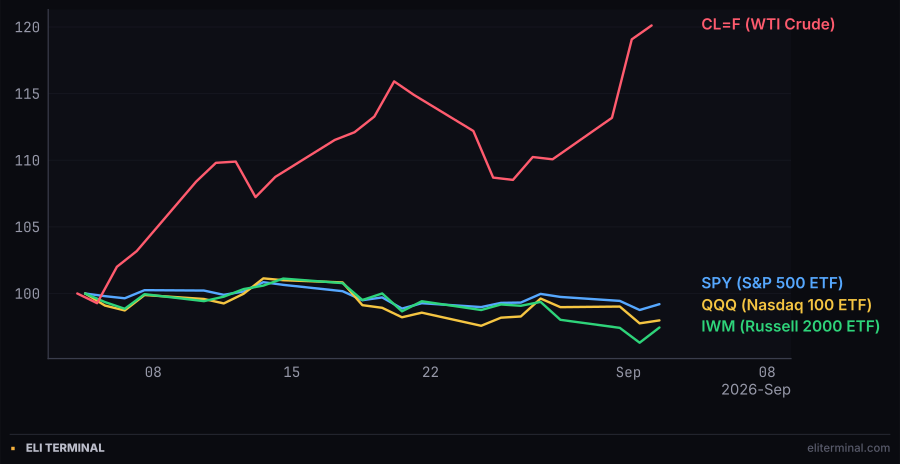
Oil is up roughly a fifth on the month. The three equity ETFs never left a seven-point band.
Palantir fell 5.81% and Broadcom slid after its own beat-and-raise quarter, the same session the S&P 500 rose 0.44% and the United States struck Iranian government tankers directly for the first time.
Oil is up roughly a fifth on the month. The three equity ETFs never left a seven-point band.
The United States struck two Iranian government tankers on Wednesday, the first time in the conflict that American forces have hit Iranian vessels in retaliation rather than to stop a blockade. A US official described it as the opening move of a new "tanker for tanker" policy Trump approved, meant to deter further Iranian attacks on shipping transiting the Strait of Hormuz.
Iran's Revolutionary Guard said two tankers were disabled after striking naval mines in the strait; US Central Command disputed the claim outright, repeating a line it had used before in the conflict: no ships had hit mines in the Strait of Hormuz. On Truth Social, Trump wrote that the US had "almost total control" over the strait and that Tehran's economy was collapsing, asking "when are the Iranian people going to rise up and fight?" The IRGC answered with strikes of its own, hitting a base in Jordan and the residence of the American commander at Kuwait's Ali Al Salem airbase; Qatar's foreign ministry condemned the broader wave of attacks as a "blatant breach" of international law.
The contract pricing an effective US-Iran ceasefire by September 4 opened near 43% shortly after 9pm ET Tuesday, then cratered to a low of 16% by 3am ET Wednesday as the tanker strikes and Iran's retaliation on Jordan and Kuwait spread across the wires. It spent the rest of the session chopping between roughly 21% and 37%, and stood at 33% at Wednesday's close, still 10 points below where it started and nowhere near its intraday low.
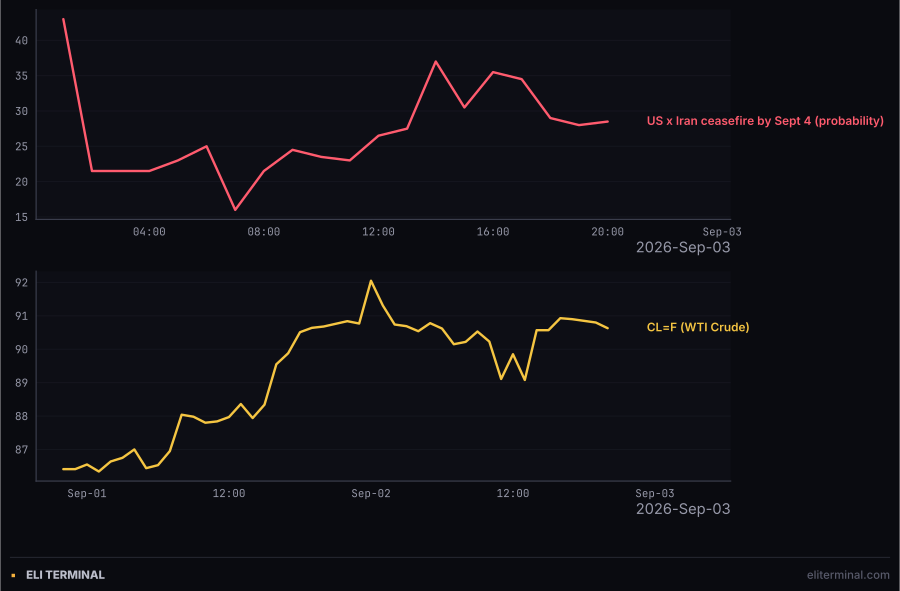
The odds market swung more than 60% peak to trough. Oil's move over the identical window was a steady climb, not a spike.
Oil itself never matched that violence. WTI spiked overnight to 92.29 by 1am ET, on the same clock as Iran's retaliatory strikes on Jordan and Kuwait, then eased back to a session low near 89.05 by 8am ET before climbing through the US afternoon to close at 91.01, up just 0.88% on the day. A market that thought a real ceasefire had gone from more likely than not to unlikely inside six hours would ordinarily be paired with a bigger move in the one asset most directly exposed to a wider war. It wasn't.
The 10-year yield pushed as high as 4.82% intraday Wednesday, the highest level captured on the tape since November 2023, with the peak landing around 10:20am ET before the yield eased back to close flat at 4.796%. Fiscal deficits, heavy Treasury issuance, and a hawkish turn in Fed pricing have been cited as the structural forces behind the climb; Wednesday's session was the first in three days where the yield didn't also end the day higher.
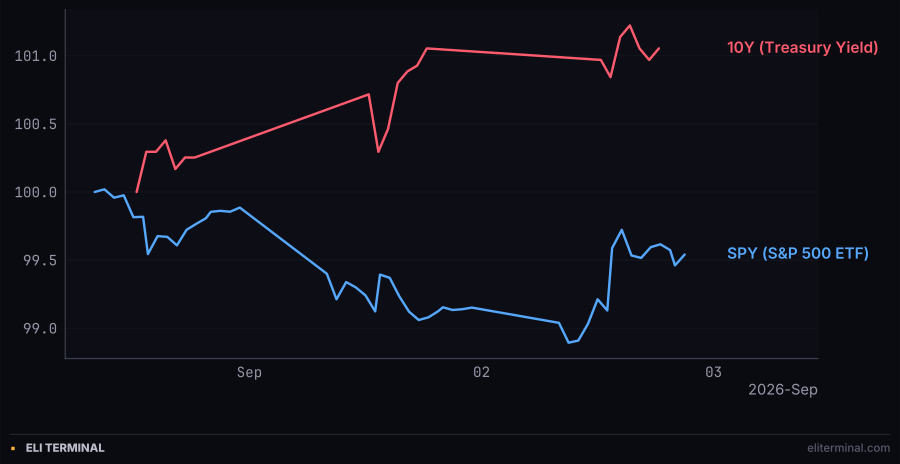
SPY's sharpest rally of the window lines up with the yield's pullback from its own high.
The contract on the Federal Reserve holding rates steady at its September 15 meeting has fallen from 68% on August 24 to 39% by Wednesday's close. Over the identical stretch, the contract on a rate hike by that same meeting climbed from 32% to 58%. That is a full week of repricing toward tighter policy, running in lockstep with the yield's climb toward 4.8%, and it is the backdrop against which Wednesday's equity rally has to be read.
The S&P 500 rose 0.44% to 765.16, the Nasdaq-100 added 0.23%, and the Dow-tracking ETF gained 0.54%, all three ending a three-session slide. The Russell 2000 led with a 1.18% gain. The VIX fell 6.98% to 15.20, easing from Tuesday's spike after holding above 16 through the European morning and grinding lower once the New York session opened.
None of that squares easily with a session that also carried the first direct US strikes on Iranian tankers and a fresh three-year high in the 10-year yield. Equities did not treat Wednesday as an escalation day. Whether that is because the tanker strikes were read as containment rather than widening, or because the yield's late pullback did more work than the morning's headlines, the tape and the odds market told two different stories at the same hour.
Nvidia gained 3.21% to 224.41, Meta rose 2.47% to 592.85, and Micron added 2.43% to 956.08, a clean rebound across the chip and megacap-tech names that carried the broader tape higher. Palantir and Broadcom, both squarely inside the same AI trade, did not participate: Palantir closed down 5.81% and Broadcom slipped 0.66% into its own earnings before falling further after hours.
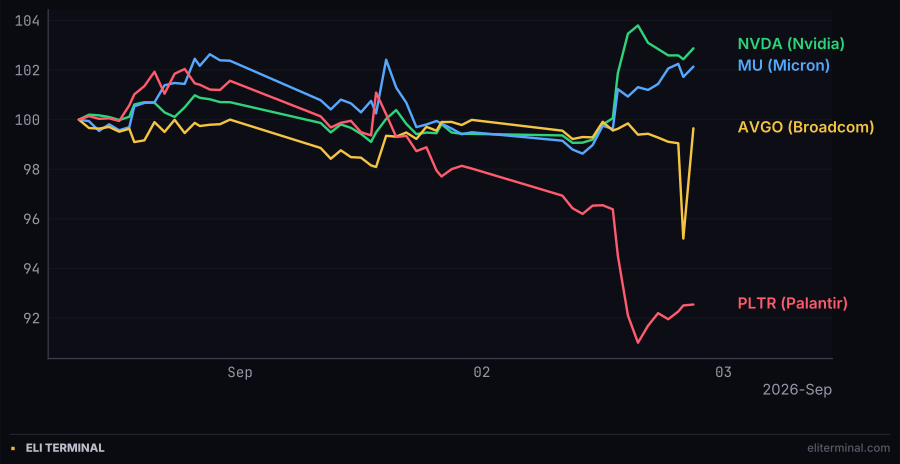
Same trade, same week, four different lines by Wednesday's close.
Palantir opened at 176.99, a gap down from Tuesday's 179.92 close, then sold off through the New York morning to a session low of 165.71 by 11:30am ET, down 7.9% intraday, before clawing back to close at 169.46. The move came in the same week the Army awarded Palantir and Anduril a $192 million contract to produce eight TITAN ground-sensing systems, and on the same day Palantir announced that Peter Zaffino, AIG's outgoing executive chair, would join as global head of financial services.
Coverage on the day pointed to profit-taking after a run that had pushed the stock to roughly 144 times earnings, alongside a broader software selloff and the pull of yields near a three-year high on richly valued growth names. Two pieces of company-specific good news landing in the same window as a 5.81% decline is itself the story: whatever was driving the sale, it wasn't reacting to Palantir's own headlines.
Broadcom reported revenue of 29.59 billion dollars for its fiscal third quarter, up 86% year over year and above the 29.36 billion consensus, with adjusted earnings of 3.32 dollars a share against a 3.24 estimate. AI semiconductor revenue rose 221% year over year to 16.7 billion dollars, now 56% of total sales, and management guided fourth-quarter revenue to 34.8 billion dollars, up 93% year over year, with AI revenue guided to 21.7 billion. Net income more than tripled to 13.09 billion dollars and operating margin hit a record 67.9%.
Broadcom shares closed the regular session down 0.66% at 367.24 ahead of the print, then extended the loss after hours: by 5pm ET the stock traded at 354.18, down 3.56% from the close. A quarter that beat on every published metric and raised guidance on top of an already steep growth rate still drew a sale, the same pattern Snowflake avoided hours earlier when its own beat-and-raise report, released just after the close, held up without a comparable after-hours drop.
The August employment report is due Friday at 8:30am ET, the first scheduled data point after a week that pushed yields to a three-year high and Fed pricing toward a hike rather than a cut. The tanker war and the ceasefire market's path both remain open questions with no scheduled resolution; Wednesday closed with the odds still well off their overnight low and the barrel still climbing.