Oil and the 10-year yield, two weeks to month-end
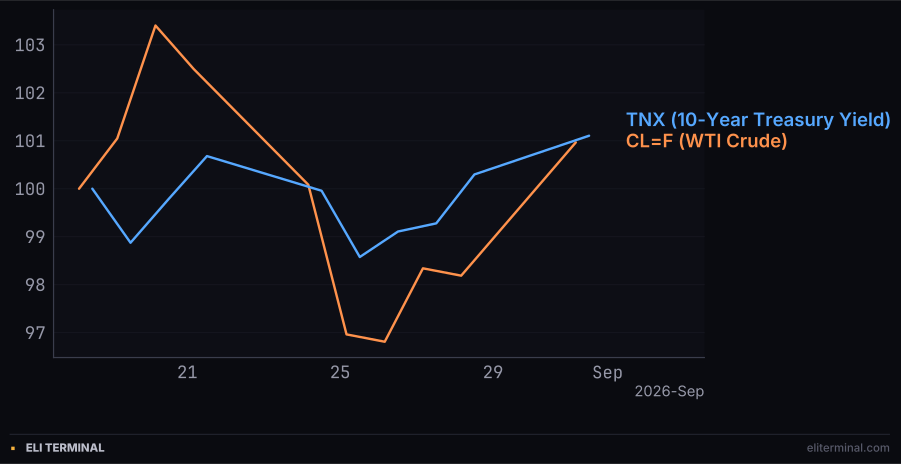
Both lines bottomed the same week and turned up together after Jackson Hole and the weekend strikes.
Tesla gained 5.5% on Cybercab bets, oil rose 2.8% after Iran's IRGC struck a Saudi tanker near Oman, and the Fed's September hike bet climbed to 58%, while Amazon, Alphabet and Microsoft all closed lower with nothing dated to explain it.
Both lines bottomed the same week and turned up together after Jackson Hole and the weekend strikes.
U.S. Central Command struck two Iranian rocket launchers on Larak Island on Sunday, August 30, after observing Islamic Revolutionary Guard Corps units preparing to lay sea mines in the Strait of Hormuz. Iran's state media reported at least two dead. The IRGC responded overnight with a combined missile and drone operation it called "Punishment of the Aggressor," hitting the King Hussein and Al Azraq bases in Jordan at 04:38 UTC Monday, an hour and a half after midnight in Amman. Jordan's military said it intercepted eight of the incoming missiles.
It was the first exchange of fire between Washington and Tehran in a month, and West Texas crude was already trading near 85 by the New York open, up from Friday's 83.40 close before a single U.S. trading desk had opened for the day.
WTI climbed from 84.35 at 00:45 UTC to 86.56 by 11:30 UTC, a gain of more than 2.6% booked entirely in the Asian and London sessions on the Jordan strikes. By 13:00 UTC, an hour before the regular U.S. equity session, the barrel had already given back a third of that move, trading at 85.50. It spent the New York morning grinding sideways in an 85.20 to 86.20 band before firming again into the last two hours of trading to settle at 85.76, up 2.83% for the day but well off the overnight high.
A Saudi-flagged VLCC, the SIDR, was struck by three unidentified projectiles roughly 17 nautical miles east of Khasab, Oman, at approximately 19:52 UTC Monday evening, with no casualties reported. Crude's five-minute bar spanning that exact minute was flat, 85.94 to 85.98. The next leg higher, from 85.99 to 86.30, didn't start until roughly 20:10 UTC, nearly twenty minutes after the strike. Whether that gap reflects the market waiting on confirmation or wire services taking that long to move the story, the tape did not react at the minute the projectiles hit.
Kalshi's contract on a 25 basis point September hike jumped from 30% to 48% between 14:00 and 15:00 UTC on Friday, August 28, the hour Fed Chair Kevin Warsh delivered his Jackson Hole keynote warning that summer inflation readings hadn't shown underlying trends had meaningfully improved. That alone would read as a one-day repricing. It wasn't. The same contract opened Monday at 54%, held there through the morning, then climbed again from 54% to a session high of 60% by 17:00 UTC, the window CNBC published a piece asking whether markets were right to read Warsh as endorsing a hike. It eased back to 58% by the 21:00 UTC close. The contract for the Fed holding rates moved the mirror amount, falling from 44% at 13:00 UTC to a low of 38% at 17:00 UTC before recovering slightly to 41% at the bell.
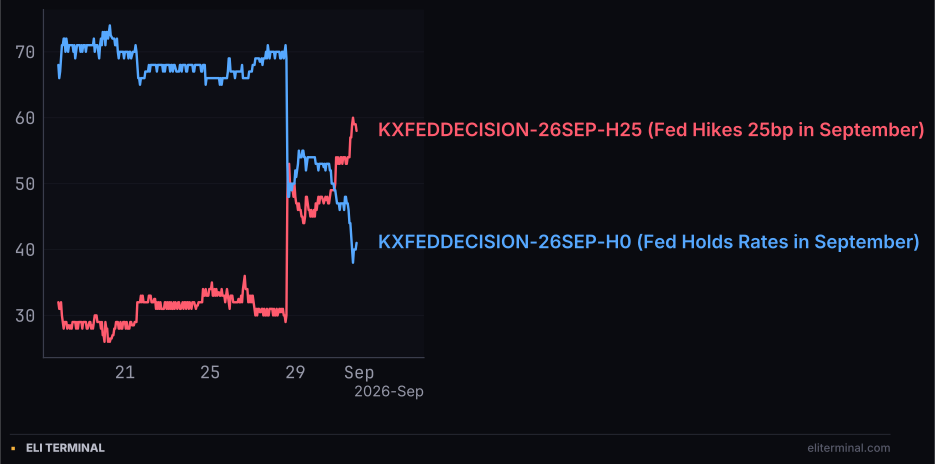
Friday's jump didn't stop at Friday. It added another six points Monday, with no new speaker on the calendar.
Gold fell 1.05% to 4,431.10 on a day that opened with fresh American strikes on Iran and closed with a tanker hit off Oman, the kind of session that has historically put a bid under the metal. It didn't. Gold's own five-minute bars show a small pop into the 19:45 to 19:55 UTC window, from 4,492 to 4,502, roughly the tanker strike's timing, before giving that back within ten minutes. The larger story for gold Monday was the same one moving crude's rate-sensitive cousin, the 10-year: a higher hike bet raises the opportunity cost of holding a metal that pays no yield, and that math outweighed the war premium.
The dollar index fell 0.27% to 99.43 on the same day, which is the harder anomaly to square. A geopolitical shock and a hawkish Fed repricing usually both point the same direction for the dollar. Monday they didn't, and nothing in the day's wires singled out a dollar-specific story to explain the gap.
Tesla traded at 347.35 at 13:25 UTC Monday, five minutes before the New York open. By 13:30 it was 352.56. By 14:00 it was 360.54, a 3.8% move inside the first thirty minutes of the session with no company statement, filing, or analyst note timestamped to that half hour. The stock kept climbing through the afternoon to close at 367.95, up 5.51% on volume nearly 50% above its three-month average, ahead of Thursday's Cybercab launch event in Austin, scheduled for 21:45 UTC.
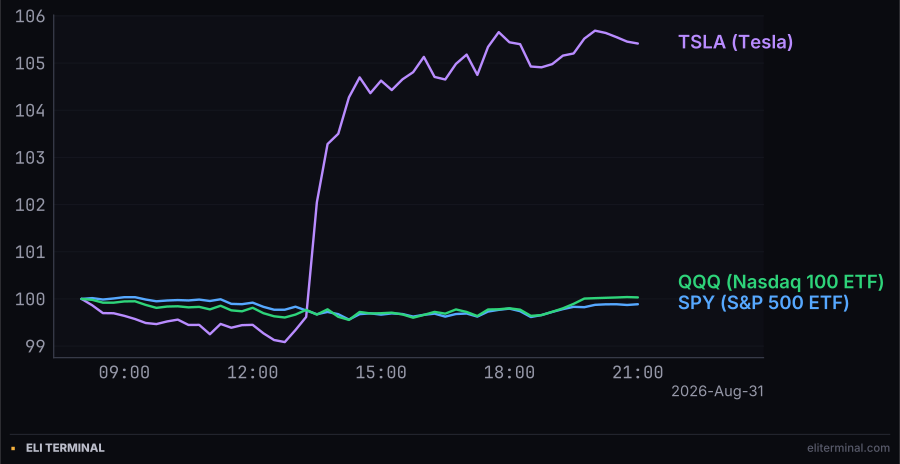
One line breaks from the other two at the opening bell and never comes back.
Amazon opened at 264.10 Monday, already down from Friday's 266.43 close, and drifted to 259.77 by the bell, a 2.50% loss with the largest single leg happening before the first trade of the New York session. Alphabet's path was the same shape: it opened at 344.48, well under Friday's 346.59, and closed at 339.35, down 2.09%. Microsoft, Meta, and Apple each lost between 0.9% and 1.2% on the same overnight-gap-then-drift pattern.
None of the five carried a dated Monday headline in the searches that turned up Tesla's Cybercab coverage or the Iran strikes. The simplest reading is that all five gapped down with the broader futures market overnight on the Jordan news and the extending Fed bet, then never found a reason to bounce. Goldman Sachs added to the Dow's drag separately, falling 0.78% to 1,025.90, pulling the 30-stock index down 0.65% versus the S&P's 0.30% loss.
The Nasdaq 100 closed up 0.05%, essentially flat, the only one of the day's four major benchmarks not to fall, even as five of its largest weights fell 0.9% to 2.5%. Tesla's 5.51% gain and Micron's 2.77% and Nvidia's 1.48% advances did the offsetting. The VIX rose 3.40% to 14.92 on a day the S&P fell just 0.30%, a bigger volatility move than the index move it was pricing, consistent with a market repricing tail risk on two fronts, Hormuz and the Fed, rather than reacting to Monday's actual close-to-close numbers.
Tesla's Cybercab event in Austin is scheduled for Thursday at 21:45 UTC, the first chance for Monday's 5.51% anticipation trade to meet an actual product. Friday brings August's jobs report at 12:30 UTC, the next data point for a Fed that Kalshi now prices at 58% to hike on September 16. Between now and then, the Strait of Hormuz market pricing a return to normal shipping traffic by September 30 sat at just 3.05% Monday, barely moved by either Sunday's strike or Monday's tanker incident.