WTI and Brent crude, August 24–25
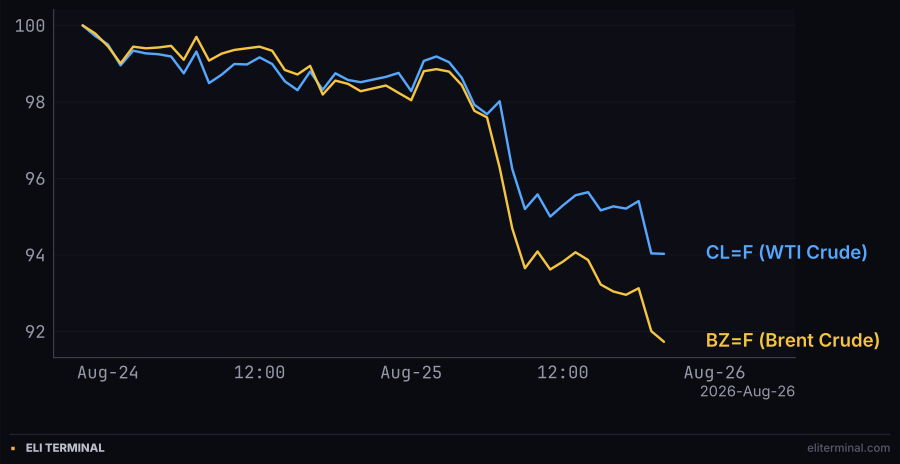
Both benchmarks did their falling well before the New York session opened Tuesday.
WTI crude settled at 82.36, down 3.1%, through a tanker strike, sweeping Iran sanctions, and a demining claim inside one 24-hour window, while Supermicro jumped 9.4% and AMD rose 4.9% on news that had nothing to do with any of it.
Both benchmarks did their falling well before the New York session opened Tuesday.
Brent crude fell from 91.35 to 87.66 between 06:00 and 09:00 UTC Tuesday, a slide of more than 4%, while West Texas Intermediate covered a nearly identical path from 91.44 to 82.12 across the same three hours. That window sits between 2am and 5am Eastern time. The New York equity session, and the afternoon headline that financial media would spend the day attaching to oil's weakness, hadn't happened yet.
President Trump posted on Truth Social at 14:32 UTC Tuesday that "all mines have been removed and/or detonated" from the Strait of Hormuz, crediting the U.S. Navy and warning Iran that any new mine would be "immediately and systematically destroyed." Brent ticked up to an intraday high of 88.82 in the hour that followed, then rolled over to close the hour at 87.86, lower than where it had opened. WTI's path over the same hour was just as flat: a high of 83.31, a close of 82.50, barely different from the prior hour.
Crude had already fallen from above 91 to the mid-82s by the time Trump's post went out. The market had done its de-escalation pricing overnight, in Asian and European hours, on the private read of Monday's sanctions rollout. The president's statement, aimed at the day's biggest oil headline, arrived to a market that had already moved on.
The UK Maritime Trade Operations center logged a report at 20:57 UTC Monday night of an unidentified projectile striking a tanker roughly nine nautical miles northeast of Ash Shishah, Oman, close to the Strait of Hormuz shipping lanes. The impact disabled the vessel's engine room; the crew was reported safe. Brent's hourly candle covering that strike closed at 92.13, up from 91.99 the hour before, a move of about 0.15%.
An attack on a tanker in the strait that supplies roughly a fifth of the world's seaborne oil produced a smaller one-hour move than the bid-ask noise on an ordinary Tuesday morning. Whatever repriced crude lower over the following day, it was not that strike.
Treasury Secretary Scott Bessent opened his press conference at 17:00 UTC Monday, unveiling sanctions against 60 entities and vessels spanning the UAE, Hong Kong, China, Singapore, and Switzerland, and warning unnamed countries they had "a defined timeline to shut down activities we have identified." He declined to name those countries or set a public deadline, and the measures stopped short of directly targeting the institutions that clear Iran's oil payments. Brent and WTI were already lower into that hour and kept falling through Monday's close near 85.
Traders read the framing, not just the sanctions list. Ole Hansen at Saxo Bank described the shift from active military confrontation toward economic pressure as easing nerves across energy markets, and said the announcement fell short of what the market had been bracing for. That reading, formed Monday afternoon, is what carried into Tuesday's overnight slide.
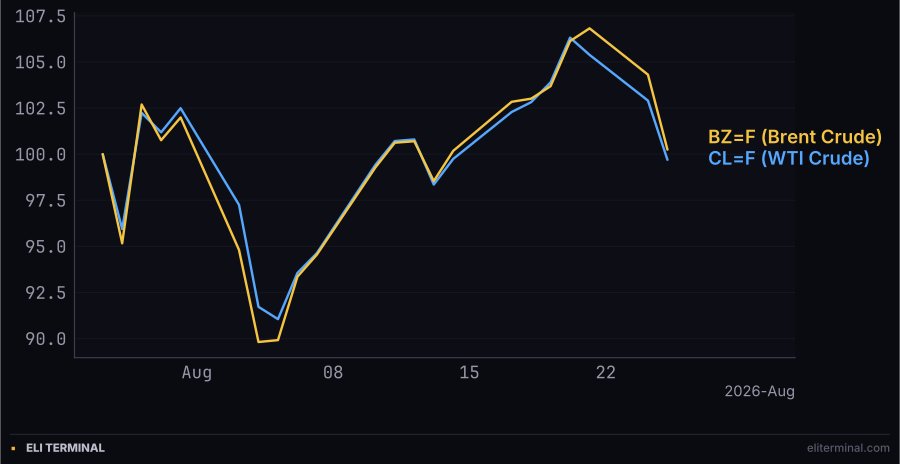
Two sessions did almost all of the damage in a month that had otherwise gone sideways.
WTI spent most of August chopping between 82 and 87, never straying far from where it started the month. Monday and Tuesday alone erased more than 7% from Friday's close, compressing a month's worth of range into 48 hours. A market handicapping a return to normal Hormuz shipping traffic by year-end priced that outcome at 33.5% Tuesday, up from 32.5% Monday, a one-point move on the same day Trump claimed the strait fully cleared. The skepticism embedded in that one-point move matches what the tape showed at 14:32 UTC: a claim the market had already discounted, not one it was newly pricing.
Supermicro closed at 38.46, up 9.35%, after Cisco said it would extend its Secure AI Factory partnership with Nvidia to include Supermicro's rack-scale server hardware starting in October. The stock's hourly candle at the 13:30 UTC open jumped from 36.15 to 37.92 in a single hour on 16.1 million shares, a gap that lines up with the announcement, not with anything happening in the Gulf.
Raymond James analyst Simon Leopold upgraded AMD to Strong Buy that morning, raising his price target to 641 from 565 on a forecast for server-CPU revenue compounding 44% a year through 2030, and the stock closed at 479.18, up 4.91%. AMD's hourly data shows the stock already trading near 474, well above Monday's 456.75 close, before the 13:30 UTC open, consistent with the note circulating pre-market.
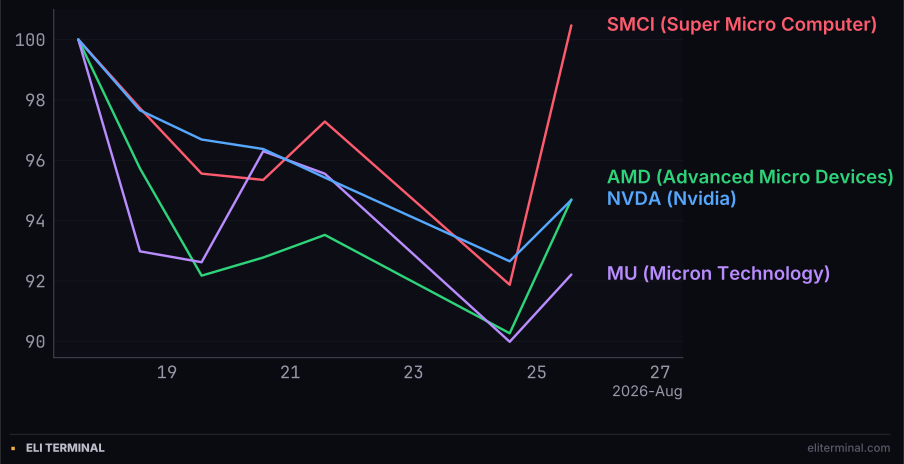
The same four names fell together Monday. They did not rebound together Tuesday.
Micron and Supermicro both fell more than 5% Monday on a weekend report that Nvidia planned to raise prices on some AI servers, a single shared catalyst that moved the whole group in the same direction. Tuesday inverted that pattern. Supermicro's 9.35% gain traced to Cisco, AMD's 4.91% gain traced to Raymond James, Micron's 2.48% gain and Nvidia's 2.19% gain came with no comparable company-specific news attached in Tuesday's wires ahead of Nvidia's own Wednesday close print. Palantir, with no Iran or chip-supply exposure at all, fell 1.80%, the one red name in an otherwise green session.
WTI fell from 82.30 to 81.12 between 18:00 and 19:00 UTC, then extended to a session low of 80.23 by 20:00 UTC, a decline with no press release, filing, or wire report timestamped to that window in a broad search of Tuesday's coverage. Three explanations were equally live: month-end futures positioning, a thin pre-settlement air pocket, or simple continuation of the morning's move. None had a timestamp attached to it. The honest read is that the last leg down is unexplained.
Nvidia reports its results after Wednesday's close, with a call scheduled for 5pm Eastern. Tuesday's session priced some optimism into the group ahead of that print, with Micron and Nvidia itself both green without a fresh catalyst of their own. Whether that positioning was warranted gets a same-day answer once the numbers are out.