Chip names against the S&P, past month
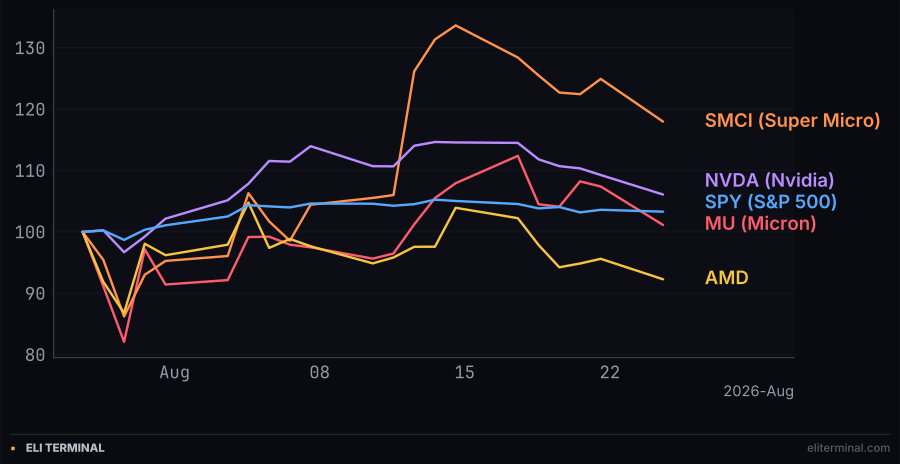
Three of the month's biggest winners gave back a chunk of August in a single session.
Micron fell 5.8% and Super Micro fell 5.6% in the same opening quarter hour Monday, while crude eased 2.4% through an Iran sanctions announcement it barely reacted to.
Three of the month's biggest winners gave back a chunk of August in a single session.
13:30 UTC, the New York opening bell, is when Micron, Super Micro, Nvidia, Tesla and the S&P 500 each posted the single sharpest move of their session. Micron's bar for that quarter hour ran from an open near 934.70 down to a low of 901.21 on 4.6 million shares. Super Micro's ran from 36.52 to a low of 34.86 on 6.3 million shares.
Neither stock had much left to say after that. The rest of Monday, for both names, was spent negotiating how much of the opening drop would still be there by the close.
Bloomberg reported Saturday that Nvidia had notified its biggest customers of AI server price increases above 15%, tied to memory costs that Deloitte estimates now make up roughly a quarter of a high-end AI rack's bill of materials. That story hit memory and server names broadly at Monday's open: Micron fell 5.83% to 910.43, Advanced Micro Devices fell 3.49% to 456.75, and Broadcom fell more than 2% to 358.76.
Super Micro's drop had a second, more specific cause. Taiwan prosecutors indicted nine people Monday, including employees of Nvidia's and Super Micro's Taiwan units, over an alleged scheme to smuggle 74 servers built around restricted Nvidia B300 chips into China through Japan, Indonesia and Hong Kong. Super Micro closed at 35.17, down 5.56%.
Micron's low of the day came twenty minutes after the open, at 887.61, down 8.2% from Friday's close. By 18:30 UTC it had recovered to 922.15, down only 4.6%, before fading into the close at 910.43. Super Micro traced the same shape: a low of 34.09, down 8.5%, recovering to 35.76, down 4.0%, by mid-afternoon before closing at 35.17.
Nvidia and Tesla moved the other way. Nvidia opened down and stayed down, touching its session low of 207.37 in the final twenty minutes of trading before closing at 208.48, down 2.91%. Tesla's worst print of the day, 347.77, also came inside the last hour, ahead of a 348.95 close, down 3.83%. Neither name had a dated, one-time catalyst of its own on Monday, and neither bounced.
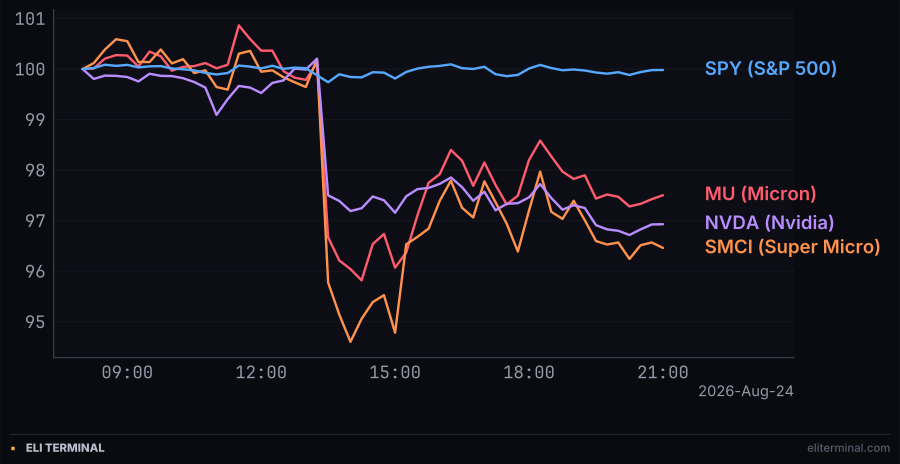
Same quarter hour, same direction. Different afternoons.
West Texas crude was already down before New York opened, trading near 85.66 at 08:00 UTC and grinding to a session low of 84.44 by 15:15 UTC, three hours before Treasury Secretary Scott Bessent stepped to a podium in the Cash Room.
Bessent unveiled Operation Economic Outcast that afternoon, calling it the single greatest financial offensive ever marshaled against an adversary and naming sanctions on more than 60 individuals, entities and vessels tied to Iran's oil revenue, weapons procurement and cyber operations. Crude traded in an 84.70-to-85.30 band both before and after his remarks and settled at 85.01, down 2.35% for the session, a level effectively set hours before he spoke.
Gold was already sitting near a three-month high entering Monday and added just 0.36% to close at 4,640.80. The 10-year Treasury yield eased 3.4 basis points to 4.704%, continuing a drift that predated the sanctions rollout by days. The dollar index rose 0.20% to 99.00.
None of the three assets most likely to reprice around a new US sanctions campaign against a state actor moved outside its recent range.
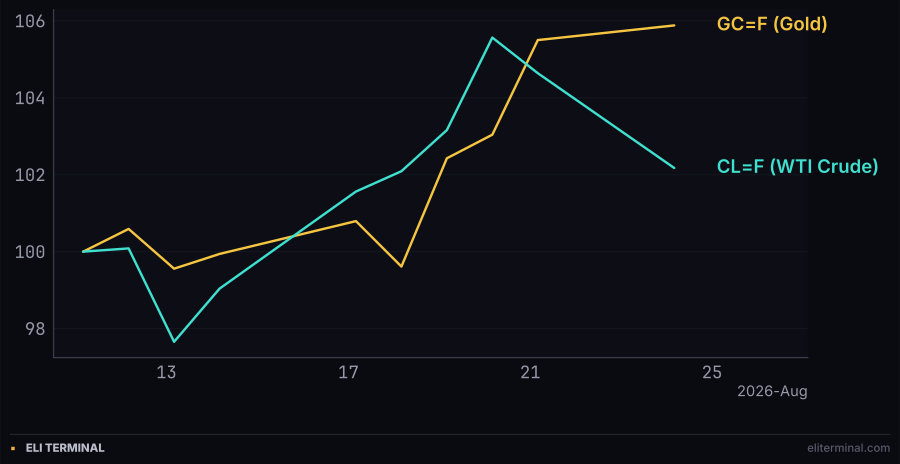
Two different two-week paths, both flat on the day the sanctions actually landed.
Kalshi's contract on the Federal Reserve holding rates steady at its September meeting opened Monday at 0.68 and closed at 0.68, trading in a one-point band the entire session, unchanged from where it settled Sunday. A chip-sector selloff, a new Iran sanctions rollout and a fresh tariff threat on Canadian autos produced no detectable move in how the market prices the next rate decision.
President Trump said Monday the US would raise tariffs on Canadian cars, trucks, auto parts and steel to 50%, effective January 1, 2027, after trade talks broke down. Tesla fell 3.83% to 348.95 the same session, with its steepest single move landing inside the same 13:30 UTC quarter hour as Micron and Nvidia.
Tesla carries far less direct exposure to Canadian assembly than Detroit's automakers, and nothing in Monday's wires tied its decline specifically to the tariff threat. The move reads as adjacency to the day's broader risk-off complex, not a confirmed reaction to the tariff story on its own.
PDD Holdings reported second-quarter revenue of 112.4 billion yuan, or 16.6 billion dollars, up 8% from a year earlier, with operating profit up 8% to 27.8 billion yuan and non-GAAP operating profit up 5% to 29.1 billion yuan, according to the company's own release. Its American shares opened near 90.95, fell to an intraday low of 86.19, and closed at 87.07, down 1.48% from Friday, a swing of more than 5% on a report that had nothing to do with the chip complex or the sanctions news moving everything else that day.
Nvidia reports second-quarter results after Wednesday's close, two trading days past Monday's session. The pattern in Monday's tape is specific: Micron and Super Micro, the two names with an identifiable, dated catalyst, recovered roughly half their opening losses by the afternoon. Nvidia, the subject of the very price-hike story that started the selloff, did not.