Bitcoin, Gold, and the 10-Year Yield, August 15–21
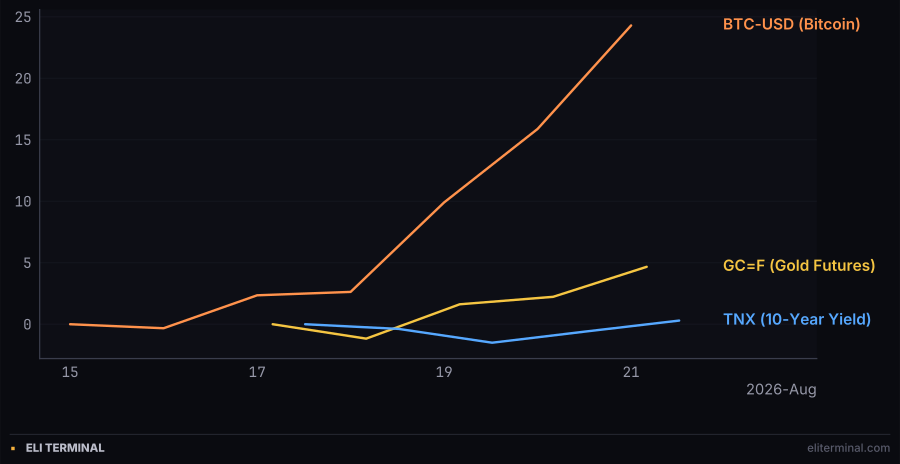
Same week, three completely different shapes. Bitcoin's line makes gold's look flat and the 10-year's look like a rounding error.
Tesla gained 5.14% and Alibaba lost 8.6% in the same session that closed out bitcoin's best week since 2023, while the 10-year yield finished right back where Wednesday's Treasury buyback found it.
Same week, three completely different shapes. Bitcoin's line makes gold's look flat and the 10-year's look like a rounding error.
527.51 is where the Dow-tracking DIA closed Thursday, down 1.27% on a session Walmart's own shares fell 9.15% after missing comparable-sales estimates and guiding fiscal third-quarter earnings below Wall Street's number. Friday's close of 532.22 recovered 0.89%, less than half of what Thursday erased.
Walmart itself never got the bounce. The stock closed Friday at 103.70, down another 0.13%, flat on top of Thursday's damage rather than a rebound. Deere, which reported the same afternoon and raised its full-year profit forecast, closed Friday at 647.47, up from Wednesday's 580.63, the one name in the batch still climbing four sessions later.
Alibaba fell 8.57% to 119.34 after fiscal first-quarter results showed adjusted earnings per American depositary share of 1.26 dollars, down 42% from a year earlier and well short of the 1.85-dollar consensus. Net income dropped 76% to 10.54 billion yuan.
The number that actually moved the stock sat further down the release: capital expenditure of 67.68 billion yuan, up 75% year over year, running at roughly 4.5 times the growth rate of the company's own cloud revenue. Alibaba's market value fell by close to 21 billion dollars in the session. Alibaba's capex now outruns its new cloud revenue by more than four to one, and the market priced that ratio, not the revenue beat sitting above it.
The Information's report that Tesla was readying an August Cybercab launch ran on August 17, four trading days before Friday's close. It was not what moved the stock Friday morning. The Nevada Transportation Authority approved Tesla's robotaxi permit late Thursday, expanding its Clark County ceiling from 10 vehicles to 5,000, and the news was still fresh when the New York session opened.
Tesla traded at 349.96 at 13:00 UTC Friday and 359.80 by 13:30 UTC, a 2.8% jump inside the first half hour of the cash session. The stock kept climbing into the afternoon, touched 366.50 intraday, and closed at 362.86, up 5.14% on the day and roughly 6.9% for the week. Nevada's regulator approved Tesla, Uber, and Waymo for commercial robotaxi service in the same vote, though Tesla's own engineers have said they would be satisfied reaching half that fleet size within the year.
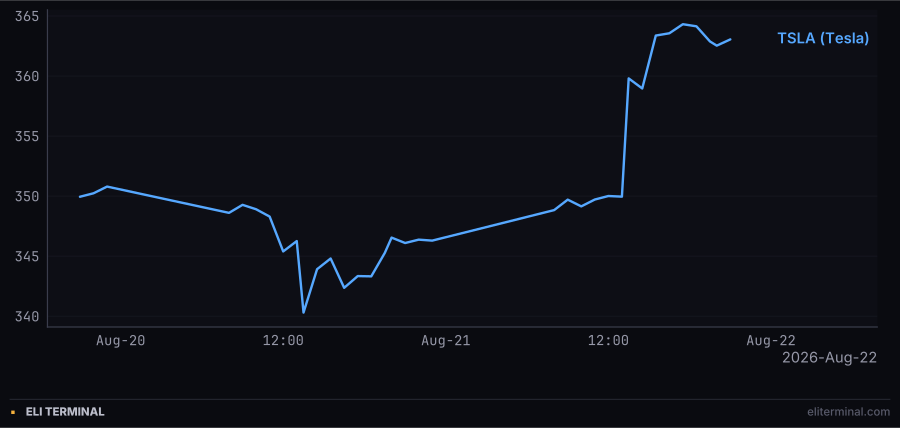
One candle, 13:00 to 13:30 UTC: 349.96 to 359.80.
Treasury Secretary Scott Bessent announced Wednesday morning that liquidity support buybacks for 10-to-30-year debt would double, from 2 billion dollars to at least 4 billion dollars per operation starting September 9. Treasury framed the move as liquidity support for a bond market under stress, aimed at long-end yields specifically.
Bitcoin traded at 65,890 dollars at 14:00 UTC Wednesday and 68,540 dollars by 15:00 UTC, a 4.0% move in one hour, the same hour the buyback story spread across trading desks. More than a billion dollars of bitcoin shorts were liquidated within about an hour, part of a record 2.7 billion dollars in crypto short liquidations across the day, the largest single-day wipeout in records going back to 2021. The SEC's August 18 proposed rulemaking on crypto asset offerings and Wednesday's separate White House meeting with crypto executives ran alongside it. By Friday's close bitcoin traded near 78,500 dollars, up roughly 24% over the trailing week.
The 10-year yield fell to 4.653% Wednesday, the day of the announcement, down from 4.706% Tuesday. By Thursday it had retraced to 4.696%, and by Friday's close it sat at 4.738%, back inside the same 4.70-to-4.74% band the 10-year occupied Monday and Tuesday, before Treasury said a word.
The dollar told a different story. The index fell from 99.65 to 98.83 the same Wednesday, an 0.82% drop, and it never recovered: Friday's close of 98.80 sat a touch below even Wednesday's low. Of the two markets the buyback was supposed to move, the currency held its reaction through the week and the yield gave all of it back.
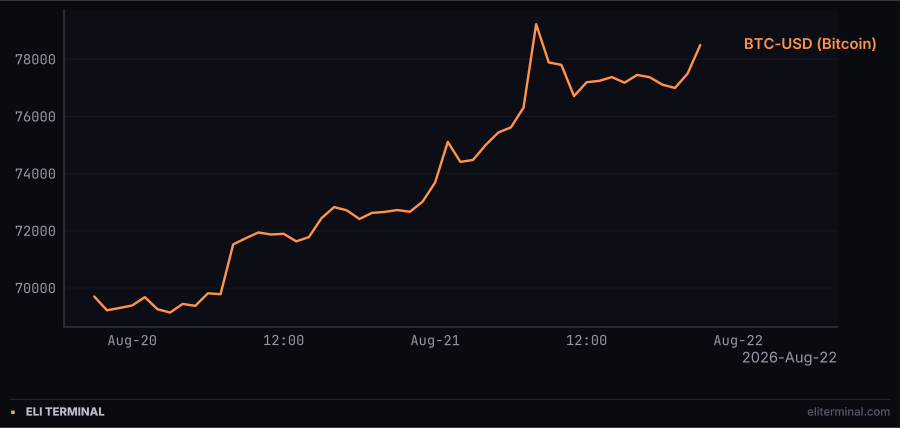
The spike at 08:00 UTC gave back most of itself by 11:00 UTC, with nothing timestamped to that hour in the day's wires.
Gold futures closed at 4,624.10, up 2.39% on the day and roughly 5.9% on the week, with spot gold trading near 4,633.90 dollars an ounce Friday morning. Friday's coverage tied the move to mounting anxiety over federal debt, which crossed 40 trillion dollars for the first time two days earlier, and to the same soft dollar the buyback produced.
The chart shape is the tell. Bitcoin's week is a handful of sharp, hour-long jumps stacked on top of each other. Gold's week is a near-continuous overnight grind, climbing through Thursday night and into Friday morning without a single outsized candle anywhere in it. A safe-haven trade and a squeezed-short trade ran at the same time, in the same week, for different reasons, and only converged on a shared chart because both happened to be up.
Bitcoin traded at 76,306 dollars at 07:00 UTC Friday and 79,225 dollars by 08:00 UTC, a jump of 3.8% in the London hour. By 11:00 UTC it had fallen back to 76,710 dollars, giving back nearly all of the spike in three hours before grinding higher again into the New York close. A search across Friday's wires turned up nothing timestamped to that hour specifically, no exchange outage, no liquidation report, no headline. Inside an already-explained week, one hour stayed a mystery.
A bipartisan Senate letter led by Jim Banks and Chuck Schumer had set Friday as the date they wanted Apple to commit to dropping two Chinese memory suppliers, ChangXin Memory Technologies and Yangtze Memory Technologies, from its parts list. Commerce Secretary Howard Lutnick had already said the administration was "not in favor" of such a deal a week earlier, and Micron had spent weeks lobbying against Apple's sourcing plans.
Micron closed Friday at 966.78, down 0.77%, and Nvidia closed at 214.72, down 0.98%, the only two of the week's AI-adjacent names to fall on a day Palantir, Super Micro, Alphabet, and Broadcom all closed higher. Nothing in Friday's wires confirmed what Apple ultimately decided.
Iranian President Masoud Pezeshkian called the U.S.-Iran memorandum of understanding a "victory" for Iran on Friday, saying it was "better to end the war today" while Tehran negotiated from what he called a position of strength. Oil prices were little changed to lower on the read that this eased rather than escalated the Hormuz standoff, with WTI closing at 87.06, down 0.88%.
Brent didn't follow. It closed at 94.39, up 0.65%, the two benchmarks moving in opposite directions on a day with one shared headline. The U.S. military separately disclosed it has escorted more than 660 million barrels through the strait since May, a reminder that the memorandum's diplomacy and the strait's actual traffic are two different measurements.
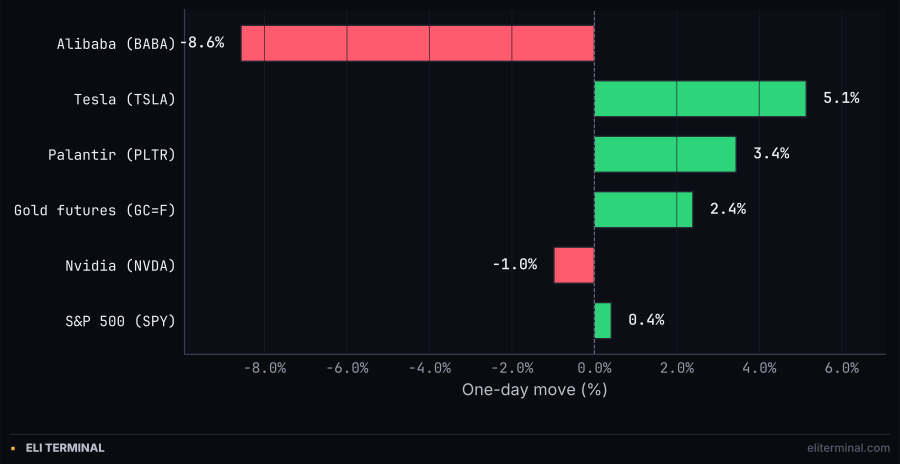
A flat index sitting on top of a nine-point earnings spread.
Nvidia reports earnings the following Wednesday, August 26, the sector's most-watched print after a week where the stock closed lower four sessions out of five with no earnings release of its own. Two days after that, incoming Fed Chair Kevin Warsh delivers his first Jackson Hole address, on a symposium theme built around payments and financial innovation, an on-brand audience for a week that put bitcoin's short squeeze on every macro desk's screen. The Fed's own September meeting stayed priced at essentially zero odds of a cut all week, on Kalshi and Polymarket alike; whatever moved the bond market this week, it wasn't a change in what the Fed is expected to do next month.