Walmart, Deere, Alibaba and the S&P, indexed to Tuesday's close
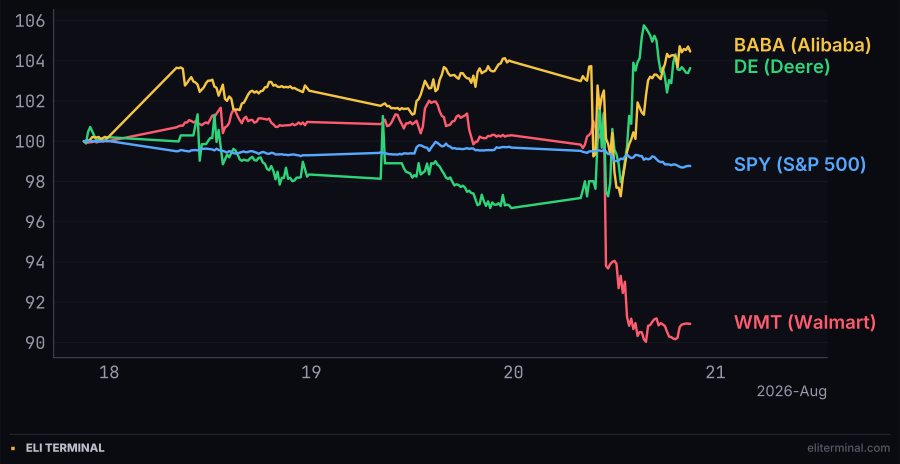
Three earnings, three separate lines, one flat index underneath them.
Walmart fell 9.15% on its slowest comparable-sales growth in six years, Deere jumped 6.94% on a construction-led beat, and Alibaba erased a 5.6% intraday drop to close green, all three verdicts written before the cash session even opened.
Three earnings, three separate lines, one flat index underneath them.
Walmart, Deere and Alibaba all reported quarterly results before Thursday's opening bell, and by 4pm each stock had settled into a different outcome: Walmart down 9.15% to 103.84, Deere up 6.94% to 620.94, Alibaba up 1.26% to 130.53. All three companies beat or raised something. Only one of the three was rewarded for it without a fight.
Walmart raised its full-year sales growth outlook to 4% to 5%, from a prior 3.5% to 4.5%, and lifted its adjusted earnings range to 2.80 to 2.87 dollars a share. U.S. comparable sales grew just 2.6% for the quarter, against a Wall Street estimate near 3.5% and the slowest pace the company has posted in six years. The stock opened near 116 in Thursday's early quotes, broke to a low near 105.90 by 11:00 UTC, kept sliding through the cash open, and bottomed at 102.85 by 14:45 UTC before closing at 103.84.
The raised full-year number said one thing. The quarter that produced it said another, and the tape sided with the quarter.
Walmart said federal drug-pricing rules cut an estimated 80 to 90 basis points from U.S. comparable sales as falling prescription prices worked through its pharmacy business. Strip that headwind out and the comp-sales miss narrows considerably. None of that appeared in Thursday's wires as new information after the release crossed near 11:00 UTC; the stock kept falling for three more hours anyway, into the regular session, without a fresh headline attached to any of the later legs down. The selling was digestion of one number, not a reaction to new news.
Deere posted earnings of 5.10 dollars a share against a roughly 4.79 dollar estimate, and raised its full-year net income outlook to a range of 4.75 to 5.0 billion dollars. Construction and forestry operating profit jumped 84%, while the company's largest division, production and precision agriculture, saw sales fall 6% as farmers kept deferring big equipment purchases. The stock opened Thursday near 611, a gap of more than 5% from Wednesday's close, then climbed as high as 639 by 15:30 UTC before giving back roughly a third of that intraday gain to close at 620.94, up 6.94% on the day.
Alibaba's adjusted earnings per American depositary share came in at 8.52 yuan, well short of the roughly 10.72 yuan analysts expected, as capital spending on AI infrastructure rose 75% year over year to just under 10 billion dollars and free cash flow swung to an outflow of 44.67 billion yuan, more than double the outflow a year earlier. Cloud revenue grew 45%, its fastest pace in 22 quarters. The stock opened Thursday's cash session at 123.47, fell to a low of 121.88 by 13:45 UTC, down 5.6% from Wednesday's close of 128.90, and then climbed almost without interruption for the rest of the session to close at 130.53, up 1.26% on the day.
A reader who checked Alibaba only at 4pm would have filed a green close and moved on. A reader who checked it at 9:45am would have filed a rout. Both would have been describing the same stock on the same day.
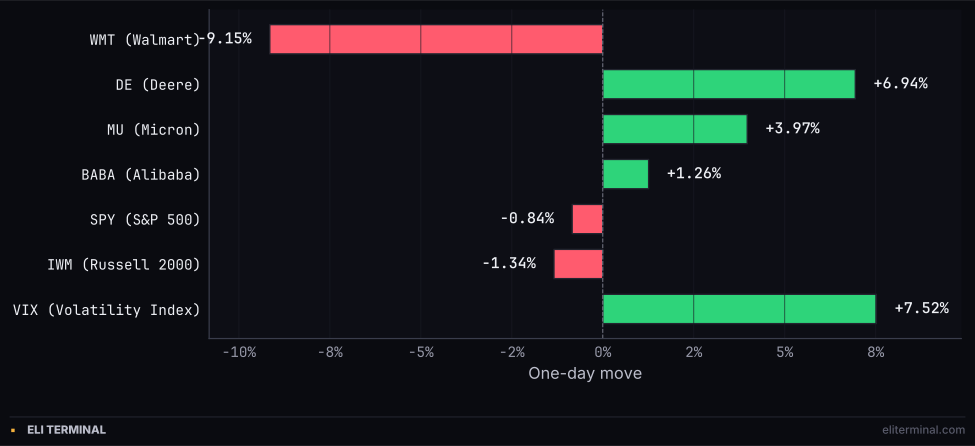
Three earnings reports, three magnitudes, no shared direction.
The VIX closed at 16.01, up 7.52% from Wednesday's 14.89, the index's largest one-day gain of the week. Nearly all of that move happened before 13:30 UTC: the VIX held near 15.1 through the European morning, then climbed from 15.56 to 16.02 between 11:45 UTC and 12:15 UTC, the same half hour Walmart's premarket break deepened. Once the New York cash session opened, the VIX spent the rest of the day drifting between 15.5 and 16.0, even as the S&P ground lower into the close. The fear priced into Thursday arrived before Thursday's stock market did.
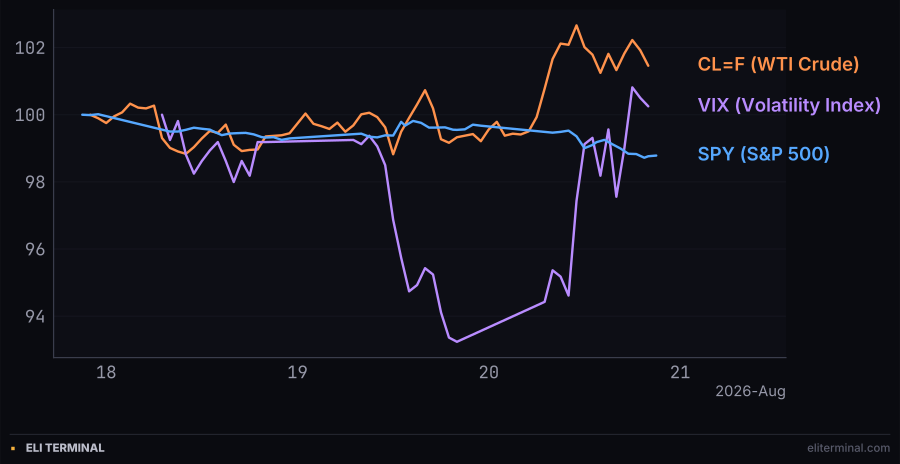
Both lines make their move before the opening bell, then go quiet once the session starts.
Persistent Strait of Hormuz tanker disruption kept a bid under crude: WTI settled at 87.83, up 2.33%, and Brent at 93.78, up 2.36%, with roughly 236 ships having transited the strait over the prior 19 days, well below the 20 million barrels a day of normal pre-war traffic. Most of Thursday's oil gain, like the VIX's, printed between 07:00 and 11:00 UTC, ahead of the New York open, before crude gave back part of the move and settled higher on the day.
Wednesday's fix didn't hold. The Treasury Department had announced it would double its long-bond buyback operations to ease pressure on longer-dated debt, and yields fell on the news, but the 10-year resumed its climb Thursday to close at 4.696%, up 0.92%. A stock market falling alongside rising oil and rising yields, with gold also higher at 4,516.30, is not the standard flight-to-safety pattern; bonds sold off on the same day equities did, offering no offsetting hedge. The market pricing a September rate hike on Kalshi eased slightly, from 29% to 28%, and the comparable Polymarket contract fell from 28.5% to 27%, arguing against a hawkish-Fed reading of the day's yield rise.
The Kansas City Fed's Jackson Hole symposium runs August 27 to 29, with Fed Chair Kevin Warsh's keynote scheduled for the morning of August 28. Thursday's odds move, a slight easing in the priced chance of a September hike, gives no early signal of what Warsh will say. Whether Thursday's cross-asset selloff in stocks and bonds together was a preview of a hawkish surprise or just a single volatile session will not be answerable until that morning.