Gold, bonds, the dollar and stocks, August 18-19
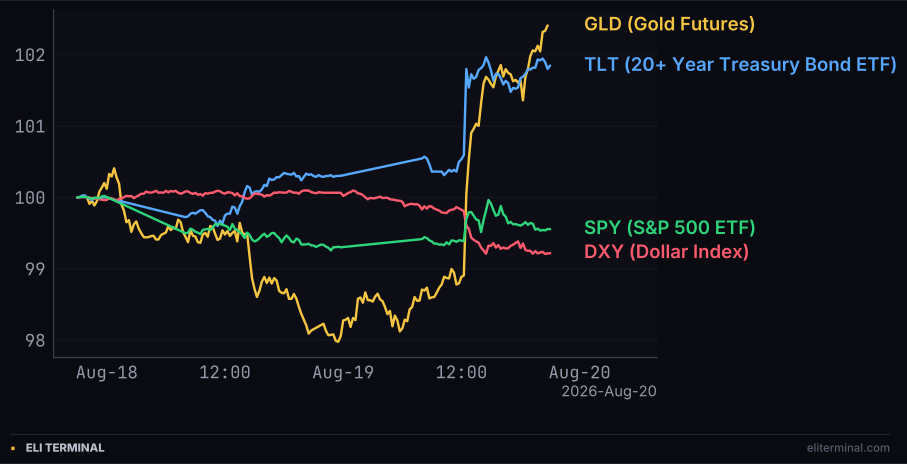
Four different asset classes, one 15-minute bar, an hour before the opening bell.
Marvell gained 9.85% and Broadcom fell 4.61% in the same pre-market quarter hour a Google chip filing crossed, fifteen minutes before Treasury's move to double its long-bond buybacks pulled the 10-year yield down 1.13% a full hour before the opening bell.
Four different asset classes, one 15-minute bar, an hour before the opening bell.
Gold futures traded at 4,474.80 at 12:30 UTC Wednesday, up from 4,424.30 fifteen minutes earlier. In the same quarter hour, the 20-plus-year Treasury bond ETF jumped from 81.94 to 82.91, the dollar index broke from 99.39 to 99.19, and the S&P 500 ETF popped from 767.79 to 770.12. All four moves landed in the 12:30 UTC bar, which is 8:30am ET, a full hour before the New York cash open at 9:30am.
The trigger was a Treasury Department announcement that it would at least double the size of its long-bond buyback operations, from 2 billion dollars to at least 4 billion dollars per operation, targeting the 10-to-20-year and 20-to-30-year part of the curve starting September 9. Secretary Scott Bessent's department has been trying to steady a market that Bloomberg and CNBC both described as having run a buyers' strike in longer-dated debt since late June (CNBC, Bloomberg).
The 10-year yield closed the day at 4.653%, down 1.13% from Tuesday's 4.706%, and the 30-year bond fell about 9 basis points on separate reporting. Gold kept climbing into the New York afternoon, closing at 4,489.40, up 2.83% and its highest level in roughly two months.
None of that is a stock market story on its own. It became one because the equity tape moved in the identical 15-minute window, before a single share had traded on the floor.
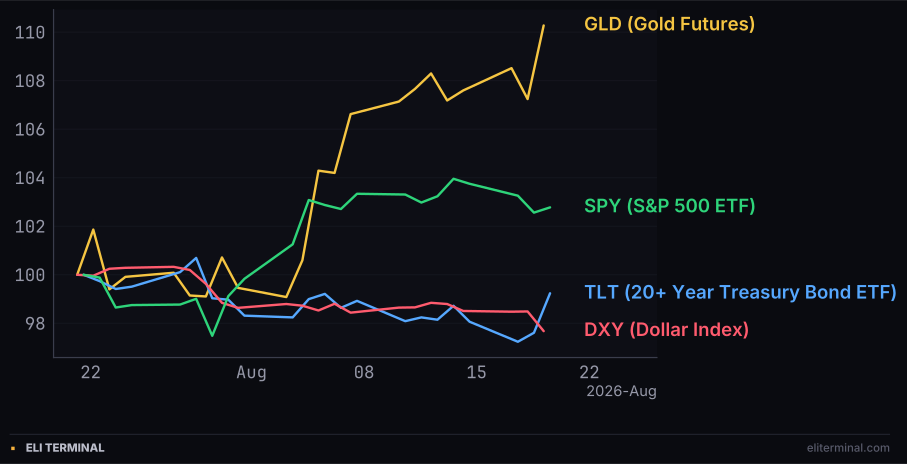
Gold's move was new Wednesday. The dollar and bonds had been leaning this way for weeks.
Zoomed out to the month, the dollar index and the bond ETF had been drifting in this direction for two weeks before Wednesday. Gold had not. Its climb from a largely stagnant summer to a two-month high happened almost entirely in the hours after the buyback announcement, not as the final leg of a slower trend the way the currency and bond moves were.
Marvell traded at 212.95 at 12:00 UTC Wednesday, then spiked to a high of 236.51 by 12:15. Broadcom did the opposite in the identical bar, opening at 380.30 and trading down to 366.08. Both moves came from an 8-K Marvell filed disclosing that Google had issued it a warrant for 58,970,907 shares, exercisable at 206.58 dollars, tied to a custom-chip agreement signed July 29 that could vest in full against 120 billion dollars of future purchases (CNBC).
Marvell's chips attach to the periphery of Google's TPU stack: inference accelerators, memory controllers, networking silicon. Broadcom still holds the core TPU compute design under a separate, earlier agreement with Google, but the market read Marvell's expansion as a dent in a relationship Broadcom had treated as close to exclusive (CNBC).
Broadcom closed at 362.48, down 4.61%. AMD, another name chasing custom-silicon work, fell 3.71% alongside it with no separate news of its own.
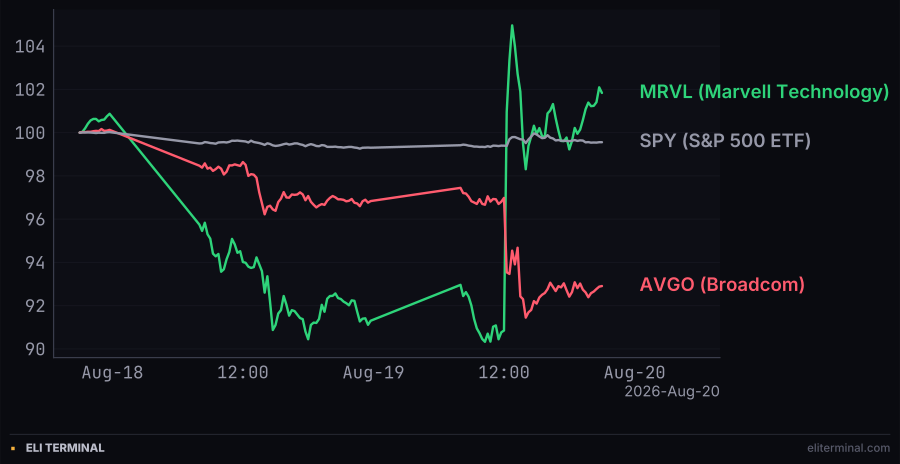
One filing, two stocks, opposite directions, and an index that barely noticed.
Marvell gave back some of its premarket spike by the close, settling at 237.27, up 9.85% rather than the near-12% peak. Broadcom took a second leg down at the 13:30 UTC opening bell, trading as low as 357.61 before closing at 362.48.
The S&P 500 ETF, which holds both names, moved less than half a point across the entire session. This was a supply-chain story inside two stocks, not a market story.
TJX closed Tuesday at 150.85. By the 13:30 UTC opening bell Wednesday the stock had traded as low as 141.94, down nearly 6%, and by the end of that same 15-minute bar it had rallied to 150.535, essentially unchanged. The entire round trip, a 6% drop and a full recovery, fit inside one quarter hour.
TJX beat on both lines, with adjusted earnings of 1.22 dollars against a 1.19 estimate and same-store sales up 4%, and raised its full-year profit forecast to a range of 5.31 to 5.36 dollars a share from 5.08 to 5.15. What the market did not like was Q3 guidance of 1.30 to 1.32 dollars, short of the 1.35 consensus, and CEO Ernie Herrman's plan to lift store-opening growth to 4% next year at a moment when discretionary spending is already under pressure (Bloomberg). The stock gave up its opening-bell recovery through the rest of the session and closed at 144.50, down 4.21%.
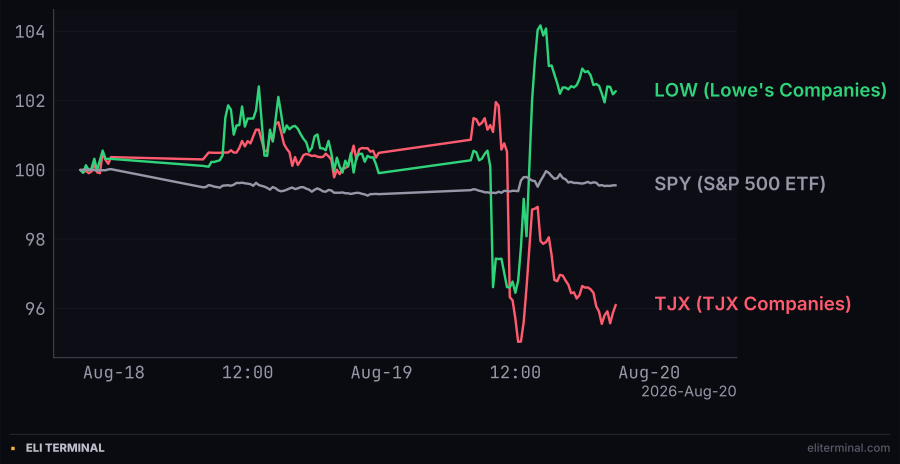
Two retailers, two round trips, opposite endings, both invisible in a close-only summary.
Lowe's closed Tuesday at 215.64 and opened Wednesday under pressure, trading down to 212.38 in the first 15 minutes after the bell. From there it reversed hard, reaching 225.79 by 14:15 UTC, a 4.7% intraday gain, before fading through the afternoon to close at 220.00, up 2.02%.
The earnings themselves were mixed. Adjusted earnings per share of 4.40 dollars beat the 4.38 estimate, and sales rose 8.3% to 25.96 billion, helped by recent acquisitions.
But Lowe's narrowed its full-year outlook, cutting the top end of its comparable-sales range from up 2% to flat and trimming its earnings-per-share guidance to about 11.75 dollars from a prior 11.75-to-12.25 range, citing cautious DIY customers (CNBC). A trimmed guide bought a green close. A raised guide, at TJX, bought a red one.
4.02 billion dollars in quarterly revenue against a 3.92 billion estimate, adjusted earnings of 3.45 dollars against 3.33 expected, and a fourth-quarter guide of 4.3 billion plus or minus 100 million versus a 4.07 billion consensus: Analog Devices beat and raised by a wide margin, with data center revenue growing more than 100% year over year in both optical and power products (Analog Devices). The stock closed at 373.26, down 0.89%.
The move was not steady. ADI broke down hard at the 13:30 UTC open, trading to a session low of 369.73, recovered to an intraday high of 382.14 by 14:15 UTC, and drifted lower for the rest of the day.
A day earlier, Home Depot beat estimates, reaffirmed rather than raised its guidance, and rose almost 2%. Three retail and industrial earnings reports in two sessions, three different guidance postures, and no consistent link between the two.
Tesla closed at 351.12, up 4.23% from Tuesday's 336.87. The move built gradually through the New York morning rather than snapping on a single headline, climbing from 338 to 347 between 14:15 and 14:45 UTC with no matching spike in volume or news timestamp.
Filings with the City of Austin surfaced that day describing an 80-stall wireless charging hub for Tesla's Cybercab fleet (EVwire), a detail that fits the day's date but reads more like background context than a catalyst large enough to move a trillion-dollar stock 4%. Coverage of a Nevada robotaxi permit that same week gave conflicting vehicle counts across outlets.
A gradual, unspiked gain with no confirmed single trigger is its own honest finding.
The Kansas City Fed's Jackson Hole symposium runs August 27 to 29, with Kevin Warsh delivering the keynote address on the morning of August 28, his first as Fed chair. Wednesday's move was fiscal, run out of the Treasury, not monetary. Whether Warsh's remarks reinforce or diverge from Bessent's push to cap long-end yields is the next scheduled point where the bond market's two most powerful voices could either confirm or contradict each other in public.