One-day moves, August 18
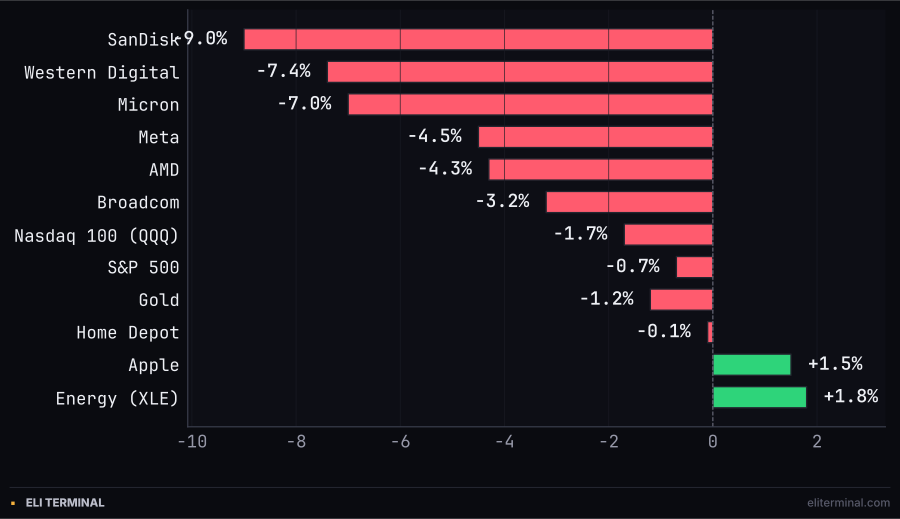
Memory names led every index and every megacap chip stock lower. Apple and energy were the only two names in the green.
SanDisk fell 9.0% and Micron fell 7.0% as the 10-year Treasury yield spiked to a fresh 20-month high right at the New York open, then gave the whole move back by the close.
Memory names led every index and every megacap chip stock lower. Apple and energy were the only two names in the green.
The 10-year Treasury yield peaked at 4.746% at 13:20 UTC Tuesday, ten minutes before the New York cash open, its highest print in 20 months. The 30-year ran to 5.34% overnight, the highest level since 2007, as a global bond selloff pushed Japanese, French and German long yields to their own multi-year highs on the same session.
By 18:50 UTC the 10-year had fallen to 4.706%, below Monday's 4.724% close. The reversal covered the entire overnight spike in about five and a half hours, and it happened while the S&P 500 kept sliding through the same stretch and never turned. Whatever the bond market decided at 13:20 UTC, equities did not treat it as resolved.
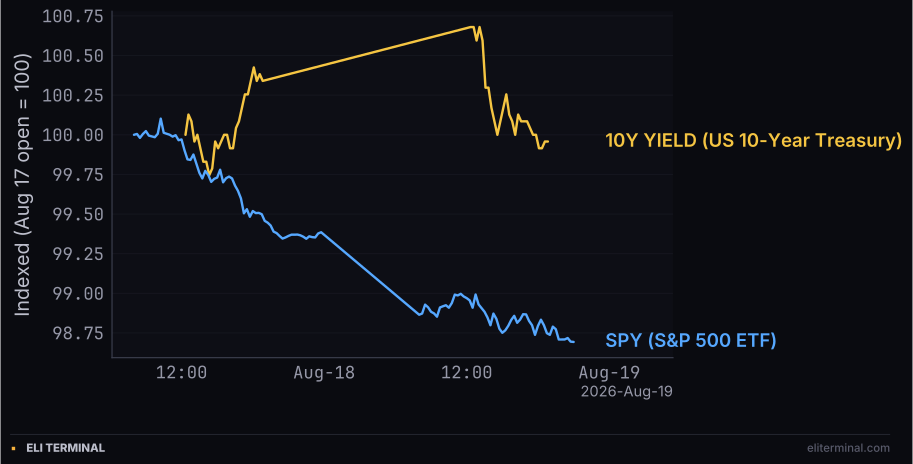
The yield's whole round trip finished by the early afternoon. The S&P kept falling for the rest of the session.
SanDisk closed down 9.01% at 1,625.78, the worst megacap move of the day. Western Digital fell 7.44% and Micron fell 7.02%, both giving back gains built the prior session. Broadcom fell 3.17%, AMD fell 4.27% and Taiwan Semiconductor fell 4.07%, a decline spread across the whole chip complex rather than concentrated in one name.
24/7 Wall St. tied Tuesday's memory-stock losses to valuations compressing as rates reset higher, not to fresh company news, and the tape agrees: none of the three memory names had a scheduled filing or release due that day.
Commerce Secretary Howard Lutnick told the Wall Street Journal last week that "it's not great American companies using Chinese memory," a comment made after a tour of Apple's Advanced Manufacturing Center in Houston and aimed at reports that Apple was weighing Chinese suppliers for its memory chips. Micron and SanDisk read the remark as protection for domestic memory makers and rallied Monday, Micron closing at 1,011.75 and SanDisk at 1,786.85.
Tuesday erased that gain. Both stocks were already lower before the cash open, tracking the broader rate-driven reset rather than any new turn in the sourcing story. No fresh reporting on Apple's supplier plans crossed the wires Tuesday, which leaves the memory complex's reversal explained by the same yield spike that hit the rest of chips, not by the story that lifted it a day earlier.
Home Depot reported 47.86 billion in revenue and adjusted earnings of 4.92 a share before Tuesday's open, both ahead of estimates of 47.27 billion and 4.71. The stock printed a premarket close of 345.71 by 13:00 UTC, roughly 2.3% above Monday's 337.88 finish, after touching an intraday high of 347.67.
The opening bell erased it. Home Depot opened at 336.78 at 13:30 UTC and touched an intraday low of 330.69 fifteen minutes later, a round trip of more than 4.6 percentage points inside half an hour. The stock spent the rest of the session grinding back toward flat, closing at 337.49, down 0.12% from Monday.
CFO Richard McPhail told reporters the company is still operating in what he called frozen housing market conditions, and management left its full-year sales guidance of 2.5% to 4.5% growth unchanged for a second straight quarter. The market has now met two straight clean beats from Home Depot with an unraised guide and a stock that ended roughly where it started.
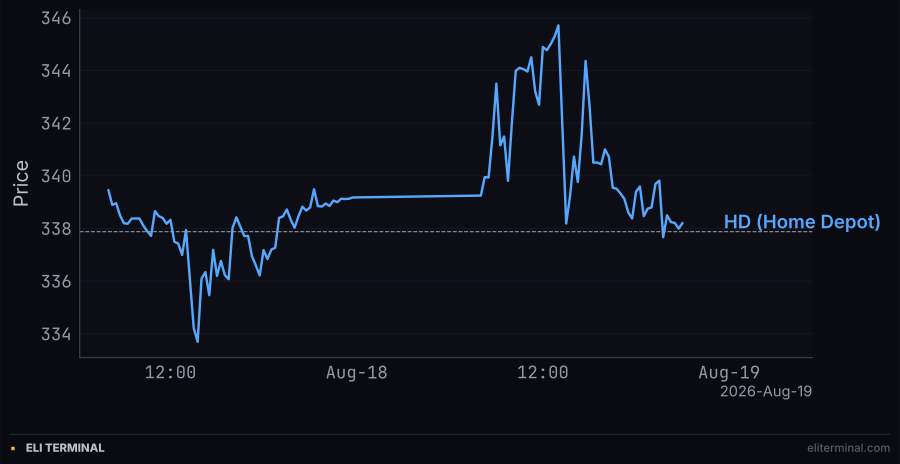
The premarket pop and the cash-open reversal both happened before most of the day's volume traded.
Meta fell 4.45% to 543.67, the worst megacap decline outside the memory names, and unlike Micron or SanDisk it had a same-day cause. A trial brought by attorneys general from 29 states opened Tuesday in California federal court, arguing Facebook and Instagram were built to be addictive to children, with potential damages that could run into the trillions.
That landed on top of an AI-spending story already under pressure. Meta's free cash flow fell 91% year over year last quarter to 784 million, and the company had already lifted the low end of its 2026 capital spending range to 130 billion. Meta falling harder than Nvidia or Broadcom on a day the whole complex fell had a specific reason behind it.
Gold closed at 4,366.00, down 1.17%, retreating from a two-month high probed the prior week. A firmer dollar and the same Treasury back-up that hit chip stocks pulled bullion lower too, the opposite of what a flight-to-safety session usually produces.
The VIX rose 4.28% to 15.84, a real move but a modest absolute level for a session with the Nasdaq's worst day in weeks. Gold falling and volatility staying under 16 point the same direction: Tuesday repriced duration and growth multiples. It did not trigger a rush for safety.
Two weeks running, the Kalshi contract on a 25 basis point cut at the Federal Reserve's September meeting has held inside a 1-2% band, and Tuesday closed it at 1%, down slightly from Monday. A separate market on the government taking a stake in Micron priced at 8%, also little changed from the prior session.
Bond yields ran to a two-decade high and the Nasdaq had its worst day in weeks, and the market's own estimate of a near-term Fed cut did not react to either. Whatever repriced Tuesday, the rate path wasn't it.
Wednesday brings earnings from Analog Devices, TJX, Lowe's and Target, three of them retailers reporting into the same guidance environment that left Home Depot flat despite a clean beat. Thursday adds Walmart, Alibaba and Deere, alongside the weekly jobless claims report due at 08:30 ET.
None of that touches the bond market directly. The cleanest test of whether Tuesday's spike was a one-day overshoot or the start of something longer is simply whether the 10-year revisits 4.75% before the week is out.