One-day moves, August 14
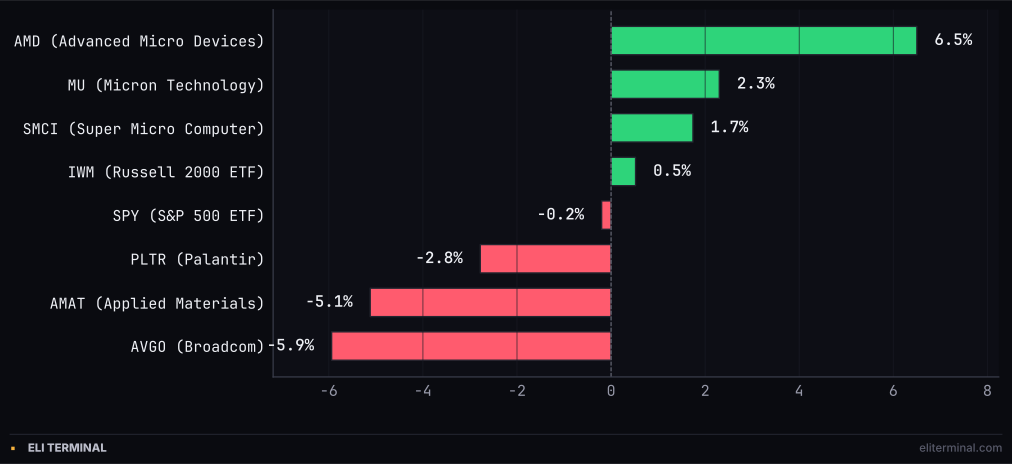
Same supply chain, three separate arguments, one trading day.
AMD gained 6.50% on a Street-high price target and its largest-ever bond sale, Broadcom fell 5.94% on a note pricing its AI financing risk at $370 billion, and July retail sales cratered 0.6% without moving the S&P at all.
Same supply chain, three separate arguments, one trading day.
July's retail sales fell 0.6% against a forecast of a 0.1% gain, the Census Bureau said at 12:30 UTC, the sharpest monthly drop in more than a year. Auto dealers fell 1.8%, gasoline stations fell 0.9%, and nonstore retailers fell 2.2% now that Amazon had pulled Prime Day forward into June.
The S&P 500's pre-market candle barely moved on the print, drifting between 778.38 and 778.6 in the hour after it crossed the wires. The index's real slide came later, in the half hour bracketing 14:00 UTC, when the University of Michigan's preliminary August sentiment reading landed at 51.0, down from 55.2 and well under the 55.0 forecast. SPY fell from 777.40 to 776.30 in that window, a steeper drop than anything the retail sales number itself produced.
AMD priced the largest US dollar bond offering in its history overnight, $4.75 billion across four tranches from 4.600% notes due 2029 to 5.500% notes due 2036, with the longest-dated tranche pricing below initial guidance on investor demand. The stock opened Friday at 487.60, and the first thirty minutes of trading carried it to 505.30, a 3.6% jump inside one hourly candle.
Baird analyst Tristan Gerra published a Street-high $1,250 price target on AMD the same morning, more than double his prior $625, modeling AMD's AI accelerator platform reaching $147 billion in revenue by 2030 on 15% of the data-center AI chip market. AMD closed at 514.39, up 6.50%, and kept climbing into the final hour of trading rather than fading from its morning high.
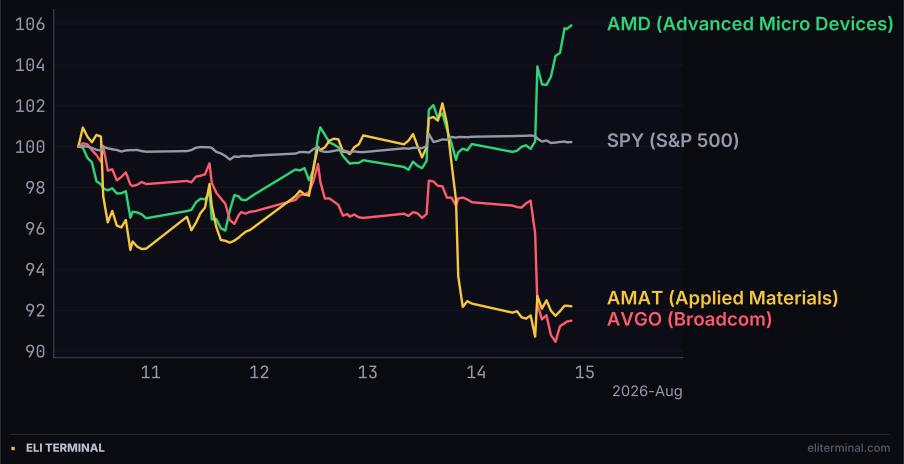
Three lines diverge in the same session the fourth barely moves.
Bank of America analyst Tom Curcuruto estimated Friday that the financing vehicle Broadcom uses to lease custom AI accelerators to customers could carry $370 billion of senior debt by mid-2029 at a 20-gigawatt scale, including roughly $150 billion of new issuance in 2027 alone. The $370 billion sits off Broadcom's own balance sheet, but the note treated it as underpriced risk to the stock.
Broadcom's decline started before the note fully digested: its pre-market candle was already down to 412 by 13:00 UTC, then fell to 395.11 within the first hour of regular trading. A separate Friday report put a security research firm's count of systems compromised through an actively exploited VMware vCenter flaw at 361 IP addresses across 47 countries, adding a second reason to sell the same stock the same morning. Broadcom closed at 392.99, down 5.94%, its third red session in four days.
Nvidia runs a similarly structured financing arrangement with Blackstone and Apollo worth roughly $500 billion and closed Friday at 225.16, down just 0.06%. No analyst had attached a specific debt figure to Nvidia's structure the way Bank of America did to Broadcom's, and the market treated the two names accordingly.
Applied Materials beat Thursday's estimates on both lines, non-GAAP earnings of $3.50 a share against $3.40 expected and revenue of $9.12 billion against $8.99 billion expected, and raised its fourth-quarter outlook. China fell to 28% of total sales from about 35% a year earlier.
The stock opened Friday at 499.40, gapped as low as 497.10, then closed at 507.18, down 5.12% from Thursday's 534.54. A stock already up roughly 108% for the year had priced in more than a record quarter delivered, and the China trend line mattered more than the beat.
The Russell 2000 ETF closed at 305.09, its highest close in at least two years, up 0.52% on a day the University of Michigan's sentiment index posted its sharpest one-month drop since the survey resumed monthly improvement in June. Small-cap companies are typically the most exposed to a domestic consumer pulling back, and IWM went the other way anyway.
Palantir gave back more than half of Thursday's 4.66% gain, closing down 2.78% with no fresh company news attached to the reversal. The VIX fell 2.60% to 14.25 on a session where the S&P itself closed lower, the mirror image of Thursday, when the VIX ticked up 0.55% as Palantir rallied.
The 10-year Treasury yield climbed to 4.696%, up from 4.641% Thursday and its highest close in the past two weeks, tracking a fifth straight session of gains in WTI crude to 82.40 as Treasury Secretary Scott Bessent detailed plans for what he called the broadest economic isolation of Iran to date and Defense Secretary Pete Hegseth said the Strait of Hormuz blockade could continue indefinitely.
A Kalshi contract tracking whether the Federal Reserve holds rates steady at its September meeting closed Friday at 71%, up from 67% at Thursday's close and from 55% just three sessions earlier. The bond market priced in more inflation risk the same day a prediction market priced in less chance of a hike, two ways of reading the same Fed decision moving in opposite directions at once.
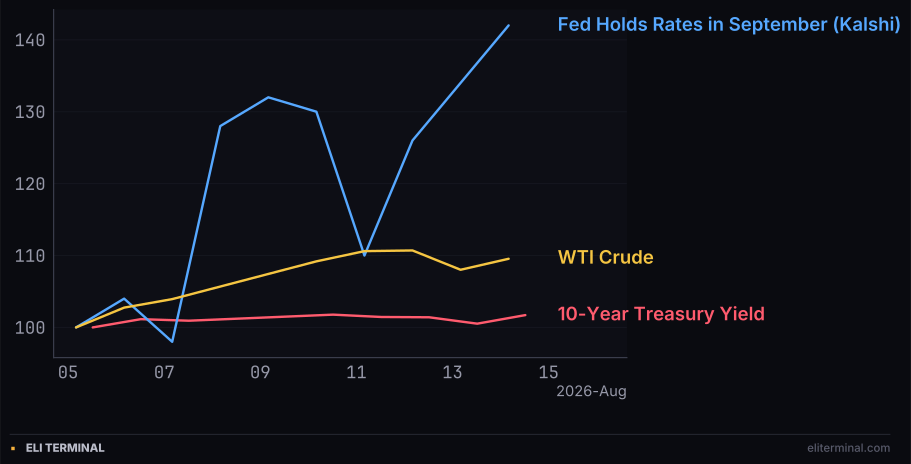
The rate-hold bet and the oil price both climbed. The yield barely followed either one.
Home Depot reports August 18 and Walmart reports August 20, the first two reads on the American consumer since Friday's retail sales miss and the University of Michigan's sentiment drop. The Federal Reserve's Jackson Hole symposium convenes August 27-29, ahead of the September 16 meeting the Kalshi contract is pricing. Applied Materials' next quarterly China disclosure will show whether Friday's 28% figure is a floor or a waypoint.