Three months, five markets
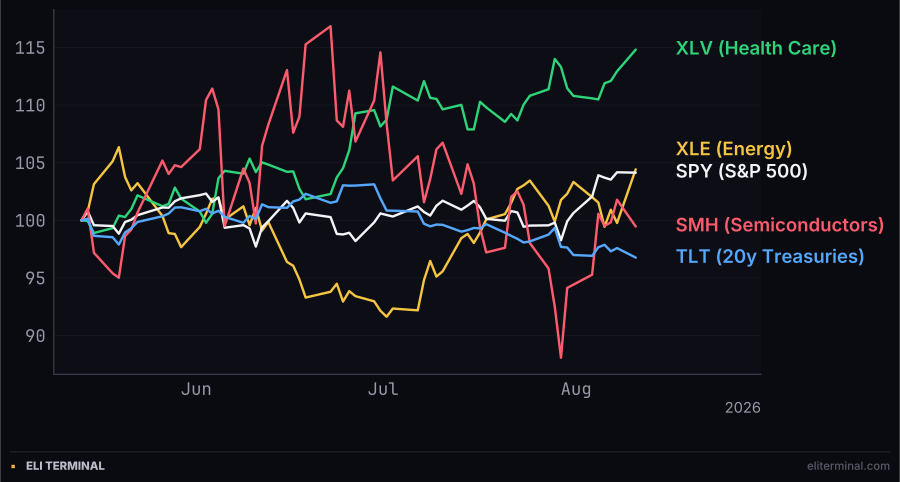
Energy spent June and July below where it started the quarter. The last bar is Monday.
Crude settled up 5.0% as Iran hardened its terms on the Strait of Hormuz, energy posted its largest session in six months, and the S&P 500 finished 0.06% lower.
Energy spent June and July below where it started the quarter. The last bar is Monday.
82.13 is where West Texas Intermediate settled, up 5.0% from Friday's 78.18, with Brent at 87.72 and up the same 5.0%. Neither move arrived as a gap. Futures reopened Sunday at 22:00 UTC at 79.23, sold back to 77.80 by 05:45 UTC Monday, and then climbed for the rest of the session.
80.98 is where the barrel printed at 13:45 UTC, fifteen minutes after the New York open, after sitting at 80.08 as the bell rang. That was the single sharpest step of the day, and it came in US hours on a Monday with no American inflation or labor data on the calendar. The grind continued to 82.38 by 20:30 UTC without giving any of it back.
77.80 to 82.38 is a range of 5.9% from the overnight low, and the shape matters more than the size. A supply shock gaps and then fades; this one stepped, held, stepped again, and closed on its high.
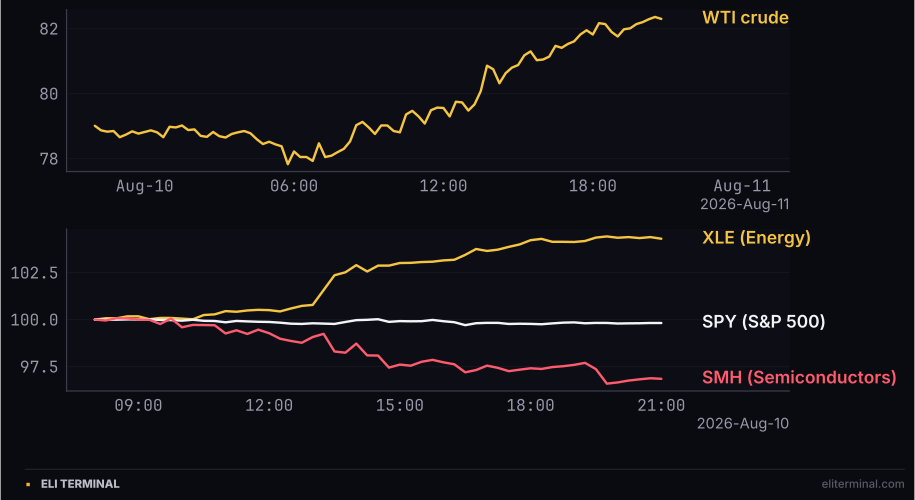
The index line is the point. Energy and semiconductors separated all day and the middle never moved.
Minus two dollars a barrel against Oman and Dubai is where Saudi Aramco set September Arab Light for Asian buyers on August 6, a six-year low and a full 50 cents below the August differential. The same notice asked Asian customers to submit contingency nominations from Yanbu or Sidi Kerir, outside the strait, alongside their Ras Tanura barrels. Aramco was pricing for a reopening and hedging against one that never came.
Eight to fifteen vessels a day moved through Hormuz over August 4 to 6, against roughly 130 a day before the war that began in late February. Crude had fallen from 92.19 on July 23 to 75.22 on August 5 on the expectation that an Iran-Oman arrangement would restore some of that traffic.
Three official Iranian statements crossed between 08:03 and 14:00 UTC on Monday, each narrowing the deal further. The Foreign Ministry tied any reopening to the end of the US naval blockade; by 11:17 UTC Tehran's line was that the blockade "cannot be lifted through diplomacy alone"; and deputy parliament speaker Ali Nikzad told the assembly that the strait's opening "has no military solution." The 13:45 UTC step in crude sits inside that last window.
4.7% is what the energy sector added on Monday, its largest single session in at least six months, larger than any up or down day since February. XLE closed at 60.18, a twenty-five-session high, 14.0% above its July 1 low of 52.81 and just 1.8% below its quarter high of 61.29 set on May 19.
10.9% is how far crude still sits below its July 23 close of 92.19 even after Monday. That gap is the whole distinction: the equities recovered to within touching distance of their best level of the quarter while the commodity underneath them recovered barely half of what it lost. Exxon at 159.79 is 1.7% under its own quarter high and up 15.1% over twenty-one sessions; Chevron at 194.91 is 1.2% under its.
Two readings fit and only one is a bounce. Names that rally 4% and stop 40% below their quarter high are covering; names that rally 4% and stop 1.8% below it are being re-rated, and Monday's energy tape was the second kind.
7.4% is what Marathon Petroleum gained, to 320.32, a three-month high and a 28.6% advance over sixty sessions. Phillips 66 rose 5.7%, Valero 5.6%, and the oil-services fund added 5.9% on 512,961 shares against 107,100 on Friday. Producers, whose barrels are the thing repricing, finished behind all of them.
400,000 barrels a day is the capacity of Saudi Aramco's Jazan refinery, which makes gasoline and ultra-low-sulphur diesel and which a Houthi drone struck at dawn Sunday. Aramco's industrial security put the fire out with no injuries, and the plant is small against world supply. It is not small against a product market where Russia's gasoline export ban runs to the end of 2026 and its diesel ban is still in force.
At 19:19 UTC the administration extended by 90 days the Jones Act waiver for foreign-flagged ships carrying oil, fertilizer and energy products between American ports. That is a domestic logistics decision, and it points the same way the refining margins do.
Minus 23,000 is what July payrolls did, against a consensus near plus 83,000, with May and June revised down a combined 103,000 and average hourly earnings up 3.2% over twelve months, the softest since May 2021. Within thirty minutes of that 12:30 UTC release on Friday, the market pricing a quarter-point increase at the September meeting fell from 47.5% to 32.5%. The contract for the Fed holding rates steady in September went from 50% to 65% in the same window.
43.5% is where that hike market closed on Monday, having opened the US session at 35.5%. It moved in steps at 14:00, 16:00, 17:00 and 19:00 UTC, tracking the barrel, and it did so with no American labor or inflation print in between. Nine points of Fed tightening got repriced by an oil market, not by data.
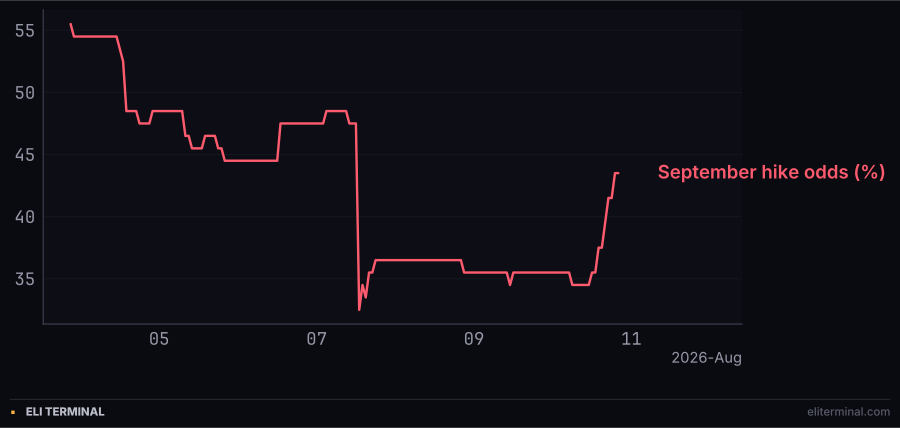
The cliff is Friday's payroll release. The climb on the right is Monday, and no data landed in it.
82.06 is where the twenty-year Treasury fund closed, its lowest finish in three months, a low set on Monday itself. Long duration has now given back 6.2% from its June 29 peak, and it did the last of that on a day the equity index did not move.
4.3 basis points is what the five-year yield added, to 4.405%, against 3.9 for the ten-year, 3.2 for the thirty-year and 0.8 for the three-month bill. The belly leading the long end is a statement about the path of policy rather than about the price of holding duration. The July 29 meeting had already held at 3.50 to 3.75% on a nine-to-three vote in which the dissents wanted a September increase.
15.46 is where the VIX closed, up 3.8%, on an index that fell 0.06%. Volatility rose on an unchanged tape, which is what happens when two large positions swap places rather than one of them leaving.
44.7% is how much Taiwan Semiconductor's July revenue rose from a year earlier, to NT$467.58bn and up 5.6% on the month, comfortably ahead of the 36 to 37% pace the company guided at its second-quarter results. It landed before the US open. The semiconductor fund closed down 2.3%.
5.2% is what Arm lost, to 267.85, the largest single-name decline in the group, and no company announcement explains it. Arm traded at 281.31 at 13:00 UTC, essentially at Friday's close, then fell to 272.41 within half an hour of the bell and finished at its low. Whatever moved it began when American markets opened, not overnight, and it left no trace on the wires.
39.1% below its June 18 high of 439.46 is where that leaves Arm, and yet it is still up 21% over sixty sessions. The chips did not break on Monday. They were sold to pay for something.
15 billion dollars is what Intel proposed raising in common stock before Monday's open, with a 2.25 billion dollar over-allotment on top, run by J.P. Morgan, Goldman Sachs, Morgan Stanley and Citigroup. The company said the proceeds are for "general corporate purposes" including capital expenditures and working capital, and that customers "continue to signal a strong and sustainable demand environment." It is Intel's first public sale of shares since it listed in 1971.
16.1 billion dollars was Intel's June-quarter revenue, up 25% and its fastest growth in more than fifteen years, and Lip-Bu Tan's line on it was that "AI is driving unprecedented demand for compute." The stock closed at 97.52, down 4.1%, though it remains 7.2% higher over five sessions and 19.1% above its twenty-five-session low. A company reporting its best growth since the last decade chose to fund the next stretch with equity, and the equity is what got marked.
500 billion dollars is the figure Nvidia confirmed on Monday afternoon, in memoranda of understanding with Apollo, Blackstone, BlackRock's Global Infrastructure Partners, Brookfield, Goldman Sachs and KKR to build financing platforms for compute infrastructure. The release says the capital is to be mobilized "over time" and "subject to execution of the final agreements." Nvidia fell 2.9% to 217.55, roughly 130 billion dollars of market value, on the announcement of a half-trillion-dollar pipeline for its own product. Bank of America kept the shares a top pick and called the financing worry overblown.
168.44 is where health care closed, its highest finish in six months, up 1.7%. Eli Lilly added 3.9% to 1,231.94, which leaves it 0.3% under its July 7 quarter high and 21.3% higher over sixty sessions, with Truist nudging its target to 1,376 on the day. That is a trend being extended, not a rescue.
2.6% is what Lockheed Martin gained, to 603.16, a twenty-five-session high and a 15.3% advance over twenty-one sessions. Deputy Defense Secretary Steve Feinberg's memo giving contractors twenty-one days to submit acceleration plans for Patriot and THAAD interceptors was reported on Sunday, naming a stockpile that fell from 2,330 interceptors before the war to 1,030 by the April ceasefire. Silver rose 3.3%.
0.2% is what high-yield credit lost, leaving it 1.0% below its late-May high and roughly where it has sat for six weeks. Nothing on Monday reached the part of the market that prices corporate solvency, which is the strongest argument that the day was a rotation and not a warning.
12:30 UTC on Wednesday is when July consumer prices are released, with producer prices and claims on Thursday and retail sales on Friday. Monday moved the September hike nine points on an oil price alone. A firm core reading arriving on top of a barrel that has added 5.0% in a session would be the second push in one week, and the September contract is priced closer to a coin flip than it was on Friday afternoon.
Two markets disagreed on Monday about what happened. Rates and energy repriced an inflation problem; the S&P 500 closed where it opened and the credit market did not flinch. One of them is reading the barrel correctly.