PALANTIR AND SANDISK, THREE MONTHS
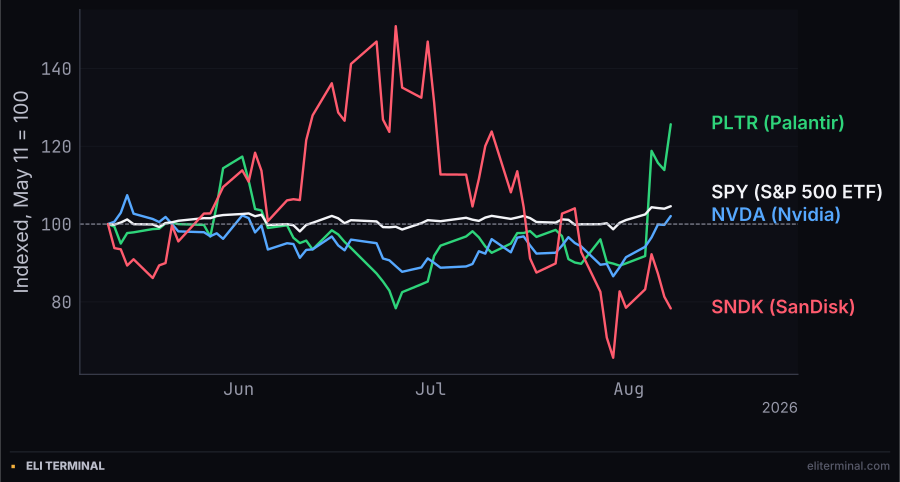
Each indexed to 100 at the May 11 close. SanDisk peaked on June 25, the same session Palantir bottomed. The two have traded places since.
Payrolls fell 23,000 against a consensus of plus 80,000, the S&P 500 closed at a record, and the two companies with the fastest revenue growth on the tape finished the week at quarter lows.
Each indexed to 100 at the May 11 close. SanDisk peaked on June 25, the same session Palantir bottomed. The two have traded places since.
7,757.64 is where the S&P 500 closed, up 0.62% and the highest close it has ever printed, on a morning that told the market 23,000 Americans lost their jobs in July. The Nasdaq Composite gained 1.30% to 26,690.62 and is still 1.5% below where it closed on June 2, so the record belonged to one index and not to the other.
3.29% is what the software group added on the day against 1.96% for semiconductors, and inside software the moves were violent: Atlassian rose 35.3% to 149.07, Twilio 24.9% to 241.28, MongoDB 7.8%, UiPath 7.5%, ServiceNow 6.4%, Cloudflare 5.6%. Palantir gained 10.3% to 172.01, its fifth-largest one-day move of the year and enough to carry it 39.8% higher over five sessions.
14.90 is where the VIX settled, its lowest close in 25 sessions, and the Russell 2000 rose 1.11%. A payroll contraction landed at 8:30 in the morning and every measure of fear ended the day lower than it started.
Minus 23,000 was the July payroll change reported by the Bureau of Labor Statistics at 12:30 UTC, against a consensus near plus 80,000, and it came with 103,000 subtracted from May and June combined. Private payrolls added 30,000; government shed 53,000, most of it local-government education.
4.1% was the unemployment rate, down from 4.2%, and it fell for the wrong reason: the participation rate slipped to 61.4% and the employment-to-population ratio to 58.9%, the lowest since May 2014. Average hourly earnings rose 0.1% on the month and 3.2% over the year, the slowest wage growth since May 2021.
3.50% to 3.75% is where the federal funds rate has sat for five meetings, and the live question into Friday was not a cut but a hike. The July 29 decision held 9 to 3, with Beth Hammack, Neel Kashkari and Lorie Logan dissenting in favor of raising 25 basis points, and Kashkari told CNBC from Aspen on August 5 that he would rather get going now in small steps than face an entrenched inflation problem later. Two days later the market that prices a September hike fell from 49% at noon UTC to 33% in the hour after the print, and closed at 35%.
4.603% was the low on the 10-year Treasury yield, reached at 12:45 UTC, fifteen minutes after the payroll release took it down from 4.672%. By 15:00 UTC it was back to 4.652%, and it finished the session at 4.660%, one basis point below Thursday. The two-year fell as much as nine basis points to 4.15% and held most of it.
2.25% is where the 10-year breakeven inflation rate sat at the close, and 2.22% the five-year, both effectively unchanged on a day that removed a rate hike from the calendar. The long end round-tripped a labor-market shock without moving its inflation expectation at all, which leaves term premium as what the afternoon actually repriced.
5% to 7% is the range the 2026 recession market held all day, on more than three million dollars of open interest, and it ended where it started. The deepest contract keyed to the labor market did not treat the first outright job loss of the cycle as new information about a recession; it treated it as news about the Federal Reserve.
8.965 billion dollars was SanDisk's fiscal fourth-quarter revenue, up 372% from a year earlier and 51% from the prior quarter, at an 84.6% gross margin, filed with the Securities and Exchange Commission at 20:09 UTC on Wednesday. The stock has fallen in all three sessions since: down 6.8% Thursday, down 3.7% Friday to 1,212.21, and down 34.8% over 21 sessions.
Two-thirds is the share of that sequential revenue gain the company itself attributed to price rather than volume, in the first bullet of its own release: growth came "approximately one-third from higher volumes and two-thirds from higher pricing." The guide that followed set first-quarter gross margin at 83.0% to 85.0%, a range whose midpoint sits below the 84.6% just delivered, on revenue of 10.30 to 10.80 billion dollars.
14 billion dollars was added to the buyback authorization in the same filing, bringing the total to 15.5 billion, and the stock is 48.1% below its June 25 close of 2,335.00. A company earning 39.25 dollars a share in a quarter announced the largest repurchase in its history and could not hold a bid for three days.
4.1 billion dollars, plus or minus 100 million, is what Western Digital guided for the September quarter against roughly 4.01 billion expected, with gross margin of 55% to 56% and earnings of 4.00 dollars against 3.81 expected. It beat on revenue, margin and earnings for the quarter just closed, and the stock fell 13.0% on Thursday and 3.8% more on Friday to 434.30.
434.30 is also the lowest close Western Digital has printed in the last 63 sessions, 41.8% below its June 18 peak of 746.23, made on the same afternoon its chief executive Irving Tan wrote of entering fiscal 2027 "with continued confidence in the durability of demand and with increasing visibility into our business."
Not one sell rating came out of the two reports. Jefferies' Blayne Curtis cut his SanDisk target from 3,000 dollars to 1,750 and stayed at Buy; Citi went 2,500 to 2,100 and stayed at Buy; Bank of America's Wamsi Mohan held 2,500 and did not cut at all. On Western Digital, Mizuho went 685 to 590, Rosenblatt 900 to 800, and Morgan Stanley raised its target to 676 from 650. The drawdown is running ahead of the people paid to publish on it.
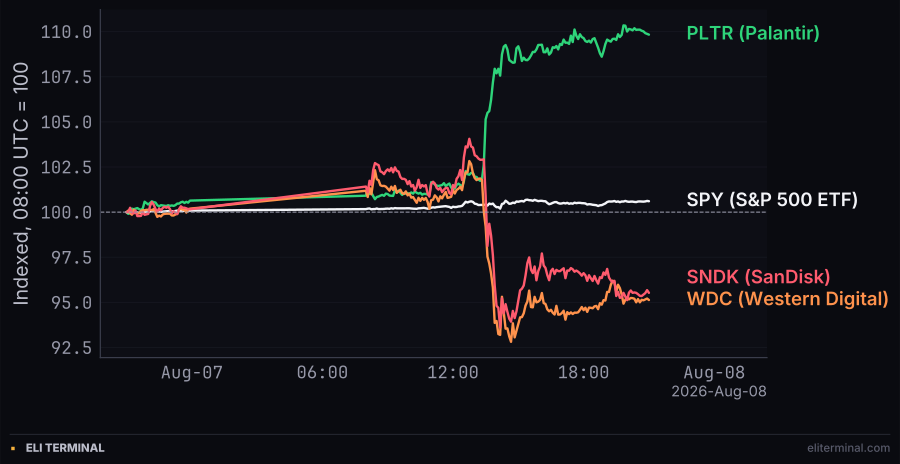
Five-minute closes, August 7. The payroll release at 12:30 UTC lifted all four. The separation came three hours later, at the 13:30 New York open, and none of it reversed.
1,327.60 was SanDisk's high of the day, set at 12:45 UTC in pre-market dealing, 5.5% above Thursday's close and fifteen minutes after the payroll release. It opened the regular session at 1,309.30, traded 1,184.37 by 14:30, and closed at 1,212.21. Western Digital ran the identical path: 469.90 pre-market, 457.45 at the open, 422.50 at the low.
158.55 is where Palantir traded at 12:30 UTC and 159.13 fifteen minutes later, which is to say the payroll print did nothing to it. It opened at 160.07, was at 164.26 within five minutes of the bell, 169.16 by 14:00 and 171.43 by 14:30, and finished at 172.01 on 77.6 million shares against 41.8 million on Thursday.
255 dollars is the target Bank of America's Mariana Perez Mora carried on Palantir into Friday with a Buy rating, citing its sovereign-AI position and government relationships. Jefferies' Brent Thill has it at Underperform with an 80-dollar target and RBC's Rishi Jaluria at Sell with 90. The stock closed between them at a price that is 60.4% above its June 25 low of 107.27 and the highest it has ever closed.
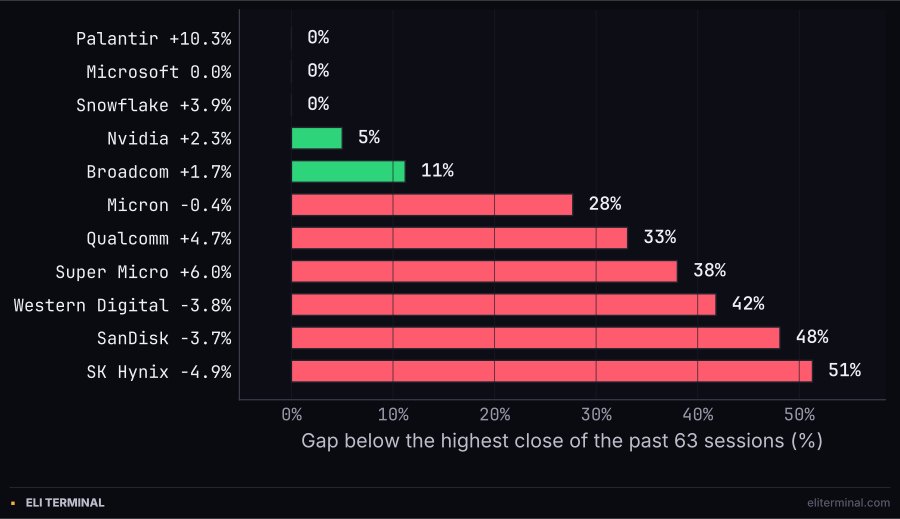
Each name's August 7 move sits in the label; the bar is the gap to its best close of the past quarter. Qualcomm gained 4.7% and Super Micro 6.0% while still sitting a third or more below their June levels.
0.0% is the gap between Friday's close and the best close of the past 63 sessions for Palantir, Microsoft and Snowflake. Nvidia sits 5.0% below its quarter high at 223.96, Broadcom 11.2% below at 427.76, and both closed at 25-session highs on the day, so the top of the tape is a genuine re-rating rather than a bounce.
33.1% and 38.0% are the same measures for Qualcomm and Super Micro, which rose 4.7% and 6.0% on Friday. Qualcomm at 167.86 is still 12.2% under its close of a month ago, and Super Micro at 31.13 is 7.4% below where it traded a quarter back. Two of the day's largest advances happened inside drawdowns nobody has climbed out of.
51.3% is where SK Hynix sits below its June 22 close, after falling 4.9% in Seoul to 1,422,000 won and 31.5% over 21 sessions. The KOSPI lost 4.58% on Thursday and slipped again Friday to 6,258.77, and the Korean memory names have now given back more than the entire move that started when Chinese memory maker CXMT listed in Shanghai on July 27 and closed its first day up 466%.
Plus 10% to 15% is the sequential price gain TrendForce published on July 3 for third-quarter NAND, against 70% to 75% in the second quarter, with DRAM decelerating from 58% to 63% down to 13% to 18%. Nothing in either August 5 filing contradicted that; SanDisk's own guide of a modest margin step-down is the same number expressed as a forecast.
93.9 billion dollars is the minimum revenue SanDisk says it has locked in at floor pricing across eight strategic customers, weighted-average duration above four years, covering more than half of fiscal 2027 bits. The company is arguing that its pricing is a contract. The tape spent three sessions arguing it is a spot rate, and the tape is the side that moved the shares 48% off their high.
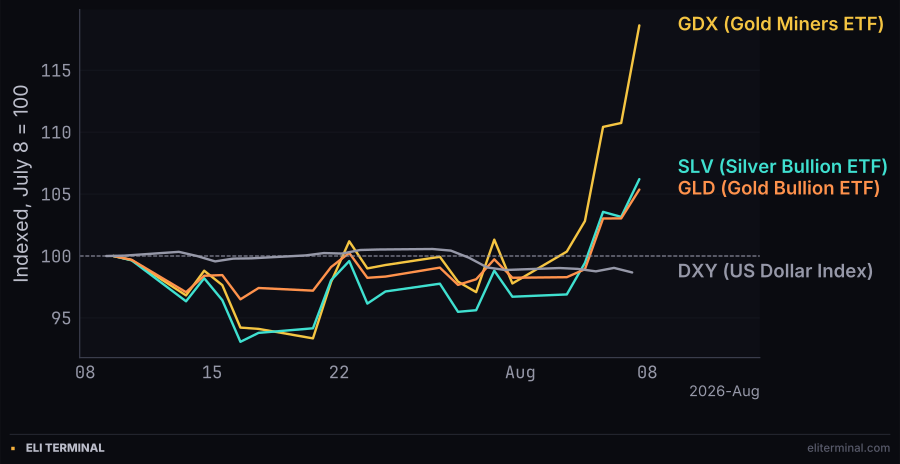
Each indexed to 100 at the July 8 close. Gold's best week since January came with the dollar at its weakest close since May.
4,340.70 dollars was the gold settlement, up 2.3% on the day and 7.2% over five sessions, its best week since January, and gold miners rose 7.11% on Friday and 18.2% over the week. Silver settled 63.33, up 3.1% and 10.0% on the week. Gold bullion moved from 395.00 to 400.63 on the exchange-traded fund between 12:25 and 12:45 UTC, which is to say it took its gain in the twenty minutes after the payroll number and kept it.
99.60 is where the dollar index closed, down 0.4% and its weakest in 25 sessions, with the euro at a seven-week high. This is not the usual haven bid: gold is still 7.6% below where it traded a quarter ago and roughly a fifth below its January record near 5,600. What lifted it was the removal of a rate hike, and what removed the rate hike was a labor market that stopped adding jobs.
78.18 dollars was the WTI settlement, up 1.2% on the day and down 7.7% over five sessions, after Treasury Secretary Scott Bessent said on August 3 that a deal restoring free movement through the Strait of Hormuz could come soon. Iran's published draft would bar United States and Israeli vessels and fine violators a fifth of cargo value, which is why crude rose on Friday even as the week's trend ran the other way. The inflation impulse that had been forcing hike pricing came out of the oil tape first, and out of the labor data second.
Minus 0.36% was the financials sector on a day the index made a record, with regional banks down 0.37% and energy down 1.13% despite crude closing higher. A steeper curve and a dead hike are supposed to be a bank story; on Friday they were not.
79.61 is where high-yield credit closed, up 0.19%, having traded in a 12-cent range all week. The first negative payroll print of the cycle produced no widening at all, which is either confirmation that the labor data is about the Federal Reserve rather than about defaults, or a lag.
6.57 dollars a pound was copper, down 1.7%, after China reported July unwrought copper imports fell 11.5% from a year earlier to 425,000 tonnes. Of everything that traded Friday, copper was the one industrial price that moved on demand rather than on rates.