Thursday August 6, 2026 • Storage Earnings Day
WD Falls on Guide, Microsoft Up
Western Digital beat every line it guides to and closed 13.0% lower at a three-month low. Microsoft, which buys what it makes, closed at 499.86, the highest of the quarter.
Thursday 4pm close
S&P 500 7,709.96 −0.18%
·
NASDAQ 26,348.35 −0.06%
·
DOW 53,885.10 −0.85%
·
VIX 15.15 −4.2%
·
WTI 77.29 +2.8%
·
10Y 4.67% +5bp
The storage tape, Thursday
WDC 451.52 −13.0%
·
SNDK 1,258.58 −6.8%
·
MU 881.47 −1.3%
·
STX 852.95 +1.8%
·
SMH 571.48 +0.3%
·
MSFT 499.86 +2.5%
Since the June 25 close
SNDK −46.1%
·
WDC −33.1%
·
KOSPI −29.5%
·
MU −27.4%
·
SMH −10.3%
·
MSFT +41.7%
The storage makers peaked the day Microsoft bottomed
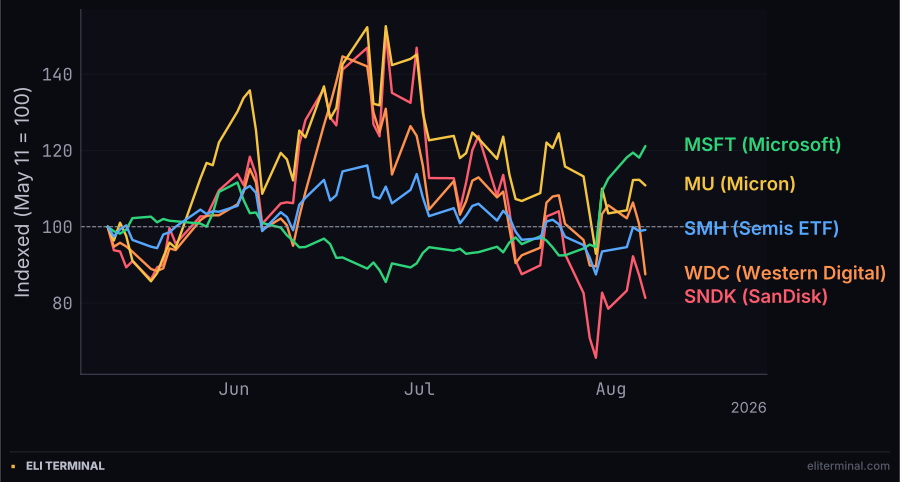
Each indexed to 100 at the May 11 close. SanDisk and Micron set their highest closes of the quarter on June 25; Microsoft set its lowest the same day. Six weeks later the lines have swapped ends.
Western Digital beat and opened 21% lower
3.747 billion dollars was Western Digital's June-quarter revenue, up 44% from a year earlier, with gross margin at 54.1% and non-GAAP earnings of 3.56 a share against a Street number near 3.29. The release reached the SEC at 20:04 UTC Wednesday and guided the September quarter to 4.1 billion dollars, growth of 42 to 49%, with gross margin of 55 to 56% and earnings of 4.00 a share.
519.07 was the last regular-hours print, at 19:45 UTC. In the quarter-hour that contained the filing the stock traded 472.30, and by 21:30 UTC it sat at 457.95, having lost 11.8% in ninety minutes without a single share changing hands in daylight.
407.48 was the low, printed inside the first fifteen minutes of Thursday's session, 21.5% under Wednesday's close. Western Digital closed at 451.52, down 13.0% on the day, its lowest close in three months and 39.5% under the 746.23 it made on June 18.
The guide slowed the rate, not the level
390 basis points is how much Western Digital's gross margin expanded in the quarter it reported, from 50.5% to 54.4% on a non-GAAP basis. The September guide of 55 to 56% asks for roughly 110 more. Everything the company said pointed up; the rate of climb was cut to a quarter of what it had just delivered.
22% was exabyte growth in the quarter, against the 25% Western Digital managed across the full fiscal year, and management put the shortfall on customer timing. At 11:21 UTC, Summit Insights' Kinngai Chan cut the stock to Hold, writing that price per exabyte would decline in 2027 as the 44-terabyte HAMR drives ship, ending four straight quarters of sequential increases.
0 is what Western Digital carried in long-term debt at the fiscal year end, against 2.485 billion dollars a year earlier, after monetizing its retained SanDisk stake through debt-for-equity and equity-for-equity exchanges. Of the 9.424 billion dollars in reported full-year net income, 6.498 billion was a non-cash mark on those shares. The company that spent the year converting one memory stock into a clean balance sheet was repriced by the same market that repriced the shares it sold.
SanDisk guided its first margin decline of the cycle
84.6% was SanDisk's June-quarter gross margin, against the 79 to 81% it had guided, on revenue of 8.965 billion dollars, up 51% from the March quarter. The release put roughly one-third of that sequential growth on volume and two-thirds on price, and the board added 14 billion dollars to the buyback, taking the remaining authorization to 15.5 billion.
83 to 85% is the September gross-margin guide, a midpoint below the quarter just delivered and the first guided decline of this cycle. Revenue of 10.30 to 10.80 billion dollars put consensus at the very top of the range. SanDisk closed at 1,258.58, down 6.8%, and 46.1% under its June 25 close.
1,250 dollars is what Jefferies' Blayne Curtis took off his price target while keeping the Buy rating. Citi's Asiya Merchant cut hers on "more muted" pricing and Wells Fargo cut its own, writing that SanDisk's selling prices "didn't increase as substantially as competitors'". Morgan Stanley reaffirmed Overweight and called strength in NAND "clear and durable." Nobody argued the business was shrinking; they argued about the slope.
The number had been public since July 3
10 to 15% is where TrendForce put third-quarter NAND contract price gains in a note dated July 3, against as much as 75% in the second quarter. Conventional DRAM was set at 13 to 18%, after 90 to 95% in the first quarter and 58 to 63% in the second.
34 days separated that note from Thursday's selling. The deceleration was published, free, and specific, and it took two 8-Ks and an opening bell to reach the price. The market did not learn something on Wednesday night; it agreed to act on something it had been able to read since the first week of July.
Seoul priced it at 01:18 UTC
01:18 UTC is when the Korea Exchange fired its sell-side sidecar, halting program sell orders for five minutes after Kospi 200 futures traded more than 5% below reference. SK Hynix briefly went limit-down, 30% lower, in the pre-market. The Kospi closed at 6,296.38, down 4.58%, with SK Hynix off 10.37% to 1,500,000 won and Samsung Electronics off 6.3% to 203,500 won.
3.33 trillion won of Kospi stock went out through foreign accounts, and individuals bought 3.34 trillion won of it, nearly the whole other side. Seoul dealers named SanDisk's September guide as the cause; no Korean release, policy change or price reset crossed that day.
More Kospi issues closed higher than lower on a day the index fell 4.58%. Two stocks made the number. The index is now 29.5% below its June 25 close, and what looks like a national equity market breaking is two memory balance sheets being marked.
Who got sold on Thursday
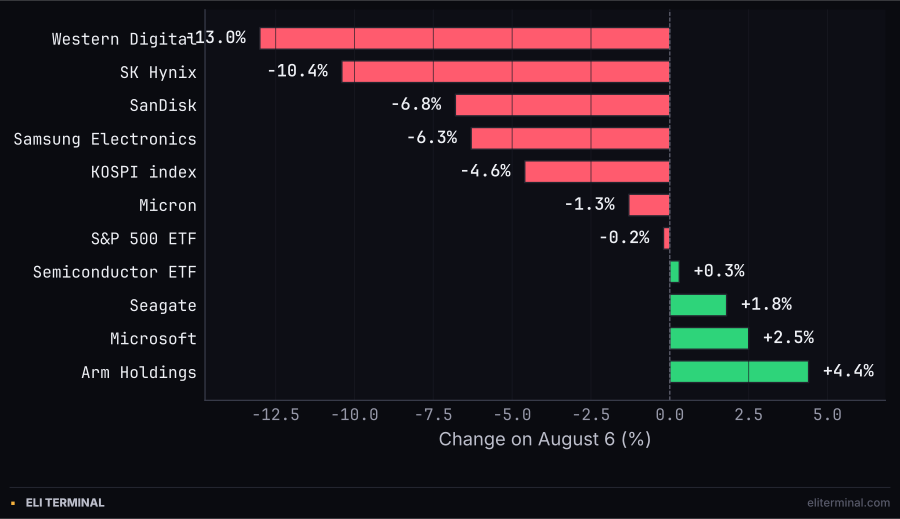
Thursday's closes. The four names that make or price memory carried the entire decline. Seagate, which makes the same drives as Western Digital, finished higher.
Seagate rose, and the selling ended at 13:45 UTC
1.8% is what Seagate gained on Thursday, to 852.95, its best close since July 31, while Western Digital fell 13.0%; the two build the same hard drives for the same buyers, and Seagate, which reported on July 28, is 16.8% below its June 25 close against Western Digital's 33.1%. Micron lost 1.3% to 881.47, the semiconductor ETF closed up 0.31% at 571.48, and Arm gained 4.4% to 286.68, an 18.7% week that still leaves it 34.8% under its quarter high. What sold was not the memory trade; it was two guides.
477.63 is where Western Digital traded at 15:15 UTC, 17.2% above the low it had printed ninety minutes earlier, before fading to 451.52 into the bell. SanDisk ran 1,163.09 to 1,324.00 across the same window; Micron ran 827.00 to 913.33. Every one of them made its low inside the first fifteen minutes and spent the rest of the day being bought.
451.52, 1,258.58 and 881.47 are Thursday's three closes, against 457.95, 1,251.16 and 880.64 at 21:30 UTC Wednesday, ninety minutes after the two releases hit. Micron ended the session 0.1% from where it stood before the sun came up. Six and a half hours of trading, a 17% swing in the worst-hit name, and the verdict was the one the after-hours had already written.
Thursday's round trip, indexed to Wednesday evening
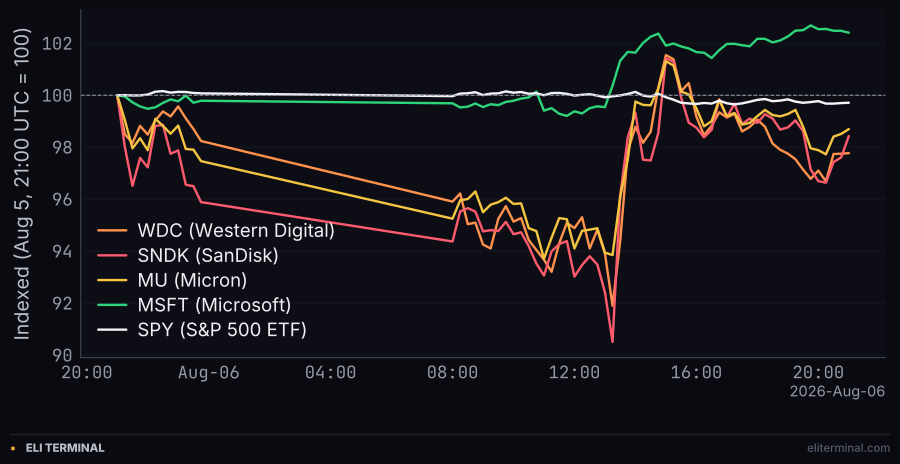
Fifteen-minute prints from Wednesday evening. The flat diagonal is the overnight, when nothing traded. Storage set its low in the first quarter-hour of Thursday's session; Microsoft's whole gain came after the open.
Microsoft closed at a quarter high with nothing to report
499.86 was Microsoft's close, up 2.5%, after a high of 501.56 at 19:45 UTC. It is the highest close of the trailing quarter, 41.7% above the 352.83 it printed on June 25, the same date SanDisk and Micron set their quarter highs. No Microsoft filing, product launch or deal crossed on Thursday; the last dated item was Tigress Financial's Ivan Feinseth lifting his target to a Street-high 690 on Wednesday.
43% was Azure growth in the June quarter Microsoft reported on July 29, with commercial remaining performance obligations up 84% to 678 billion dollars and calendar-2026 capital spending held near 175 billion, cut from the roughly 190 billion guided in April. Commercial bookings fell 4% as reported and rose 7% excluding the OpenAI commitments, which is the soft line inside a record backlog.
30% of hyperscale capital spending goes to memory this year, against roughly 8% in 2023 and 2024, on figures from SemiAnalysis that put the increase near 100 billion dollars a year. A slower climb in contract prices lands on Western Digital's revenue line and Microsoft's cost line. Thursday paid one side of that and charged the other, in the same six and a half hours, with the S&P 500 moving 0.18%.
Claims 199,000, and the Dow's streak ended
199,000 initial claims printed at 12:30 UTC for the week ended August 1, against a 203,000 consensus, a third straight week under 200,000 and a four-week average of 198,750. Second-quarter productivity came in at 1.4% with unit labor costs up 1.3%, and announced job cuts at 11:30 UTC fell 27% from June to 33,429, the lowest month in two years.
4.670% was the 10-year yield at the close, 5 basis points higher, with the 30-year at 5.213%. The Federal Open Market Committee held at 3.50 to 3.75% on July 29 with three dissents, all of them for a hike, and St. Louis Fed President Alberto Musalem said on Thursday that he had preferred to raise rates at that meeting. The market pricing a September hold has moved from 42% on Tuesday to 52%, its highest in three weeks, while the long end sold off anyway.
464.02 points came off the Dow, to 53,885.10, ending a run that had set a record 54,349.12 on Wednesday. The VIX fell 4.2% to 15.15, within 1% of its lowest close in twenty-five sessions, on a day the largest storage maker in the market lost an eighth of its value. July payrolls land Friday at 12:30 UTC.
Oil took back half of a two-day collapse
75.14 was where West Texas crude traded at 09:45 UTC and 77.29 was the settlement, up 2.8%, with Brent at 82.49, up 3.8%. The step came between 15:30 and 15:45 UTC, 76.85 to 77.75, and Iran's Fars agency published an initial draft bill that day setting terms for reopening Hormuz: United States and Israeli vessels barred, transit tolls, and fines of up to 20% of cargo value. No wire copy carries the crossing to the minute.
5.7% is what crude lost on Tuesday, after Treasury Secretary Scott Bessent said a deal to open the strait "with freedom of movement" could come "today or tomorrow." Two sessions took 6.4% out of the front month and Thursday put 2.8% back. Crude is 5.1% higher than a month ago and 18.7% below where it stood a quarter ago.
2.479 million barrels was the crude build reported at 14:30 UTC Wednesday, against a consensus draw, and the front month rose 2.8% the next day. Energy shares took the smaller half of it: the sector fund gained 1.5% and ConocoPhillips, which reported before the open, opened at 120.00 and closed at 116.76, up 1.5%, giving back the entire gap.
What else moved
7.3% was Parker-Hannifin's gain, to 1,069.80, on a fiscal year that cleared 20 billion dollars in sales for the first time, aerospace organic sales up 13.4%, a record 8.5 billion dollar backlog, and a long-term segment margin target raised to 30% by fiscal 2031 from 27%. Disney added 2.9% to 104.68, its highest close in twenty-five sessions, a second day of gains on Wednesday's quarter.
3.3% came off Boeing, to 232.19, with no dated release, order or regulatory item to attach to it, on a name that had gained 2.9% over the two prior sessions and sits 3.5% under its quarter high. Uber recovered 3.4% to 70.47 after losing 5.3% on Wednesday's guide. Cloudflare and Airbnb report after Thursday's close.
Western Digital beat revenue, earnings and margin, guided September revenue up 42 to 49%, and closed 13.0% lower at a three-month low, because the guide asked for 110 basis points of margin expansion after delivering 390; SanDisk, which said two-thirds of its 51% sequential growth was price, guided a gross-margin range whose midpoint sits below the quarter it just reported and fell 6.8%, and the Kospi lost 4.58% on those two sentences while more of its issues rose than fell. Seagate closed up 1.8% and the semiconductor ETF up 0.31%, so the market did not reprice storage demand, it repriced the rate of storage prices, and it handed the proceeds to Microsoft, which buys the memory, has no news of its own, and closed at 499.86, the highest of the quarter and 41.7% above the June 25 low it set on the day the storage makers peaked.
END
eli terminal • Thursday August 6, 2026