Three months of the AI hardware trade
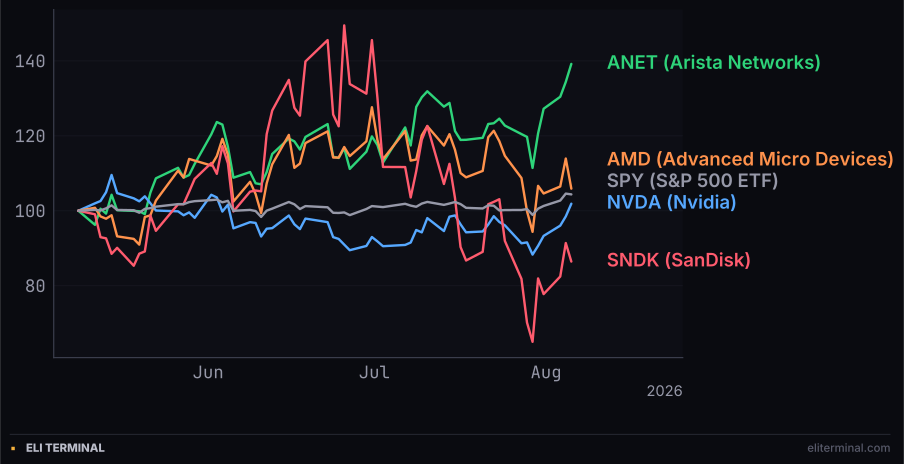
Each indexed to 100 at the May 6 close. Arista finishes the quarter at its high. SanDisk, up a third in five sessions, is still 42% below the level it held on June 25.
AMD more than doubled data-center revenue and fell 7.0%, Arista set a record close after giving back a 16.3% premarket gain, and gold rose 4.1%, while the S&P 500 slipped 0.17%.
Each indexed to 100 at the May 6 close. Arista finishes the quarter at its high. SanDisk, up a third in five sessions, is still 42% below the level it held on June 25.
54,349 is where the Dow finished, up 0.49% and at a one-year closing high for a third straight session, while the Nasdaq Composite fell 0.83% and the S&P 500 slipped 0.17% to 7,723. The distance between those two numbers was the entire session, and it fell along a single line: who has already spent the money to build artificial-intelligence capacity, and who has only promised to.
0.67% is how far the S&P 500 was up in the opening minutes, at 776.48 on the tracking fund, before it closed 0.86% below that mark. The Nasdaq-100 fund gave back 1.5% from the same opening print and broke to its low in the final fifteen minutes. Every point of the morning was sold, and the selling had a sector.
17.40 is where the volatility index sat at the opening bell, and it fell all day to 15.49 by 3:15pm before closing at 15.81, down 4.2%. An index bleeding lower while its own fear gauge collapses is not a market cutting risk. It is a market moving money from one shelf to another.
6.718 billion dollars was AMD's Data Center revenue for the quarter ended June 27, up 107% from a year earlier, with segment operating income of 2.103 billion against a 155 million dollar loss in the same quarter of 2025. Total revenue was 11.536 billion, up 50%. The stock closed at 482.05, down 7.04%.
20:16:24 UTC on Tuesday is when the results 8-K reached the Securities and Exchange Commission, one hour and sixteen minutes after the close. In the fifteen minutes that followed, AMD went from 523.84 to 484.34, a fall of 7.5%, and it never recovered the level. The quarterly guide of 13 billion dollars, roughly 500 million above the consensus, and a gross-margin outlook held flat near 56% were what a book positioned for more had to read.
12.2% is what AMD had gained over the five sessions into the print, and Wednesday took back most of it. Not one named analyst cut the stock. Bernstein's Stacy Rasgon kept an outperform rating and a 650 dollar target and called it a solid quarter that "may have fallen short of elevated investor expectations"; Wedbush's Matt Bryson held at 600, Citi at 575 called the fall a buying opportunity, and Jeff Pu of GF Securities raised his target to 700 from 640. The sell side raised its numbers and the tape sold the stock anyway.
30.276 billion dollars is the total of AMD's unconditional purchase commitments as of June 27, and 17.386 billion of that falls due in the remainder of 2026 alone. Against it the company held 5.086 billion in cash and equivalents and 8.025 billion in short-term investments, 13.111 billion in all. The commitments cover wafers, substrates, components, and multi-year cloud-compute capacity bought from cloud providers.
4.5 billion dollars is what AMD owes on data-center and other real-estate leases that have not yet commenced, on terms of six to eleven years, with the first of them beginning in the second half of this year. The filing then discloses that after the quarter closed the company signed further long-term data-center leases carrying "aggregate future payments of 9.5 billion dollars over lease terms of up to 16 years," commencing in 2027 and 2028. Those signatures are three weeks old and appear on paper for the first time here.
320 million shares is the combined size of the warrants AMD has issued to OpenAI and to Meta Platforms, 160 million each, struck at one cent and vesting against purchase milestones and share-price targets. That is 19.6% of the 1.632 billion shares outstanding. None had vested as of June 27, and the filing states plainly that they "had no impact on the Condensed Consolidated Financial Statements."
21:40:01 UTC on Tuesday is when that filing reached the Commission, eighty-four minutes after the results. AMD traded 472.30 at 21:00 and 471.88 at 21:45. Thirty billion dollars of commitments, fourteen billion of leases and a fifth of the share count in warrants crossed the wire, and the stock did not move a tick on it. The market had already priced the direction; it had not yet read the invoice.
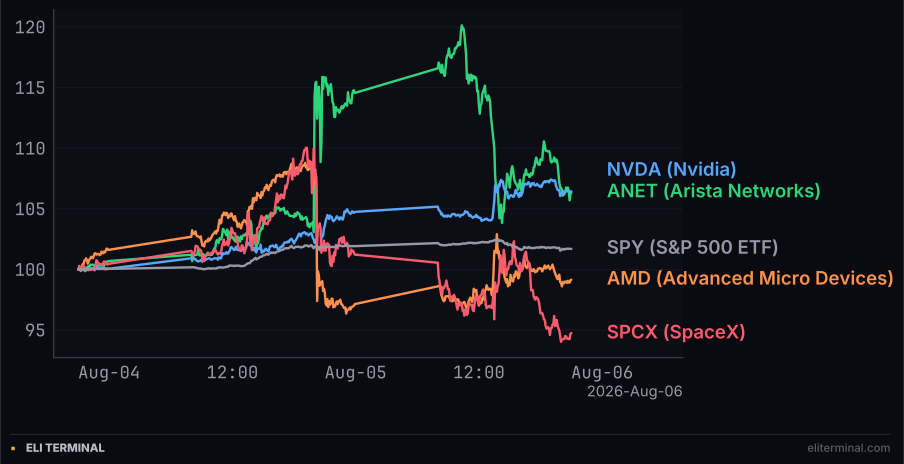
Indexed to 100 at the August 4 premarket open. The vertical breaks at 20:15 UTC on Tuesday are the earnings releases. Arista carried its gain for eighteen hours and lost most of it in the first minutes of Wednesday's session.
221.58 is where Arista Networks traded at 10:15 UTC Wednesday, 16.3% above Tuesday's close, on a quarter that grew revenue 37.7% to about 3.01 billion dollars and earned 1.02 a share against consensus near 0.88. It opened at 210.19, fell to 191.01 within the first minutes, 0.26% above where it started, and closed at 197.31. That close was a record, and it was still 11.0% under the premarket mark.
12.6 billion dollars is Arista's raised full-year revenue target, the third increase this year and about 40% growth, and the company guided the coming quarter to roughly 3.3 billion against a 2.95 billion consensus. Two lines in the call cut against it: gross margin guided to about 63%, below the 63.4% just delivered and 220 basis points under last year, and a top two or three customers still above half of revenue with management declining to name the new ones.
9.7 billion dollars is Arista's purchase commitment balance, up about 170% from a year ago, alongside deferred revenue of 6.87 billion, up 69%. Barclays lifted its target to 289 from 195, Wells Fargo to 255, Evercore ISI to 250. The company raised the year, the sell side raised the stock, and buyers who paid 221 at breakfast were 24 dollars worse off by noon.
13.61% is what SpaceX lost on Wednesday, closing at 108.27 after Tuesday's 125.33, the highest close it had printed in twelve sessions. It opened 10.3% down, rallied back to within 6.3% of Tuesday by 11:25am, and then bled all afternoon to finish near the low. Revenue of 7.81 billion beat and the loss came in smaller than expected.
18.4 billion dollars was the quarter's capital spending against roughly 13.2 billion expected, of which about 15.8 billion went to artificial-intelligence infrastructure, and management pointed at something near 65 billion for 2027, some 17 billion above prior estimates. The AI unit grew revenue 247% and lost 1.3 billion doing it. Chief financial officer Bret Johnsen told the call that on AI compute "we're getting less than a one-year payback."
Three companies delivered growth of 37% to 107% in twenty-four hours and all three finished below where the news found them. What they share is not a market or a product. It is a forward obligation written down in a filing.
219.22 is where Nvidia closed, up 3.43% and at a twenty-five-session high, on no company news at all. Broadcom finished unchanged, also at a twenty-five-session high. Neither has reported; Nvidia's quarter is still weeks away. On a day the semiconductor index fell 2.12%, the two largest members of it went up.
7.0% is how far Nvidia still sits below the high it set on May 14, and that gap is the cleanest sorting rule of the session. Arista, at its quarter high, rose. Nvidia, 7% under, rose. AMD, 17% under its June 30 peak, fell 7.0%. Lam Research, 29% under, fell 3.25%. Arm, 37.5% under, fell 2.13%. Qualcomm, 37.2% under, fell 3.16%.
32.9% is what SanDisk had gained in the five sessions into Wednesday, the largest bounce in the group, and it fell 5.40% to 1,350.50, still 42.2% below its June 25 close of 2,335. The deeper the drawdown a name was climbing out of, the harder it was sold. Wednesday paid for names that had already re-rated and took profits on names that had merely bounced.
4.14% is what the bullion fund gained, its largest single-day rise since February 3, with silver up the same 4.14% and the gold miners up 7.39%. The dollar index fell 0.20%, from 99.89 to 99.69, and the ten-year Treasury yield closed at 4.62% against 4.63%. Neither currency nor duration explains a move of that size; something in the path of policy did.
44,000 private jobs was the ADP count for July released at 12:15 UTC against roughly 70,000 expected, the smallest gain in six months, with June revised down to 95,000. At 14:00 UTC the Institute for Supply Management put its services index at 54.1 against 54.5 expected, with the employment component at 47.4, back into contraction from 51.2, and prices paid at 70.3 from 67.7.
1.24% is what the bullion fund gained in the hour after that release, moving from 385.83 at 13:45 UTC to 390.62 by 15:00, while the S&P 500 fund fell 0.47% over the same sixty minutes. Soft hiring with hot input costs is a difficult combination for equities and a straightforward one for metal.
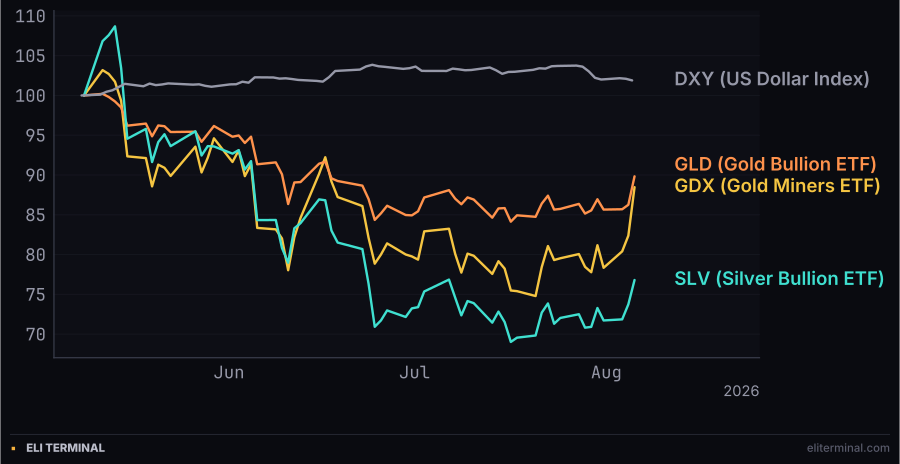
Each indexed to 100 at the May 6 close. Gold, silver and the miners lost 10% to 25% over the quarter while the dollar barely moved, and all three turned up together on the last bar.
48.5% is where the market pricing a Federal Reserve rate increase in September finished Wednesday, down from 54.5% on Tuesday, while the contract on the Fed holding rates steady that month rose from 42% to 50%. This is a central bank the market expects to tighten, not to ease, and Wednesday took roughly six points of that tightening out.
12:26 UTC is when Neel Kashkari, one of three dissenters in favour of a hike at the July meeting, told CNBC that now is the time to start slowly moving rates up but that he was "not calling for a dramatic increase." At 12:30 UTC the Treasury held its quarterly refunding at 125 billion dollars with auction sizes unchanged. The hawk hedged, the supply did not grow, and the front end of the rate expectation gave way.
75.22 dollars is where West Texas crude settled, down 0.73% after losing 10.5% over the two prior sessions on progress toward reopening the Strait of Hormuz. Crude had run back to 76.52 by 12:00 UTC and gave all of it up after the American open, with an Energy Information Administration build of 2.5 million barrels landing at 14:30 UTC. Cheaper oil removes the energy leg of the inflation problem, which is precisely how a market that fears rate increases reads it as bullish for gold. Energy shares fell 2.07%.
14:23 UTC is when Google said Jeff Dean was leaving after twenty-seven years, taking senior fellow Sanjay Ghemawat, DeepMind research head Oriol Vinyals and Google Brain co-founder Quoc Le with him to a new company, while Demis Hassabis moved from running Google DeepMind to chairman and Alphabet chief scientist. Alphabet was at 380.27 when it crossed and 382.05 half an hour later. The tape did not care.
375.88 is where Alphabet traded at 15:55 UTC and 359.32 ten minutes after that, a fall of 4.41% inside two candles, ninety minutes after the only news of the day about the company. Over those same ten minutes the S&P 500 fund moved 0.03%, Microsoft 0.11% and Amazon 0.09%. Nothing else crossed at noon Eastern; the market read the same headline twice and priced it the second time.
362.43 is where Alphabet closed, down 4.03% and 5.7% below its intraday high of 384.48, and it never traded above 365 again through the after-hours session. It had risen 6.0% over the two prior sessions. The departures landed on a company that had just lifted its 2026 capital-spending plan to a range of 195 to 205 billion dollars, which is the same ledger every other name on this page was being marked against.
2.58 dollars a share is what CVS Health earned against 1.87 expected, on revenue of 106.1 billion against 101.1 billion, and it raised full-year guidance to a range of 7.90 to 8.10 from 7.30 to 7.50. The stock fell 5.08%. What the call added was expected declines in pharmacy-benefit membership in 2027 and an elevated medical benefit ratio, and that is what traded.
22.97 billion dollars was Eli Lilly's revenue, up 48% and about 11% above consensus, on Mounjaro at 9.9 billion and Zepbound at 4.93 billion, with the full-year revenue target raised to 85 to 87 billion. It reached 9.1% up on the day, fell back to 2.0% up, and closed 4.86% higher. The give-back came where the company said realized prices would fall as medical-exception usage of Zepbound declines, and where acquired research charges of 3.03 a share more than swallowed a 2.78 raise to the operating guide.
16.98% is what Shopify gained, the day's largest rise, and it is the exception that names the rule: the only large reporter that guided its next quarter materially above the street, at growth in the low 30s against 26.3% expected, was the only one the tape rewarded. Uber beat on bookings, guided the coming quarter to a midpoint below consensus, and fell 5.29%. Disney raised its buyback target above 9 billion dollars and rose 3.65%.
5.36% and 5.40% are what Western Digital and SanDisk lost during regular hours, before either had said a word, and both did most of that damage in the last two hours: Western Digital from 547.53 at 17:00 UTC to 519.07 by 19:45, SanDisk from 1,410.77 to 1,345.00 over the same stretch. Seoul had gone the other way overnight, with SK Hynix up 5.8%, Samsung Electronics up 2.5% and the Korean index up 3.8%, though SK Hynix remains 42.9% below its own quarter high. The market sold two American storage makers into their own results while buying their Korean competitors.
20:04:35 UTC is when Western Digital's results reached the Commission with revenue of 3.747 billion dollars, up 44% from a year earlier, non-GAAP earnings of 3.56 a share against 3.29 expected, and a coming quarter guided to 4.1 billion and 4.00 a share, above the street on both. By five o'clock the stock was at 466.50, a further 10.15% below its close.
8.965 billion dollars was SanDisk's quarter, up 372% from a year earlier at an 84.6% gross margin, with 39.25 a share against roughly 34.50 expected, a coming quarter guided to 44.00 to 46.00 a share and an extra 14 billion dollars of buyback authorization. It fell another 4.01% to 1,296.31 by five o'clock. The line that mattered sits in the second bullet of the release: sequential revenue growth "came approximately one-third from higher volumes and two-thirds from higher pricing." Two of every three dollars of growth came from a price the company does not set, in the quarter after industry forecasts cut expected memory contract price increases from about 70% to about 12%.