THREE MONTHS, REBASED TO 100
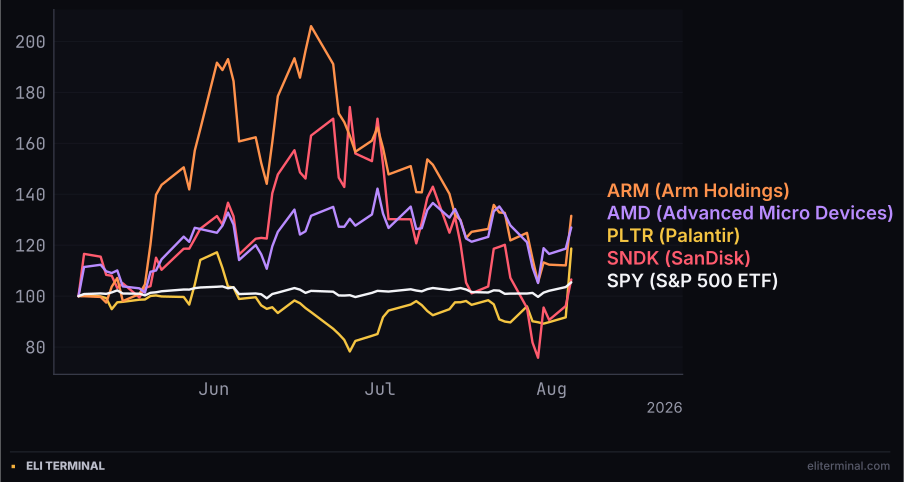
Palantir bottomed for the quarter on June 25, the same session SanDisk and Micron topped. Six weeks later Palantir prints the quarter high and they are 38.9% and 26.4% below theirs.
Palantir closed +29.5% at a three-month high, the chip names that led it behind stayed 26 to 39% under their June peaks, and crude settled −5.7% after the tape broke at 11:43 UTC.
Palantir bottomed for the quarter on June 25, the same session SanDisk and Micron topped. Six weeks later Palantir prints the quarter high and they are 38.9% and 26.4% below theirs.
Palantir closed at 162.66, up 29.5% and its highest close in more than three months, on 175 million shares against a 77 million-share Monday. The quarterly report filed at 20:06 UTC on Monday put second-quarter revenue at $1.935bn against $1.004bn a year earlier, growth of 92.8%, with income from operations of $912m, a GAAP operating margin of 47.1% versus 26.8% in the same quarter of 2025.
United States revenue was $1.573bn of the total, up 114.7%, while everything outside the United States grew 33.7% to $362m. The company's entire acceleration is domestic: US commercial revenue rose 149% and US government revenue rose 90%, and the guide lifted full-year revenue to $8.15bn to $8.158bn from roughly $7.65bn.
The stock opened at 145.15, a gap of 15.5%, touched 143.28 in the first five minutes and then added another 12.1% between the opening print and the bell, closing within 1.9 points of the session high. Options going into the report had been priced for a swing near 12%; the realised move was more than twice that, and even after it the close sits 21.5% below the 207.18 the stock printed on November 3.
Deutsche Bank's Brad Zelnick moved to Buy from Hold and took his target from 80 to 200; Citi's Tyler Radke went to 245 from 200 and BofA's Mariana Perez Mora to 255 from 215. Jefferies' Brent Thill kept Underperform and raised his target only to 80, on the arithmetic that the year-over-year comparison hurdle climbs from 67% in the second half of 2026 to 89% in the first half of 2027. With 2.403 billion shares outstanding, the close values the company near $391bn against the $8.15bn of revenue it guided to for this year (CNBC).
Eleven names closed up more than 6% and ten of them are still 10% to 39% below their June highs. Arm ended 17.4% higher and 36.2% under its June 18 close; SanDisk rose 10.8% and remains 38.9% under June 25; Intel rose 10.8% and sits 28.4% under June 22; Qualcomm and KLA both rose about 7% and both sit 35.2% under late-June marks.
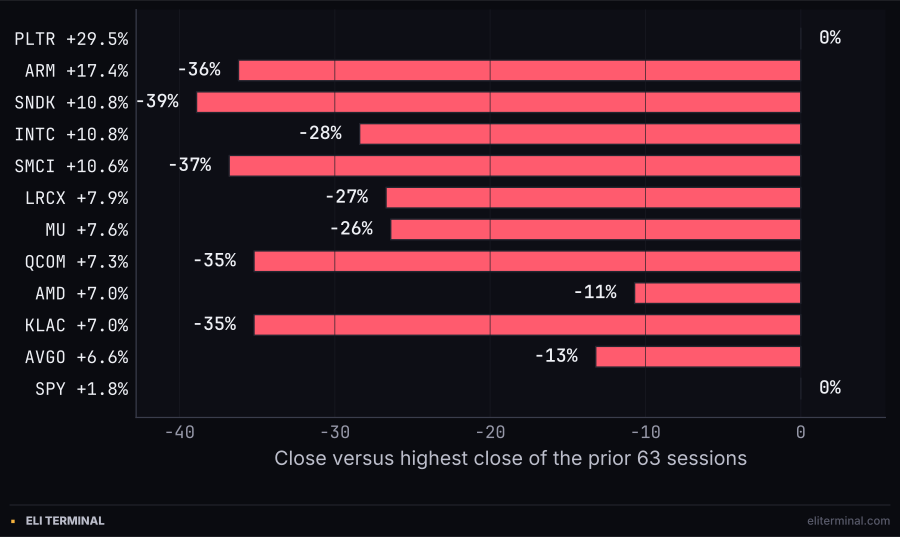
Ranked by Tuesday's gain. The bar is the distance from the highest close of the prior 63 sessions. Palantir and the index sit at zero; everything in between is a bounce inside a drawdown.
Palantir and the index were the exceptions: both closed at a 63-session high, as did Arista and Microsoft. The order is close to an inversion, with the largest single-day gains attaching to the deepest holes, which is the signature of a market repricing what it abandoned rather than one paying up for what has been working.
The chip complex as a whole added 6.8% on the day and 16.6% across four sessions from the July 29 close, after falling 21.2% through July. Even after that run it sits 17.2% under its June 22 level, and the Nasdaq Composite's 2.6% gain left it roughly 2% short of its own early-June high on a day the Dow closed above 54,000 and the S&P 500 above 7,700 for the first time.
Arm's 17.4% was its largest one-day gain of the past year and it carried no company news of its own. Fiscal first-quarter results landed on July 29 after the US close: revenue of $1.29bn, up 22% and a record, royalty revenue of $715m, adjusted earnings of $0.45 against a $0.37 to $0.40 range, and a September-quarter guide of $1.38bn.
The tape spent four sessions doing nothing with it, closing 241.54, 239.69 and 239.06 after a single 7.4% reaction day, then repriced the whole thing on Tuesday. JPMorgan's Harlan Sur lifted his target to 255 from 240 on data-centre royalties growing more than 100% year over year for a second consecutive quarter; Morgan Stanley went to 212 from 202, having called the original print overshadowed by slowing royalty growth.
Qualcomm's 7.3%, Broadcom's 6.6%, Lam Research's 7.9% and KLA's 6.9% arrived with no dated company event at all. Memory had one: SanDisk and SK hynix published the first High Bandwidth Flash specification through the Open Compute Project at 19:34 UTC on Monday, covering stacks to 512GB and three bandwidth grades from roughly 0.4 to 3.0 terabytes per second (SanDisk).
Three houses initiated on SK hynix during the New York session, RBC at Outperform with a 200 target citing a memory upcycle running through 2027, Stifel at Buy with 240, and William Blair at Outperform on tight supply having roughly tripled AI memory prices (24/7 Wall St). SK hynix itself had closed in Seoul at 06:00 UTC, up 0.6% at 1,577,000 won, hours before any of it printed; the buying landed in New York, where Micron rose 7.6% and SanDisk 10.8%.
Caterpillar filed at 10:31:44 UTC with the first quarter above $20bn in the company's history, sales and revenues of $20.543bn against $16.569bn, adjusted profit of $8.17 a share against $4.72, and an adjusted operating margin of 21.9% against 17.6%. Construction Industries sales rose 35% and North American sales rose 37%.
The stock opened at 922.00, an 11.1% gap, marked 935.00 in the first fifteen minutes, and by 14:15 UTC had traded 866.85, giving back 7.3% from the high in forty-five minutes. It closed 876.54, up 5.6%, roughly half the gap surrendered, and still 17.7% below its June level after a record quarter (CNBC).
Inside the $4.295bn of operating profit sat $392m of expected recoveries under the International Emergency Economic Powers Act, disclosed in the release itself, with the company narrowing full-year tariff cost to about $2.2bn and no further recoveries expected in the second half. Roughly 9% of the operating line does not repeat, which is one arithmetic reason a 32% beat on the headline number could not hold a gap.
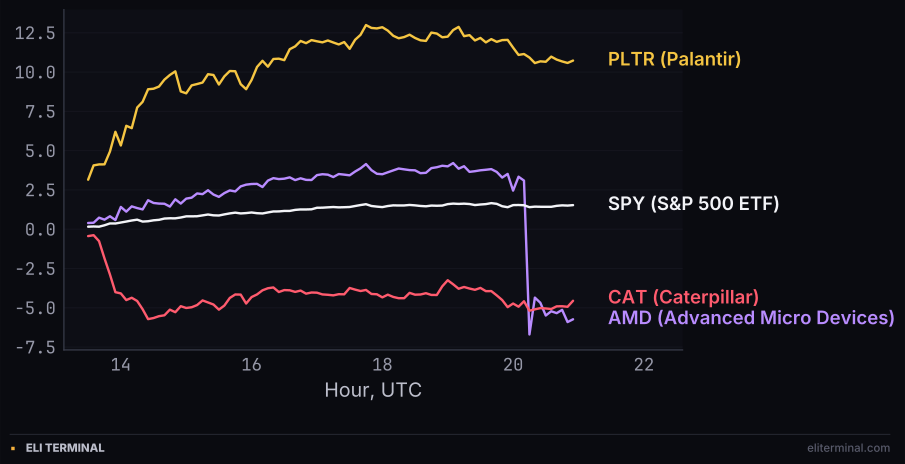
Palantir climbed all session from its gap. Caterpillar lost its gap inside the first hour. AMD held a 4% gain until 20:15 UTC.
WTI ran to 82.33 in the 09:50 UTC candle and then lost it. The break is dated to the minute: at 11:43 UTC the front contract opened 79.53 and printed 78.59 on 2,177 lots against 198 to 664 lots in each of the preceding five minutes, then slid to 76.58 by 11:59 UTC, a 7.0% round trip from the morning high inside two hours.
Treasury Secretary Scott Bessent had said on television that morning that there was "a chance we may have a deal today or tomorrow to open the strait," and that the American position on Iranian transit fees was "freedom of movement" (CNBC). Qatar's foreign ministry described contacts at "very progressive stages" with an interim proposal drafted, while Tehran denied that direct talks were taking place (Associated Press).
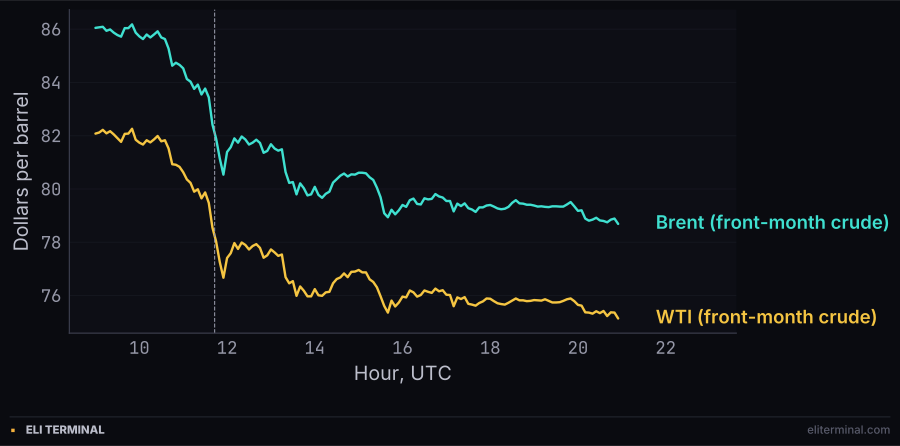
Dashed line at 11:43 UTC, the minute WTI printed 78.59 on 2,177 lots. Both grades stepped down again after 15:15 UTC and finished at the lows.
WTI settled 75.77, down 5.7%, and Brent 79.36, down 5.3% and its first close under 80 in three weeks. That erases the whole July move: crude closed at 68.55 on July 6, ran to 92.19 on July 23 after Houthi strikes on two Saudi-flagged tankers closed the Red Sea detour around the shut strait, and is now 17.8% below that peak with a 10.5% gain over the past month still attached to it.
Energy shares priced almost none of a 5.7% crude break: the sector fund fell 0.46%, Exxon 0.71% and Chevron 1.44%, while the pure crude vehicles took the full hit at 5.2%. Oilfield services went the other way, with the services fund up 2.6%, Schlumberger up 3.0% and Halliburton up 1.5%.
That split reads as a restart rather than a demand scare: a reopened strait means Gulf work returns even as the barrel gets cheaper, and equity holders acted on the second-order consequence while the futures market acted on the first. Airlines took the fuel side of it, with Southwest up 3.5% and Delta up 1.3%.
The ten-year yield fell 5.9 basis points to 4.627% and the five-year fell about 8, the largest move on the curve, while the thirty-year gave up 3. A rally led by the five-year on the day crude collapses is an inflation-expectations move rather than a duration move, and it came one session after the Treasury raised its July-to-September privately held borrowing estimate to $739bn, $68bn above the May figure (Treasury).
June job openings printed at 7.359m at 14:00 UTC against a 7.40m estimate, a three-month low, with the quits rate at 2.0% for a second month and information-sector openings down 33% from a year ago (Bureau of Labor Statistics). The June trade deficit narrowed to $73.3bn at 12:30 UTC on imports falling $7.3bn.
Prediction markets still put a September rate increase near 55% and a hold at 42%, against 24% for an increase a month ago, which is the frame the whole day sits inside: at the July 29 meeting Kevin Warsh's committee held at 3.50% to 3.75% for a fifth time on a 9 to 3 vote, with Logan, Hammack and Kashkari all dissenting in favour of a hike (CNBC). Volatility rose 4.0% to 16.50 on a record close, which is not what a market that believes its own rally usually does.
AMD closed the regular session at 518.58, up 7.0% and up 20.7% across four sessions, then filed at 20:16:24 UTC. Second-quarter revenue was a record $11.536bn, up 50%, with Data Center revenue of $6.7bn up 107% and 58% of the company, non-GAAP earnings of $1.66 a share against roughly $1.61 expected, and a third-quarter guide of about $13bn plus or minus $300m, above the roughly $12.5bn the sell side carried (AMD).
The stock traded 523.29 down to 463.00 between 20:15 and 20:20 UTC, a fall of 11.5% inside five minutes, and was changing hands near 477 at 21:00 UTC, 8.0% under the closing price and below Monday's 484.64 close. Non-GAAP gross margin was guided flat at 56% for a quarter in which revenue is guided up 13%, and the conference call had not yet begun.
Arista went the other way in the same twenty minutes, releasing near 20:05 UTC with first-ever quarterly revenue above $3bn, at $3.036bn and up 37.7%, non-GAAP earnings of $1.02 against roughly $0.90 expected, and a third raise to the full-year guide, to about $12.6bn (Business Wire). It marked 214.01 at 21:00 UTC, 12.3% above its close, while Nvidia added 1.1% after the bell and Micron gave up 0.9%.
Amazon fell 2.3% after gaining 20.6% over the two prior sessions, the day after a Form 144 disclosed a proposal to sell 15 million shares, about $4.07bn, under a plan adopted in November 2025, and the morning New Jersey's attorney general filed an antitrust suit over its delivery-contractor arrangements (New Jersey Attorney General). Chipotle fell 9.7% on a Minnesota salmonella investigation, and Novo Nordisk raised guidance and closed 6.0% lower after trading 4.4% higher intraday, on oral Wegovy sales of 3.22bn kroner against 3.27bn expected (CNBC).
Merck closed 0.18% higher on the day it cut full-year adjusted earnings guidance to $2.66 to $2.76 from $5.04 to $5.16 on charges tied to Terns and Cidara while raising the revenue guide, a headline the wires ran two ways and the tape priced at zero (CNBC). McDonald's rose 1.2% with US comparable sales at 0.8% against 2.5% a year ago.
Wednesday brings the July services survey at 14:00 UTC, with the prices-paid component the more consequential half, weekly crude inventories at 14:30 UTC, and the quarterly refunding statement. SanDisk and Western Digital both report after that close, which puts the two names that have run 30.2% and 18.3% in five sessions in front of their own numbers; Eli Lilly, Disney, Shopify, Uber and AppLovin report the same day, and the July employment report lands Friday at 12:30 UTC.