Three months, five paths
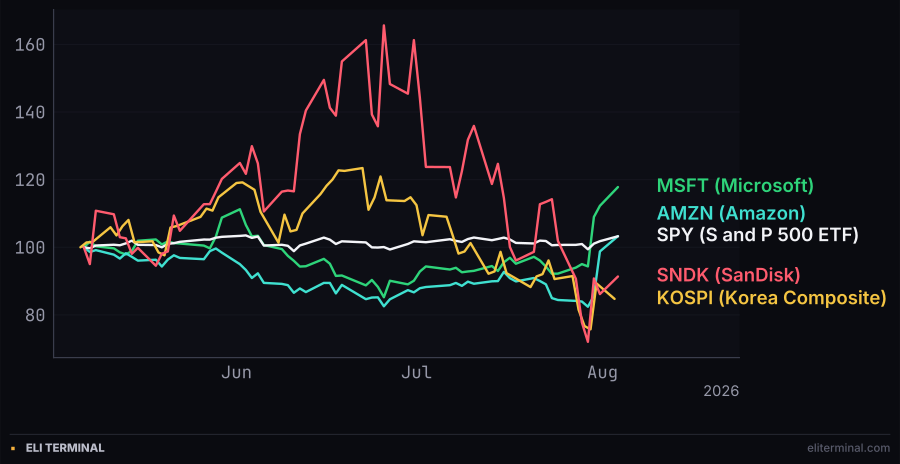
Each indexed to 100 at the May 6 close. SanDisk and the KOSPI led the quarter by a wide margin, then gave all of it back and more. Microsoft ends the period on top, at its highest close of the six months.
Microsoft closed at a six-month high, SanDisk rose 6.0% and finished 44.8% below its own, and Brent gave back 7.0% on a promise to reopen Hormuz.
Each indexed to 100 at the May 6 close. SanDisk and the KOSPI led the quarter by a wide margin, then gave all of it back and more. Microsoft ends the period on top, at its highest close of the six months.
6,257.45 is where the KOSPI closed Monday, down 5.12%, after gaining 16.5% over the two sessions before it. The Korean tape gave back roughly a fifth of a two-day gain that had included the largest single-session advance in the index's history.
4.0% is what the semiconductor ETF lost in New York pre-market hours as that news arrived, sliding from 549.90 at 08:00 UTC to 528.00 by 12:00 UTC. The S&P 500 ETF over the identical window went from 751.51 to 750.18. Only one part of the market imported Seoul.
1,121.33 was SanDisk's low, printed within five minutes of the 13:30 UTC opening bell, down 7.7% from Friday's close. By 14:25 UTC it traded 1,251.37, and it closed at 1,288.03, up 6.03%. The distance from that low to the close is 14.9%.
770.15 was Micron's low in the same opening minutes and 814.41 was its price fifty-five minutes later. The S&P 500 ETF opened at 749.44, reached 754.50 by 14:30 UTC, and then added only 3.17 points across the remaining five and a half hours. The session was decided before eleven in the morning.
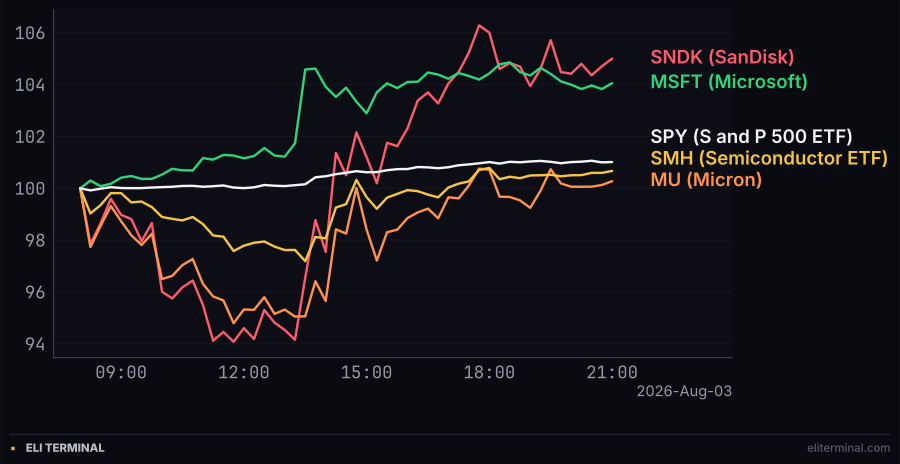
Each indexed to 100 at its 08:00 UTC pre-market price. The memory names carried Seoul's loss for five hours; the index carried none of it; the opening bell erased the gap.
487.65 is Microsoft's close, up 4.93%, and it is the highest closing price the stock has made in six months. Amazon closed at 284.02, up 4.58%, also a six-month high, and crossed three trillion dollars of market value for the first time. Neither name has a drawdown to recover.
19.5%, 9.2% and 6.0% are the gains CoreWeave, Oracle and SanDisk put on in the same session, and they finished 37.8%, 42.8% and 44.8% below their own highest closes of the quarter. Two moves of the same sign and the same magnitude meant opposite things, and the difference is which side of the artificial-intelligence build they sit on: the companies buying capacity re-rated, the companies selling it bounced.
0.8% is what SanDisk has gained over five sessions despite rising 19.6% across the two before Monday and 6.0% on Monday. Meta rose 6.02% to 590.24 and is down 0.6% on the same five days, having lost 4.9% over the two prior. Both names spent the day retrieving what they had just lost.
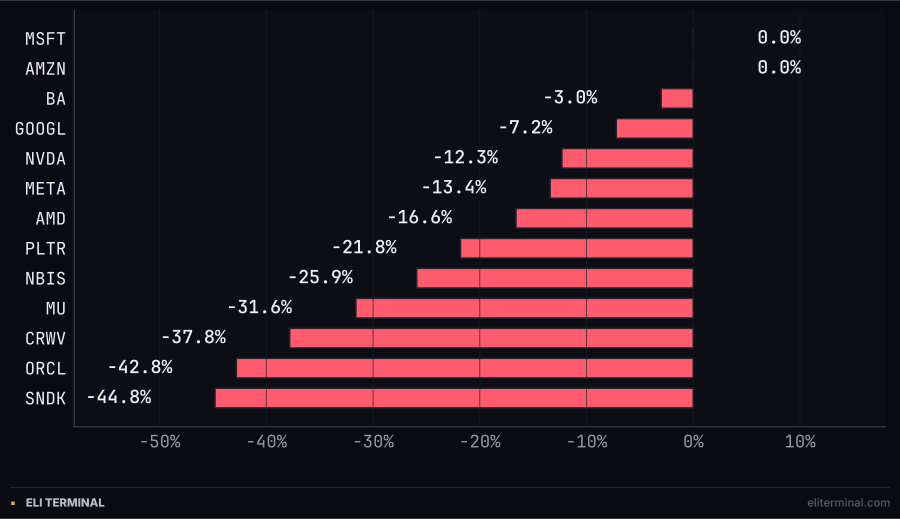
Every name shown closed higher on Monday. Microsoft and Amazon closed at the top of their own quarter; SanDisk, Oracle and CoreWeave rose from 38% to 45% underneath theirs.
4.77 trillion won is what foreign investors and domestic institutions sold on net in Seoul on Monday, against 4.65 trillion won of net retail buying, on turnover of 26.1 trillion won. Samsung Electronics and SK hynix alone absorbed 95.4% of the foreign net selling. Cash and KOSPI 200 futures fell together from the opening bell, which is what an unwind looks like rather than a reaction to a headline.
1,567,000 won is SK hynix's close, down 8.79% after rising 22.6% over the two prior sessions, leaving it 46.3% under its highest close of the quarter. Samsung fell 8.76% to 239,500 won. Lee Kyoung-min of Daishin Securities attributed the fall to foreign profit-taking concentrated in the chipmakers.
9,000 is the KOSPI target Daniel Blake of Morgan Stanley attached to an upgrade of Korea to overweight published Sunday, some 36% above Friday's close. The index fell 5.12% at the first opportunity to price it.
43% is the constant-currency growth Microsoft reported for Azure on July 29, the quarter in which the business crossed one hundred billion dollars of annual revenue. Amazon Web Services grew 37% to 42.2 billion dollars, its fastest rate in eighteen quarters, and Google Cloud grew 82% to 24.8 billion. Three separate cloud businesses accelerated in the same week.
24.9% is what Microsoft has added across the three sessions since that report, and 22.7% is Amazon's five-session gain. Target raises followed from Citi to 600 and Bernstein to 641. The money went to the demand side of the build and stayed there for three straight sessions.
303.42 is Apple's close, down 1.78%, the only megacap in the red and now 10.8% lower across four sessions. It traded 311.80 at 12:00 UTC in pre-market hours, opened at 309.58, and reached 302.56 by 15:30 UTC. Apple went down on the same clock that turned everything else up.
30.74 billion dollars was Apple's Services revenue against roughly 31.2 billion expected, with Greater China at 18.8 billion against roughly 19.5 billion, and a September-quarter guide of 9 to 11% growth. Tim Cook also flagged an increasing impact from memory-cost inflation on margins.
Third is where Apple now sits by market value, behind Amazon after Monday. The one large-capitalization name that fell is the one that told the market its input prices are rising, on a session when the market marked the sellers of those inputs 30% to 45% below their quarter highs.
83.77 is where Brent settled, down 7.05%, with West Texas down 5.11% to 80.34. The move followed a Truth Social post late Saturday night in Washington in which Donald Trump said he had called off strikes on Iran "subject to being able to rapidly make a DEAL," and described that deal as including the "Immediate, Complete, and Total OPENING OF THE HORMUZ STRAIT". The Strait has been effectively shut since mid-April.
29.2% below its March 31 close of 118.35 is where Brent now sits, and 16.8% below its July 23 close of 100.69, after a July in which it gained 23.6%. Iran's foreign ministry spokesman Esmail Baqaei said Monday morning in Tehran that Iran has no negotiations with the United States, and Trump called the Iranian leadership "unbelievably duplicitous" during New York hours. Crude did not take the discount back.
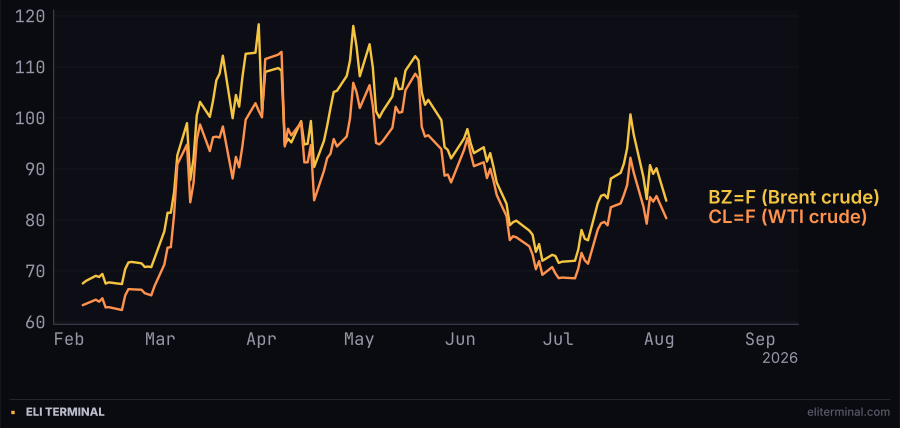
Front-month settlement prices. The premium built in March and April, drained through June, rebuilt in the last ten days of July, and lost a seventh of itself on Monday.
1.28% is all the energy sector ETF gave up against crude's 5.11%, with the exploration and production ETF down 1.76%, Chevron down 1.85% and Occidental down 2.80%. Energy equities never capitalized the full war premium, so they had little to hand back. Prediction markets were equally unpersuaded: the deepest contract on Hormuz traffic normalizing during August moved only into the mid-teens on the day, and the mid-August contract stayed in low single digits.
43% is how far Marriott's international revenue per available room fell on a Middle East collapse, disclosed with its results before Monday's open, and the stock fell about 7% on a Q3 guide of 2.74 to 2.82 dollars against 2.87 expected. The hotel operator still raised its full-year outlook. The same conflict that had been paying oil producers was billing hotel operators.
55.6 was the July manufacturing index from the Institute for Supply Management, released at 14:00 UTC against 54.0 expected and the highest reading since May 2022, with prices paid at 71.1 and employment at 52.8, in expansion for the first time in 33 months. The S&P 500 ETF traded 753.60 at 13:55 UTC, 753.41 at 14:00 and 753.58 at 14:05.
4.686% is where the 10-year yield finished, down 5.9 basis points, with the 5-year down 6.0 and the 30-year down 4.4. Three members of the Federal Open Market Committee, Beth Hammack, Neel Kashkari and Lorie Logan, dissented on July 29 in favor of raising rates from 3.50 to 3.75%. The bond market bought duration into a hot manufacturing print anyway, and took its direction from crude instead.
739 billion dollars is the Treasury's new estimate of July-to-September marketable borrowing, published at 19:00 UTC, 68 billion above the May figure. Yields did not move into the 20:00 UTC close.
233.49 is Boeing's close, up 8.03%, and it is 3.0% under its own quarter high, which puts it with the buyers rather than the bouncers. Matthew Akers of BNP Paribas moved the stock two notches from underperform to outperform before the open, raising his target from 230 to 300 on the view that free-cash-flow estimates had fallen too far.
221.00 was the opening print and 228.06 was the price an hour later, with the rest of the gain arriving through the afternoon as the Federal Aviation Administration certified the 737 MAX 7 after roughly a decade. The certification extended a move the upgrade had already started.
1.935 billion dollars was Palantir's second-quarter revenue, up 93% year over year, with United States commercial revenue up 149% to 764 million and adjusted earnings of 41 cents against a 28-cent forecast. The company raised full-year revenue guidance to a range of 8.150 to 8.158 billion dollars. The stock went from 125.65 at the bell to 140.88 by 21:00 UTC.
77.3 million shares changed hands in Palantir's regular session against 29.1 million on Friday, and it closed up 2.10% at 125.65, still 21.8% under its quarter high. AMD, Caterpillar and Merck report Tuesday; Eli Lilly, SanDisk, Western Digital and Disney report Wednesday. Two of those four Wednesday names are the ones that spent Monday climbing out of a hole.