MEMORY AND THE CLOUD THROUGH JULY
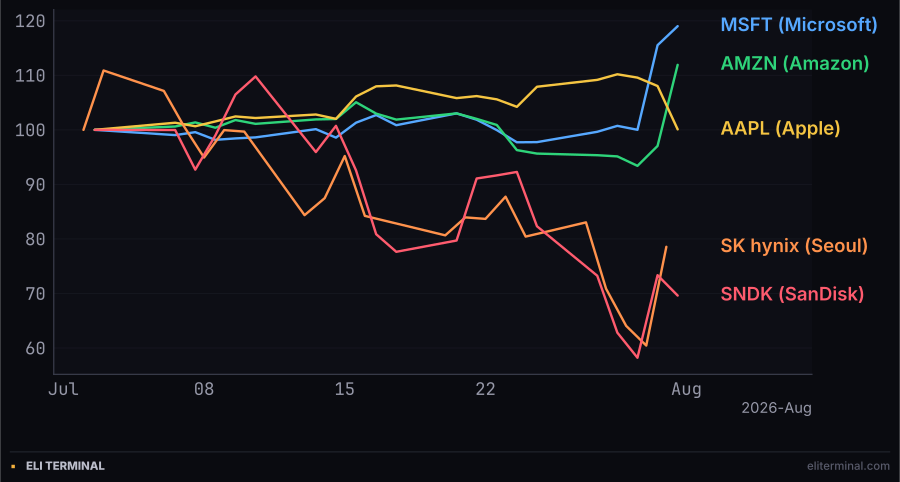
Indexed to 100 at the July 2 close. The two memory lines lose about 40% and take back a third of it in the last two sessions. The two cloud sellers finish the month at their highs. Apple ends where it began.
Amazon rose 15.3% on a bigger build budget, Apple fell 7.4% on the memory bill behind that build, and the whole chip complex opened up 3.5% and was sold.
Indexed to 100 at the July 2 close. The two memory lines lose about 40% and take back a third of it in the last two sessions. The two cloud sellers finish the month at their highs. Apple ends where it began.
220 billion dollars is the 2026 cash capital budget Amazon named on its call, raised from about 200 billion, and the stock closed up 15.3% at 271.58. The 8-K accepted at 20:06 UTC Thursday said net sales "increased 20% to $200.6 billion in the second quarter, compared with $167.7 billion in second quarter 2025," and that "AWS segment sales increased 37% year-over-year to $42.2 billion." Amazon's cloud unit had not grown that fast in eighteen quarters.
7.6 billion dollars is what the same release calls Amazon's trailing twelve-month free cash flow, "an outflow," it says, "driven primarily by a year-over-year increase of $66.1 billion in purchases of property and equipment." A company that burned cash for a year and just told the market it would spend 20 billion more than planned was bought 15.3% in a session. That is not a beat being rewarded; it is a spending line being re-read.
496 billion dollars is the number that made the re-read possible, disclosed in the 10-Q rather than the press release: contracts "not yet recognized were approximately $496 billion as of June 30, 2026," with "a weighted-average remaining life of our long-term contracts" of 6.4 years. JPMorgan's Doug Anmuth lifted his target to 365 from 330 and named that backlog; Benchmark's Daniel Kurnos went to 400 from 370 and Goldman Sachs to 375 from 335, all on Friday morning.
6.7% is what Alphabet gained to 356.13 without filing anything, reporting anything, or announcing anything. Nine days earlier it had guided 2026 capital spending to a range of 195 to 205 billion dollars and been sold 7.1% for it, bottoming at a closing 317.69 on July 23.
12.1% above that low is where Alphabet closed Friday, and it is still 11.5% below its May 13 close of 402.62. The disclosure that got it sold on July 22 is the same disclosure that got Amazon bought on July 31. What changed in between was Microsoft's cloud line on Wednesday night and Amazon's on Thursday night, and the reaction function moved with them.
464.72 is both where Microsoft closed and the highest close of its quarter, set on the same day. Amazon closed at a 25-session high and 1.2% under its own quarter high from May 6. The two names that resold the most compute in the quarter finished the month at the top of their ranges while the index that contains them did not.
17.91% is what the KOSPI gained on Friday to 6,595.45, the largest one-day gain in the index's history. The Amazon and Apple calls both began at 21:00 UTC Thursday. Seoul opened at 00:00 UTC up 1.15%, its buy-side sidecar tripped at 00:06 UTC, and the index closed the session 17.9% higher at 06:30 UTC.
30.0% is exactly the Korean daily price limit, and SK hynix closed there, at 1,718,000 won, having opened up 28.4%, dipped to 1,586,000, and finished on its high. Samsung Electronics closed up 26.8%. Both were still deep in a hole: SK hynix finished 41.1% below its June 22 close of 2,919,000 won, and Thursday's 1,322,000 was the lowest close of its quarter. This was day one off a quarter low, not a breakout.
10 million won to 30 million won is the size of the minimum cash deposit the Financial Services Commission imposed on leveraged exchange-traded funds, and those restrictions took effect Friday, pulled forward from August. The index posted its biggest day on record on the day its regulator tightened access to the instruments that had amplified the crash. The rally ran against policy, not with it.
3.5% is how much the semiconductor ETF SMH gapped up at the 13:30 UTC open, tracking Seoul, and it closed the day up 0.30%. Micron opened at 919.65 and printed its high of 930.88 inside the first fifteen minutes; it never closed a five-minute bar above its opening price all session and finished at 823.03, down 5.9% on the day and 10.5% below its own open.
12.2% below its opening print is where SanDisk closed, at 1,214.83. Arm gave up 7.4% from its open, Lam Research 7.1%, Intel 6.7%, CoreWeave 6.8%, Taiwan Semiconductor 3.6%. Every one of them opened green on the Seoul read-through and every one of them was distributed through the session.
18.4% and 26.0% are what Micron and SanDisk gained on Thursday, while Seoul was shut. New York had already taken that trade a day earlier, on Microsoft's cloud numbers; Friday was Korea's turn to have it, and the American memory names had nothing left to buy.
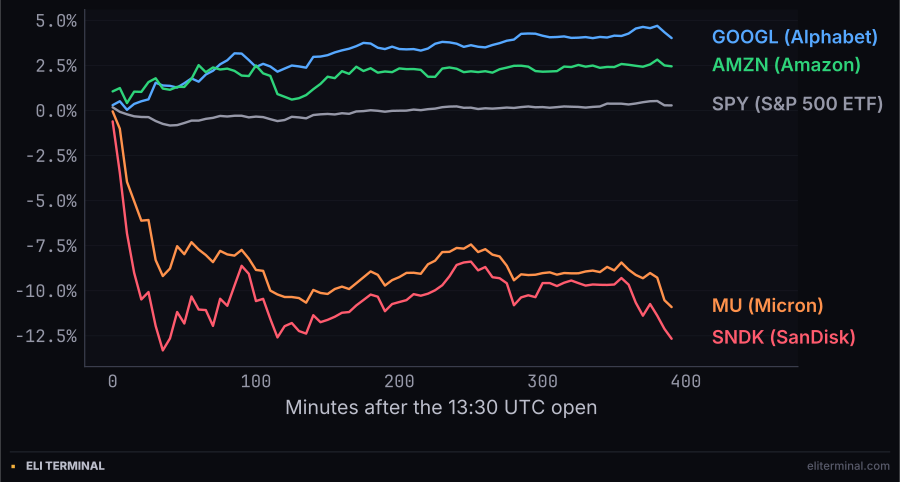
Each line measured against its own opening price. The memory names lost 10% and 13% inside the first 35 minutes of trading. Alphabet, which reported nothing, made its high in the last hour.
47 to 48% is the gross margin Apple guided for the September quarter on its 21:00 UTC call, against the 50.1% it had just reported, and the stock fell 7.4% to 308.91. Tim Cook called memory pricing a "100-year flood" and said supply constraints would bite harder into iPhone, Mac and iPad in the current quarter.
109.4 billion dollars was Apple's quarterly revenue, up 16%, with iPhone at 54.25 billion and up 21.7%, and it did not matter. Services came in at 30.74 billion, growing 12.1% after 16.3% the quarter before, and Greater China at 18.82 billion, up 22% from a year earlier and still short of what the street carried. The reported gross margin of 50.1% included roughly two points of benefit from tariff refunds that will not repeat.
340.08 was Apple's close on July 28, three sessions before, when it was worth about five trillion dollars. It closed Friday 9.2% under that, at roughly 4.6 trillion, touched exactly 300.00 at 16:30 UTC and then bought back 3.0% into the bell. Barclays' Tim Long cut his target to 245 from 253; Bank of America's Wamsi Mohan held Buy and 380, arguing the limiter is supply and not demand, and the sell side split on which one it was.
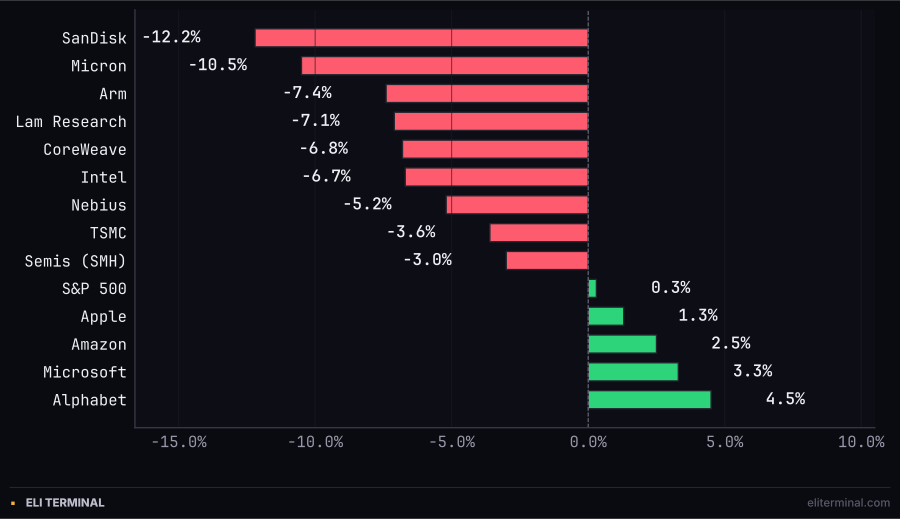
Where each name closed against its own 13:30 UTC opening price. Apple, down 7.4% on the day, still finished above its open. Nine chip names did not.
4.75% is where the 10-year Treasury yield closed, up about 8 basis points and the highest close of the quarter, with the 30-year near 5.26%. The Employment Cost Index landed at 12:30 UTC at 0.9% for the second quarter against 0.8% expected, and the 10-year moved about a basis and a half on it. The wage print the hawks would most want to see barely registered.
4.710% to 4.731% is the move the 10-year made inside the single fifteen-minute bar containing the 13:45 UTC Chicago PMI at 57.6, against 56.0 expected. Fifteen minutes later the University of Michigan's final July sentiment reading came in at 55.2, revised up from 54.4 and a five-month high. Growth data, not wage data, is what pushed the curve.
3 of 12 votes went against the Federal Reserve's July 29 decision to hold at 3.50 to 3.75%, with Hammack, Kashkari and Logan all wanting 25 basis points more. Chair Kevin Warsh said five-plus years of inflation above target "cannot be cured in nine weeks, or by a single month of modest price decreases," and that the committee "will not waver." The September hike market ended Friday at 52%, up from 31% on July 11, and the market pricing a 2026 recession fell to 6% from 13% the day before.
11.95% is what DexCom gained, to 83.45, and that close was the highest of its quarter, up 21.2% over the past 21 sessions, and 4.5% above its own opening price. That is what a re-rating looks like on the tape.
28.74% is what AXT gained, and it is a different animal: the stock opened at 66.71 and closed at 60.43, giving back 9.4% from the open, and it finished 57.1% below its May 22 close of 140.83. A 28.7% day that ends 9.4% off its own open is a bounce inside a drawdown the session was already selling.
26.9% and 21.0% are what Roblox and Reddit lost, both to the lowest closes of their quarters, at 35.60 and 140.67. Roblox guided third-quarter bookings to a year-over-year decline and pulled its full-year outlook; Reddit beat on both revenue and earnings and was sold anyway, with no new artificial-intelligence licensing deals to show. Coinbase fell 10.6% to 146.26 after a third straight revenue miss, with bitcoin down 3.0% to 62,814.
0.03% is what the S&P 500 tracker did across the whole of July, from 746.77 on June 30 to 747.03 on Friday. The Nasdaq-100 tracker fell 6.57% over the same month, the equal-weighted S&P rose 1.05%, and the energy sector fund gained 12.13%. A flat index hid a 7.6-point gap between the average large-cap stock and the largest ones.
0.22% is what the technology sector fund lost on a day the S&P 500 rose 0.70% and the Nasdaq Composite rose 1.00%, and consumer discretionary, where Amazon sits, gained 3.29%. The Russell 2000 fell 0.48%, the only major index red, and nine of eleven sectors were underwater in mid-morning trading. The S&P's low came at 14:15 UTC and it rose for the following five and three quarter hours.
15.99 is where the VIX closed, down 6.4% and within 6.4% of its lowest close in 25 sessions, on a day the long bond made a quarter high in yield. Exxon Mobil missed on refining and fell 1.0%; Chevron posted its largest quarterly profit on record and rose 2.4%, with crude at 84.67 and 23.5% higher than 21 sessions ago. Palantir reports Monday, AMD on Tuesday, Eli Lilly and SanDisk on Wednesday, and the July employment report lands Friday.