The Round Trip Behind Thursday
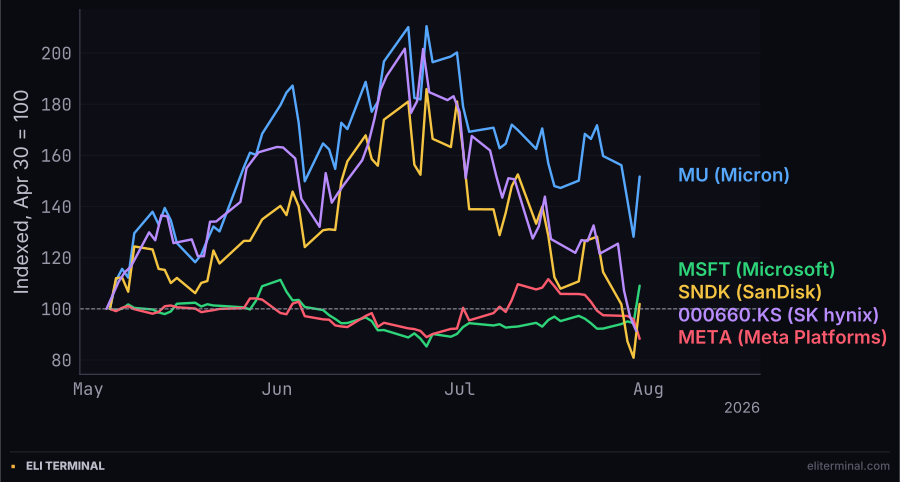
SanDisk and SK hynix more than doubled between April 30 and June 25, then handed all of it back. Thursday's rally is the small upward tick at the right edge.
Microsoft added roughly 450 billion dollars of market value in one session, Meta closed at a quarter low, and SanDisk rose 26.0% on the same shortage warning Seoul had already sold.
SanDisk and SK hynix more than doubled between April 30 and June 25, then handed all of it back. Thursday's rally is the small upward tick at the right edge.
Microsoft's annual report was accepted at 20:08 UTC Wednesday, minutes after the results crossed, and it carries the line the equity market spent Thursday paying for: commercial remaining performance obligation of 678 billion dollars, up 84%. Additions to property and equipment ran 115.9 billion dollars for the fiscal year against 64.6 billion a year earlier. The filing also discloses 329.1 billion dollars of leases, mostly data-center capacity, signed and not yet commenced, scheduled to begin between fiscal 2027 and fiscal 2033.
The stock did almost nothing for the first two hours after the release, trading 396 to 403 against a 390.54 close. It broke at 22:00 UTC, about half an hour into the call, going from 397.86 to 417.00 inside a single five-minute bar and reaching 429.88 ten minutes later.
Azure grew 43% in constant currency against a 39% to 40% guide and crossed 100 billion dollars of annual revenue for the first time. Morgan Stanley's Brian Nowak flagged the four-point sequential acceleration Thursday morning and held an Overweight with a 600 dollar target; Citi raised to the same level and called the quarter a rebuttal to the bear case. Microsoft closed 451.10, up 15.5%, roughly 450 billion dollars of market value added in a session and its largest one-day gain since 2008, and it now sits 2.0% under its June 1 close of 460.52 after trading as low as 352.83 on June 25.
Meta's release crossed at 20:01 UTC with revenue of 60.8 billion dollars, up 28% and above consensus, and diluted earnings of 6.18 dollars against roughly 7.15 expected. Second-quarter capital expenditure including finance leases came in at 31.1 billion dollars, below the 33 to 34 billion the street modelled, and the full-year range was narrowed to 130 to 145 billion. Free cash flow for the quarter was 784 million dollars.
Asked directly for a 2027 capital-spending figure, CFO Susan Li declined, saying "we aren't providing a specific outlook for 2027 CapEx at this time" and that "near term capacity is more valuable than long term capacity." Mark Zuckerberg told the same call there is "nowhere near enough compute for all the demand." Meta's posted transcript carries a footnote on the final answer recording a correction of a reference to "demand" during the call; the printed text reads supply constrained.
The worst print came during the questions, not on the release: 533.13 in the first hour after the wire, then 518.30 between 21:00 and 22:00 UTC, down 11.5%. Thursday's session opened at 526.00, put its low in at 524.49 in the first half hour, and closed 539.03, down 8.0% and at the top of the day's range. Wells Fargo cut its target from 835 to 640 and JPMorgan from 725 to 640, while Nowak at Morgan Stanley held near 775.
That close, 539.03, is the lowest of the past 63 sessions and sits 20.9% under the 681.31 Meta printed on July 15. It has closed lower in each of the last eleven sessions, an unbroken run that began the day after that July 15 high.
Samsung Electronics reported second-quarter operating profit of 89.5 trillion won on 171.5 trillion of revenue and used its call, running from roughly 01:00 UTC, to tell investors the squeeze is not ending. Jaejune Kim, the executive vice president running memory, said it will be "unlikely to see any significant increase in incremental supply through 2028" and that constraints will be more severe in 2027 than in 2026. The company said it is committing 60% to 70% of capacity to long-term contracts.
The Korean tape bought that for forty-five minutes and then rejected it. The KOSPI opened at 5,685.74, fell to 5,547.41 by 00:30 UTC, ran to 5,976.82 at 01:45 while Kim was speaking, and closed at 5,593.56, down 1.2% and 6.4% below its own intraday high. Samsung itself went 202,000 won at the low, 226,000 at 01:45, and 207,000 at the bell.
SK hynix, which had reported record results a day earlier that still missed on operating profit and raised 2026 capital spending by about half, traded 1,287,000 won at 00:45 UTC, spiked to 1,459,000 at 01:45, and closed 1,322,000, down 5.6%. It has fallen 54.7% from its June 22 close and it closed Thursday at the lowest level of that entire stretch.
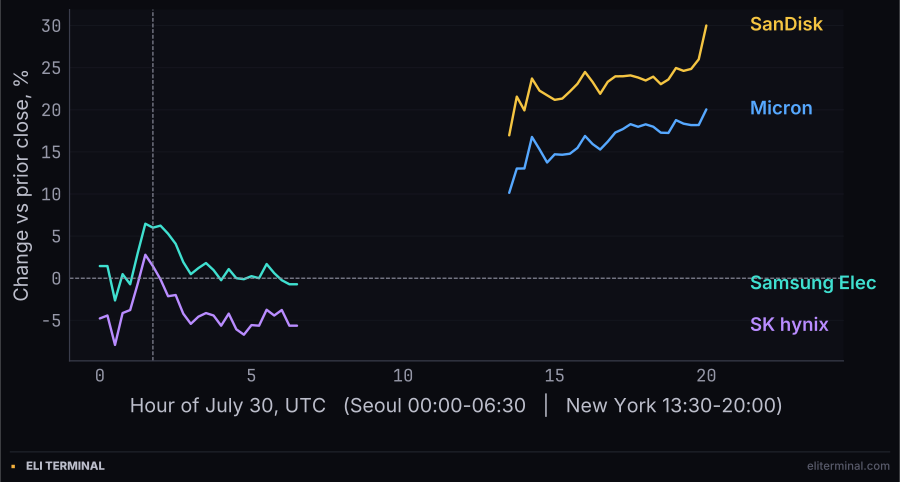
Dashed line marks 01:45 UTC, the peak of the Samsung call. Seoul gave the move back within two hours. New York opened at 13:30 UTC and never stopped bidding.
SanDisk closed 1,279.96, up 26.0%, which recovers the 20.5% it lost over the two prior sessions and still leaves it 45.2% under its June 25 close of 2,335. Micron closed 874.66, up 18.4% against a 17.9% two-day loss. Western Digital added 15.4% and Intel 11.3%, and the Philadelphia-listed semiconductor basket rose 8.5% after falling 5.2% the day before.
The shape of Thursday's memory buying was not a gap. Micron was already at 793 in the pre-market by 13:15 UTC, opened at 813.92, and closed at 874.66, meaning roughly two-thirds of its move was added after the opening bell rather than overnight. SanDisk did the same, opening at 1,135.01 and finishing 145 points higher.
The one American print that spoke to physical memory demand was Lam Research, which posted 6.72 billion dollars of revenue and 1.82 dollars of earnings against 1.68 expected and guided the September quarter to 8.10 billion, a 21% sequential step. Memory was 46% of systems revenue, a record for the company, and NAND revenue more than doubled sequentially. CFO Douglas Bettinger told the call that 2026 industry undersupply "rolls into 2027."
Lam opened at 318.29, up 26.1%, printed its high of the day at 319.50 in the first minutes and closed at 297.72, up 18.0%. Arm peaked at 259.69 in the pre-market at 13:15 UTC, up 15.5%, then dropped to 241.33 within fifteen minutes of the open and closed 241.54, up 7.4%. KLA opened at 186.86, which was also its high, and closed 180.33.
Micron, SanDisk, Western Digital and Intel reported nothing on Thursday, and all four closed within a fraction of their session highs after rising through the afternoon. Three names that opened at or near their session highs on their own results closed lower than they opened; four names with no results of their own closed at theirs. Both patterns ran in the same industry group in the same six hours.
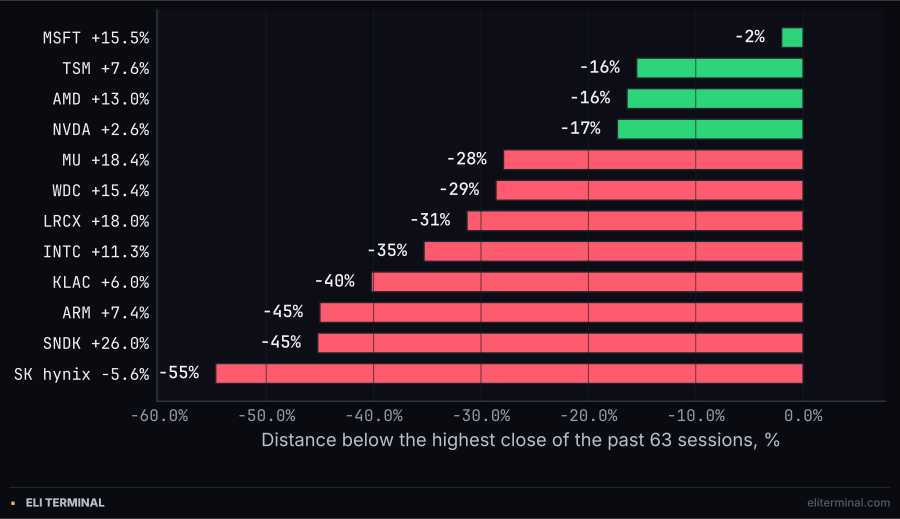
Each label carries Thursday's move. Microsoft is the only name on the list that closed inside 10% of its quarter high.
SanDisk gained 26.0% and closed 45.2% under its June 25 high. Arm gained 7.4% and closed 45.0% under its own. Micron is 27.9% down, Lam 31.3%, Intel 35.3%, KLA 40.2%. The Nasdaq 100 tracker rose 3.3% and finished 7.2% below its June 30 close; the S&P tracker rose 1.7% and finished 1.8% below its July 10 close.
Microsoft, at 2.0% under its quarter high, is the single exception on the list, and it is the one name whose gain came attached to a signed backlog rather than to a supplier's forecast. Every other name on Thursday recovered roughly what it had lost in the two prior sessions and stopped there.
Nvidia rose 2.6% to 195.04 on a day the semiconductor basket rose 8.5% and Micron rose 18.4%, and it closed just 2.6% above the 190.01 low it set on Wednesday. Its quarter high, 235.74 on May 14, is 17.3% away. Broadcom managed 4.7% and is 19.5% below its own quarter high.
The money on Thursday went to the constrained input, not to the accelerator that consumes it. That is a coherent trade if the binding shortage is DRAM and NAND rather than logic, and Thursday's 15.7-point gap between Micron and Nvidia is the widest since the memory names peaked on June 25.
The thirty-year closed at 5.208%, up 6.5 basis points and the highest close of the past quarter, on a session the S&P rose 1.7%. The ten-year added 4.1 basis points to 4.663% and the five-year 2.3 basis points to 4.375%, a steepening at the long end rather than a rally in duration. The long bond ETF fell 0.1% and finished at its own 25-session low.
Wednesday's FOMC decision at 18:00 UTC held the target range at 3.50% to 3.75% on a 9-3 vote, with Hammack, Kashkari and Logan all dissenting in favor of a hike, and the Dow fell 2.19% after it. Thursday's data cut the other way: the advance second-quarter GDP estimate at 12:30 UTC came in at 1.5% annualised against 2.1% expected, initial claims at 197,000 against roughly 206,000, and June core PCE at 0.1% on the month and 3.3% on the year.
The prediction market on a 2026 Federal Reserve rate increase sat at 76.5% on Tuesday and 61.5% by Thursday's close, a 15-point unwind in two sessions. The dollar index closed 100.01, down 0.8% and its lowest close of the past 25 sessions after touching 99.86, with the Bank of England holding at 3.75% on a hawkish 6-3 at 12:00 UTC. Gold added 1.6% to 4,100.10.
Brent traded 89.27 at 02:00 UTC, ran to 92.93 by 06:00 after overnight American strikes on Iranian military targets, and closed at 89.03, down 1.9%, a complete round trip inside a single session. WTI did the same shape, 83.43 to 85.31 and back to 83.59. Energy shares closed up 0.5%, having given back most of an early bid of their own.
Eli Lilly fell 4.5% to 1,154.97, its steepest one-day drop since March 17, and it did not report, guide, or announce anything on Thursday. Altria fell 9.3% on its own numbers, Regeneron rose 6.2% on a large earnings beat, and Stryker closed down 1.2% before falling further after the bell. The Lilly move has no print behind it that crossed on Thursday.
Amazon's results were accepted at 20:06 UTC with net sales of 200.6 billion dollars, up 20%, and AWS revenue of 42.2 billion, up 37% at a 39.4% operating margin. Andy Jassy called it "our fastest growth in 18 quarters" in the release, which also discloses that purchases of property and equipment rose 66.1 billion dollars year over year, "primarily reflects investments in artificial intelligence," and that trailing twelve-month free cash flow is negative 7.6 billion. By 21:00 UTC the stock was near 255.60 against a 235.50 close.
Apple's release landed at 20:30 UTC: revenue 109.4 billion dollars, up 16%, iPhone 54.3 billion, and Services 30.7 billion, up 12.1% against roughly 31.2 billion expected. Greater China came in at 18.8 billion. Earnings of 2.02 dollars and a 50.1% gross margin both include tariff refunds worth about 0.11 dollars and two points of margin. The stock traded near 319.28 at 21:00 UTC against a 333.43 close.
Exxon, Chevron, Linde and Sony report Friday, and the Bank of Japan decides the same morning. The dollar's 25-session low on Thursday landed the day before that meeting.