The quarter behind Wednesday
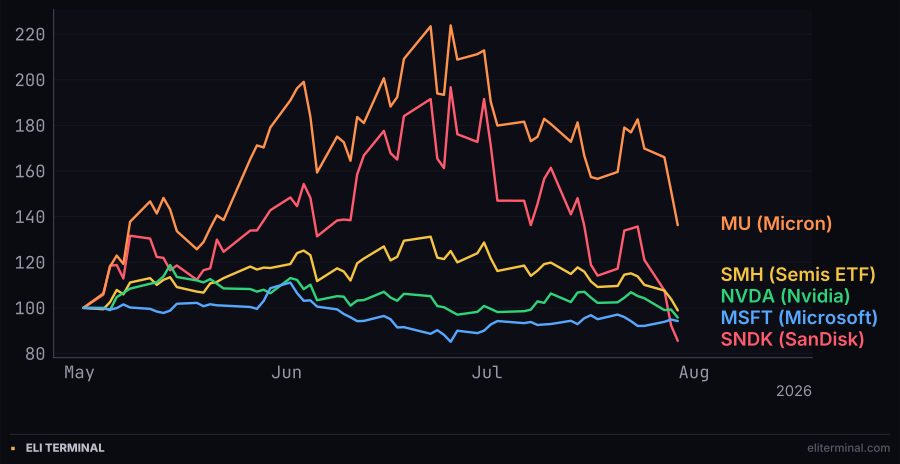
Daily closes rebased to 1 May 2026 = 100, through the 29 July close. Micron doubled and gave most of it back; Nvidia and Microsoft never left the band.
Three Fed governors dissented for a hike, the S&P surrendered its whole session in the last 75 minutes, and Meta reported $784 million of free cash flow against $31.08 billion of quarterly capital spending.
Daily closes rebased to 1 May 2026 = 100, through the 29 July close. Micron doubled and gave most of it back; Nvidia and Microsoft never left the band.
At 18:45 UTC the S&P 500 ETF traded 741.93, above Tuesday's close, and the VIX at 17.55 sat under where it had settled the night before. Seventy-five minutes later SPY closed 729.46, its lowest finish in more than a month, and the VIX closed 20.66, up 13.5%.
The whole decline printed after 19:00 UTC. Micron went from 787.15 at 19:00 to 739.00 at the bell, a 6.1% fall in the final hour of a session it had opened 1.5% higher; the semiconductor ETF gave up 4.1% over the same stretch to close 504.22, its lowest close of the past three months.
Nothing crossed the wires in that hour. The Federal Reserve had spoken at 18:00 UTC, Kevin Warsh had been at the podium since 18:30, and Microsoft and Meta were sixty-five minutes from reporting.
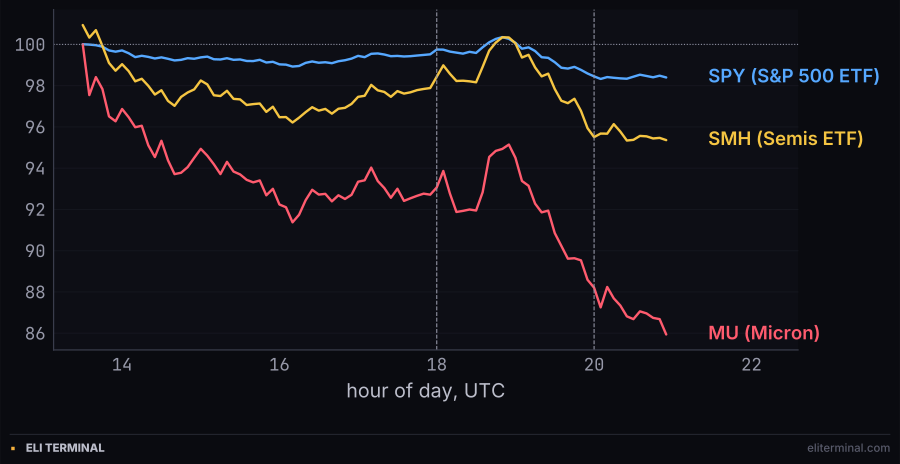
Rebased to the 13:30 UTC open. Dashed lines mark the 18:00 UTC rate decision and the 20:00 UTC close; the series run on through the post-close session.
The Committee held its target range at 3.50% to 3.75% at 18:00 UTC, a fifth consecutive hold, on a 9-3 vote. Beth Hammack, Neel Kashkari and Lorie Logan each preferred a quarter-point increase.
The statement ran short and gave no path: activity "expanding at a solid pace" against "elevated uncertainty that owes, in part, to the conflict in the Middle East," with inflation still elevated against the Committee's target. "There is no soft inflation target," Warsh said at the press conference, "not on this committee's watch."
The curve did the interpreting. The 30-year yield rose 4.7 basis points to 5.143% while the 5-year fell 0.9 to 4.352%, and the long-bond ETF lost 1.7% on a day equities fell: a hold three voters wanted to be a hike is not a dovish hold, and the long end priced it as the opposite. The market on a quarter-point increase at the September meeting closed at 55.5%, against 48.5% a week earlier.
SK hynix reported at 22:56 UTC Tuesday with revenue of 79.32 trillion won, up 257% from a year earlier, and operating profit of 60.54 trillion won on a 76% operating margin. Both were records, and both landed roughly 5% short of the 83.94 trillion and 63.99 trillion the street carried.
On the call between 00:00 and 01:00 UTC the company raised 2026 capital spending into the "high 40 trillion won range" and said it had pulled forward the M15X and Yongin timelines. A memory maker that had just missed on price told the market it would build faster.
The KOSPI closed down 5.98% at 5,663.24 after trading as much as 12% lower, and tripped its circuit breaker for a second straight session. SK hynix fell 9.6% after 14.7% on Tuesday and Samsung Electronics fell 5.2%; two sessions took 16.2% off the index.
ChangXin Memory closed its Shanghai debut on 27 July up 466%, raising about 57.9 billion yuan, and its prospectus assigns the proceeds to DRAM wafer lines with no HBM project attached while warning about oversupply in the same document. Reuters reported the same day that China had begun serial production of domestic immersion lithography tools for SMIC, Hua Hong and ChangXin.
That is the frame the SK hynix capex raise landed inside, which is why the equipment names took the worst of it. KLA closed 170.19, down 10.8%, a full session after its own beat, with Morgan Stanley's Shane Brett keeping an overweight rating and cutting his target to 253 from 274. Applied Materials closed 436.45, down 8.4%; ASML has lost 6.3% in two sessions.
The multi-day path separates two different events that look identical on a one-day screen. SanDisk closed 1,015.89, down 7.3% and 56.5% below its 25 June high of 2,335, which leaves it under where it began May; Micron at 739.00 is 39.1% below its own 25 June high and still 36% above its 1 May close. The drawdown has erased a month, not a quarter.
Nvidia is the quiet one. It closed 190.01, down 3.6% and only 2.5% lower than a month ago, but that is its lowest close in three months and 19.4% under its 14 May peak, which is a name sliding without a single bad session to point at.
Vertiv beat on earnings, raised full-year guidance above consensus on both lines, and closed down 17.3% at 223.04. Second-quarter revenue of $3.27 billion, up 18% organically, came in under the $3.37 billion expected; full-year earnings guidance went to $6.65-6.75 from $6.30-6.40 and revenue to $13.8-14.2 billion from $13.5-14.0 billion. Chief executive Giordano Albertazzi called the shortfall a matter of timing.
The tape declined to accept timing. Vertiv is down 26.6% from its 23 July close and 40.7% from its 14 May high, and it took the rest of the electrical build with it: Eaton lost 6.3%, Quanta 4.6%, GE Vernova 4.6%, Vistra 3.9%.
Caterpillar fell 6.9% to 782.71, its lowest close of the quarter and 26.5% below its 30 June level, after Baird's Mircea Dobre moved it to neutral and cut his target to 900 from 1,200, citing state and local resistance to data-center permitting. A machinery name and a cooling name were repriced on the same argument on the same morning.
Microsoft's release crossed at 20:05 UTC with revenue of $90.0 billion, up 18%, operating income of $40.6 billion, and diluted earnings of $4.81 against the $4.21 the calendar carried. Azure and other cloud services grew 43%, and Microsoft Cloud revenue reached $59.3 billion.
Revenue was not the number that mattered. Commercial remaining performance obligation, the contracted work booked but not yet delivered, rose 84% to $678 billion; the company spent $35.80 billion on property and equipment in the quarter and $115.95 billion across the fiscal year against $64.55 billion the year before, and disclosed a contracted claim on that spending twice the size of its annual revenue.
The filing also books a $3.2 billion gain on Microsoft's investment in Anthropic, part of $0.27 of per-share items the company flagged against its April guidance. Shares traded 402.18 at 21:00 UTC, up 3.0% from the close and still 12.7% below their 1 June level, which makes this a bounce inside a drawdown rather than a new high.
Meta's release crossed at 20:01 UTC with revenue of $60.801 billion, up 28%, against costs and expenses of $42.03 billion, up 55%. Operating income fell 8% to $18.775 billion, the operating margin went from 43% to 31%, and diluted earnings of $6.18 came in 13% below last year and well under the $7.10 the calendar carried.
Capital expenditure including finance-lease principal was $31.08 billion for the quarter. Cash from operating activities was $31.86 billion. Free cash flow, the residue, was $784 million.
Guidance offered no relief. Full-year capital spending was "narrowed from our prior outlook of $125-145 billion" to $130-145 billion, which lifts the floor and leaves the ceiling alone; full-year expenses went to $165-169 billion to absorb a $2.40 billion legal charge, and the tax-rate guide rose to 15-17% from 13-16%.
At 20:00 UTC Meta traded 585.00 and Microsoft 390.41; by 20:03 Meta printed 539.58 and Microsoft 407.00. At 21:00 UTC Meta sat at 538.47, down 8.1% from its close and below its 25 June low of 542.87, while Microsoft sat at 402.18.
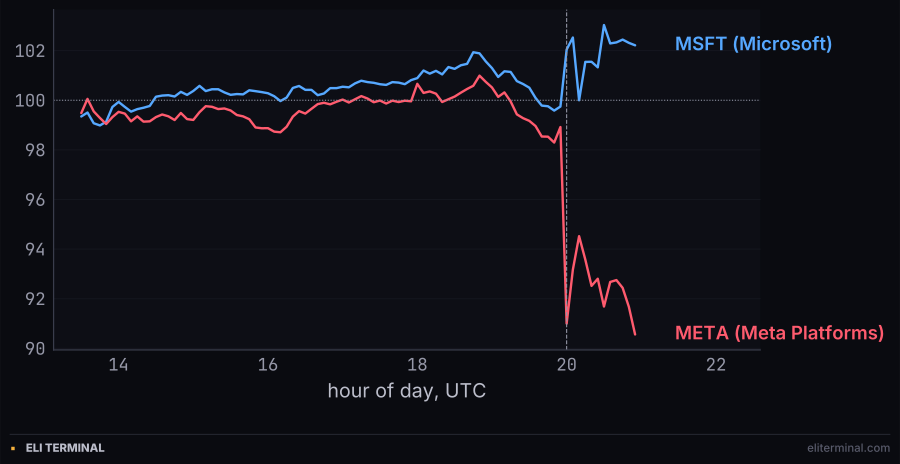
Rebased to the 13:30 UTC open. The two names tracked within a point of each other for six and a half hours, then split by eleven points in three minutes.
Both companies buy the same accelerators from the same vendor for the same buildout. One reported an order book that grew 84%; the other reported that the buildout consumed 97.5% of the cash its operations produced. Pricing the difference took three minutes.
The rest of the after-hours sorted along the same seam. Lam Research, which lifted its 2026 wafer-fab-equipment estimate to the low $150 billions from about $140 billion, traded 267.41 at 21:00 UTC, up 6.0% after closing down 6.4%; Fortinet was up 11.8% and Starbucks up 6.5%; Qualcomm, whose handset revenue fell 20%, was down 5.7% at 146.88. Apple and Amazon report Thursday, Exxon and Chevron on Friday.
WTI settled 84.46, up 6.6%, after giving up 11.3% over the two prior sessions. The climb came in three steps: 82.11 at 10:00 UTC to 83.18 in the following hour as Iran's Revolutionary Guard said it had halted three tankers in the Strait of Hormuz; 82.53 to 84.54 inside the 12:00 hour, a window that also carried televised remarks from President Trump that the United States would be "hitting them hard"; and a run to 85.36 after the 14:30 UTC inventory report.
The inventory number carried the largest surprise of the day. Commercial crude stocks excluding the reserve fell 7.167 million barrels against a consensus draw near 1.3 million, with refinery utilization at 97.2%.
Crude has done nothing but round trips this month. It bottomed near 68.50 in the first week of July, ran to 92.19 on 23 July after Houthi missile strikes on two Saudi tankers, gave back 11.3% on a pause in US strikes, and closed Wednesday 8.4% under that high and 23% above the July low. Energy was the day's strongest sector at 1.9%, staples the only other green one at 0.3%.
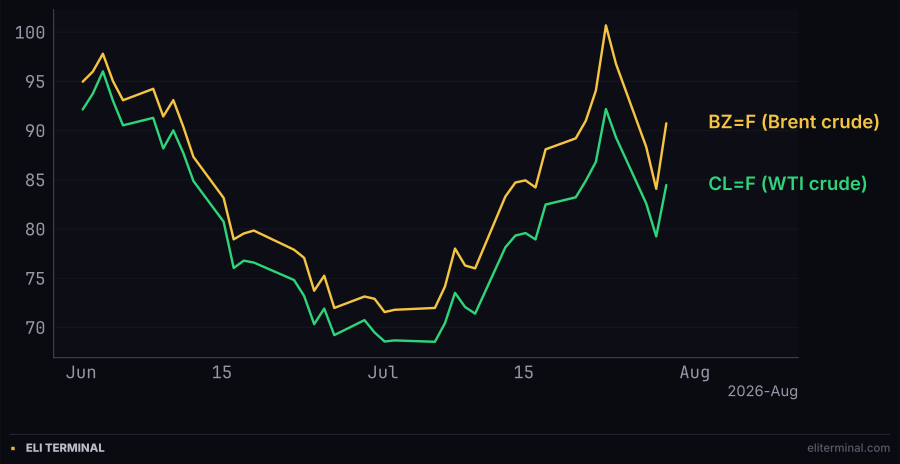
Daily settlements through 29 July. The July round trip has been wider than the level: WTI has covered a 24-point range in twenty sessions and finished where it began the month.
Alphabet closed 336.71, up 0.9%, the only megacap that gained, and it has now recovered 6.0% from the 317.69 it printed on 23 July after its own results. The recession market on Kalshi closed at 10%, barely moved from 8% on Tuesday and 13% a week earlier, which is a set of traders declining to read a semiconductor drawdown as a macro event.
Credit refused to participate at all. The high-yield ETF closed 79.24, down 0.2% and 1.0% below its level a month ago, while the semiconductor ETF fell 13.1% in four sessions: this is an equity-sector repricing, not a funding event, and the day gave no evidence to the contrary.