Three Months, Five Lines
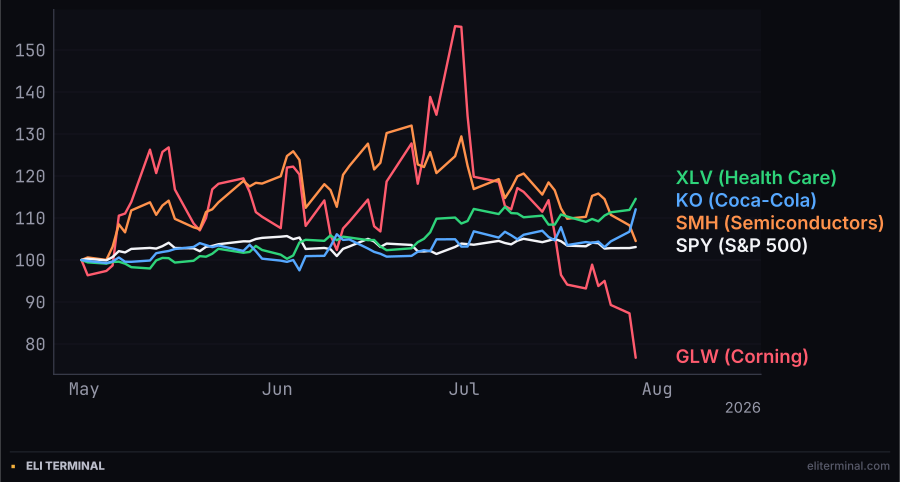
Each indexed to 100 at the April 28 close. Corning ran 56% above its April level by late June and finished 23% below it. Coca-Cola and health care spent the quarter going nowhere and ended it at one-year highs.
Corning grew optical sales 32% and fell 12.1%, Seoul stopped trading twice, and Coca-Cola, health care and the banks all closed at one-year highs, on a day the S&P 500 rose 0.21%.
Each indexed to 100 at the April 28 close. Corning ran 56% above its April level by late June and finished 23% below it. Coca-Cola and health care spent the quarter going nowhere and ended it at one-year highs.
7,428.78 is where the S&P 500 closed Tuesday, up 0.21%, with the Dow up 1.03% to 52,747.32 and the Nasdaq Composite down 0.22%. The Dow finished 0.6% under its July 6 one-year high; the Nasdaq-100 finished at its lowest close in twenty-five sessions and 9.5% under its June 2 high.
Three separate parts of the market closed at one-year highs on the same session: financials, health care and Coca-Cola. On the same session, Corning closed 50.7% below its June 29 level and SanDisk 53.1% below its June 25 level. The flat index was two extremes cancelling, not an absence of movement.
18.21 is where the VIX closed, down 2.5%, and the high-yield bond fund HYG closed at its highest level in twenty-five sessions. Nothing about the day looked like risk being cut. Money was being moved from one half of the market to the other.
07:03 UTC is when Corning filed its second-quarter results, and the release described the strongest demand signal any company put on the wire that week. Core sales grew 17% to $4.74 billion and core earnings per share grew 30% to $0.78, with Optical Communications sales up 32% to $2.07 billion and Enterprise Networks inside it up 65%.
Two customer agreements were named in the release. Amazon signed "a multiyear, multibillion-dollar agreement under which Corning will supply the optical fiber, cable, and connectivity solutions that power Amazon's expanding data center infrastructure across the United States," and NVIDIA agreed a partnership in which Corning "will expand its U.S.-based optical connectivity manufacturing capacity by 10x and expand its U.S. fiber production capacity by more than 50% to meet the accelerating demand driven by AI factory buildouts."
126.01 is where the stock closed, down 12.10% from Monday's 143.36. It had already given up 4% by 08:00 UTC, traded at 118.65 by 11:15 UTC, opened New York at 121.75 and printed 114.50 at 14:15 UTC, 20.1% under Monday's close. It then climbed for the rest of the session and finished 10.1% above that low.
16% is the year-over-year core sales growth Corning guided for the third quarter, against the 17% it had just delivered, in a range of $4.9 billion to $5 billion. Core earnings per share were guided to grow "approximately 28%," against the 30% just reported. One point on the top line and two on the bottom.
$40 billion by the end of 2030 is the annualized sales run rate the same release laid out, from roughly $20 billion at the end of this year, on a stated 19% compound growth rate. A company demonstrating that AI buildouts want ten times its current optical capacity guided one point below its own last quarter and lost an eighth of its value in a session. Demand was never the question being asked.
6,023.66 is where the KOSPI closed, down 732.09 points and 10.84%, after opening 2.72% lower. A sell sidecar fired on the futures at 00:06 UTC, a second on the KOSDAQ at 00:14 UTC, and at 01:13 UTC the exchange halted the whole market for twenty minutes with the index down 8.04%. The KOSDAQ tripped its own halt at 03:01 UTC.
5,992.91 was the intraday low, 11.29% down, and the index has now fallen 34% in twenty-five sessions from its June 22 peak. SK hynix closed 14.65% lower and Samsung Electronics 13.39% lower. The Nikkei fell 4.0% to 62,364.92.
4.98 trillion won is what foreign investors sold on the day, a third consecutive session of net selling, against 4.31 trillion won bought by Korean retail accounts. The foreign money left and the domestic money took the other side, which is what the halts were pausing.
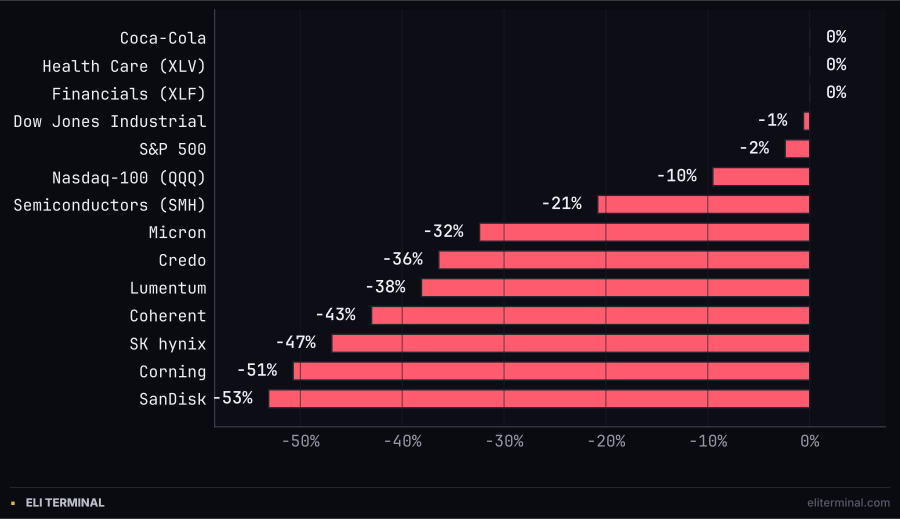
Where Tuesday's close sits against the highest close of the trailing quarter. The three at zero set their highs that afternoon. The three at the bottom set their lows the same afternoon.
466% is how much ChangXin Memory rose on its Shanghai debut on Monday, closing at 49 yuan against an 8.66 yuan offer price and a market value above 3 trillion yuan, the largest mainland semiconductor offering on record. The fourth-largest DRAM maker in the world was handed a valuation that funds expansion into a market its Korean rivals had been priced to own.
8% is roughly what ASML lost on Monday after The Information reported that a Shanghai firm had begun mass-producing domestic immersion lithography scanners, with first machines going to SMIC, Hua Hong and ChangXin. Separately, Nvidia was reported in talks to guarantee up to $250 billion of OpenAI's data-center lease payments.
197.01 is where Nvidia itself closed on Tuesday, up 0.25%, while the companies that supply it fell between 6% and 15%. The supplier of the capital was flat. The suppliers of the equipment were not.
$631 million of free cash flow is what Boeing reported at 11:31 UTC, against $200 million of burn a year earlier, alongside a core loss of $0.76 per share and a record $715 billion backlog covering more than 6,200 commercial airplanes. It delivered 171 aircraft, up 14%. The stock opened at 214.00, fell to 209.35 inside fifteen minutes, and closed at 221.56, up 4.76%.
88.27 is where Coca-Cola closed, up 5.00% and its highest level in a year, after reporting at 10:58 UTC that organic revenue grew 6%, unit case volume 5%, and comparable earnings per share 11%, and raising its full-year guidance on both lines. It touched 90.22 at 14:45 UTC and gave back 2.2% of that into the bell.
One company missed its earnings line and rose 4.8%; the other beat on volume and raised guidance and rose 5.0%. What they share is that neither has an artificial-intelligence capital budget attached to it. S&P Global, which grew adjusted earnings per share 23% to $4.83 on revenue up 11%, fell 3.5%.
4.60% is where the ten-year Treasury yield closed, down about 4 basis points, with the long-bond fund TLT up 0.59% to its highest close in twenty-five sessions and the dollar index flat at 101.38. A day that took 10.8% out of Seoul and 3.5% out of the chip index produced no bid for safety beyond a routine four basis points.
79.26 is where West Texas crude settled, down 4.06%, and 14.0% below its July 23 settlement of 92.19. The decline printed through the New York session while Benjamin Netanyahu was at the White House and the United States was visibly stepping back from its threats against Iran. Energy shares fell 1.35% and gold slipped 0.94% to 4,036.30.
90.8 was the Conference Board's July consumer confidence reading, released at 14:00 UTC against 92.3 expected, with the present-situation component down 3.6 points to 114.9 for a third straight decline. The Richmond Fed's manufacturing index came in at 5 against 10 expected in the same minute.
Four session lows printed in the fifteen minutes that followed: the Nasdaq-100 at 667.88, Micron at 789.09, the chip index at 518.31 and Corning at 114.50. Staples peaked fifteen minutes after that, at 14:30 UTC, and Coca-Cola at 14:45 UTC. Both sides of the rotation reached their extremes inside forty-five minutes of the open and spent the next five hours partially unwinding.
3.50% to 3.75% is where the federal funds rate stood as the Federal Open Market Committee began its two-day meeting that morning, Kevin Warsh's second as chair, with futures pricing roughly a one-in-three chance of an increase at Wednesday's decision. A soft confidence print into a live hike debate is a reason for the longest-duration equities to stop falling, and that is the minute they stopped.
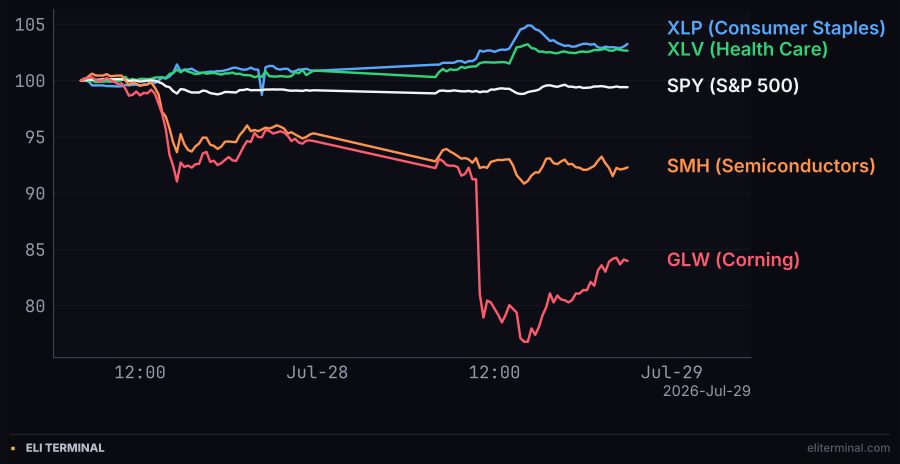
Indexed to 100 at the July 27 pre-market open. Corning's gap, its 14:15 UTC low and its afternoon climb, against staples and health care rising all day and the S&P 500 doing neither.
20:05, 20:07 and 20:08 UTC is when Visa, Seagate and KLA filed, three minutes apart, and all three beat. Visa reported net revenue of $11.6 billion, up 14%, non-GAAP earnings of $3.32 per share, payments volume up 10% and 71.7 billion processed transactions, along with $563 million of severance costs in the quarter. It closed up 1.12% and traded down 1.9% from there.
$3.63 billion is what Seagate reported, up 48% from a year earlier, with non-GAAP gross margin at 52.7% against 37.9% and full-year revenue up 34%. It had fallen 8.53% during the session, before it said anything, and traded up about 6.5% afterward.
$3.66 billion is what KLA reported, above the midpoint of its guidance, with earnings at the upper end and $817 million of quarterly free cash flow. Its chief executive said the company "remains uniquely positioned on the critical path of AI infrastructure expansion" with momentum "accelerating." The stock had closed down 6.18% and fell a further 8.3% on the release, ending the day 13.9% below Monday.
$5.2 trillion of combined market value reports on Wednesday, when Microsoft and Meta publish alongside SK hynix, Lam Research, Arm and Qualcomm, and the Federal Reserve delivers its decision. These are the two largest artificial-intelligence capital budgets in the world, and Tuesday was spent selling everything they buy.
$44.9 billion was Alphabet's capital spending in its June quarter, reported July 22, with the full-year guide lifted to a range of $195 billion to $205 billion and the buyback set to zero. Alphabet has risen 5.0% in the three sessions since; the companies it buys from made new lows on Tuesday. The market has already decided which side of that transaction it wants to own.